A grain of sand can fit on your fingertip, but the Sun is so large that more than a million Earths could fit inside it. That is one of the most amazing ideas in science: nature includes objects of many different sizes, from things too tiny to see with your eyes to objects so huge they stretch across space. Learning about these size differences helps us understand Earth, living things, and the universe.
When scientists study nature, they notice an important pattern: natural objects exist across a huge range of sizes. Some are very small, such as tiny particles and cells. Some are easy to see, such as trees, rivers, and mountains. Others are immensely large, such as planets, stars, and galaxies. Even though these objects are very different, they are all part of the natural world.
Size matters because it affects how we observe things. You do not need a special tool to see a rock or a rabbit. But you do need a microscope to study a cell, and you need a telescope to study distant stars. The object does not change based on how we view it; our tools simply help us notice what is already there.
Natural object means something found in nature rather than made by humans. Scale means the size of something or the level at which we are looking at it. Apparent brightness means how bright an object looks to an observer, which can depend on distance.
A useful way to think about scale is to picture a giant zoom. At one level, you might look at a forest. Zoom in, and you see a leaf. Zoom in farther, and you find cells inside the leaf. Zoom out, and you see Earth from space. Zoom out again, and Earth becomes just one planet near one star in a vast galaxy.
Natural objects include living and nonliving things. A whale is a natural object. So is a snowflake. So is a planet. Water in a river is natural, and the atoms in that water are natural too. Humans may use machines to collect or study these things, but the objects themselves are not human-made.
Scientists often organize natural objects by their size, structure, and location. A drop of pond water may contain tiny living things. A mountain may be built from rocks and minerals. Earth is made of land, water, air, and layers deep inside the planet. The Sun is a star made mostly of hot gases, and stars gather in giant groups called galaxies.
You already know that matter is anything that has mass and takes up space. Natural objects are made of matter too. Matter can be found in solids, liquids, and gases, and those forms appear at many different sizes in nature.
Scientists also compare natural objects by asking questions such as: Can we see it with our eyes? Does it need magnification? Is it part of Earth, or is it in space? These questions help us sort objects from the very small to the immensely large.
Scientists often compare very small objects by arranging them in order of size. [Figure 1] introduces this sequence from extremely tiny particles to larger visible materials.
Some of the smallest natural objects are so tiny that we cannot see them directly without special tools. An atom is one of the basic building blocks of matter. Atoms can join together to form molecules. For example, water is made of molecules of \(\textrm{H}_2\textrm{O}\).
Living things are also built from tiny parts. A cell is the basic unit of life. Your body contains many cells, and plants do too. Cells are much larger than atoms and molecules, but they are still usually too small to see without a microscope. This is why microscopes are so important in biology and medicine.
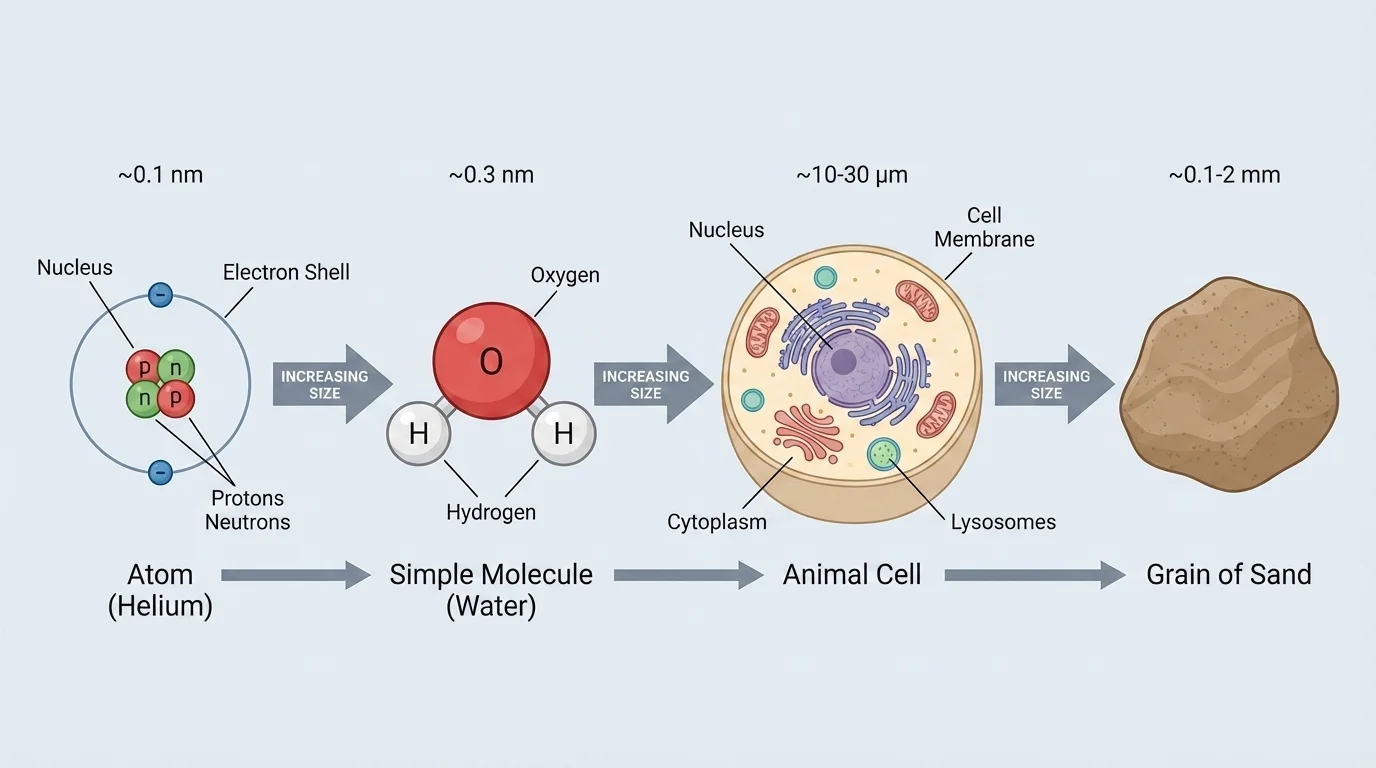
Not everything small is invisible. A grain of sand, a seed, or a drop of rain is small enough to hold, but large enough to see. These objects remind us that the natural world includes many steps in size, not just "tiny" and "huge." Nature is full of middle sizes too.
Scientists use evidence from observations to compare these small objects. For example, a microscope lets us see that pond water contains organisms and materials much too small to notice with our eyes alone. That evidence shows that the natural world is richer and more detailed than it first appears.
A pinhead-sized speck of matter contains billions of atoms. Even something that looks solid and simple is built from incredibly tiny parts.
Thinking about small objects helps explain why materials behave the way they do. Ice, liquid water, and water vapor all involve the same kind of molecule, \(\textrm{H}_2\textrm{O}\), but the particles are arranged and moving differently in each state.
Many natural objects are on a scale that we can observe easily. Trees, insects, lakes, cliffs, clouds, and animals all fit into this familiar range. These objects may seem ordinary because we see them often, but they are part of the same pattern of scale that includes cells and stars.
Earth itself is a natural object, but it is much larger than the things we see in everyday life. You cannot tell Earth is round by standing in your yard, because you are seeing only a tiny part of it. From space, however, Earth appears as a large spherical planet with oceans, continents, clouds, and ice.
Mountains and oceans may feel enormous to us, yet they are tiny compared with Earth as a whole. This reminds us that size is often relative. A hill is large compared with a rock, but small compared with a mountain. Earth is huge compared with a hill, but small compared with the Sun.
| Natural object | Can we usually see it with our eyes? | Typical tool if needed | Scale idea |
|---|---|---|---|
| Atom | No | Special scientific instruments | Extremely small |
| Molecule | No | Special scientific instruments | Very small |
| Cell | Usually no | Microscope | Tiny living unit |
| Grain of sand | Yes | None | Small |
| Tree | Yes | None | Everyday visible size |
| Earth | No, not all at once from the ground | Satellite or spacecraft view | Planet-sized |
| Star | Yes, from far away | Telescope for detail | Immensely large |
| Galaxy | Usually no with eyes alone | Telescope | Vast collection of stars |
Table 1. A comparison of natural objects, whether they are visible to our eyes, and the tools used to study them.
To understand Earth's place in space, it helps to compare it with nearby objects in the solar system. [Figure 2] shows Earth placed among nearby solar system bodies.
Earth is one planet in a system of objects that orbit the Sun. Earth has one natural satellite, the Moon. Other planets also orbit the Sun, and each planet is part of the solar system.
The solar system includes the Sun, planets, moons, asteroids, and other objects. The Sun is at the center of our solar system and contains most of its mass. Earth moves around the Sun, and the Moon moves around Earth. These motions help explain seasons, the changing appearance of the Moon, and many other patterns we observe from Earth.
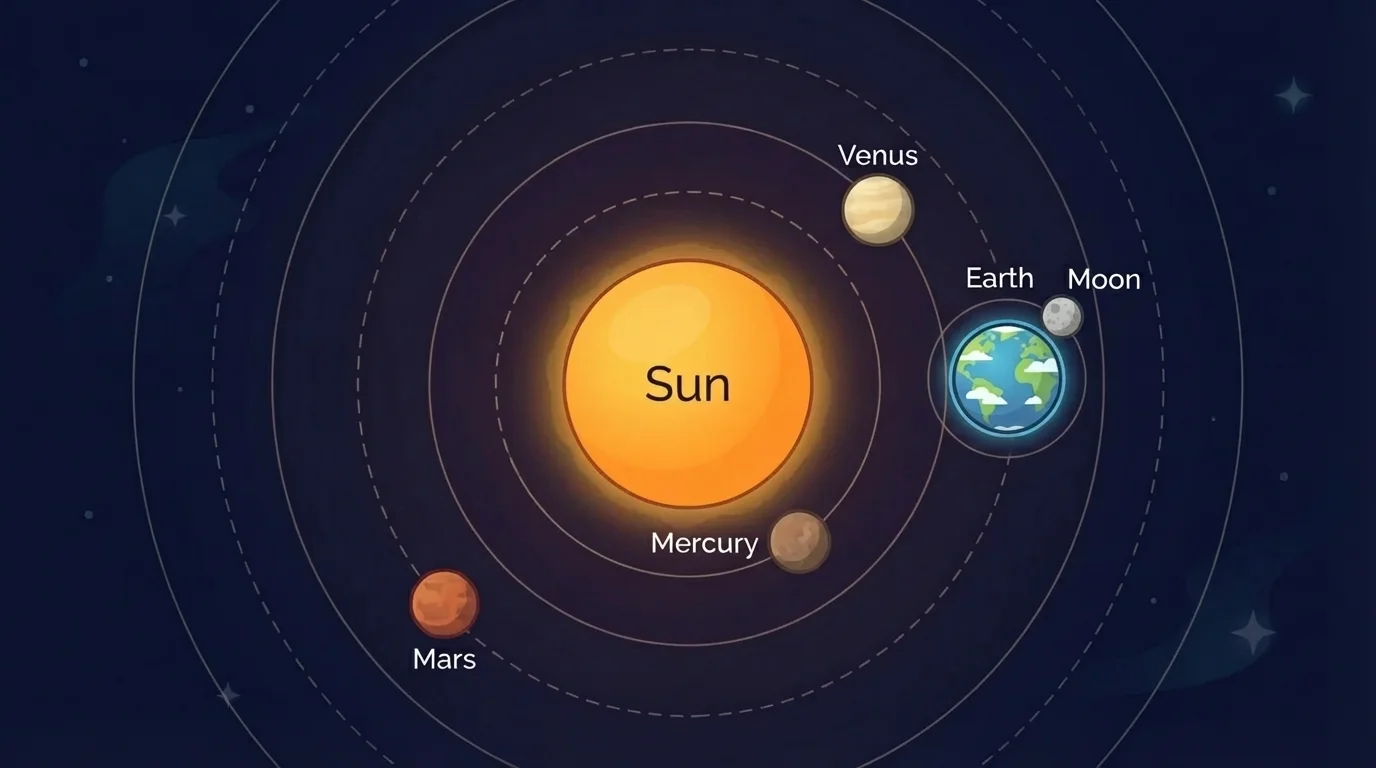
The Sun and Moon may look similar in size in the sky, but they are actually very different. The Sun is far larger than the Moon. It only appears similar in width from Earth because the Sun is also much farther away than the Moon. This is another example of how what we see depends not just on actual size, but also on distance.
Distance changes what we observe. A nearby object can look bigger or brighter than a more distant object even if the distant object is actually larger. This idea helps scientists explain why the Moon can appear large in the sky and why the Sun looks much brighter than the stars we see at night.
When we compare Earth and the Sun, the difference is enormous. Earth is a planet, while the Sun is a star. Stars produce their own light, but planets do not. Earth is lit by sunlight, and that sunlight supports weather, photosynthesis, and life.
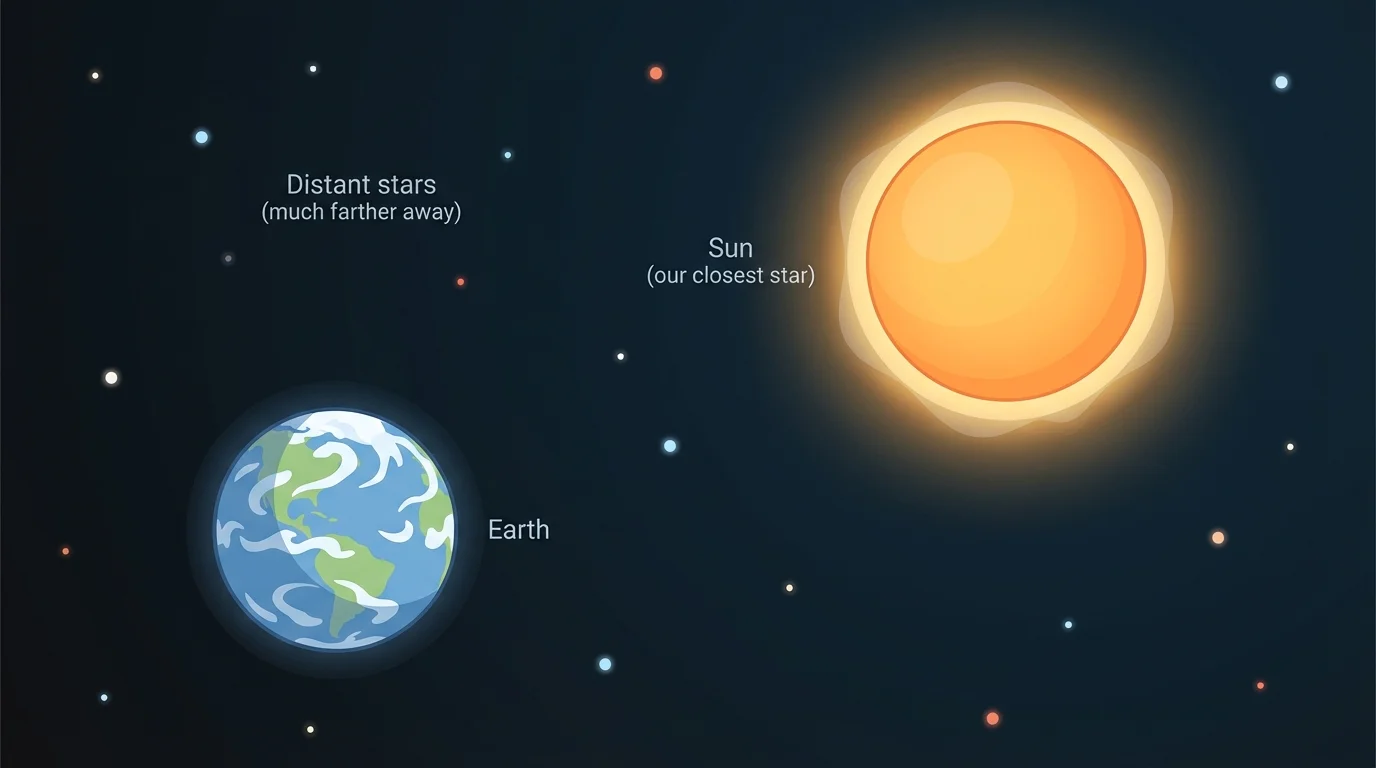
Scientists often compare the Sun with other stars to understand why it looks so bright from Earth. [Figure 3] compares the nearby Sun with much more distant stars.
The apparent brightness of the Sun compared with other stars is one of the best examples of how distance affects what we observe. The Sun looks much brighter than the stars we see at night, but that does not mean the Sun is the biggest star in the universe. The main reason it appears so bright is that it is much closer to Earth.
Our Sun is a star. The stars we see at night are also stars like the Sun, but they are incredibly far away. Because they are so distant, they look like tiny points of light. The Sun is close enough to Earth that it appears as a bright disk and lights up our daytime sky.
Scientists support this idea with evidence. First, telescopes show that stars are spread across vast distances in space. Second, stars that are farther away usually appear dimmer than similar stars that are closer. Third, if Earth were moved much farther from the Sun, the Sun would appear dimmer too. These observations support the argument that distance strongly affects apparent brightness.
A simple way to think about this is to compare flashlights. If one flashlight is nearby and another is far across a field, the nearby one looks brighter to you, even if both are shining. In space, distance matters on an enormous scale.
Scientists often describe this pattern by saying that brightness decreases with distance. For an age-appropriate simplified rule, if one star were moved to about twice the distance from an observer, it would appear dimmer. The exact pattern is more complex, but the big idea is clear: farther usually means dimmer.
Simple scale example: comparing distance and brightness
Suppose Star A and Star B give off the same amount of light, but Star B is much farther from Earth.
Step 1: Start with the same kind of stars.
If the stars are alike, then distance becomes the main reason they look different in brightness.
Step 2: Compare their distances.
If Star A is at a distance of \(10\) distance units and Star B is at \(100\) distance units, then Star B is \(10\) times farther away.
Step 3: Use the observation rule.
The star that is farther away appears dimmer, so Star A looks brighter from Earth even though both stars are giving off the same kind of light.
This is why the Sun appears brighter than other stars: it is our nearby star.
Later, when astronomers study stars in detail, they also consider a star's true energy output. But for the question of why the Sun looks brighter from Earth, the most important evidence-based answer is its relative closeness.
As we look beyond our solar system, the scale of the universe becomes even easier to appreciate. [Figure 4] shows a zoomed-out view from the solar system to galaxies farther out in the universe.
Beyond our solar system are many other stars, and beyond those stars are enormous collections called galaxies. A galaxy is a huge group of stars, gas, dust, and other matter held together by gravity. Our solar system is part of the Milky Way galaxy.
The Milky Way contains billions of stars. That number is so large it is hard to picture. And the Milky Way is only one galaxy among many. Scientists estimate that the universe contains enormous numbers of galaxies, each with its own stars and systems.
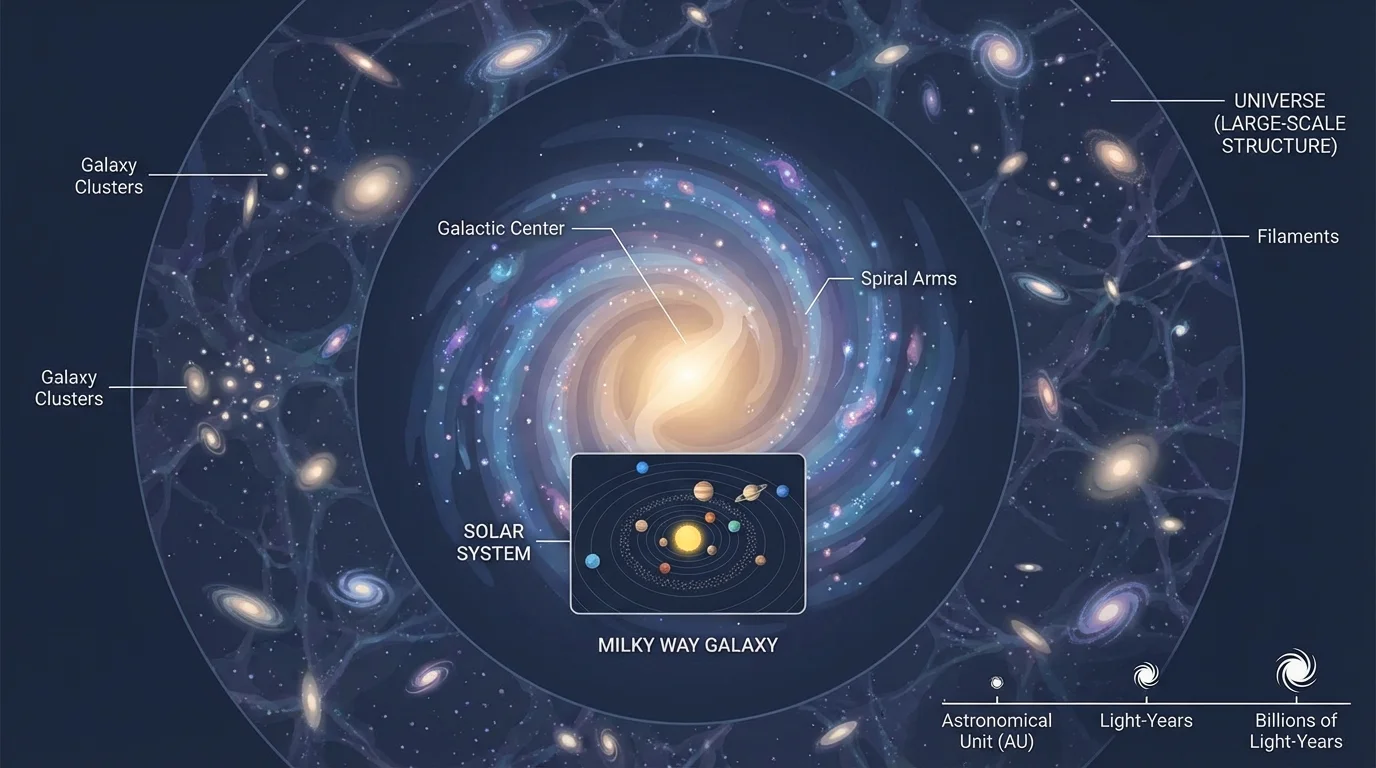
This means that when you look at the night sky, you are seeing only a tiny sample of the universe. Some visible stars are relatively close to us compared with others, but all of them are far beyond the planets in our solar system. The scale difference is astonishing.
Thinking across these scales helps scientists ask bigger questions. How do stars form? How do galaxies move? Where is Earth in the universe? These questions become easier to explore when we understand that natural objects range from the microscopic to the cosmic.
The light from some stars takes years to reach Earth. That means when you look at those stars, you are seeing light that began its journey long ago.
The idea of looking back in time through light is another reason astronomy is so exciting. Telescopes do not just show distant objects; they also help us study the history of the universe.
Even though atoms, trees, planets, and galaxies are very different, they can all be studied by looking for patterns. Scientists compare size, shape, motion, and position. They also use models, measurements, and tools to understand things that are too small, too large, or too far away to examine directly.
The sequence in [Figure 1] helps us remember that the natural world is not made of separate disconnected parts. Small things can make up larger things. Atoms form molecules, molecules are part of cells, cells build organisms, and organisms live on Earth. Earth is part of the solar system, which is part of a galaxy.
Likewise, the solar system view in [Figure 2] and the distant-space view in [Figure 4] work together to show nested scales. Each level fits inside a larger level. This pattern helps students and scientists organize the complexity of nature.
The brightness comparison in [Figure 3] also teaches an important science idea: observations need explanation. Something may look larger, smaller, brighter, or dimmer because of position and distance, not just because of what the object truly is.
Understanding scale has practical uses. Doctors and scientists use microscopes to examine cells, bacteria, and tiny structures in the body. This helps them diagnose disease and study how living things work. Farmers and environmental scientists study soil grains, water droplets, and plant cells to understand growth and ecosystems.
Astronomers use telescopes, satellites, and computer models to study planets and stars. Knowing that the Sun appears brighter because it is close to Earth helps scientists compare our star with other stars more fairly. They do not rely only on how bright a star looks from Earth. They also consider distance and other evidence.
Real-world application: why telescopes matter
A telescope gathers more light than your eyes can gather.
Step 1: Look with your eyes alone.
You can see some stars at night, but many are too dim to notice.
Step 2: Look with a telescope.
The telescope collects more light, so dim and distant objects become easier to observe.
Step 3: Use the evidence.
By seeing more stars and galaxies, scientists learn that space is filled with faraway objects that our eyes alone cannot reveal.
This tool extends human observation across immense distances.
Spacecraft and satellites also help us see Earth as a planet. From the ground, Earth feels endless. From space, it is clearly one world among many natural objects. This change in view is a powerful reminder that scale affects understanding.
Scientists often compare distances using multiplication. If one object is \(2\) times farther away than another, it will not look the same to an observer. If one star is \(5\) times farther away than another similar star, the farther one will generally appear dimmer. The exact amount of dimming is studied more deeply in later grades, but the key pattern remains: increasing distance reduces apparent brightness.
For example, suppose a nearby star is at a distance of \(4\) units and another similar star is at \(20\) units. Since \(20 \div 4 = 5\), the second star is \(5\) times farther away. We would expect the farther star to appear less bright in the sky. This kind of comparison helps students build an argument from evidence instead of guessing.
"The universe is under no obligation to make sense to you."
— Neil deGrasse Tyson
Science helps us make sense of it anyway by gathering evidence, comparing observations, and building explanations. When we do that, the pattern becomes clearer: natural objects exist across a breathtaking range of sizes, and what we see depends greatly on scale and distance.
