People sometimes think an argument is just a loud disagreement. In science, it is almost the opposite. A scientific argument is a careful way to answer a question by using facts, data, and logical thinking. If two students disagree about why one plant grew taller than another, the winner is not the loudest voice. The stronger explanation is the one supported by the best evidence.
Scientists do this all the time. They ask questions such as: Why did a bridge design hold more weight? Which material keeps ice frozen longer? Why did a certain animal population decrease? Then they collect information and decide which explanation makes the most sense. This process is called argument from evidence, and it is one of the most important ways science moves forward.
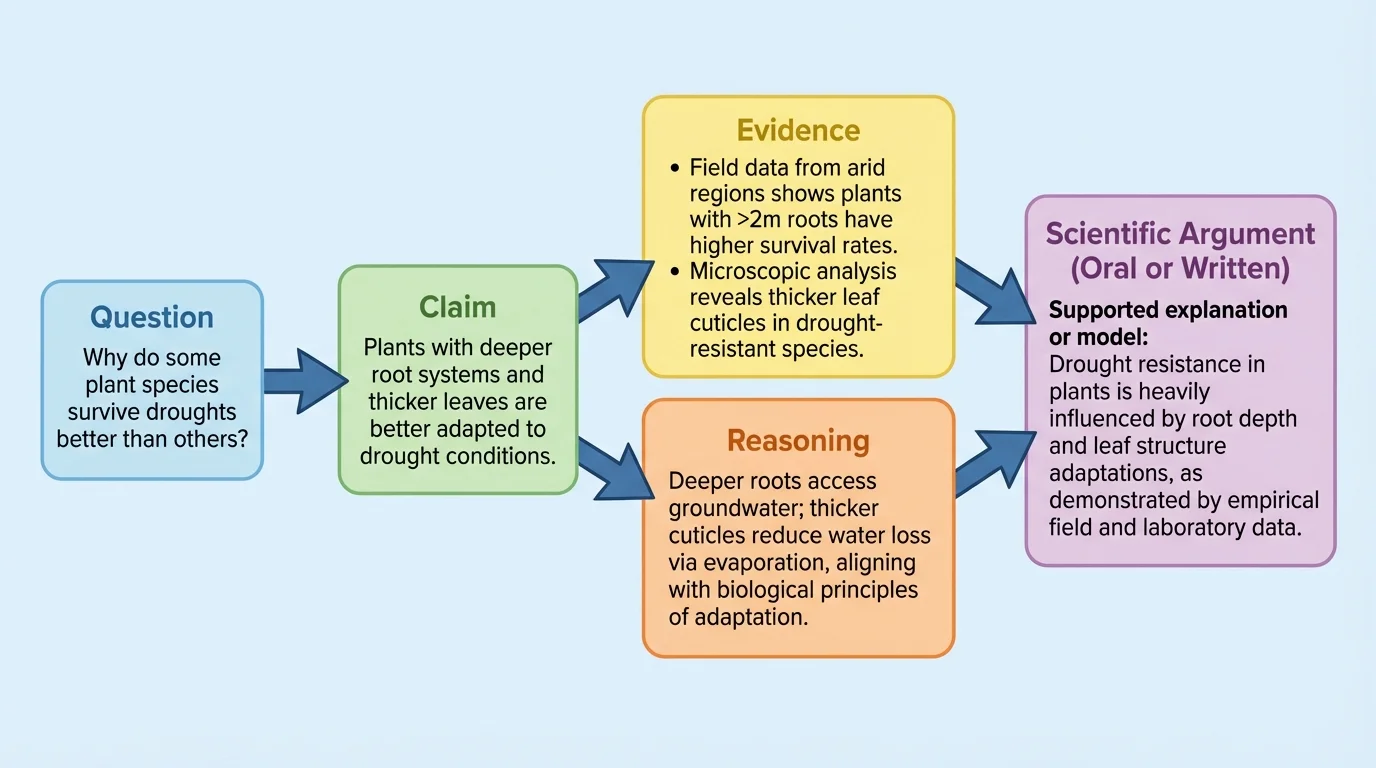
In science, a strong argument has parts that fit together, as [Figure 1] shows. These parts are a claim, evidence, and reasoning. The claim answers a question. The evidence is the information that supports the claim. The reasoning explains why the evidence matters.
Suppose the question is, "Does sunlight affect plant growth?" A claim might be: "Plants grow taller when they receive more sunlight." Evidence might include measured plant heights after several days. Reasoning would explain that plants need light to make food, so more light can help growth.
Claim, Evidence, and Reasoning are the three main parts of a scientific argument. A claim is the answer or explanation. Evidence is the data, observations, or results that support it. Reasoning is the scientific thinking that connects the evidence to the claim.
A scientific argument is not just a guess. A guess may be a starting point, but it becomes a scientific argument only when it is supported by evidence and explained with reasoning. This is why people in science ask, "How do you know?" instead of simply saying, "I believe it."
Scientists also understand that arguments can change. New evidence can strengthen a claim, weaken it, or even show that it is wrong. That is not a failure. It is part of how science becomes more accurate.
Not all information counts as scientific evidence. Empirical evidence comes from things people can observe or measure, as shown in [Figure 2]. That means using senses, tools, or both. If a student says, "I think this paper airplane flies farther because it looks better," that is not empirical evidence. If the student measures the distance of several flights and records the results, that is empirical evidence.
Observations can be qualitative or quantitative. Qualitative observations describe qualities, such as color, smell, texture, or shape. Quantitative observations use numbers, such as length, mass, temperature, or time. Both can help, but numbers often make comparisons clearer.
For example, if students test whether fertilizer helps bean plants grow, they might measure plant heights each week. Suppose one group of plants grows to an average of \(18 \textrm{ cm}\) and another grows to an average of \(12 \textrm{ cm}\). Those numbers are evidence. But the students still need to ask whether the test was fair.
A fair test changes only one variable at a time while keeping the others the same. In the plant example, if one set of plants gets more water, better soil, and more sunlight and fertilizer, then students cannot tell which factor caused the difference. To make a fair test, they should change only the fertilizer and keep other conditions alike.
Repeated trials also matter. A single result may happen by accident. If students test paper towels for absorbency one time, they may get an unusual result. If they repeat the test several times and find the same pattern, their evidence becomes stronger.
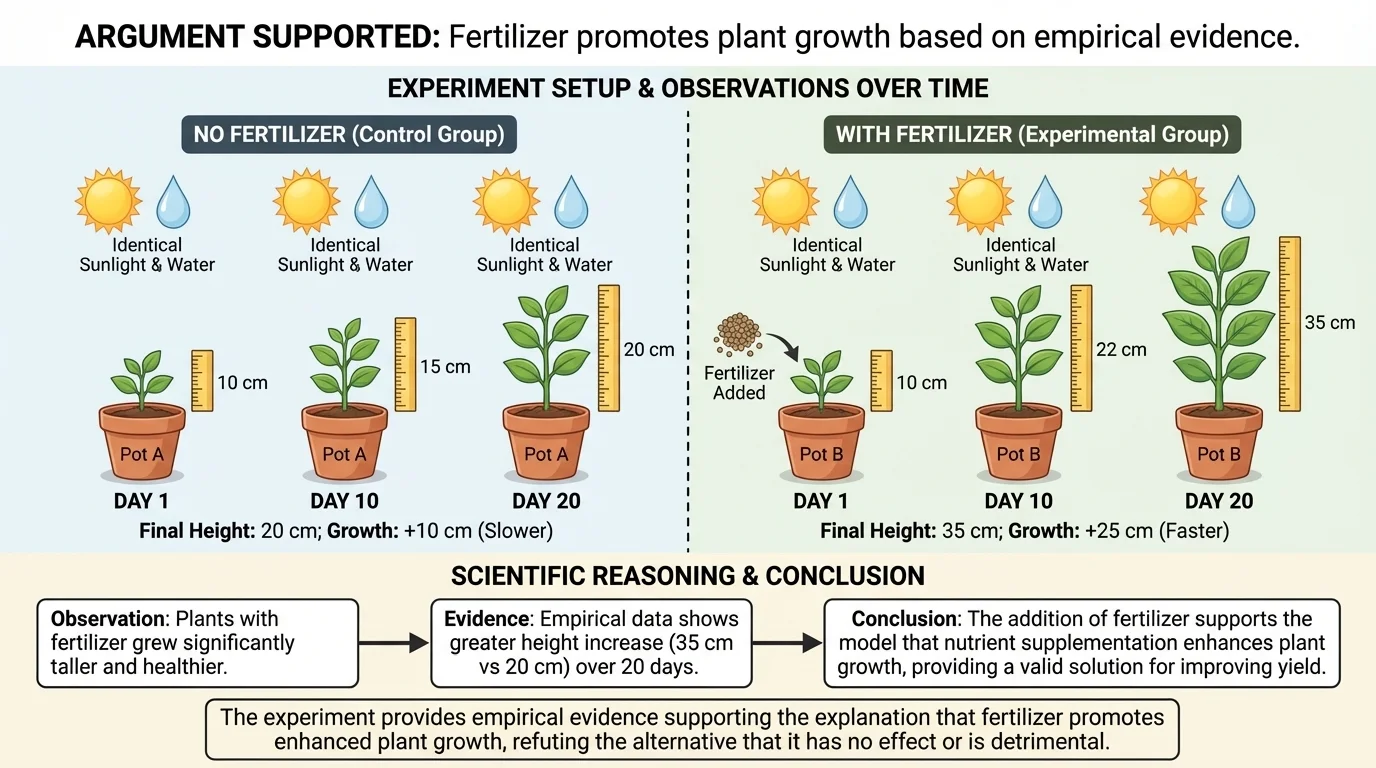
Scientists often organize data in tables and graphs so patterns are easier to see. A table can show exact measurements, while a graph can reveal trends quickly.
| Plant Group | Sunlight | Water | Fertilizer | Average Height After 2 Weeks |
|---|---|---|---|---|
| A | Same | Same | No | \(12 \textrm{ cm}\) |
| B | Same | Same | Yes | \(18 \textrm{ cm}\) |
Table 1. A simple fair-test comparison showing that fertilizer is the only changed variable.
Evidence becomes more trustworthy when the test is controlled, the measurements are careful, and the results can be repeated.
Some scientific discoveries began with careful observations that seemed minor at first. A change in mold growing on a dish helped lead to the discovery of penicillin, an important medicine.
Evidence by itself is not enough. Students must explain why the evidence supports a claim. That explanation is scientific reasoning. It uses known scientific ideas, patterns, and cause-and-effect thinking.
Suppose students test two playground surfaces on a hot day and find that black rubber is hotter than light-colored concrete. Their claim might be that darker surfaces heat up more in sunlight. Their evidence is the temperature data. Their reasoning would explain that dark colors absorb more light energy, which can make them warmer.
Scientific reasoning often uses words like because, therefore, and so. For example: "The ice melted faster on the metal tray because metal transfers heat more quickly than foam." That sentence connects what happened to a science idea about heat transfer.
Why reasoning matters
If two students use the same evidence but make different claims, reasoning helps us decide which claim fits science better. Good reasoning connects the data to accepted scientific ideas, not to random opinions.
Sometimes scientific reasoning includes simple calculations. If a car model rolls \(150 \textrm{ cm}\) on a smooth ramp and only \(90 \textrm{ cm}\) on a rough ramp, students can compare the difference: \(150 - 90 = 60\). The smoother ramp allowed the car to roll \(60 \textrm{ cm}\) farther. That number strengthens the argument, but students still need reasoning: the rough ramp creates more friction, which slows the car.
In science, students not only support explanations. They may also refute them. To refute an explanation means to show, with evidence and reasoning, that it does not fit the facts well.
Suppose someone says, "Heavier objects always fall faster than lighter ones." Students test a heavy ball and a lighter ball dropped from the same height. If they land nearly together, that evidence challenges the explanation. The reasoning may explain that gravity pulls on both objects, and for many dropped objects the heavier one does not automatically fall faster in the way people expect.
Refuting an idea does not mean being rude. It means carefully showing that the evidence does not support it. Scientists can disagree while still listening respectfully and checking one another's methods.
Case study: Which explanation fits better?
Question: Why did one cup of water evaporate faster than another?
Step 1: State two possible explanations.
Explanation A: The cup near the window evaporated faster because it was warmer.
Explanation B: The cup near the window evaporated faster because it was blue.
Step 2: Look at the evidence.
The window-side cup was measured at \(28^\circ \textrm{C}\), while the other cup was \(22^\circ \textrm{C}\). The warmer cup lost more water over the same time.
Step 3: Use reasoning.
Higher temperature gives water particles more energy, so evaporation happens faster. Cup color does not explain the difference as well as temperature does.
Explanation A is supported better. Explanation B is weaker because the evidence does not connect strongly to it.
Strong arguments compare more than one explanation. If students only look for evidence that supports their favorite idea, they may miss a better answer.
A model is a representation of something that helps us understand it. Models can be drawings, diagrams, physical objects, computer simulations, or even mental pictures. The water cycle picture in [Figure 3] is a model because it helps show how water moves through evaporation, condensation, precipitation, and runoff.
Scientists use models to explain things that are too large, too small, too far away, or too complicated to study directly. A globe is a model of Earth. A drawing of the solar system is a model. A diagram of atoms is a model.
But a model is not exactly the same as the real thing. A model leaves out some details so important parts are easier to study. Because of that, models can be tested, improved, supported, or challenged by evidence.
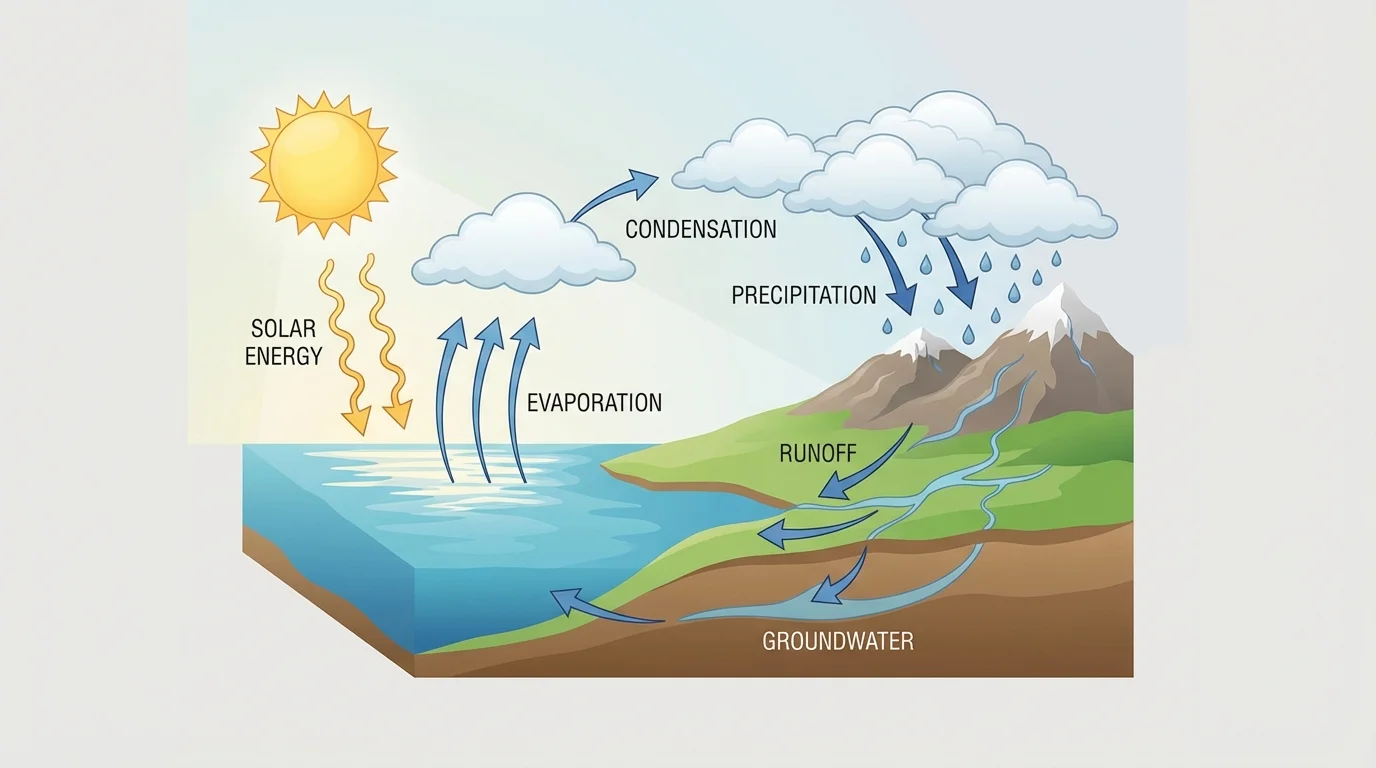
For example, a model of the water cycle predicts that water evaporates, forms clouds, and later falls as precipitation. If weather observations match those steps again and again, the model is supported. If observations do not match, the model may need changes.
Later, when students explain weather changes, the process shown in [Figure 3] helps them connect their observations to a model instead of treating each rainy day as a separate mystery.
Earlier science learning about observing, measuring, and recording data is important here. Scientific arguments become stronger when students use those skills carefully and honestly.
Science is not only about explaining natural events. It also helps people solve problems. When students design a solution, they can still use evidence and reasoning to argue that one design works better than another. The comparison chart in [Figure 4] shows how evidence can help choose between two designs.
Suppose a class is designing a water filter. One group uses gravel, sand, and cotton. Another uses only cotton and paper towel. To decide which design is better, students need criteria such as how clean the water becomes, how fast the water moves, how much the filter costs, and how easy it is to build.
Evidence can come from measurements and observations. If Filter A cleans the water more clearly, works in \(40 \textrm{ s}\), and costs less than Filter B, students can argue for Filter A. But if Filter B cleans the water a little better even though it is slower, then students must decide which criterion matters most for the problem.
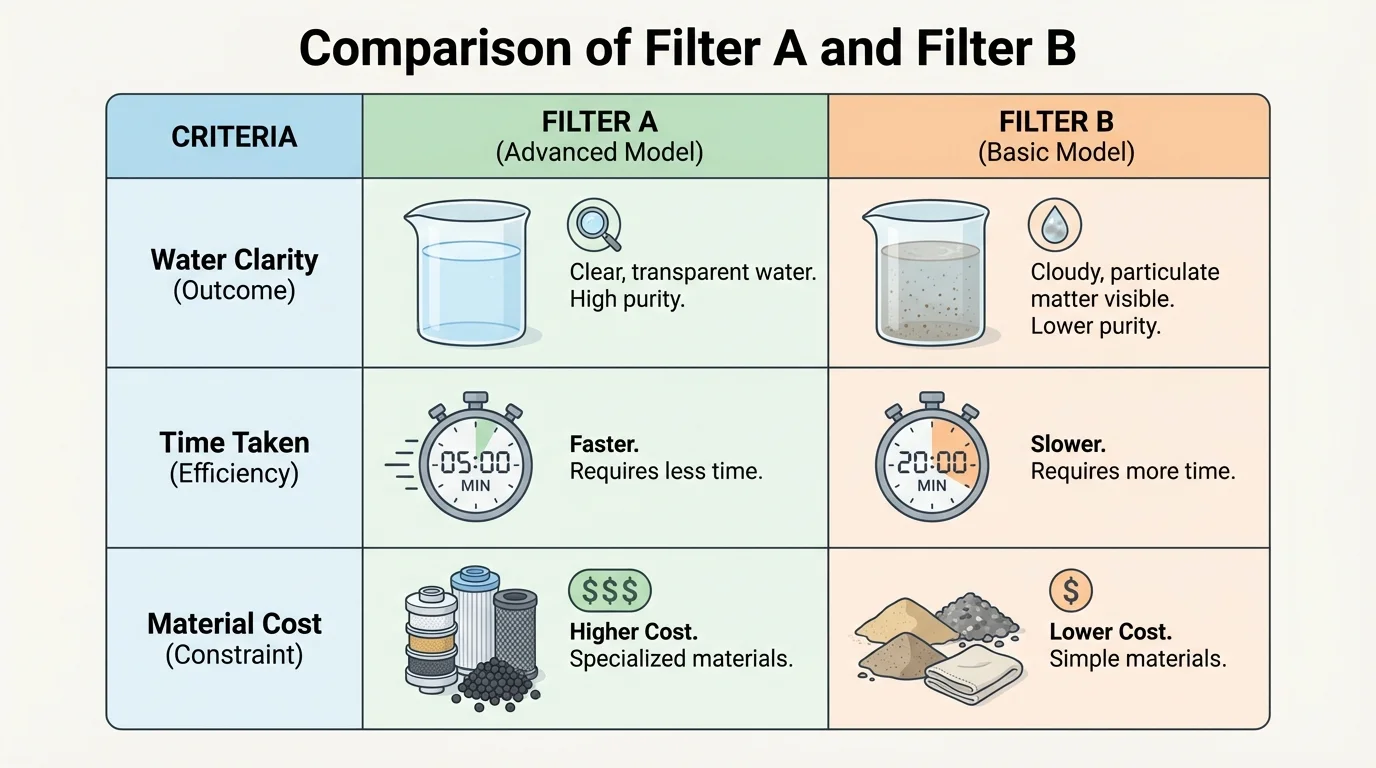
Engineers often compare trade-offs. A trade-off means gaining one advantage while giving up another. A stronger bridge design may cost more. A faster paper airplane may be harder to control. A good scientific or engineering argument explains these trade-offs honestly.
The chart remains useful when students defend their design choices because it turns opinions into visible comparisons based on evidence.
Case study: Choosing a lunchbox insulator
Question: Which material keeps food cool longer?
Step 1: Identify the claim.
"Foam is a better insulator than aluminum foil for keeping a lunchbox cool."
Step 2: Add evidence.
An ice pack wrapped in foam reaches \(8^\circ \textrm{C}\) after one hour. An ice pack wrapped in aluminum foil reaches \(12^\circ \textrm{C}\) after one hour.
Step 3: Explain the reasoning.
Lower temperature means less heat entered the lunchbox. Since the foam-wrapped ice pack stayed colder, foam reduced heat transfer better in this test.
This argument supports one solution with data and scientific reasoning.
Students should be able to present arguments in two ways: by speaking and by writing. In both forms, the goal is clarity. A listener or reader should understand the question, the claim, the evidence, and the reasoning.
In an oral argument, students speak clearly, use data accurately, and listen to questions. They may point to a table, a graph, or a model while they explain. Good oral arguments are not rushed. They stay focused on the evidence.
In a written argument, students organize ideas into complete sentences and paragraphs. A common structure is simple: state the question, answer it with a claim, provide evidence, and explain the reasoning. A final sentence may compare the claim with another possible explanation.
For example, a short written argument might say: "The metal spoon warmed faster than the wooden spoon. After \(2\) minutes in hot water, the metal spoon reached \(41^\circ \textrm{C}\), while the wooden spoon reached \(30^\circ \textrm{C}\). This supports the claim that metal transfers heat more quickly than wood." That is short, but it includes the main parts.
"Science is a way of thinking much more than it is a body of knowledge."
— Carl Sagan
Whether speaking or writing, students should use respectful language. Phrases like "The evidence suggests..." or "Our results support..." are stronger and more scientific than "I just know..." or "You are wrong."
A strong scientific argument does not ignore other ideas. It considers counterclaims, which are different claims that answer the same question in another way. If another team says a different material is a better insulator, students should compare the data instead of dismissing the idea.
Scientists also talk about limitations. A limitation is something that may weaken confidence in the results. Maybe the sample size was small. Maybe one thermometer was inaccurate. Maybe the test lasted only one day. Pointing out limitations is honest and helps improve future investigations.
For example, if students tested only one kind of paper towel, they cannot claim all brands behave the same. If they tested only one paper airplane shape, they cannot say every airplane made from heavy paper flies poorly. Strong arguments stay as precise as the evidence allows.
Strong evidence versus weak evidence
Strong evidence comes from careful measurements, fair tests, repeated trials, and results that fit known science ideas. Weak evidence may come from one trial, unclear methods, missing measurements, or personal opinions.
Scientific arguments are everywhere. Doctors compare evidence to decide which treatment works better. Weather scientists use data and models to predict storms. City planners study evidence before choosing materials for roads or playgrounds. Farmers compare soil, rainfall, and plant growth data to make better decisions.
Even in everyday life, students use argument from evidence. If you say one backpack strap design is stronger, you can test how much weight each design holds. If you think one route to school is faster, you can time each route for several days and compare the results. The habit of asking for evidence helps people make smarter choices.
Good science does not ask people to stop questioning. It asks them to question carefully, measure honestly, reason clearly, and be willing to change their minds when better evidence appears. That is what makes scientific arguments powerful.
