You have never seen the inside of Earth with your own eyes, and you cannot watch a single tiny particle of water evaporate into the air. Yet scientists can explain both. How? They use models. A model is one of the most powerful tools in science because it helps us understand things that are too small, too large, too far away, too fast, too slow, or too hidden to observe directly.
In science, a model is a simplified representation of something in the real world. A model is not the real thing. Instead, it helps us think about the real thing. A model may be an object, a drawing, a map, a diagram, a verbal description, or even a mathematical relationship.
Model means a representation of an object, system, or process that helps people describe, explain, or predict what happens.
Phenomenon means something that happens and can be observed, such as rain falling, shadows changing, or ice melting.
Mechanism means the way something works or the hidden process that causes a phenomenon.
For example, a globe is a model of Earth. It is much smaller than the real planet, but it shows the shape of Earth and where continents and oceans are. A drawing of the water cycle is also a model. It helps explain how water moves even though we cannot see every step happening at once.
Good scientific models focus on the most important parts. They leave out details that are not needed for the question being studied. If a scientist wants to explain why the Moon appears to change shape, the model needs Earth, the Moon, the Sun, and light. It does not need every mountain on the Moon.
Scientists use models to do several important jobs. First, models help people describe what they notice. Second, models help people explain why something happens. Third, models help people predict what may happen next. Fourth, models help people communicate ideas clearly to others.
Suppose students notice that a puddle disappears after a sunny day. That disappearing puddle is a phenomenon. A model can help explain the hidden mechanism: tiny water particles gain energy and move into the air as water vapor. We may not see each particle, but the model helps us understand what is happening.
Models connect what we can see to what we cannot see. In science, many causes are hidden. We can see leaves move, but not the wind itself. We can see a magnet pull a paper clip, but not magnetic forces directly. We can see bread rise, but not every gas bubble forming inside the dough. Models help bridge that gap.
Scientists also revise models when new evidence appears. That is one reason science continues to advance. A model is useful, but it can always be improved.
[Figure 1] There are many kinds of models in science, and each kind is useful for different purposes. Some models are things you can hold. Others are pictures or ideas. What matters is whether the model helps explain or predict something clearly.
A physical model is an object that looks like or acts like the real thing. A toy car can be a model of a real car. A globe is a model of Earth. A model skeleton helps students learn about bones. Physical models are helpful because students can see size, shape, and parts.
A diagram model is a drawing that shows parts and relationships. A food web, a water cycle diagram, and a labeled plant drawing are all diagram models. A diagram can show movement with arrows and show names of parts with labels.
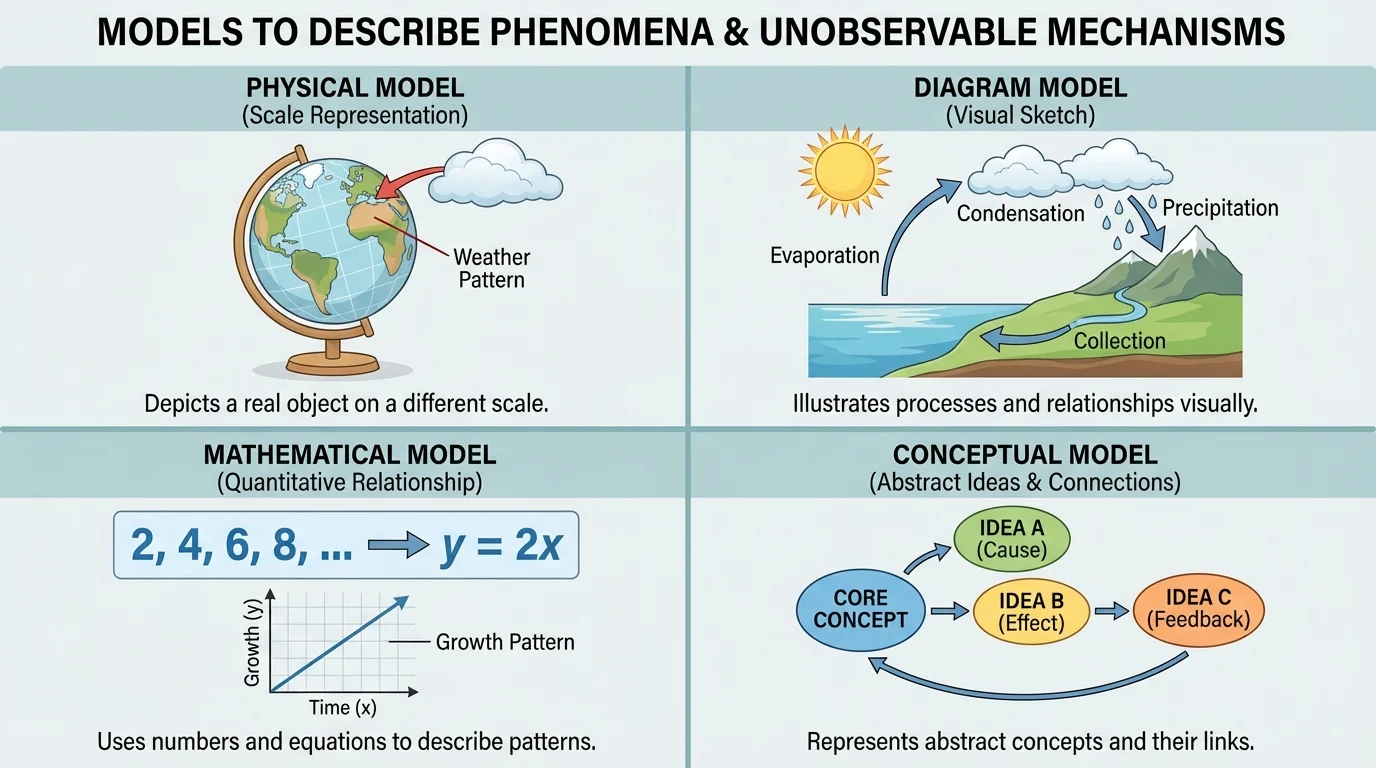
A mathematical model uses numbers, measurements, and rules to describe a pattern. For example, if a plant grows about \(2 \textrm{ cm}\) each week, students can use a number pattern to predict its future height. After \(4\) weeks, the growth would be \(2 \times 4 = 8 \textrm{ cm}\). That number pattern is a simple mathematical model.
A conceptual model is an idea-based explanation of how something works. For example, students may use the idea that heat moves from warmer places to cooler places. That idea helps explain why an ice cube melts faster in a warm room than in a freezer.
One real scientific problem often needs more than one kind of model. Weather scientists use maps, diagrams, computer models, and number patterns together. Using different models helps them learn more than one model alone can show.
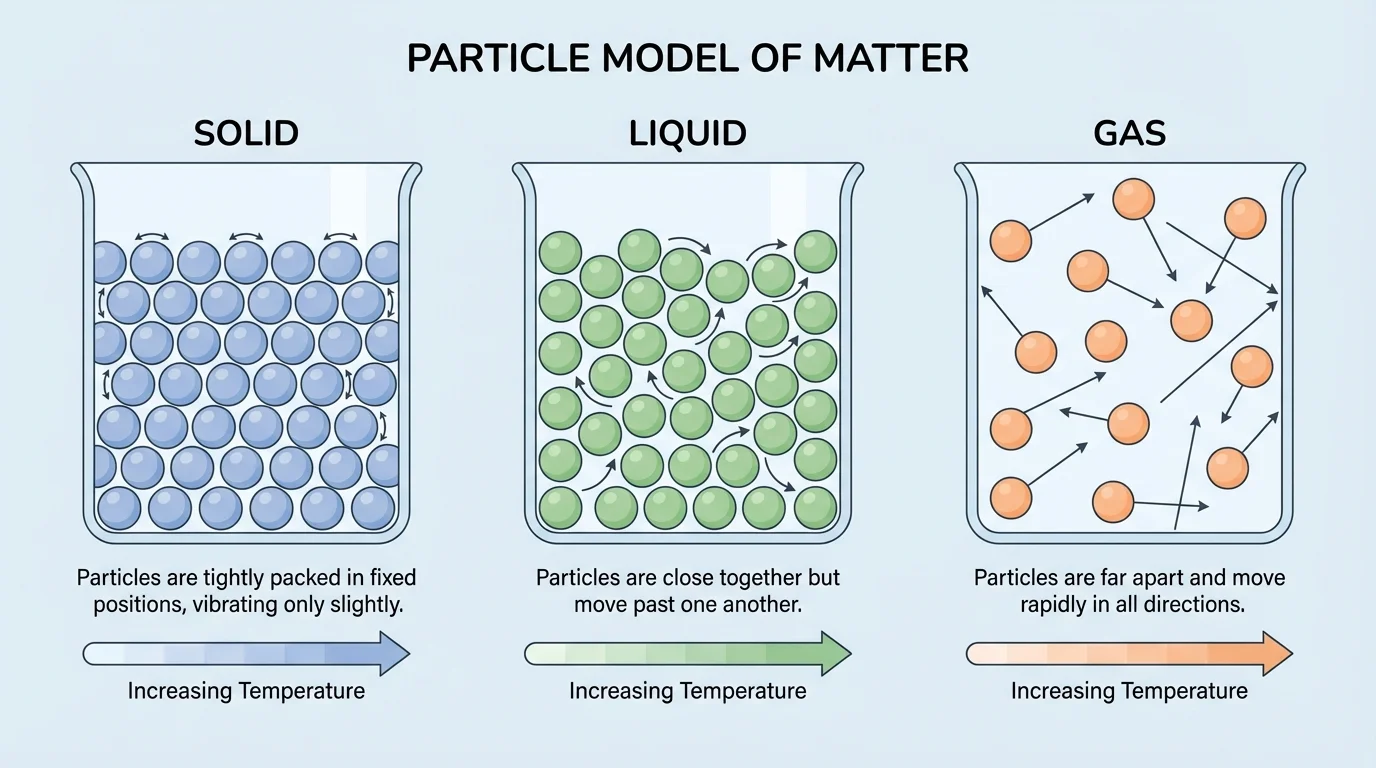
[Figure 2] Some of the most important scientific ideas involve things we cannot observe directly. Scientists use a particle model to describe matter because particles are far too small to see without special tools. Even though we cannot observe the particles in classroom air one by one, the model helps explain many familiar events.
For example, the particle model says that all matter is made of tiny particles that are always moving. In a solid, the particles are packed closely and mainly vibrate in place. In a liquid, the particles stay close but can slide past one another. In a gas, the particles spread farther apart and move freely. This helps explain why ice keeps its shape, water flows, and air fills a balloon.
Models also help explain things that are too large or too far away to examine closely. No one can cut open Earth all the way to the core, but scientists use evidence from earthquakes and rock studies to build models of Earth's layers. No one can touch the Sun, but scientists use light, heat, and space measurements to model what it is like.
Later, when you think again about solids, liquids, and gases, [Figure 2] remains useful because it connects a hidden mechanism, particle spacing and motion, to visible properties such as shape and flow.
Air may seem empty, but it is full of moving particles. The particle model helps explain why a scent from soap, popcorn, or flowers can spread through a room even when no one stirs the air.
When scientists cannot see a mechanism directly, they often look for clues in what they can observe. Then they build a model that fits those clues. If the model explains many observations well, it becomes a strong scientific tool.
Developing a model is not guessing wildly. It is careful thinking based on evidence. Scientists begin with observations. They ask, "What is happening?" Then they ask, "What parts and interactions may be causing it?"
A useful process for developing a model includes several actions. First, observe the phenomenon carefully. Second, identify the main parts of the system. Third, decide what relationships matter most. Fourth, choose a form for the model, such as a diagram, object, or number pattern. Fifth, compare the model with real evidence. Finally, revise the model if it does not explain the evidence well.
Example of developing a model
A class notices that wet clothes dry faster outside on a warm, windy day than inside a cool room.
Step 1: Observe the phenomenon.
The visible event is that water disappears from the clothes faster outdoors.
Step 2: Think about hidden causes.
Students infer that heat gives water particles more energy, and moving air carries water vapor away.
Step 3: Build a model.
A diagram might show water in fabric, energy from the Sun, moving air, and water vapor leaving the cloth.
Step 4: Test the model.
If the model is useful, it should also help explain why clothes dry slowly on a cool, still, humid day.
This model does not show every particle, but it includes enough important ideas to explain the drying process.
Notice that a model should match the question. If the goal is to explain why clothes dry, a model about cloth color may not help much unless color affects heating. The best models are focused.
[Figure 3] The water cycle is a great example of a familiar phenomenon that includes hidden steps. We can see rain, puddles, rivers, clouds, and snow, but some parts of the cycle involve water vapor that we do not easily see. A model of the water cycle links visible events to the hidden mechanism of water changing location and state.
In this model, energy from the Sun warms water in oceans, lakes, and puddles. Some water changes from liquid to gas and moves into the air. This process is called evaporation. Higher in the air, water vapor cools and changes into tiny liquid droplets. This process is called condensation. Those droplets gather into clouds. When droplets become heavy enough, water falls as rain or snow. This is precipitation.
The model may also show runoff across land, soaking into the ground, and water collecting again in lakes and oceans. The arrows in the model matter because they show movement. Without arrows, a student might see the parts but miss the process.
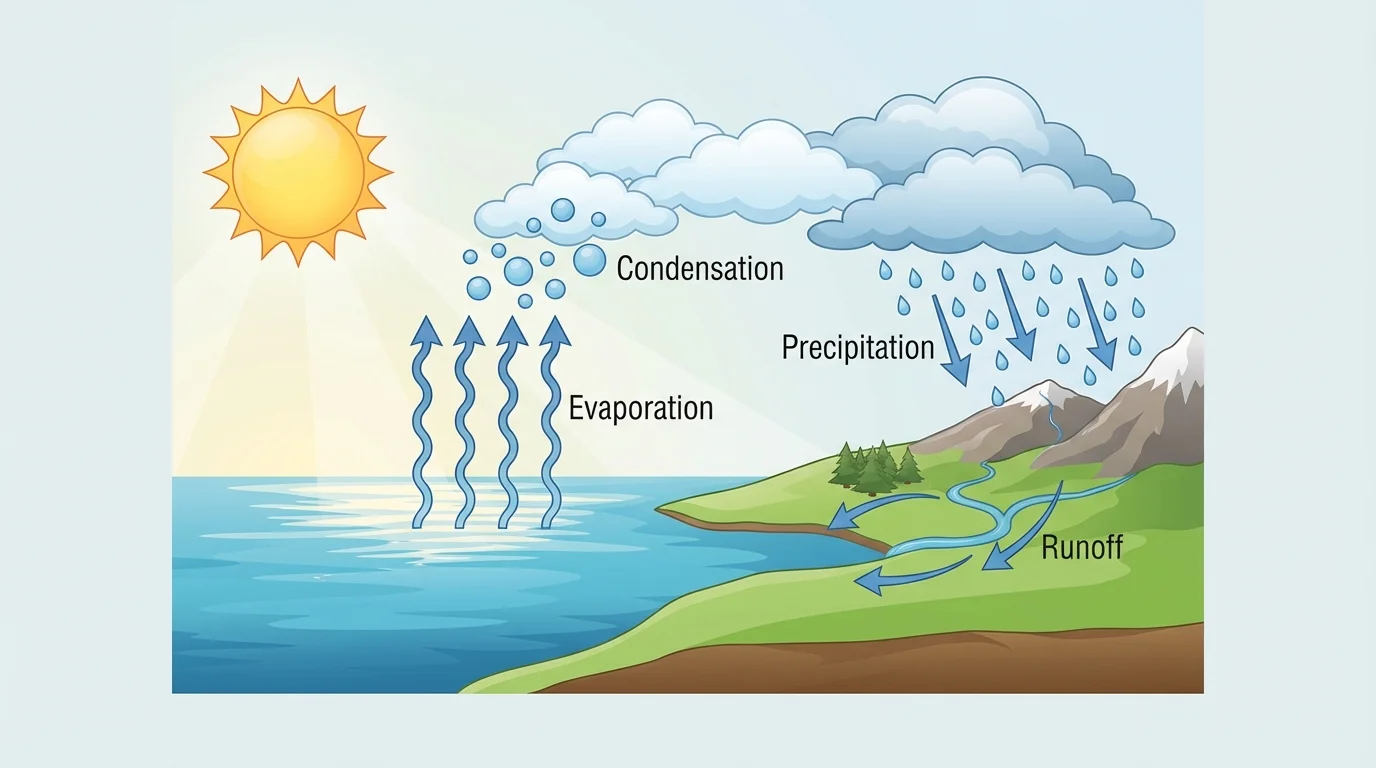
The water cycle model is useful because it explains more than one event. It helps explain why puddles shrink, why clouds form, why rain falls, and why water keeps moving around Earth. Later, when students study weather, [Figure 3] still helps because it connects heating, cooling, and movement of water.
A water cycle model also has limits. It does not show every drop of water or every wind pattern. It simplifies reality. That is not a weakness if the model still answers the question well.
Think about an ice cube melting. The solid ice becomes liquid water, and with enough heating, the water can become gas. We observe the changes, but we do not see the tiny parts moving. The particle model explains that heating increases particle motion. As the motion changes, the arrangement and behavior of the particles change too.
This same model explains why a balloon expands when air is warmed. Warmer gas particles move faster and push outward more. It also explains why the smell of perfume spreads through a room: particles move and mix through the air.
A strong model explains many related phenomena. The particle model is powerful because it helps explain melting, freezing, boiling, spreading of odors, compressing gases, and why solids keep their shape. Scientists value models that work in many situations, not just one.
Even so, the particle model has limits for beginners. It often uses circles to represent particles, but real particles are much more complex than simple dots. The model is still useful because it highlights spacing and motion, which are the main ideas students need first.
[Figure 4] A model can also explain why day and night happen. Many students can observe the Sun rising and setting, but a Sun-Earth model helps explain the hidden mechanism: Earth rotates. The side of Earth facing the Sun has daylight, and the side turned away has night.
If Earth turns once in about one day, places on Earth move from sunlight into darkness and then back into sunlight. A simple model using a lamp for the Sun and a ball for Earth can make this much easier to understand.
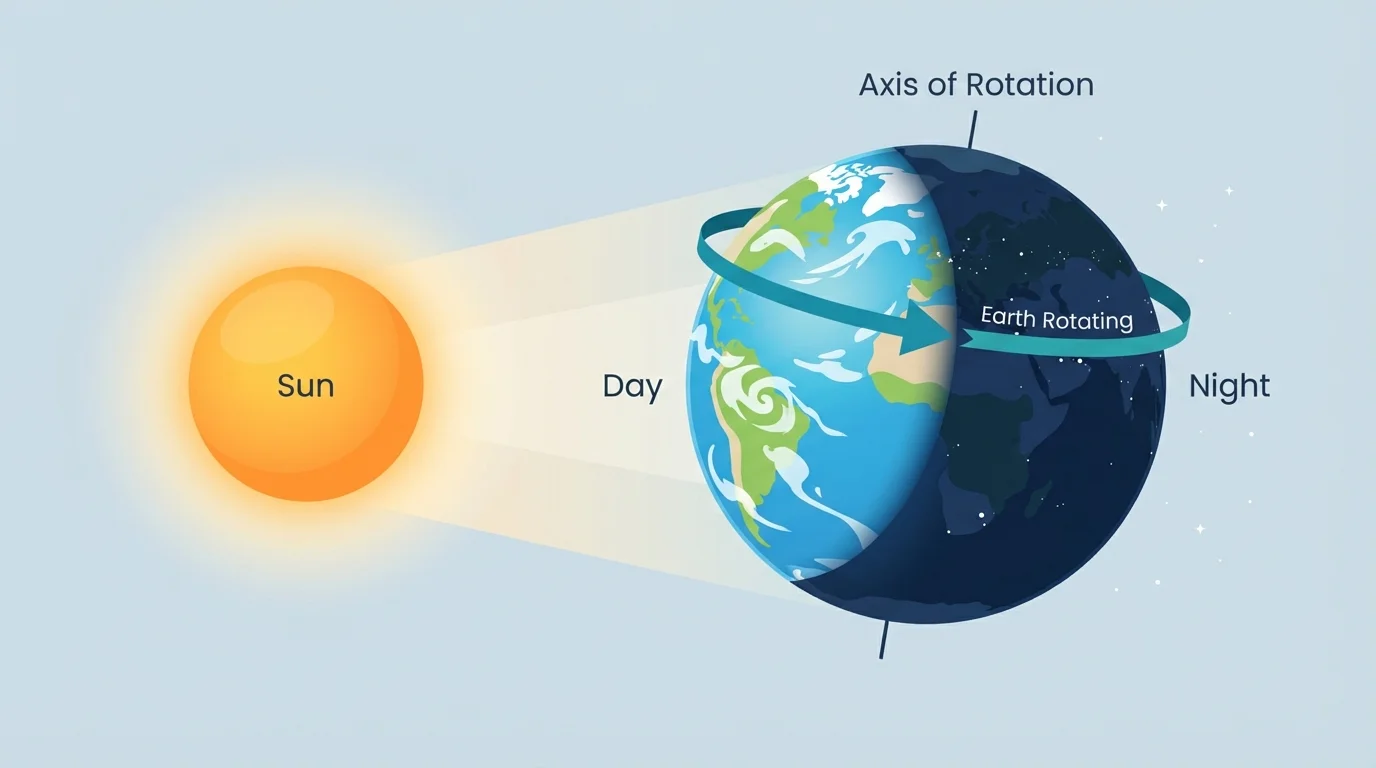
This model also helps with prediction. If a location is turning toward the lit side, sunrise is coming. If it is turning away, sunset is coming. That shows another strength of models: they are not only for explaining the past; they also help forecast what happens next.
Later on, [Figure 4] also supports learning about time zones and seasons, although more details must be added for those topics. A simple model can be the first step toward a more advanced one.
Every model has strengths and limitations. A strength is what the model explains well. A limitation is what the model leaves out or oversimplifies. Good scientists know both.
The table below compares some common strengths and limits.
| Model type | Useful for | Possible limitation |
|---|---|---|
| Physical model | Showing shape, size, and parts | May not show motion or hidden processes well |
| Diagram model | Showing relationships and movement with arrows | May not show real size or exact amounts |
| Mathematical model | Showing patterns and making predictions | May miss details if the pattern is too simple |
| Conceptual model | Explaining how or why something works | Can be harder to picture without drawings |
Table 1. Comparison of common model types, what they help explain, and what they may leave out.
Scientists often improve a model when they gather new evidence. This is called revision. Revision does not mean the earlier model was useless. It means science is becoming more accurate.
You already know that scientists make observations and collect evidence. Models are built from that evidence. They are not random drawings or opinions.
For example, an early drawing of the solar system may show only planets and the Sun. A later model might add orbit paths, moons, and relative distances. The newer model answers more questions.
Models are everywhere, not just in science class. Weather forecasts use computer models to predict rain and temperature. Doctors use models of the heart, lungs, and skeleton to understand the body. Engineers use models before building bridges, cars, and airplanes. Game designers and architects use digital models to test ideas before creating the real thing.
Even simple maps are models. A map is not the full neighborhood or city. It leaves out most details but keeps the information needed to help people travel. That is exactly what a scientific model does: it keeps the important parts for a purpose.
Real-world application
Suppose meteorologists want to predict whether a storm will reach a town. They collect measurements such as temperature, wind speed, air pressure, and cloud movement. Then they use computer models to test how those parts interact.
If the model matches new evidence well, people can prepare for heavy rain or strong wind. In this way, models help keep communities safe.
When you develop or use a model, it helps to ask a few smart questions: What does the model explain? What evidence supports it? What has been left out? What predictions can it make? Thinking this way turns a model into a real scientific tool.
Learning to use models is important because many big scientific ideas cannot be understood by direct observation alone. Models help students and scientists build explanations from clues, evidence, and patterns. They turn hidden mechanisms into understandable ideas.
