A hummingbird wing, a bicycle frame, a shark's skin, and a suspension bridge seem to belong to completely different worlds. Yet they all follow the same deep rule: what something does depends strongly on how it is built. Scientists and engineers can often look at an unfamiliar object and make good guesses about its job just by studying its shape, its parts, and the materials inside it. That is one of the most powerful ideas in science and technology.
When we talk about structure, we mean more than just outer appearance. Structure includes the overall form of an object, the way its parts are arranged, and the tiny features inside the materials it is made from. When we talk about function, we mean what the object or system does: support weight, move air, absorb shock, store energy, resist corrosion, transmit signals, or carry out some other task.
Structure is the shape, arrangement, and internal organization of an object, material, or system.
Function is the job or role that the object, material, or system performs.
Property is a characteristic such as strength, stiffness, elasticity, density, conductivity, or transparency that affects function.
These ideas apply across many scales. A tree trunk supports a large mass because of its cylindrical form, layered tissues, and the chemistry of cellulose and lignin. A phone screen resists scratching because of the atomic arrangement and bonding in its glass. A kidney filters blood because millions of tiny structures are organized into a larger functional system. In each case, structure helps explain function.
A useful way to study this topic is to think in three levels. First, there is the overall shape: long, flat, curved, hollow, branching, folded, or streamlined. Second, there is the arrangement of components: joints, layers, tubes, fibers, hinges, supports, membranes, or circuits. Third, there is the molecular substructure: the kinds of atoms present, how they are bonded, and how molecules or crystals are arranged.
All three levels can influence one another. A bird bone is hollow at the large scale, reinforced internally by struts at the component scale, and made of minerals and proteins at the molecular scale. The result is a structure that is light enough for flight but strong enough to handle forces from landing and takeoff.
Inferring function from form
To infer function means to make a reasoned conclusion based on evidence. If an object is broad and flat, it may be adapted for collecting or spreading force. If it is sharply pointed, it may be adapted for piercing. If it has many folds or branches, it may be adapted for exchange or increased surface area. If it is made of a slippery, layered material, it may be adapted to reduce friction.
This does not mean structure determines only one possible function. Many structures serve multiple roles, and some can be used in ways they were not originally shaped for. Still, structure gives strong clues, and these clues are central to biology, engineering, medicine, and materials science.
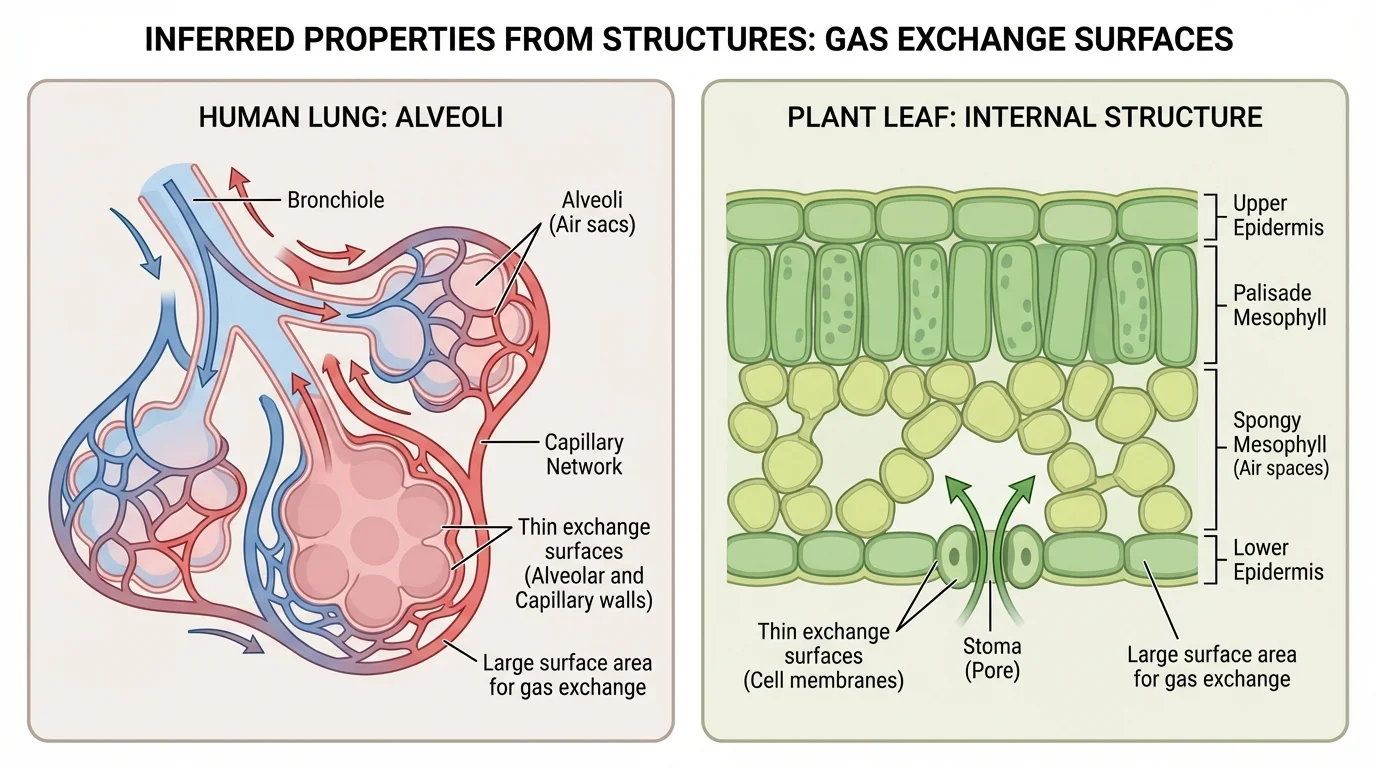
[Figure 1] Living things provide some of the clearest examples of structure-function relationships. Gas exchange in lungs and leaves depends on huge internal surface areas through folded and branching structures. A structure that looks compact from the outside can contain an enormous amount of exchange surface on the inside, allowing oxygen, carbon dioxide, and water vapor to move efficiently.
Human lungs contain millions of tiny air sacs called alveoli. Each alveolus has very thin walls and is surrounded by capillaries. Because the walls are thin, gases diffuse across them quickly. Because there are so many alveoli, the total surface area is very large. A leaf works in a related way: its broad shape captures light, while internal air spaces and specialized cells support gas exchange and photosynthesis.
Bones also reveal structure-function relationships. Many bones are not solid all the way through. Long bones often have a dense outer layer and a spongy inner structure. This arrangement gives strength without excessive mass. The dense outer layer resists bending and impact, while the internal structure helps distribute forces. For an athlete, this matters every time force travels through the leg during running or jumping.
The shape of a bird wing suggests lift and control. Its curved upper surface and feather arrangement affect how air moves around it. The skeleton beneath the feathers provides support while keeping mass low. Even the feather structure matters: interlocking barbs create a smooth but adjustable surface. A wing is not just one object; it is a system of bones, muscles, tendons, and feathers working together.
Teeth offer another useful example. Incisors are sharp and chisel-shaped for cutting. Molars are broader with ridges for grinding. From structure alone, you can infer different functions in eating. Similarly, the beak shape of birds often reflects diet: a hooked beak may be suited for tearing flesh, while a short thick beak may be better for cracking seeds.
Protective structures in nature can also be inferred from form. Turtle shells, porcupine quills, and thick tree bark all suggest defense. Their shapes and materials are adapted to absorb impact, resist penetration, or discourage predators. Even skin has structural specialization: human skin is layered, flexible, and able to heal, while fish scales overlap to protect the body yet still allow motion. [Figure 2]
Shark skin is covered with microscopic tooth-like structures that reduce drag in water. Engineers have copied this pattern to design surfaces that move more efficiently through fluids.
The relationship shown earlier in [Figure 1] appears again in many natural systems: when a task requires fast exchange, organisms often evolve folding, branching, or thin layered surfaces. This same pattern is seen in roots, blood vessels, gills, and intestines.
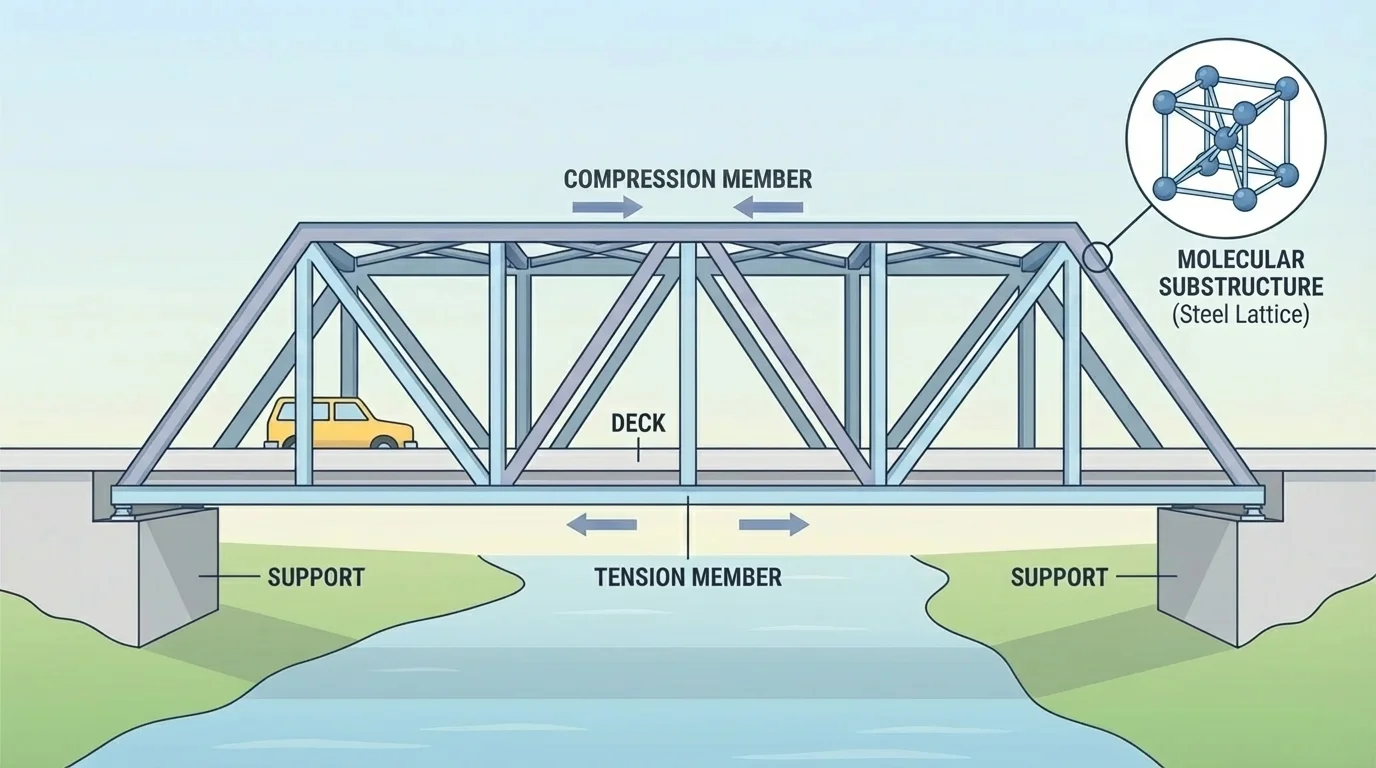
Engineered objects follow the same principle, but here the structure is chosen deliberately rather than shaped by evolution. The strength of a bridge, for example, depends not only on the material but also on the arrangement of parts in a truss design. Engineers study how loads move through a structure so that forces are carried safely to the ground.
Triangles appear often in bridges, towers, and roof supports because they resist shape change. A rectangle can deform into a parallelogram if its joints move, but a triangle is much more rigid unless a side changes length. That is why truss bridges use repeated triangular units. The overall structure and the shapes of the components together determine stability.
A bicycle frame gives another clear example. It must be light enough to ride efficiently but strong enough to handle bumps, pedaling forces, and turns. Its tubes are often hollow rather than solid. Hollow tubes can provide excellent stiffness for their mass because material is placed away from the center, where it better resists bending. The frame's triangular geometry also improves strength and stability.
Consider a screwdriver, kitchen knife, or hammer. Their structures immediately suggest their uses. A screwdriver has a shaped tip to fit a screw head. A knife has a thin sharpened edge for cutting. A hammer has a hard, dense head and a handle that lets the user apply torque and control impact. In each case, the shape of the parts and the chosen material work together.
Buildings are designed with purpose as well. Skyscrapers use steel or reinforced concrete frames because these materials can handle large loads. Their foundations spread weight into the ground. In windy regions, structures may be shaped to reduce oscillation. In earthquake-prone areas, designers may include flexible joints or dampers so that a building can move without collapsing.
Modern devices also reveal hidden structure-function relationships. A smartphone contains layers: glass for protection and touch input, semiconductors for computation, metals for conduction, polymers for insulation and casing, and tiny component layouts that control heat and signal flow. Even if a student cannot see the internal circuitry directly, its organized structure determines the function of the entire device. [Figure 3]
Some of the most surprising properties come from the invisible level of particles. The same chemical element can behave in very different ways depending on arrangement, as carbon shows. To understand why one material is hard, another flexible, and another conductive, we have to look at atoms, bonds, and molecular patterns.
Crystal lattice structure matters in metals, salts, and many minerals. In a crystal, atoms or ions are arranged in repeating patterns. The shape and bonding of that pattern influence hardness, melting point, and electrical behavior. In polymers, long molecular chains may slide past one another easily or may be strongly linked, which changes whether the material is stretchy, brittle, or tough.
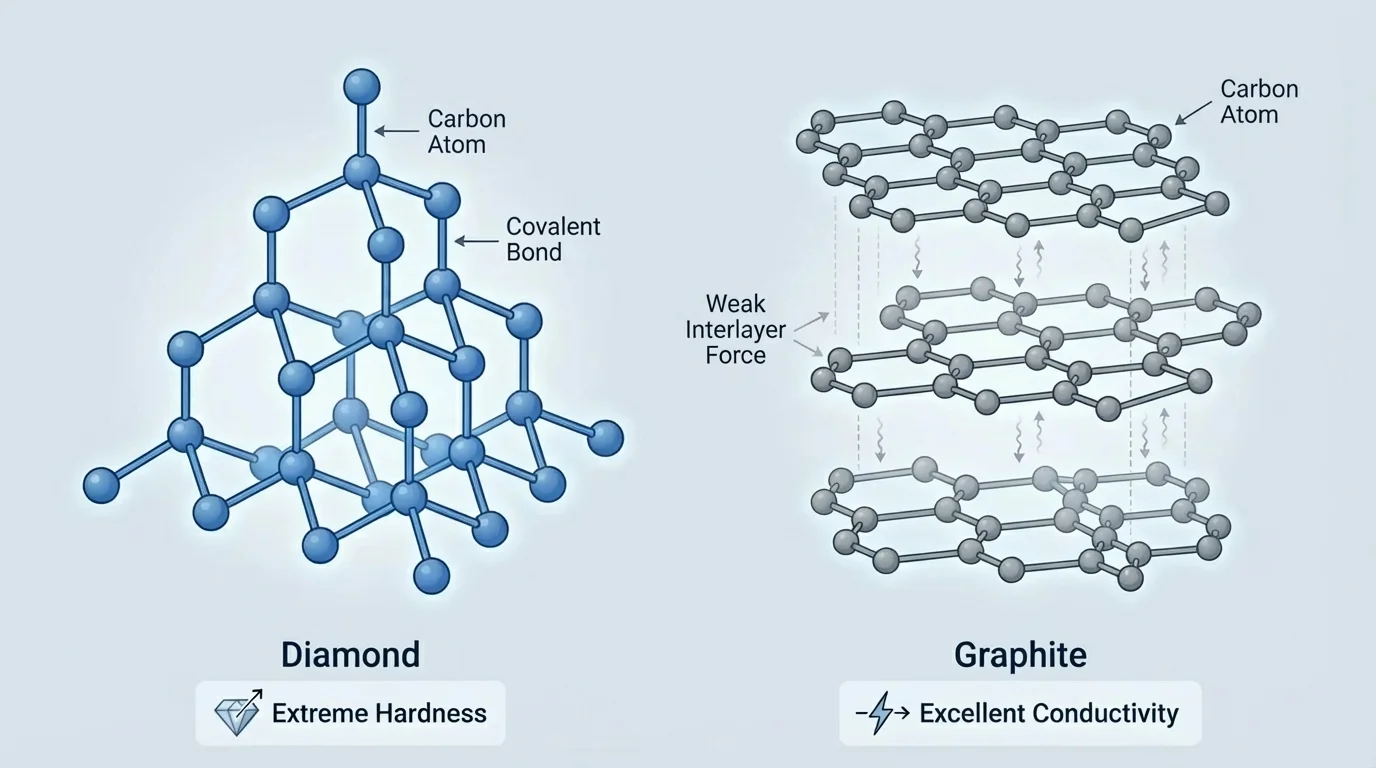
Diamond and graphite are both made only of carbon. Yet diamond is extremely hard, while graphite is soft enough to leave marks on paper. In diamond, each carbon atom forms strong bonds in a three-dimensional network. In graphite, carbon atoms form flat layers, and the layers slide over one another easily. Structure at the atomic scale creates very different properties from the same element.
Metals conduct electricity because some electrons move relatively freely through the material. That is why copper is widely used in wires. Rubber, by contrast, is usually an electrical insulator because its molecular structure does not allow charge to move as easily. This difference in property leads directly to different functions in electrical systems.
Material scientists often connect a visible property to microscopic structure. Brittleness may result from a structure that cracks rather than bends. Elasticity may result from coiled or flexible molecular chains that can stretch and then return to shape. Transparency depends on how light interacts with the internal structure of a material. Corrosion resistance depends on chemical stability and surface behavior.
| Material | Structural feature | Important property | Common function |
|---|---|---|---|
| Steel | Metal atoms in a strong lattice | High strength and toughness | Buildings, tools, vehicles |
| Glass | Rigid disordered network | Transparency and hardness | Windows, screens, containers |
| Rubber | Flexible polymer chains | Elasticity | Tires, seals, grips |
| Wood | Aligned fibers and cellular structure | Good strength-to-mass ratio | Construction, furniture |
| Copper | Metallic bonding with mobile electrons | Electrical conductivity | Wiring, motors, circuits |
Table 1. Examples of materials showing how structural features connect to useful properties and functions.
Atoms combine into molecules or large networks, and the way they bond affects the behavior of the material. Physical properties such as density, hardness, and conductivity are not random; they come from structure at small scales.
The contrast in carbon structures shown in [Figure 3] is a reminder that chemistry and engineering are closely linked. Designers do not choose materials just by name; they choose them for specific structural properties.
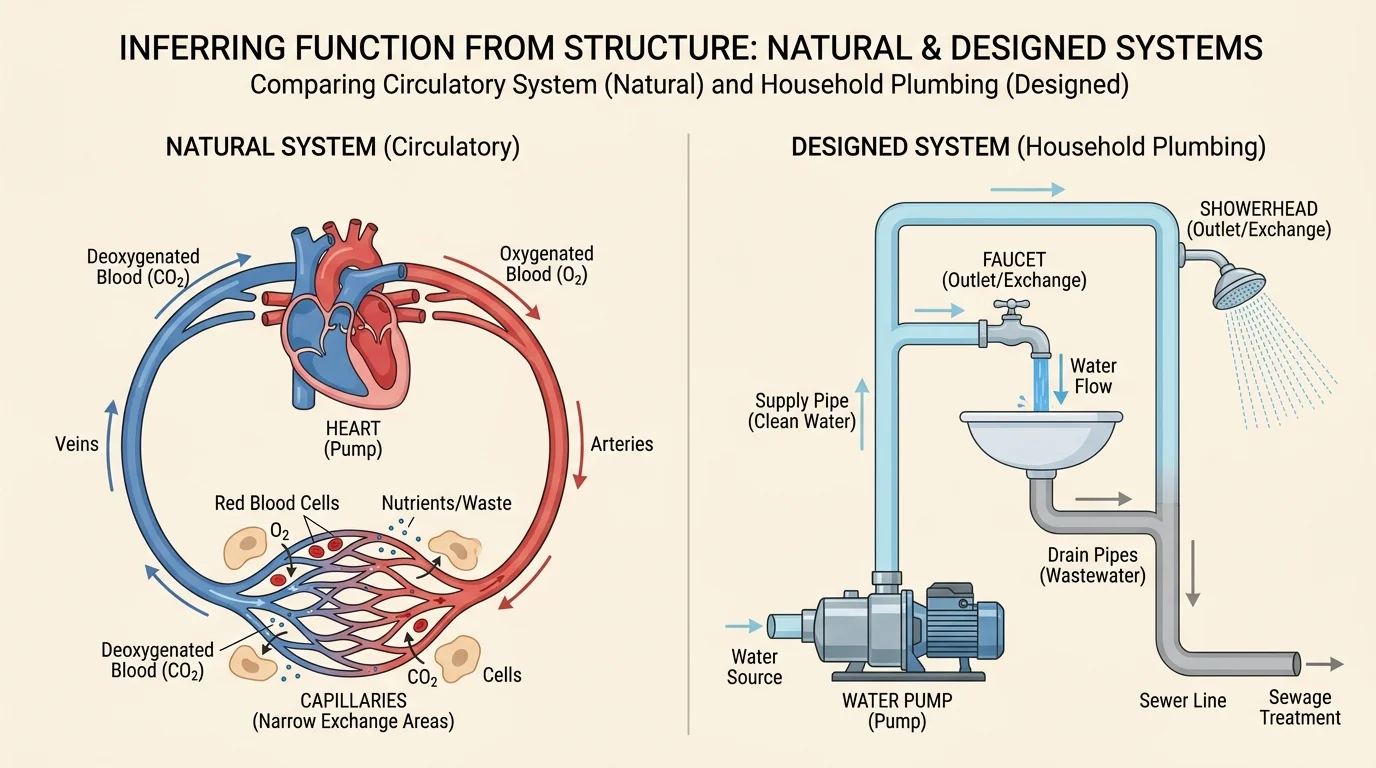
[Figure 4] A system is a set of interacting parts that work together. In many cases, the function of the whole system cannot be understood by looking at one part alone. Flow through a system depends on pathways, connections, control points, and feedback in both living and designed examples.
The circulatory system includes the heart, arteries, veins, capillaries, and blood. The heart pumps, the vessels branch and narrow, and exchange happens in capillaries. A household plumbing system has a pump or pressure source, pipes, valves, and outlets. These systems are not identical, but both use structured pathways to move fluid where it is needed.
In ecosystems, function also depends on connections. A wetland slows water, traps sediment, and provides habitat because of its plant structures, soil composition, and water pathways. Remove one major part, and the whole system may function differently. The same is true in machines: if one gear, sensor, or support fails, the output of the system changes.
Biological systems often include feedback. For example, blood vessels can widen or narrow to help regulate flow and temperature. Engineered systems do something similar with thermostats, valves, and control circuits. The exact mechanisms differ, but in both cases, component structure affects how the whole system responds to change.
The comparison shown in [Figure 4] helps show that systems thinking goes beyond single objects. It asks how shape, arrangement, and material properties combine to produce a larger result.
Scientists often infer the function of structures they cannot observe directly in action. Paleontologists examine fossil bones and infer how an animal moved. Archaeologists study tool shape and infer cutting, scraping, grinding, or piercing functions. Biomedical researchers examine proteins and infer possible roles from their folded shapes and chemical binding sites.
Engineers do something similar during design and failure analysis. If a beam bends too much, they examine its geometry and material. If a battery overheats, they study internal structure and heat flow. If a shoe sole wears unevenly, they infer which forces were concentrated where. In each case, structure provides evidence.
Case study: Biomimicry in design
Biomimicry is the practice of using structures in nature as models for engineered solutions.
Step 1: Observe a natural structure.
Lotus leaves have microscopic surface features that cause water to bead and roll off.
Step 2: Identify the useful function.
The surface stays cleaner because rolling water removes dirt particles.
Step 3: Apply the idea to design.
Engineers create coatings and surfaces that imitate this structure for self-cleaning materials.
The function is inferred from structure first, then adapted for technology.
Biomimicry includes examples such as Velcro, inspired by burrs that hook onto animal fur, and efficient turbine or fin designs inspired by marine animals. Natural selection and engineering design are different processes, but both connect form to performance.
Sometimes the connection between structure and function can be expressed with formulas. One important idea is pressure, which depends on how force is spread over area:
\[P = \frac{F}{A}\]
Here, pressure is larger when the same force is concentrated on a smaller area. This helps explain why a sharp knife cuts better than a blunt one and why snowshoes prevent a person from sinking deeply into snow.
Numeric example: Pressure and area
A force of \(100 \textrm{ N}\) is applied to two surfaces.
Step 1: Small contact area
If \(A = 0.01 \textrm{ m}^2\), then \(P = \dfrac{100}{0.01} = 10{,}000 \textrm{ Pa}\).
Step 2: Larger contact area
If \(A = 0.1 \textrm{ m}^2\), then \(P = \dfrac{100}{0.1} = 1{,}000 \textrm{ Pa}\).
The same force produces much greater pressure on the smaller area. This is a structure-function relationship because contact shape changes the result.
Another useful quantity is density:
\[\rho = \frac{m}{V}\]
Density helps explain why some materials are useful where low mass matters. For example, aluminum is often chosen for transportation because it has lower density than steel while still offering useful strength. If a material has mass \(m = 2 \textrm{ kg}\) and volume \(V = 0.001 \textrm{ m}^3\), then its density is \(\rho = \dfrac{2}{0.001} = 2{,}000 \textrm{ kg/m}^3\).
In electrical systems, resistance and conductivity also depend on material structure. In thermal systems, heat transfer depends on thickness, surface area, and molecular behavior. Formulas do not replace structural thinking; they make it more precise.
No structure is best for every purpose. A racing bicycle is light and fast but may be less comfortable than a heavier one. Thick armor protects well but reduces mobility. Large leaves collect light effectively but may lose more water or tear in strong winds. Every design, natural or engineered, involves trade-offs.
Trade-off means gaining one advantage while accepting a cost. In living things, these trade-offs are shaped by evolution. In engineering, they are shaped by goals, safety, cost, available materials, energy use, and manufacturing limits. A structure that maximizes one property may reduce another. Stronger can mean heavier. More flexible can mean less stable. Harder can mean more brittle.
"Form follows function."
— A principle often associated with architecture and design
This famous idea is useful, but it is not the whole story. In reality, form often follows multiple functions at once, along with limits and constraints. That is why natural structures and engineered products can look so complex.
In medicine, doctors infer function from structure when reading X-rays, CT scans, and MRIs. A narrowed blood vessel suggests reduced flow. A fractured bone reveals where structure has failed. Artificial joints must match the shapes, motion ranges, and material properties required inside the body.
In sports science, shoe design depends on cushioning structure, sole pattern, material elasticity, and weight. A sprinting spike, a hiking boot, and a basketball shoe look different because their functions differ. Their structures are not accidental; they are matched to force, traction, and movement needs.
In environmental science, understanding leaf shape, root structure, and soil texture helps explain water movement and ecosystem health. In aerospace, the streamlined shape of aircraft reduces drag, while internal ribs and spars support the wings. In civil engineering, the bridge features shown earlier in [Figure 2] remain central to safe transport systems.
Even everyday objects become more interesting when viewed through structure and function. A reusable water bottle, a winter coat, a charger cable, and a food container each reveal design choices about shape, components, and materials. Asking, "Why is it built this way?" is a scientific habit of mind.
