A forest can burn, regrow, and still remain recognizably the same kind of forest for decades. A lake can look calm on the surface while constant chemical cycling, predation, and competition are happening below. This is one of the most important ideas in science: explaining not only why things change, but also why some patterns stay surprisingly stable. In ecology, that question becomes especially powerful. Why do many ecosystems keep similar numbers and types of organisms over time, and why do some suddenly shift into something very different?
Scientists do not just list observations. They build explanations. When ecologists study a prairie, coral reef, wetland, or city park, they ask what processes maintain the system and what processes can disrupt it. That means looking at causes, testing claims with evidence, and deciding whether the reasoning actually fits the data. The goal is not to memorize isolated facts about species. The goal is to understand the mechanisms that produce stability and the mechanisms that drive change.
An ecosystem includes organisms and the nonliving parts of their environment, such as water, soil, temperature, sunlight, and nutrients. Science treats ecosystems as systems because the parts interact. If rainfall drops, plant growth may decline. If plant growth declines, herbivores may have less food. If herbivores decrease, predators may also change. A small shift in one part of the system can spread through many others.
At the same time, ecosystems are often not chaotic. A stable pond does not contain exactly the same number of frogs every day, but over many years it may support similar populations within a certain range. In science, stability usually does not mean "perfectly unchanged." It means that the system tends to remain within limits or return to a familiar pattern after small disturbances. Explaining this kind of stability is as scientific as explaining dramatic change.
Stability is the tendency of a system to remain within a limited range or return to a usual state after small disruptions.
Change is a shift in the state, structure, or functioning of a system over time.
Dynamic equilibrium is a condition in which many processes continue to occur, but the overall system remains relatively constant.
Disturbance is an event that disrupts ecosystem structure or resource availability, such as fire, drought, flood, disease, or human land use.
Resilience is the ability of an ecosystem to recover after disturbance.
A useful comparison is the human body. Your temperature stays near a stable range even though cells are constantly using energy and your surroundings change from hour to hour. Ecosystems behave in a similar way. Stability is often maintained by ongoing interactions, not by inactivity.
In a stable ecosystem, populations are controlled by factors that prevent unlimited growth. If one species becomes too abundant, food may become scarce, disease may spread more easily, or predators may increase. These processes can reduce the population again. Scientists call this kind of pattern feedback. Feedback is a process in which a change in one part of a system influences future changes in that system.
One important idea is carrying capacity, the largest population size that an environment can support over time. Carrying capacity is not fixed forever. It depends on resources such as food, water, shelter, nesting sites, and space. If a grassland can supply enough food for about 1,000 rabbits, then a sudden rise to 2,000 rabbits will usually not last. Competition and food shortage will push the population downward.
Population change can be described with a simple relationship. If the number entering a population through births and immigration is larger than the number leaving through deaths and emigration, the population grows. The relationship can be summarized with a compact model:
\[\Delta N = (B + I) - (D + E)\]
Here, the change in population size results from births plus immigration minus deaths and emigration. For example, if a deer population has 120 births, 30 immigrants, 100 deaths, and 20 emigrants in one season, then \(\Delta N = (120 + 30) - (100 + 20) = 30\). The population increases by 30 deer. This formula is simple, but it reminds us that stability depends on several processes working together.
Some ecosystems appear stable only when viewed over long time scales. A desert may look nearly unchanged from day to day, yet after rare rains its productivity and species activity can surge dramatically before settling again.
Scientists also distinguish between resistance and recovery. Resistance means the ecosystem changes very little during a disturbance. Recovery means it changes but later returns toward its earlier state. A mature forest may resist small temperature shifts, while a grassland may recover quickly after grazing or fire.
The most important explanation for ecosystem stability is that organisms do not live separately. They are linked by feeding relationships, competition, symbiosis, reproduction, and habitat use. A rise or fall in one population can influence others, and these linked responses often keep total numbers within a range rather than allowing endless increase.
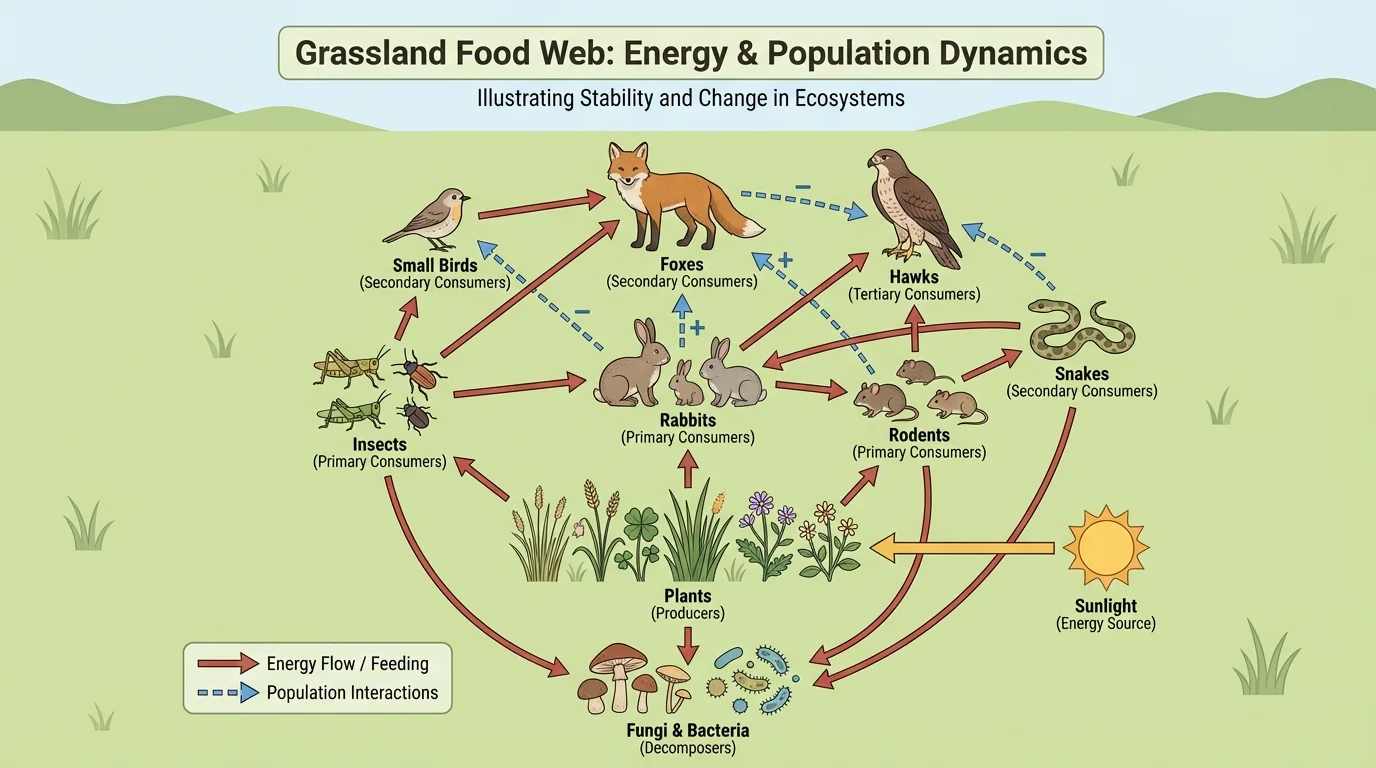
[Figure 1] Predation is one stabilizing interaction. If prey populations rise, predators may find food more easily and survive better. Increased predation can then reduce prey numbers. If prey decline too far, predator numbers may also fall, which can allow prey to recover. This does not create perfect balance, but it often prevents runaway growth.
Competition also matters. Organisms that need the same limited resource, such as light, water, nesting space, or prey, compete with one another. Competition can occur within the same species and between different species. For example, trees in a forest compete for sunlight. If too many seedlings sprout in a small area, many will die before adulthood because the environment cannot support them all.
Mutualism can support stability too. Pollinators and flowering plants help each other. Microbes in the soil help plants absorb nutrients. Coral animals and microscopic algae exchange resources. These partnerships can make ecosystems more productive and more resilient, although they can also make ecosystems vulnerable if one partner disappears.
Disease and parasitism can limit population size in ways that are sometimes overlooked. When organisms become crowded, pathogens often spread more easily. This can act as a density-dependent control. In other words, the effect becomes stronger as population density increases.
The idea of feedback becomes clearer here. If rabbits increase, foxes may increase. If foxes increase, rabbits may decrease. If rabbits decrease, foxes may later decline. That is a negative feedback loop because it tends to reduce the original change. Negative feedback is a major reason why ecosystems can remain relatively consistent over time. The pattern in [Figure 1] is not a static picture of who eats whom; it is a map of processes that regulate populations.
Why "stable" does not mean "unchanging"
In ecology, a stable system still has births, deaths, migration, seasons, and disturbances. Stability means that these changes do not usually push the system outside its normal range. A stable forest has falling leaves, new seedlings, predators hunting prey, and decomposers recycling dead material all the time.
Physical conditions matter just as much as biological interactions. Temperature, soil nutrients, pH, water availability, and oxygen levels can limit which organisms survive. That is why a freshwater pond does not turn into a coral reef, and why a tundra does not support tropical trees. Stability depends on organisms interacting with one another and with the nonliving environment.
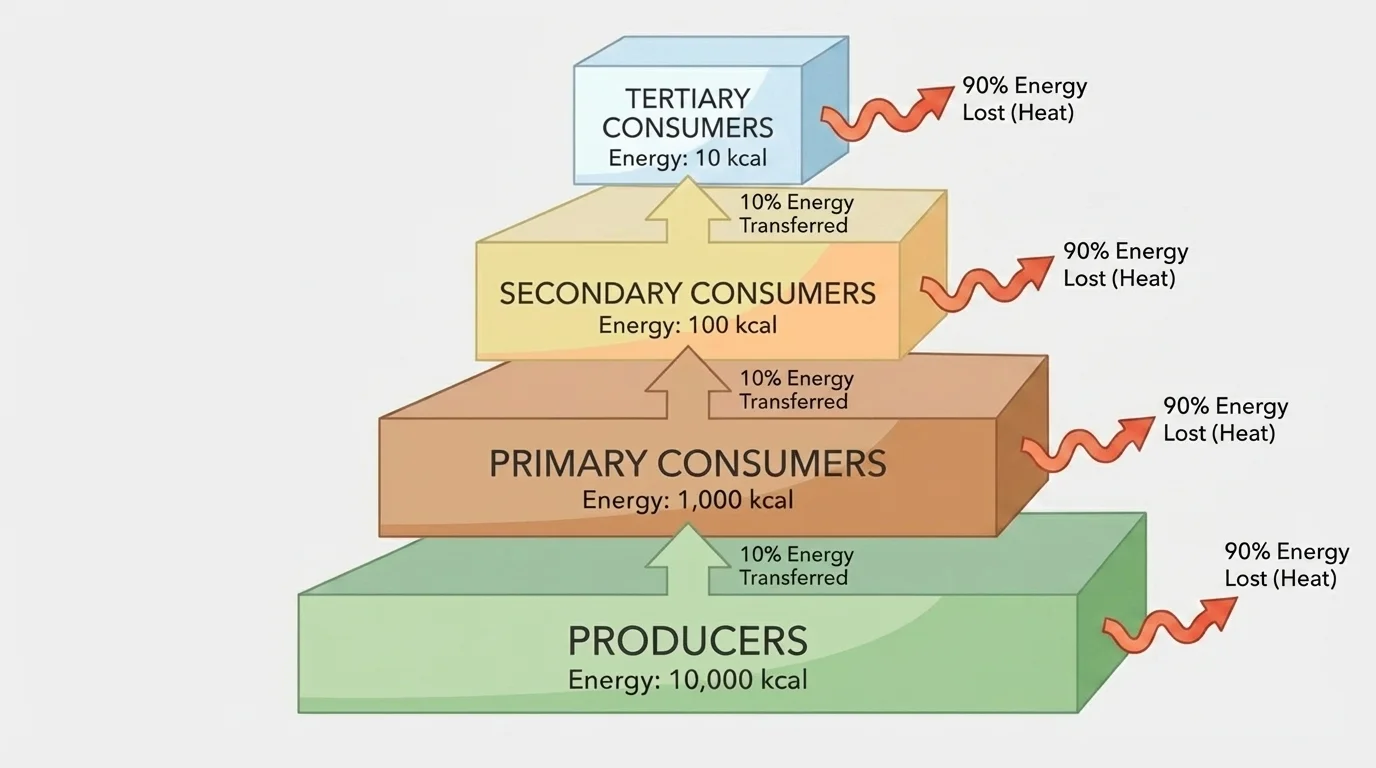
Another major explanation for both change and stability is the movement of energy and matter. Ecosystems can support only a certain amount of life because energy enters mainly through sunlight captured by photosynthetic organisms. The structure of trophic levels, shown in [Figure 2], helps explain why ecosystems do not contain unlimited numbers of large predators.
Producers such as plants, algae, and some bacteria convert light energy into chemical energy through photosynthesis. The basic equation is
\[6\textrm{CO}_2 + 6\textrm{H}_2\textrm{O} + \textrm{light energy} \rightarrow \textrm{C}_6\textrm{H}_{12}\textrm{O}_6 + 6\textrm{O}_2\]
For a numeric example, if an ecosystem stores 10,000 units of energy in plant biomass, only part of that energy becomes available to herbivores because organisms use much of it for metabolism, movement, and heat loss.
Consumers obtain energy by eating other organisms, and decomposers break down dead matter and wastes. A common ecological rule of thumb is that only about 10% of energy passes from one trophic level to the next. If producers contain 10,000 energy units, primary consumers might receive about 1,000, secondary consumers about 100, and tertiary consumers about 10. In shorthand: \(10,000 \rightarrow 1,000 \rightarrow 100 \rightarrow 10\). This is why top predators are always fewer than producers.
While energy flows through ecosystems and is eventually lost as heat, matter cycles. Carbon, nitrogen, phosphorus, and water move repeatedly between organisms and the environment. Stability depends on these cycles functioning properly. For instance, decomposers release nutrients back into soil and water, making them available to producers again.
If decomposition slows or nutrient input suddenly changes, the ecosystem can shift. Too little available nitrogen can limit plant growth. Too much nitrogen or phosphorus can trigger algal blooms in lakes. The energy pyramid in [Figure 2] also connects to this idea: because energy is limited at higher trophic levels, even small changes at the producer level can affect the entire ecosystem.
Scientific explanations are only as strong as the evidence supporting them. In ecology, evidence may come from field observations, long-term population counts, satellite data, experiments, chemical measurements, and computer models. A claim such as "the wolf population caused the deer population to decline" is not enough by itself. Scientists ask: What evidence supports this claim? Are there alternative explanations, such as disease, harsh winters, or reduced plant growth?
Ecologists often use repeated sampling because measuring every organism in an ecosystem is impossible. They may count organisms in sample plots, use camera traps, tag individuals, measure water chemistry, or compare data across many years. Strong reasoning links the evidence to the claim through a mechanism. For example, if plant biomass increases after a herbivore declines, and other conditions remain similar, a scientist may reason that reduced grazing pressure contributed to the increase.
Evaluating a claim about pond fish
Claim: "A drop in dissolved oxygen caused a fish population decline in a pond."
Step 1: Examine the evidence.
Suppose oxygen levels fell from \(8 \textrm{ mg/L}\) to \(3 \textrm{ mg/L}\) over two weeks, while fish counts dropped from \(200\) to \(120\).
Step 2: Look for a mechanism.
Fish need oxygen for cellular respiration. When dissolved oxygen becomes too low, many species experience stress or die.
Step 3: Consider other causes.
Scientists would also check for toxins, rapid temperature changes, disease outbreaks, or overfishing.
Step 4: Judge the reasoning.
If the oxygen drop is large, the timing matches the fish decline, and no better explanation fits the data, the claim is well supported.
Good scientific reasoning also avoids confusing correlation with causation. Two things may change at the same time without one causing the other. For example, rising temperatures and declining amphibians might occur together, but the real cause could involve drying wetlands, disease, or chemical pollution. Ecologists strengthen explanations by using multiple lines of evidence, not just one graph or one observation.
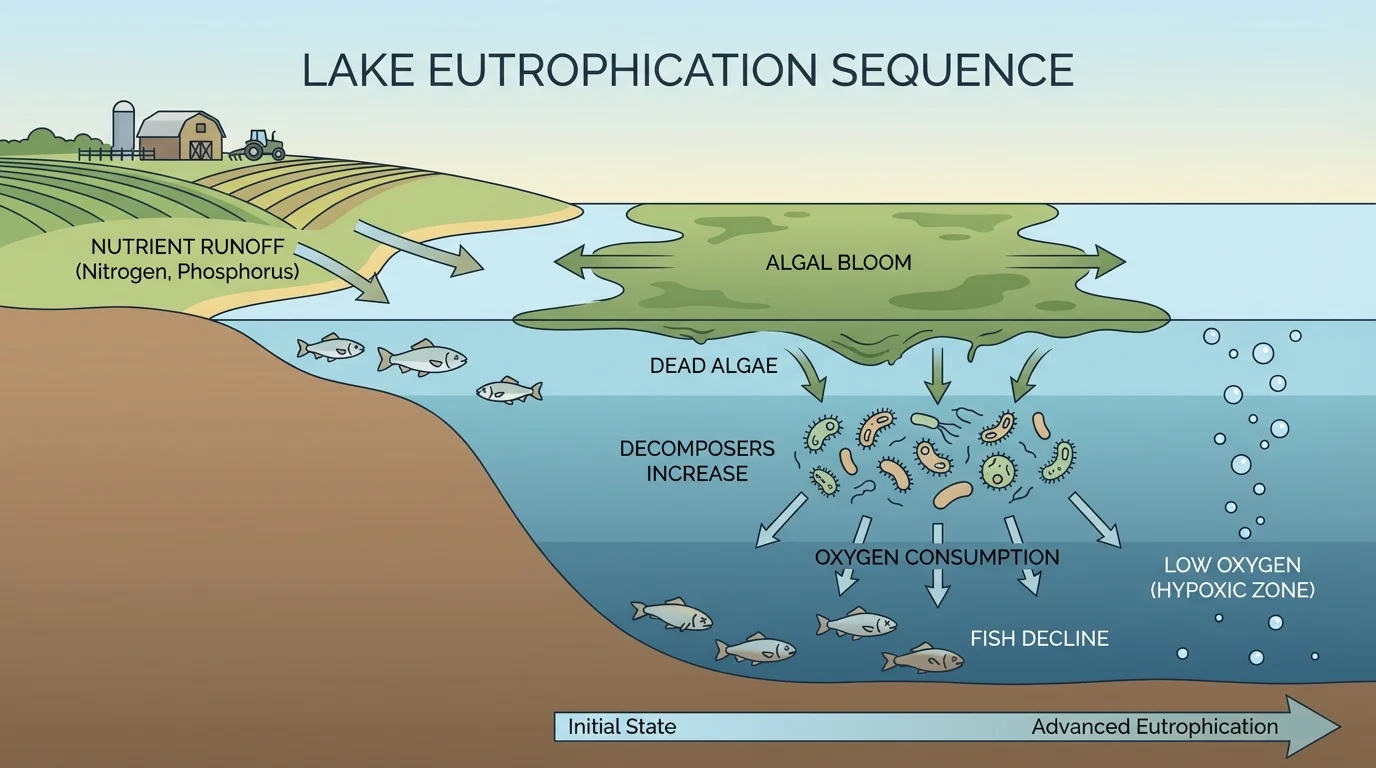
Stable conditions can maintain relatively consistent numbers and types of organisms, but changing conditions may produce a new ecosystem. Sometimes the shift is gradual. Sometimes it is sudden. The threshold-like change shown in [Figure 3] helps explain why an ecosystem can remain fairly stable for years and then transform rapidly when environmental pressure crosses a limit.
Natural disturbances such as wildfires, storms, droughts, floods, volcanic eruptions, and insect outbreaks can alter ecosystems. Human activities can also act as powerful disturbances: deforestation, urbanization, overfishing, introduction of invasive species, greenhouse gas emissions, and nutrient runoff from farms. Whether the ecosystem returns to its previous state depends on the disturbance size, frequency, and the system's resilience.
A classic example is eutrophication in lakes. When fertilizers rich in nitrogen and phosphorus wash into water, algae can grow extremely quickly. At first, this may seem like increased productivity. But when the algae die, decomposers break them down and consume dissolved oxygen. Fish and other aerobic organisms may then die or leave, and the lake can shift toward a murkier, lower-oxygen state.
The same general pattern appears in many environments. Coral reefs may shift from coral-dominated systems to algae-dominated systems after warming, pollution, and overfishing. Forests may convert to shrublands after repeated severe fires and drought. Arctic ecosystems may change as warming alters ice cover, growing seasons, and species ranges.
Climate change is especially important because it affects many variables at once: temperature, precipitation, ocean acidity, seasonal timing, and extreme weather. For example, more atmospheric \(\textrm{CO}_2\) dissolves into oceans and contributes to acidification. Organisms that build calcium carbonate structures, such as many corals and shell-forming organisms, can be stressed under these changing chemical conditions.
Not every disturbance causes collapse. Some grasslands depend on periodic fire. Some pine forests require fire to open cones and release seeds. In those systems, disturbance is part of the pattern that maintains long-term stability. The eutrophication process in [Figure 3] reminds us that whether change is harmful or natural depends on context, magnitude, and timing.
From earlier biology, remember that organisms survive and reproduce only when environmental conditions stay within their tolerance ranges. Ecosystem stability emerges from those individual limits combined across many interacting species.
Another useful term is regime shift. This means a persistent change from one stable state to another. A clear lake becoming a cloudy algae-dominated lake is not just a temporary fluctuation if it remains in the new condition even after the original trigger weakens.
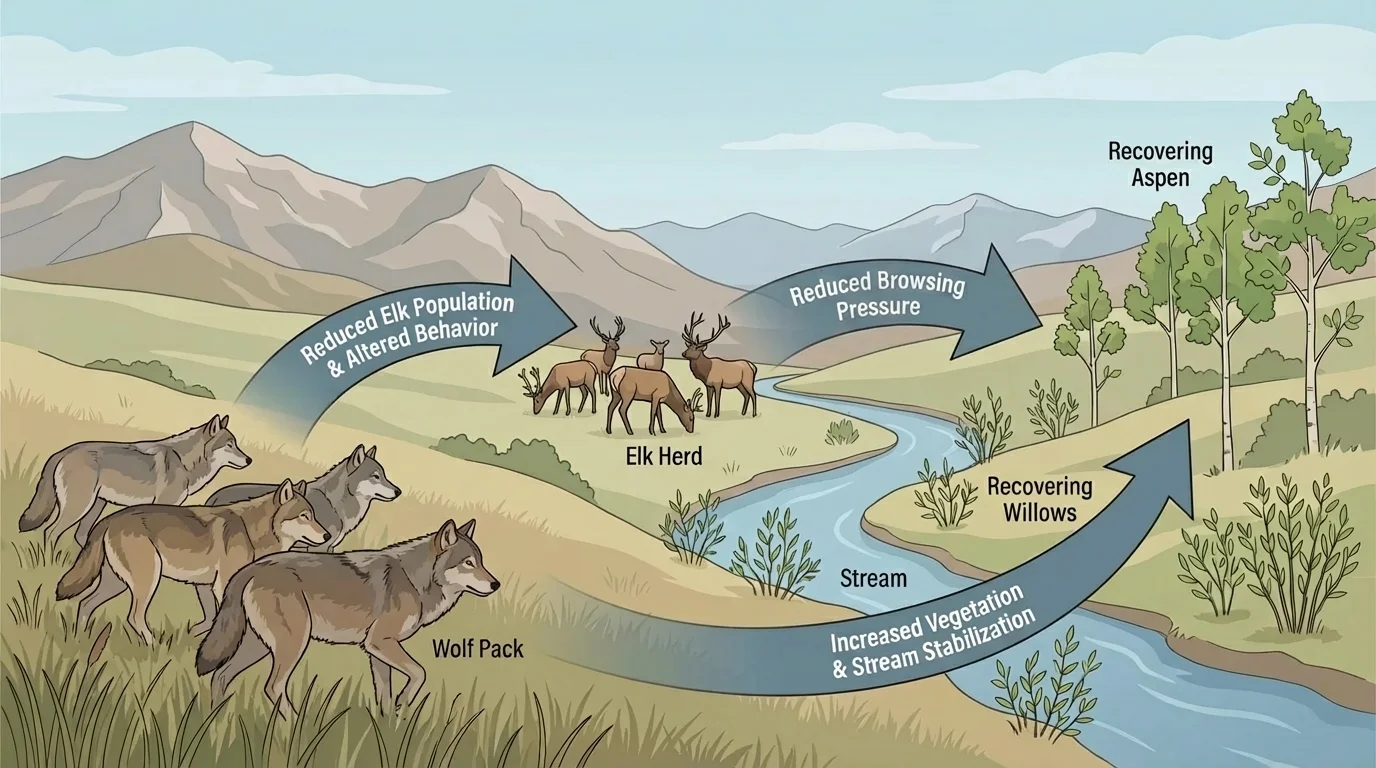
[Figure 4] One famous example of ecosystem change involves wolves in Yellowstone National Park through a trophic cascade. Wolves were removed from Yellowstone in the early twentieth century and later reintroduced in the 1990s. Ecologists observed that elk behavior and abundance changed after wolf return, especially in some areas near streams.
As browsing pressure by elk decreased in certain locations, willow and aspen recovery improved. That affected habitat for beavers and birds and influenced streamside conditions. Scientists still debate exactly how large each effect was and how much climate, bears, and human management contributed. This is an excellent example of evaluating evidence carefully: the broad claim that predators can influence entire ecosystems is well supported, but the detailed mechanism requires multiple forms of data.
Coral reefs provide another case. In stable conditions, corals, algae, fish, and invertebrates form complex communities with relatively consistent structure. But if ocean temperature rises too high, corals may expel their symbiotic algae in a process called coral bleaching. If stressful conditions persist, many corals die, and the reef may shift toward a different community dominated by algae.
A smaller-scale example appears in farm ponds. A pond may remain clear for years with balanced nutrient cycling, aquatic plants, insects, fish, and decomposers. Then repeated fertilizer runoff can alter nutrient levels enough to trigger algal blooms and oxygen decline. Students often think a transformed ecosystem must look dramatic, but even a familiar neighborhood pond can reveal how stable conditions and changing conditions lead to different ecological outcomes.
The Yellowstone pattern in [Figure 4] also helps explain why biodiversity matters. When many species perform overlapping roles in an ecosystem, the system may be better able to absorb disturbances. Losing a key species can weaken important interactions and make future change more likely.
"Everything is connected to everything else."
— A central ecological principle
Understanding stability and change is not only an academic exercise. It affects agriculture, fisheries, forestry, disease control, urban planning, and conservation. If fish are harvested faster than populations can replace themselves, the ecosystem and the economy both suffer. If wetlands are drained, flood risk may increase because the landscape loses a natural water-buffering system.
Ecological management often tries to maintain conditions that support long-term stability rather than short-term gain. In fisheries, managers estimate sustainable catch levels based on reproduction and population trends. In forests, managers may use controlled burns to reduce fuel buildup and mimic natural disturbance cycles. In restoration ecology, scientists replant native species, remove invasive species, or rebuild stream channels to restore system functions.
These decisions depend on claims, evidence, and reasoning. Suppose a city proposes planting more trees to reduce stream flooding and heat. Scientists would ask whether data show that tree cover increases water absorption, reduces runoff, lowers local temperatures, and supports biodiversity. They would also evaluate limits: tree planting alone cannot solve flooding if paved surfaces and drainage design remain unchanged.
| Condition | Likely ecosystem response | Scientific explanation |
|---|---|---|
| Stable rainfall and nutrient input | Relatively consistent plant and consumer populations | Resources remain within ranges that support existing species interactions |
| Introduction of an invasive predator | Decline of native prey, possible food-web disruption | New predation pressure alters established interactions |
| Repeated fertilizer runoff into a lake | Algal blooms and oxygen decline | Excess nutrients stimulate primary production, then decomposition reduces oxygen |
| Moderate periodic fire in fire-adapted grassland | Maintenance of grassland structure | Fire suppresses woody encroachment and recycles nutrients |
| Prolonged severe drought | Species loss or shift to a different community | Water stress changes survival, reproduction, and competition |
Table 1. Examples of how different conditions can maintain ecosystem stability or drive ecosystem change.
Science is especially powerful here because it allows us to move beyond simple statements like "nature balances itself" or "humans always destroy ecosystems." Real ecosystems are more complex. Some remain stable because many interactions and feedbacks keep them within limits. Others change because conditions shift beyond what the system can absorb. Scientific explanations help identify which processes matter most.
