Your body is carrying out complex regulatory processes every second, even when you are asleep. If your temperature rises during a workout, if your blood sugar changes after a meal, or if you lose water on a hot day, internal systems respond almost immediately. The striking part is that survival depends not just on having these responses, but on having the right kind of response. Some feedback pushes a system back toward balance. Other feedback pushes it farther in the same direction. That difference can mean the difference between stability and crisis.
Biologists often describe the body as a collection of interacting systems rather than isolated parts. A system has components that affect one another. In living organisms, these components include cells, tissues, organs, chemical signals, and electrical impulses. When one part changes, other parts respond. These responses are called feedback mechanisms.
A feedback mechanism is a process in which the output of a system influences the system itself. That influence can reduce the original change or strengthen it. If the influence reduces the change, the system tends to become more stable. If the influence strengthens the change, the system can move quickly away from its starting condition.
Homeostasis is the maintenance of relatively stable internal conditions in an organism, even when the external environment changes. Negative feedback reverses a change and tends to stabilize a system. Positive feedback amplifies a change and tends to drive a system farther in the same direction.
Living things do not keep internal conditions perfectly constant every moment. Instead, they usually keep them within a safe range. Body temperature, blood glucose level, water balance, blood pressure, oxygen concentration, and blood pH all fluctuate, but not without limits. When regulation works well, these variables remain close enough to normal for cells to function properly.
Homeostasis is not a frozen state. It is more like careful adjustment. Think about a car using cruise control. The speed may vary slightly uphill or downhill, but the system keeps correcting toward the target. In organisms, the "target" is often called a set point, a preferred value or range for a condition such as body temperature.
For humans, a typical body temperature is about \(37 \textrm{ °C}\), though it naturally varies somewhat. Blood glucose also changes across the day, especially after eating or during exercise. The key idea is not that the value never changes, but that control systems detect the change and respond before conditions become dangerous.
Some of the fastest homeostatic responses happen before you are even aware of them. Blood vessels in your skin can change diameter within moments, altering heat loss without any conscious decision.
Homeostasis matters because cells depend on stable conditions. Enzymes work best in specific temperature and pH ranges. Differences in solute concentration affect osmosis. Glucose concentration affects energy supply because cells use glucose in cellular respiration, such as in the overall reaction \(\textrm{C}_6\textrm{H}_{12}\textrm{O}_6 + 6\textrm{O}_2 \rightarrow 6\textrm{CO}_2 + 6\textrm{H}_2\textrm{O} + \textrm{energy}\). If internal conditions drift too far, proteins may stop functioning normally, nerve cells may misfire, and organs may fail.
[Figure 1] Most biological feedback systems follow a common pattern, which can be illustrated with a temperature-control example. First, something changes inside or outside the body. That change is the stimulus. Then a receptor detects the change. Information is sent to a control center, which compares the condition with the set point and decides how to respond.
Next, the control center activates an effector, a structure that carries out the response. An effector might be a muscle, gland, blood vessel, or organ. The response changes the internal condition. In negative feedback, the response moves the condition back toward the set point. In positive feedback, the response increases the original change.
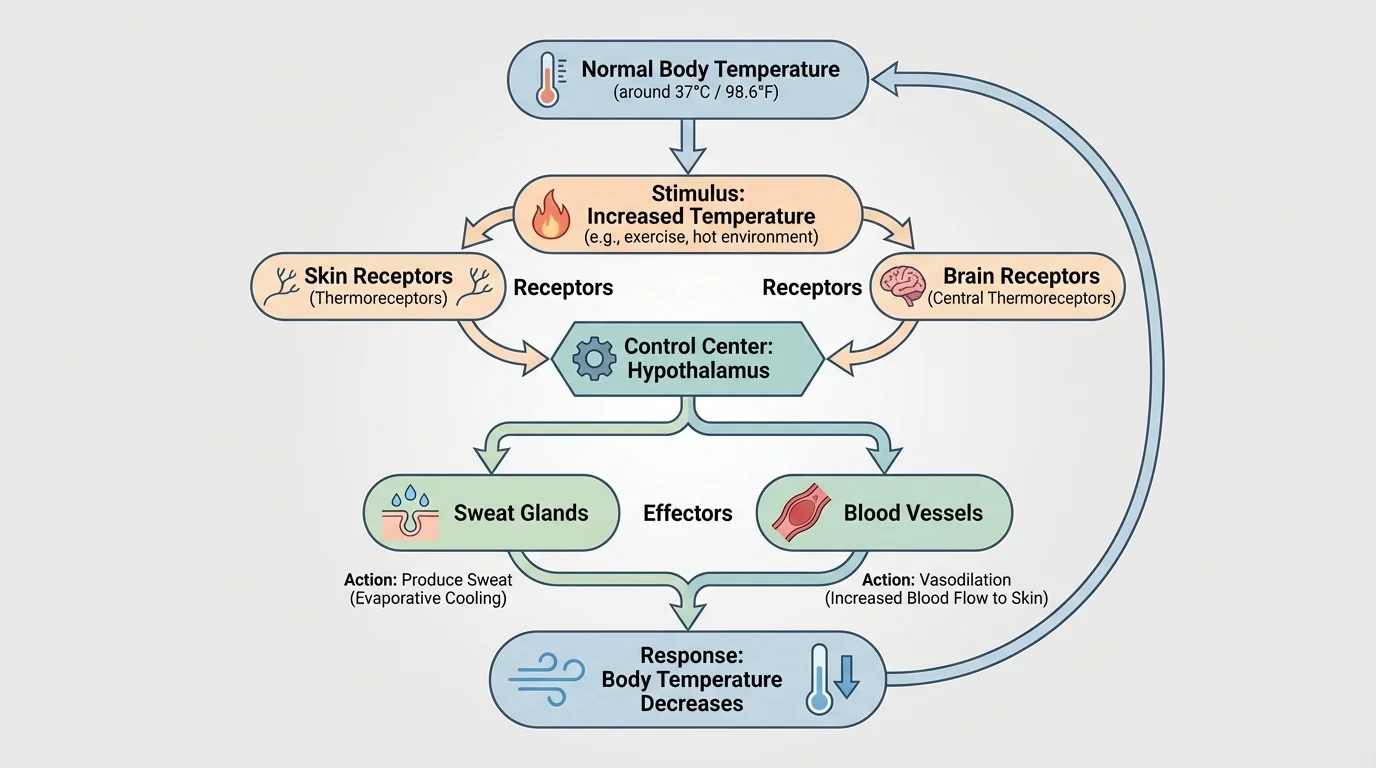
This loop can be written as a sequence: stimulus \(\rightarrow\) receptor \(\rightarrow\) control center \(\rightarrow\) effector \(\rightarrow\) response. The biology is more complex than a simple arrow diagram, but the pattern is useful because it helps scientists design investigations. If you want evidence for a feedback mechanism, you need to identify what changed, what detected it, what responded, and whether the response restored stability.
Notice that feedback is not the same as a one-time reaction. A true feedback system uses the result of the response to influence what happens next. If temperature begins returning toward normal, signals to sweat may weaken. If glucose is still too high, insulin release may continue. The system constantly updates itself.
[Figure 2] Negative feedback is the most common mechanism used to maintain homeostasis, and one of its clearest examples is body temperature regulation. In negative feedback, a change triggers a response that opposes that change. The result is stabilization. This is why negative feedback is essential in biology: it prevents variables from drifting too far from safe ranges.
Body temperature regulation is a classic example. If body temperature rises above its set point, receptors in the skin and brain detect the increase. The hypothalamus, a region of the brain, acts as a control center. It activates sweat glands and causes blood vessels near the skin to widen, a process called vasodilation. Sweating increases evaporative cooling, and widened vessels release more heat to the environment. If body temperature falls too low, the hypothalamus triggers shivering and narrows skin blood vessels, reducing heat loss.
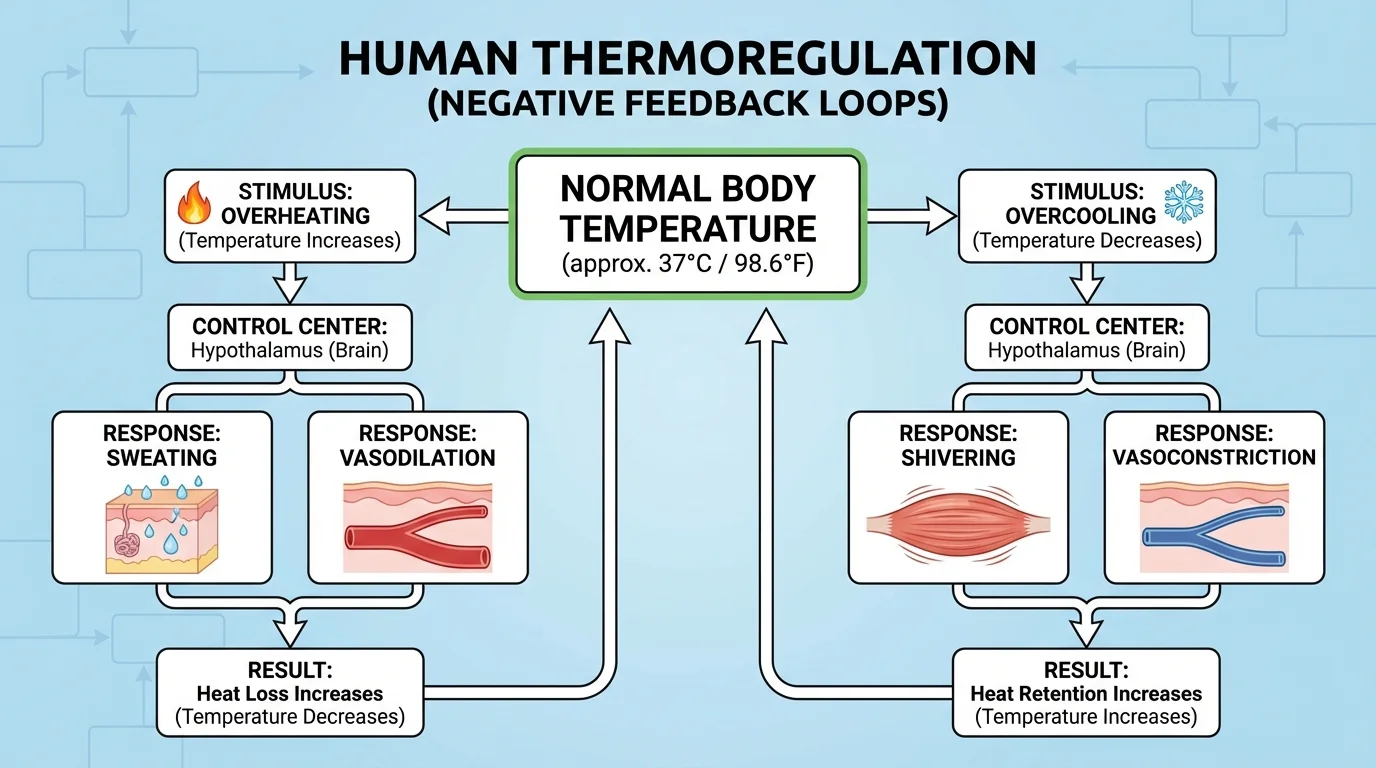
As the body returns toward normal temperature, the response becomes weaker. That is the key negative-feedback feature. The correction reduces the original problem. If a student's temperature rises from \(37 \textrm{ °C}\) to \(38 \textrm{ °C}\) during intense exercise and then falls back toward \(37 \textrm{ °C}\) during recovery, the trend provides evidence that the system is regulating itself.
Blood glucose control is another major example. After a meal, glucose enters the bloodstream from digested carbohydrates. The pancreas detects the increase and releases insulin. Insulin helps body cells absorb glucose and promotes storage of excess glucose as glycogen in the liver and muscles. As blood glucose falls toward normal, insulin release decreases.
When blood glucose drops too low, the pancreas releases glucagon. Glucagon stimulates the breakdown of glycogen to glucose, raising blood glucose levels. Notice that insulin and glucagon have opposite effects, but together they support the same larger goal: homeostasis.
Why negative feedback stabilizes a system
Negative feedback works because the response has the opposite sign of the disturbance. If a variable rises, the response pushes it downward. If it falls, the response pushes it upward. In systems language, the response reduces deviation from the set point instead of increasing it.
Water balance also depends on negative feedback. If a person becomes dehydrated, the concentration of solutes in the blood rises. Receptors in the hypothalamus detect this change. The brain increases thirst and signals the pituitary gland to release antidiuretic hormone. The kidneys reabsorb more water, producing more concentrated urine. As hydration improves, the signals weaken.
The same logic applies to many other variables: calcium ion concentration, blood pressure, oxygen levels, and carbon dioxide levels. In each case, the system senses deviation and acts against it. This repeating pattern is why negative feedback is so strongly associated with stability.
[Figure 3] Positive feedback contrasts clearly with negative feedback. Instead of reversing a change, positive feedback strengthens it. The response pushes the system farther in the same direction as the original stimulus. That means positive feedback usually does not maintain a stable condition. Instead, it drives a process toward a rapid outcome.
Blood clotting is a useful example. When a blood vessel is damaged, platelets stick to the injured area. These platelets release chemicals that attract and activate more platelets. The new platelets release more chemicals, attracting still more platelets. The result is a quickly growing plug that helps stop bleeding.
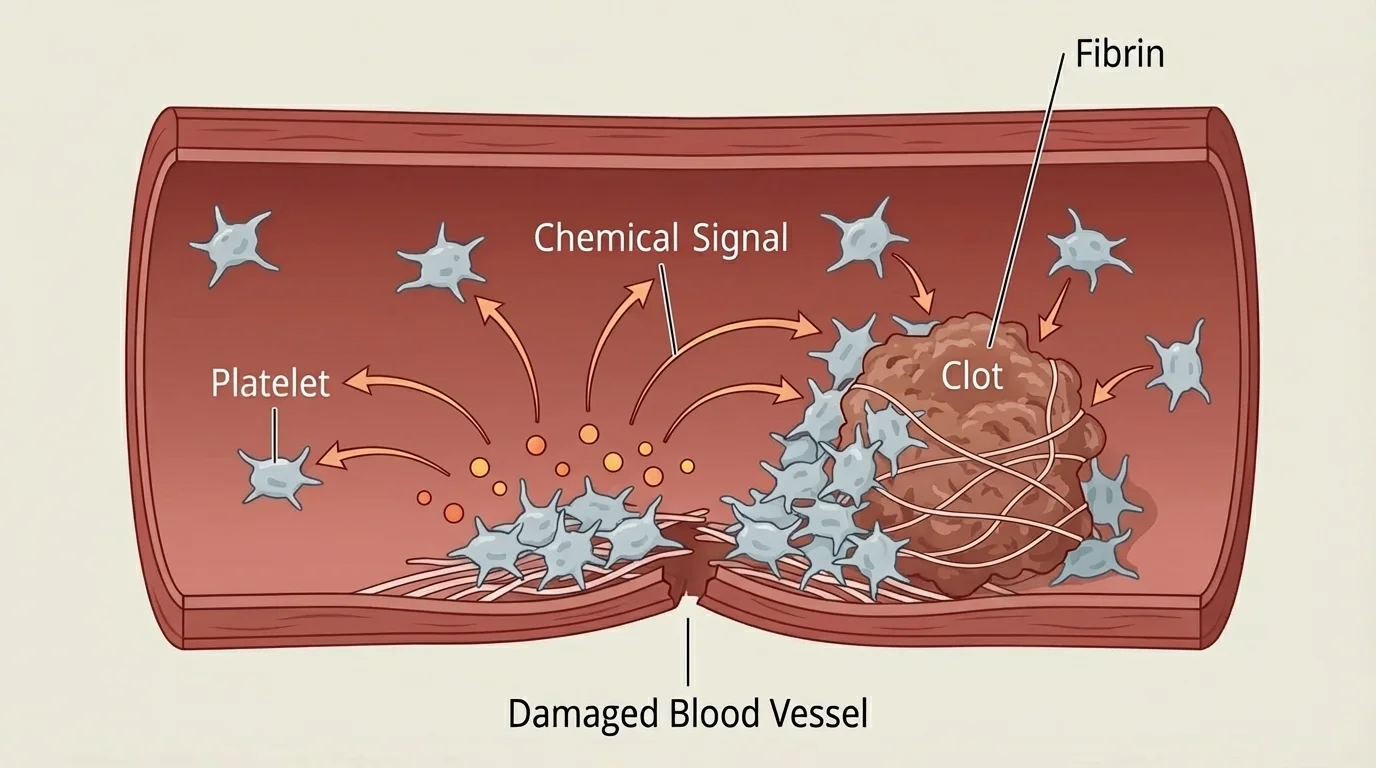
This is beneficial because the body needs a rapid response. If clotting worked too slowly, blood loss could become life-threatening. But the very property that makes positive feedback useful here—self-amplification—also makes it dangerous if not confined. Unwanted clot formation inside a vessel can block blood flow and become a serious medical emergency.
Childbirth provides another classic example. Pressure from the baby's head on the cervix triggers nerve signals to the brain. The brain causes the release of oxytocin, a hormone that increases uterine contractions. Stronger contractions increase pressure on the cervix, which leads to even more oxytocin release. The cycle continues until birth, at which point the stimulus ends.
Positive feedback also appears in nerve signaling. Once a neuron begins an action potential, the opening of some sodium channels causes depolarization, which opens more sodium channels. This rapid amplification helps generate the full electrical signal. The process is then stopped by other mechanisms, preventing endless activation.
Case study: Why positive feedback needs a stopping point
Suppose a small change causes a response that doubles that change, and the next response doubles it again. The pattern grows rapidly rather than settling.
Step 1: Start with a small disturbance
A system changes by \(1\) unit.
Step 2: Amplify the disturbance
If the response adds another \(1\) unit, the change becomes \(2\) units. If the next response adds \(2\) more units, the change becomes \(4\) units.
Step 3: Recognize the consequence
The sequence \(1, 2, 4, 8, ...\) does not move back toward the starting point. It moves away from it. That is why positive feedback must usually be limited in time or space.
Biological positive feedback is more complex than this simplified number pattern, but the pattern helps explain why it is potentially destabilizing.
As with clotting and childbirth, positive feedback is often part of a process with a clear endpoint. Once the clot seals the break or the baby is delivered, the original stimulus changes or disappears. Without an endpoint, amplification can become harmful.
The words negative and positive do not mean bad and good. They describe the direction of the response. Negative feedback is usually stabilizing because it counters deviation. Positive feedback is often destabilizing because it increases deviation. However, positive feedback can be useful when a fast, decisive event is needed.
The temperature loop in [Figure 2] shows stabilization clearly: overheating triggers cooling responses, and overcooling triggers warming responses. In contrast, the platelet cascade in [Figure 3] shows amplification clearly: activated platelets recruit more activated platelets. The system does not aim to stay halfway through clot formation; it aims to complete the process rapidly.
Whether a feedback mechanism stabilizes or destabilizes a system depends on context and control. In the short term, positive feedback may help achieve an important goal. In the long term, an unchecked positive loop can be dangerous. Negative feedback, on the other hand, is the routine maintenance strategy that keeps organisms alive from minute to minute.
| Feature | Negative feedback | Positive feedback |
|---|---|---|
| Effect on original change | Opposes it | Amplifies it |
| Typical result | Stabilization | Rapid change |
| Role in homeostasis | Maintains internal balance | Usually does not maintain balance directly |
| Common examples | Thermoregulation, blood glucose control, water balance | Blood clotting, childbirth, action potentials |
| Need for endpoint | Less urgent because it self-limits | Very important because it self-amplifies |
Table 1. Comparison of negative and positive feedback in biological systems.
Feedback systems are powerful, but they are not perfect. Disease can result when receptors fail, control centers send incorrect signals, effectors do not respond, or the signaling molecules are absent. Failure in any part of the loop can disrupt homeostasis.
Diabetes mellitus is an important example. In type 1 diabetes, the pancreas produces little or no insulin. In type 2 diabetes, body cells become less responsive to insulin. In both cases, the negative feedback loop that normally regulates blood glucose is impaired. As a result, blood glucose can remain dangerously high for long periods, damaging blood vessels, nerves, kidneys, and eyes.
Heat stroke is another example of failed homeostasis. If body temperature rises too far and cooling mechanisms cannot keep up, enzymes and cells begin to malfunction. Sweating may become ineffective if dehydration is severe. The negative feedback loop exists, but extreme conditions can overwhelm it.
Recall that cells rely on enzymes to speed up chemical reactions. Because enzyme shape and activity depend strongly on temperature and pH, failures of homeostasis can quickly affect the entire organism.
Shock can involve failure of blood pressure regulation. Severe blood loss reduces blood volume, which lowers blood pressure and decreases oxygen delivery to tissues. The body attempts compensation through increased heart rate and vessel constriction, but if the disruption becomes too great, feedback responses may no longer restore stability.
These examples show that homeostasis is not automatic in the sense of guaranteed success. It is an active process with limits. The effectiveness of feedback depends on both the design of the mechanism and the size of the disturbance.
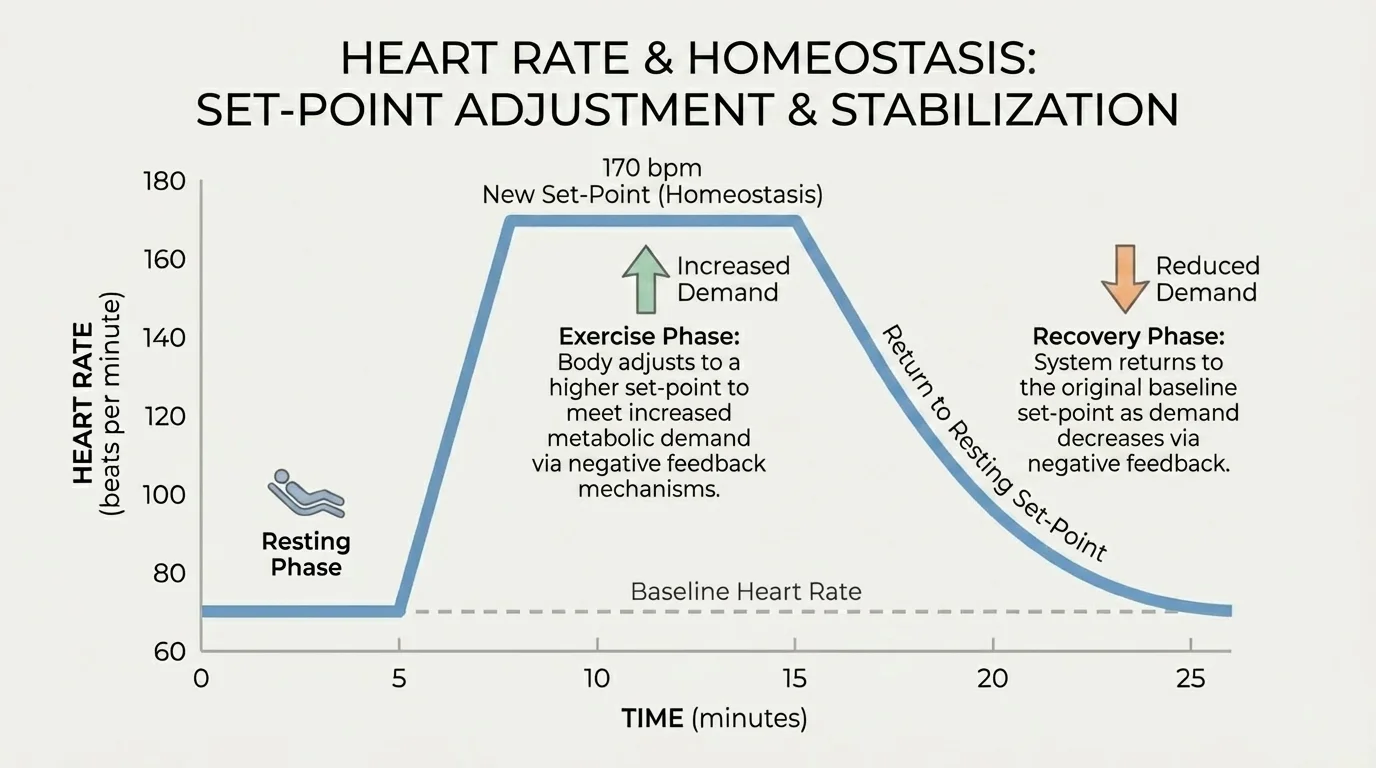
[Figure 4] Scientists do not merely assume that feedback mechanisms maintain homeostasis; they gather evidence. One practical way to investigate this idea is to measure how a variable changes after a disturbance and whether it returns toward a baseline. If it does, that pattern supports the presence of a stabilizing feedback process.
For example, students can investigate heart rate before exercise, immediately after exercise, and during recovery. Exercise acts as the disturbance. The body responds by increasing heart rate to deliver more oxygen and nutrients to muscles. During recovery, heart rate gradually decreases toward resting level. That return toward baseline is evidence of regulation.
In such an investigation, the independent variable might be time after exercise or exercise intensity. The dependent variable could be heart rate, measured in beats per minute. Controlled variables might include room temperature, duration of exercise, hydration, and the method of measuring pulse.
A similar investigation can be done with skin temperature after moving from a cool room into a warmer environment, or with plant leaf water loss under different conditions if the focus is on regulation in organisms more broadly. The essential idea is to create a measurable change, collect reliable data over time, and determine whether the system moves back toward a stable range.
Investigation example: Exercise and pulse recovery
A class measures pulse rate for one student at rest and after \(2\) minutes of stair climbing.
Step 1: Record a baseline
The resting pulse is \(72\) beats per minute.
Step 2: Measure after the disturbance
Immediately after exercise, pulse rises to \(132\) beats per minute.
Step 3: Measure recovery
After \(3\) minutes of rest, pulse falls to \(92\) beats per minute, and after \(6\) minutes it falls to \(76\) beats per minute.
Step 4: Interpret the pattern
The pulse does not stay at \(132\). It moves back toward the original value of \(72\). That trend is evidence of a stabilizing feedback response.
To strengthen the evidence, measurements should be repeated with several students and multiple trials.
Good investigations also consider sources of error and limitations. Human measurements vary. Recovery rate depends on fitness, stress, sleep, and caffeine intake. Strong scientific conclusions require repeated trials, clear procedures, careful controls, and honest interpretation of the data.
The graph in [Figure 4] also highlights an important point: homeostasis is dynamic. The variable rises, then gradually returns toward its usual range. Stability in biology often looks like a controlled curve, not a perfectly flat line.
Feedback is a systems idea that also appears outside physiology. In ecology, predator and prey populations can influence one another through feedback-like relationships. In climate science, melting ice can reduce Earth's reflectivity, leading to more warming and more melting, a positive feedback. In technology, thermostats use negative feedback to maintain room temperature.
These comparisons are useful because they show that the logic of feedback is general. A system can either reduce change or reinforce it. Biology gives especially vivid examples because organisms must constantly balance stability with the ability to respond quickly.
That is one reason feedback is such an important scientific idea. It connects molecules, cells, organs, organisms, ecosystems, and even engineered devices. Once you recognize the pattern, you begin to see that life depends not only on change, but on how change is controlled.
