A single change in DNA can affect whether a person can digest lactose, how a flower is colored, or whether a disease runs in a family. That is powerful—but it also shows why careful interpretation is necessary. If one tiny molecular change can influence a visible trait, then every model of heredity leaves room for deeper questions. In biology, learning is not just about accepting diagrams and explanations. It is about examining them closely and asking what they show, what they leave out, and what relationships still need to be clarified.
Scientists use questions to move from simple descriptions to deeper understanding. In heredity, that means asking how DNA stores information, how chromosomes carry that information, how genes affect proteins, and how traits are passed from parents to offspring. A good question does not simply show confusion; it shows careful thinking. It targets a relationship, a missing piece of evidence, or a limitation in a model.
A scientific model is a representation of something that is too small, too complex, too large, or too abstract to study directly all at once. A model might be a drawing of a chromosome, a pedigree chart, a three-dimensional DNA structure, or a computer simulation of inheritance patterns. A scientific theory is a well-supported explanation backed by a large body of evidence. In genetics, theories about inheritance and molecular biology help explain why offspring resemble their parents but are not identical to them.
Even strong models and theories are not complete copies of reality. A Punnett square may predict probable combinations of alleles, but it does not show how genes are expressed in cells. A chromosome diagram may show where genes are located, but it does not explain how environment influences the final trait. Because of these limits, scientists ask questions such as: What relationship is this model showing? What evidence supports that relationship? What information is missing?
Questioning as a scientific practice
In science, asking questions is not a side activity. It is how knowledge grows. When students examine a model or theory and ask targeted questions, they are doing the same kind of thinking scientists use in research: identifying patterns, noticing gaps, and seeking better explanations.
In genetics, the most useful questions often focus on relationships. For example, rather than asking only, "What is DNA?" a stronger question is, "How does the sequence of DNA in a gene relate to the production of a protein that influences a trait?" That second question pushes toward mechanism, not just vocabulary.
[Figure 1] To understand heredity, students need a clear picture of how biological structures are connected. Inside most body cells, DNA is packaged into structures called chromosomes. A chromosome contains a long DNA molecule wrapped around proteins. A section of DNA that contains instructions for making a functional product, often a protein, is called a gene.
The sequence of bases in DNA helps determine the sequence of amino acids in a protein. Proteins then affect cell structure and function, and those cellular effects contribute to traits. A trait may be visible, such as eye color in humans or seed shape in pea plants, or less obvious, such as blood type or the ability to produce a certain enzyme. This is why inherited traits are linked to information coded in DNA.
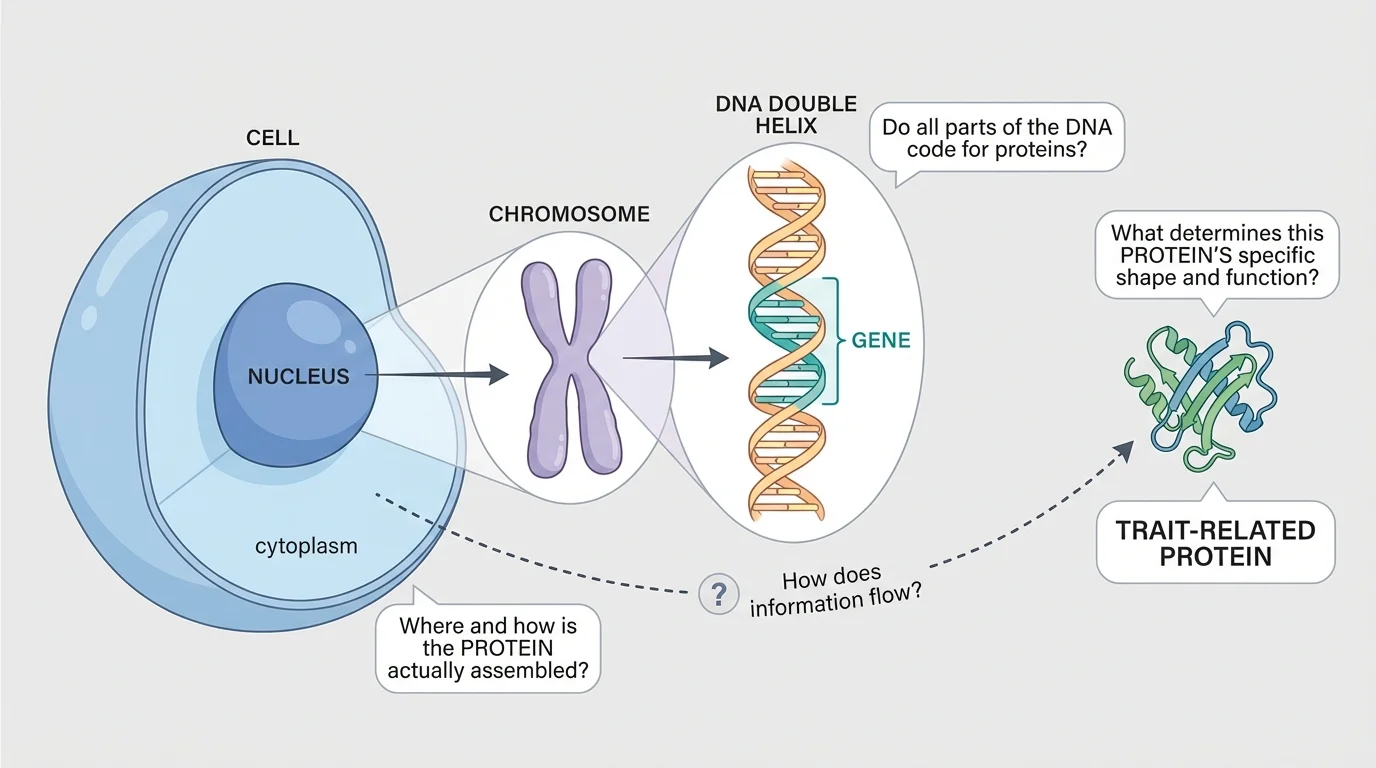
However, the relationship is not always a simple one-gene-to-one-trait pattern. Many traits are influenced by multiple genes, and many genes affect more than one characteristic. Also, environmental factors matter. Height, for example, depends on inherited genetic instructions and environmental influences such as nutrition and health. This complexity is exactly why questioning models is important.
DNA is the molecule that stores hereditary information in living organisms. A trait is a characteristic of an organism, and inheritance is the passing of genetic information from parents to offspring.
When scientists say DNA "codes" for traits, they do not mean that DNA directly paints an eye blue or makes a leaf long. Instead, DNA contains information for building molecules—especially proteins—that participate in processes producing those traits. One useful way to express this relationship is:
\(\textrm{DNA sequence} \rightarrow \textrm{protein structure/function} \rightarrow \textrm{cell processes} \rightarrow \textrm{trait}\)
That chain is simplified, but it helps students see where to ask clarifying questions. If a trait changes, was the DNA sequence different? Was the gene expressed differently? Did the environment affect the process? A strong question aims at one of those links.
In genetics, models come in many forms. A ball-and-stick DNA model helps visualize molecular structure. A chromosome map helps show gene locations. A pedigree chart helps trace the inheritance of traits through generations. A Punnett square helps predict probable allele combinations in offspring. Each model is useful, but each highlights only certain relationships.
A theory is broader. The chromosome theory of inheritance, for example, explains that genes are carried on chromosomes and that chromosome behavior during meiosis helps explain inheritance patterns. The theory is supported by evidence from microscopy, breeding studies, molecular genetics, and modern DNA analysis. Students should not think of a theory as a guess. In science, a theory is a well-supported explanation.
When examining a theory, students can ask questions such as: What evidence supports this explanation? How does this theory explain observations from family inheritance patterns? What exceptions or complications does it not fully address? These questions clarify the reach and limits of the theory.
Not every question is equally useful. A strong scientific question is specific, focused on a relationship, and answerable with evidence. It often begins with words like how, why, or what is the relationship between. In genetics, it should point toward DNA, chromosomes, genes, proteins, inheritance, or trait variation.
Compare these examples:
| Weak question | Stronger question | Why it is stronger |
|---|---|---|
| What is a trait? | How does a difference in DNA sequence lead to a difference in an inherited trait? | It asks about mechanism and relationship. |
| Why do children look like parents? | What is the relationship between parental chromosomes and the combination of genes inherited by offspring? | It targets inheritance more precisely. |
| What does DNA do? | How does DNA in chromosomes code the instructions for proteins that affect traits? | It connects structure, information, and outcome. |
Table 1. Comparison of weak and strong questions in genetics.
One helpful strategy is to examine a model and ask four kinds of questions: structure, function, relationship, and limitation. Structure questions ask what parts are shown. Function questions ask what those parts do. Relationship questions ask how one part affects another. Limitation questions ask what the model does not include.
Case study: asking better questions from a chromosome model
A student sees a diagram of paired chromosomes during meiosis.
Step 1: Identify what the model clearly shows.
The model shows chromosomes in pairs, suggesting that one chromosome in each pair came from each parent.
Step 2: Notice what relationship is implied.
The diagram implies that genes on chromosomes are sorted into gametes, affecting which versions of genes offspring may inherit.
Step 3: Ask a clarifying question.
A strong question is: "How does the separation of chromosome pairs during meiosis explain why siblings can inherit different combinations of traits?"
This question connects the model to inheritance, variation, and mechanism.
Questions can also be revised. A first draft may be broad, such as "How do genes work?" A revised version becomes more useful: "How does a mutation in a gene on a chromosome change the protein produced and possibly alter a characteristic trait?" Revision is part of scientific thinking.
Many of the best genetics questions focus on the path from DNA to trait. For example, students might ask how a change in one base pair affects a protein, or why two people with similar genes can still show different forms of a trait. These questions move beyond memorizing definitions and into understanding cause and effect.
Here are several useful question patterns:
Consider sickle cell disease. It is linked to a change in the DNA sequence of the gene that helps code for part of hemoglobin. That altered sequence changes the protein, and the altered protein changes the shape and behavior of red blood cells. This is a powerful example because it allows students to ask several connected questions: How can one DNA change alter a protein? Why does that protein change affect cell shape? Why do symptoms vary among individuals?
A human genome contains about 3 billion base pairs of DNA, yet even tiny sequence differences can contribute to noticeable trait variation or disease risk.
Another useful example is lactose tolerance. In some human populations, regulatory DNA helps keep a gene active after childhood, allowing adults to digest lactose, the sugar in milk. This shows that asking about traits should include not only coding regions of DNA but also gene expression—when, where, and how strongly a gene is used.
This is also where students should question oversimplified statements. If someone says, "There is a gene for intelligence" or "There is a gene for athletic ability," a scientifically responsible response is to ask what evidence supports that claim, whether multiple genes are involved, how environment contributes, and how the trait is measured. Many human traits are complex, not single-gene outcomes. [Figure 2]
Different genetics models answer different questions. A good scientist does not ask whether a model is "right" in an absolute sense. Instead, the question is whether the model is useful for the specific purpose.
A pedigree chart can help identify whether a trait may be dominant, recessive, sex-linked, or mitochondrial, but it cannot reveal the exact DNA sequence involved. A Punnett square can estimate probabilities, but it cannot guarantee one specific outcome for one family. A DNA model can show double-helix structure, but it does not show how a trait appears at the level of the whole organism.
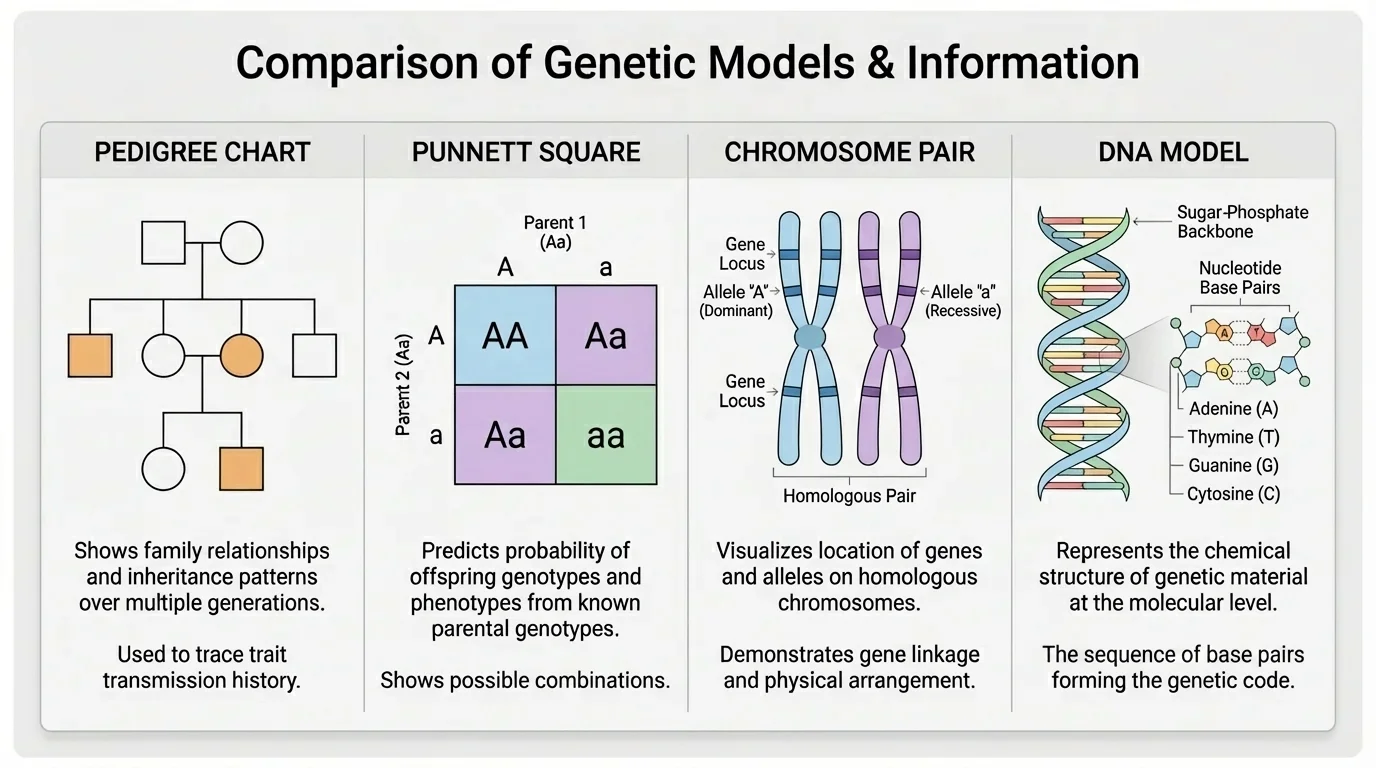
This matters because students often confuse a model with reality itself. For instance, a Punnett square for a monohybrid cross may show a probability of \(\dfrac{1}{4}\) for a recessive phenotype, but that does not mean every set of four offspring will contain exactly one recessive individual. Probability describes expected patterns across many cases, not guarantees in each small sample.
Suppose a model predicts that two heterozygous parents have offspring with genotype probabilities of \(\dfrac{1}{4} \, AA, \, \dfrac{1}{2} \, Aa, \, \dfrac{1}{4} \, aa\). If a family has only two children, many combinations are possible. That does not disprove the model. Instead, it leads to a clarifying question: "How does probability in a genetic model relate to outcomes in a small real family?" Asking that question shows mature scientific reasoning.
Earlier biology learning about cells and proteins matters here. Genes do not act as isolated labels; they influence cellular processes by helping direct the production of functional molecules, especially proteins.
Models also leave out molecular details. As seen earlier in [Figure 1], knowing that DNA is packed into chromosomes helps explain organization, but it does not by itself explain how genes are turned on or off in different cells. A skin cell and a nerve cell usually contain the same DNA, yet they function differently because different genes are expressed. [Figure 3]
Questioning genetics models is not just an academic exercise. In medicine, real decisions often begin with questions raised by inheritance patterns. If several relatives have the same inherited disorder, doctors and genetic counselors ask whether the pattern fits a known mode of inheritance, whether a chromosome abnormality may be involved, or whether DNA testing can identify a mutation.
In cancer research, scientists ask whether changes in DNA within body cells alter proteins that control cell division. In agriculture, breeders ask how particular genes affect crop yield, drought tolerance, or disease resistance. In forensic science, investigators ask how DNA variation can be used to identify individuals with high accuracy. In each case, the questions come from examining patterns, models, and evidence.
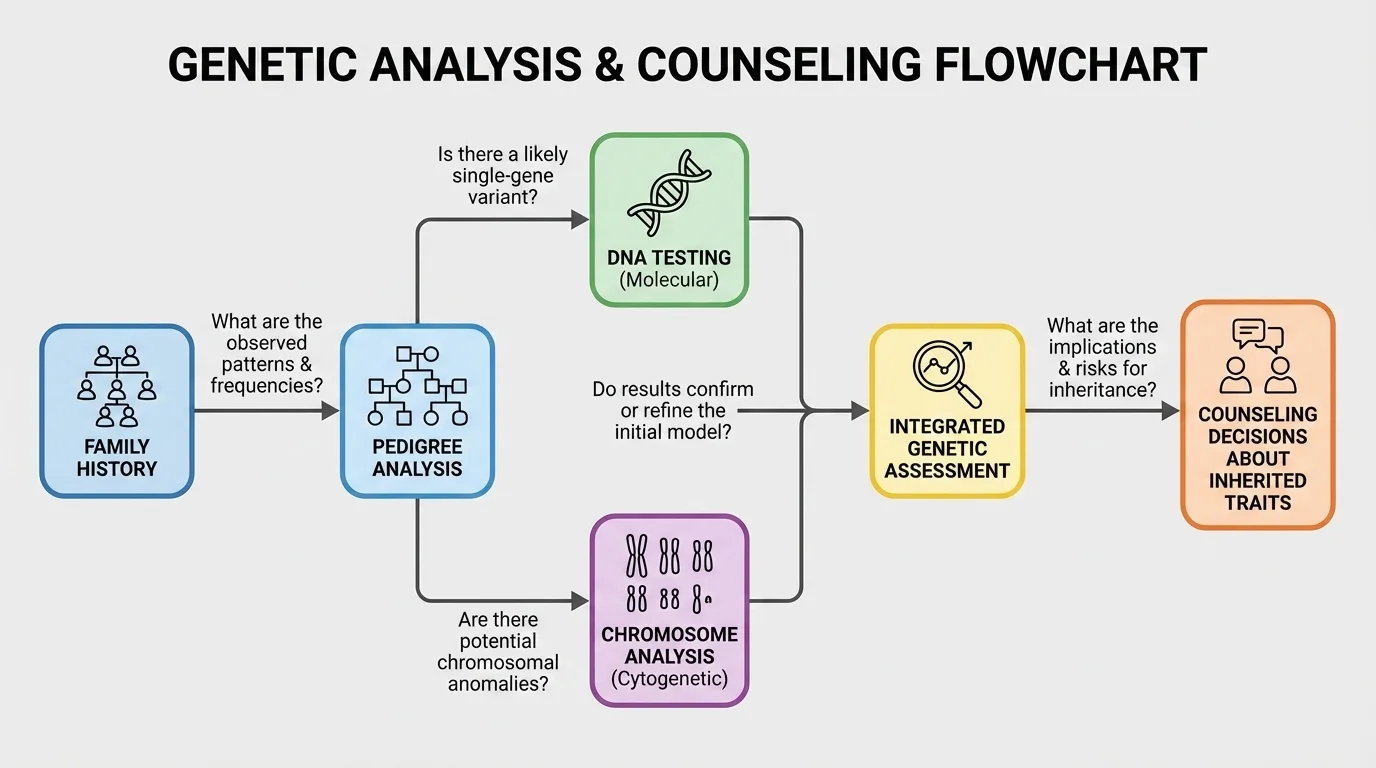
Genetic counseling provides a clear example. A pedigree may suggest that a trait is recessive. That raises further questions: Which gene is involved? Are both parents carriers? What is the probability of passing the condition to offspring? Are there tests that examine the chromosome or DNA directly? The model does not end the investigation; it starts it.
Real-world example: cystic fibrosis screening
Cystic fibrosis is often inherited in an autosomal recessive pattern.
Step 1: Use a family model.
A pedigree suggests that unaffected parents had a child with the disorder, which is consistent with both parents being carriers.
Step 2: Ask a clarifying question.
"Does DNA testing show that both parents carry a mutation in the same gene associated with cystic fibrosis?"
Step 3: Connect model to evidence.
If testing confirms the mutation, the pedigree interpretation becomes stronger. If not, scientists and doctors must ask whether another genetic explanation is involved.
This shows how models guide questions, and questions guide evidence gathering.
Later, when more detailed molecular evidence is available, scientists may return to the broader pattern first seen in [Figure 2]. The choice of model depends on the question being asked.
One common misunderstanding is genetic determinism, the idea that genes alone rigidly control all traits. This is too simple. Some traits are strongly influenced by single genes, but many depend on multiple genes and environmental factors. Better questions ask how genes and environment interact rather than assuming one factor explains everything.
Another misunderstanding is thinking that chromosomes from each parent are "blended" into a smooth mix. In reality, offspring inherit distinct chromosomes and gene versions, called alleles, from each parent. A strong question here is: "How does inheriting one allele from each parent create both similarity and variation among offspring?"
Students also sometimes believe that if two people share a trait, they must have exactly the same genetic cause. That is not always true. Similar traits can arise from different genes or from different mutations in the same gene. A better question is: "Can different DNA changes produce similar phenotypes, and how would scientists tell the difference?"
Asking questions from models and theories is one of the habits that makes science powerful. In genetics, this practice helps students move from memorizing terms to seeing living systems as connected processes. DNA is not just a molecule; it is information. Chromosomes are not just shapes under a microscope; they are organized carriers of heredity. Traits are not just labels; they are outcomes of interactions among genes, proteins, cells, and environments.
When you examine a model, slow down and ask: What relationship is being shown? What evidence supports it? What does the model simplify? What more do I need to know? Those questions turn a diagram or theory into a tool for thinking. They also prepare students for more advanced biology, where evidence, uncertainty, and explanation matter just as much as facts.
"The important thing is not to stop questioning."
— Albert Einstein
In heredity, the most meaningful questions are often the ones that connect levels of biology: molecule to cell, cell to organism, organism to family, and family to population. That is where scientific understanding becomes deep, precise, and useful.
