A well-designed solution can create a new problem if no one asks the next question. A pesticide may protect crops but also harm pollinators. A stronger flood wall may shield one neighborhood but redirect water toward another. A highly efficient battery may power devices longer but depend on mining methods that damage ecosystems. Science-based design is not just about making something work. It is about understanding how and why it works, what evidence supports it, and what effects may appear after it is used in the real world.
Many important problems begin as design challenges: how to reduce air pollution, how to make transportation safer, how to provide clean drinking water, or how to keep buildings cooler with less energy. A design problem is a situation in which people need to create or improve a system, object, or process to meet a need. Scientific ideas matter because every design operates in the natural world. Materials have properties, heat moves, forces act, chemicals react, and living things respond.
To solve a design problem well, students and engineers must understand causes and mechanisms. If a bridge vibrates, what forces are acting on it? If a medical mask filters particles, what particle sizes are blocked and why? If a fertilizer increases plant growth, what happens to nearby streams when rain carries extra nutrients away? A scientific explanation connects observations to underlying principles. That explanation then guides better design.
Criteria are the features a successful solution must achieve, such as safety, efficiency, or durability. Constraints are the limits a solution must stay within, such as cost, time, available materials, or environmental regulations. A trade-off happens when improving one aspect of a design causes another aspect to become worse or more difficult to achieve.
For example, a reusable water bottle might need to be lightweight, leak-proof, inexpensive, and strong. Those are criteria. But it may need to be made from available materials, sold at a reasonable price, and produced with limited energy use. Those are constraints. Choosing stainless steel instead of plastic may improve durability but increase mass and cost. That is a trade-off.
Scientists often focus on constructing explanations: identifying patterns in evidence and explaining what causes them. Designers and engineers use those explanations to build solutions. These are closely connected. If students understand why greenhouse gases trap heat, they can evaluate designs that reduce emissions or increase energy efficiency. If they understand how pathogens spread through water, they can evaluate filtration and sanitation systems.
A scientific explanation is strongest when it uses evidence and reasoning together. Evidence may include measurements, observations, controlled experiments, simulations, or field data. Reasoning links that evidence to scientific principles. Suppose a class compares two insulating materials. If one keeps a container of hot water warmer over the same time period, and students know heat flows from warmer to cooler places, then they can reason that the better insulator reduces energy transfer more effectively.
Constructing explanations and designing solutions means more than naming a fact. It involves identifying the mechanism behind a problem, predicting what kind of change could improve it, and checking whether the proposed solution really matches the science. Strong solutions grow out of strong explanations.
This is why weak explanations often lead to weak designs. If someone says, "This filter works because it looks dense," that is not enough. A better explanation would identify pore size, adsorption, flow rate, and the types of particles or chemicals being removed. Once those details are understood, the design can be tested and improved.
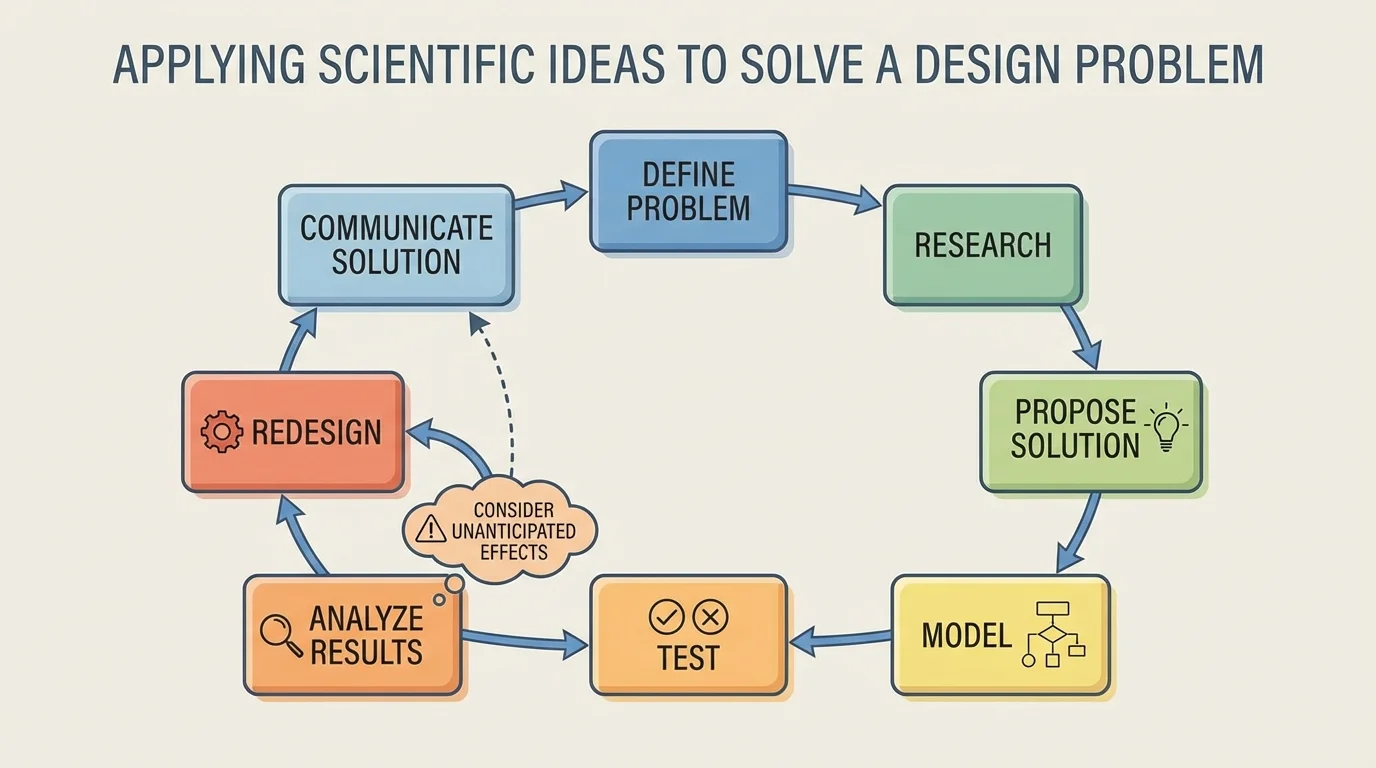
As [Figure 1] suggests, good design is rarely a single brilliant idea. It is an iterative process in which a problem is defined, researched, modeled, tested, and revised. This cycle helps designers avoid guessing and instead build on evidence.
A typical process includes several connected actions: define the problem clearly, identify criteria and constraints, gather scientific information, generate possible solutions, build models or prototypes, test them, analyze results, and redesign. The redesign step matters because early solutions often reveal flaws that were not obvious at first.
Suppose a team wants to design a bicycle helmet that better reduces head injury. They must understand force, momentum, energy transfer, and material deformation. They may test how different foam layers compress during impact. If a material reduces the peak force on a sensor, that evidence supports the claim that the design may improve protection. But if it becomes too heavy or cracks after one small hit, redesign is needed.
Science also helps with quantitative comparison. If force is spread over a longer collision time, the average force decreases. In a simplified form, this relationship can be expressed as impulse:
\[F \Delta t = \Delta p\]
Here, if a moving object undergoes the same change in momentum, a larger value of \(\Delta t\) leads to a smaller average \(F\). For example, if \(\Delta p = 12 \textrm{ kg m/s}\) and the stopping time is \(0.02 \textrm{ s}\), then \(F = \dfrac{12}{0.02} = 600 \textrm{ N}\). If padding increases the stopping time to \(0.06 \textrm{ s}\), then \(F = \dfrac{12}{0.06} = 200 \textrm{ N}\). That scientific idea directly informs helmet design.
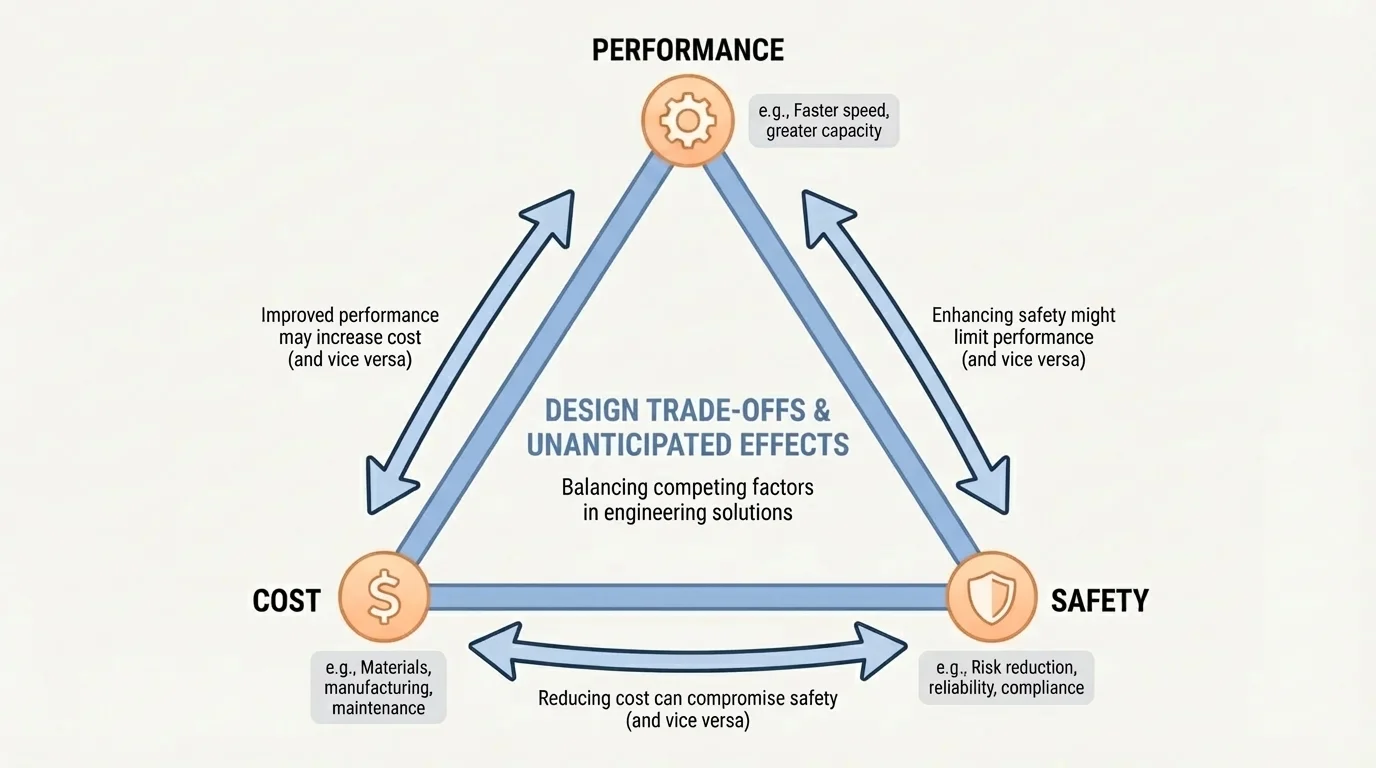
As [Figure 2] suggests, real solutions almost never maximize every desirable feature at once. Improving one dimension such as performance may raise cost or introduce safety concerns. This is why designers compare options instead of asking only whether something works.
Consider a solar cooker. Important criteria may include reaching a high enough temperature to cook food, keeping heat for a useful amount of time, remaining stable outdoors, and being affordable. Constraints may include the local climate, available materials, construction time, and user safety. A polished metal reflector may increase heating, but bright reflections might affect nearby drivers or overheat parts of the device.
Trade-offs are not mistakes. They are unavoidable parts of decision-making. The key is to make them visible and support decisions with evidence. A high-performance air filter may remove more particles but reduce airflow. A stronger phone case may protect the device but make it bulkier. A fertilizer that boosts yield may also increase nutrient runoff.
Designers often compare options in a structured way.
| Option | Main advantage | Main limitation | Possible trade-off |
|---|---|---|---|
| Thicker insulation | Less heat loss | More material needed | Higher cost and larger size |
| Faster water flow | More water delivered | Less contact time with filter | Lower purification effectiveness |
| Lighter construction material | Easier transport | May be less durable | Shorter product life |
Table 1. Examples of how design choices can improve one feature while limiting another.
Design is not only about building. It is also about defending claims. An argument from evidence means making a claim, supporting it with relevant data, and explaining why the data justify the claim. In science and engineering, this matters when different people propose different solutions.
Suppose two teams design school lunch trays that reduce waste. One claims its tray reduces spilled liquids because it has deeper compartments. Another claims a flatter tray is easier to clean and stack. To decide which is better, students would need measurements: spill rates, cleaning time, durability, cost, and perhaps student surveys. The strongest argument is not the loudest opinion. It is the one most strongly supported by reliable evidence.
Case of competing claims
Two roof materials are tested on identical small model houses under the same lamp.
Step 1: State the claim
Team A claims a reflective roof keeps the house cooler than a dark roof.
Step 2: Gather data
After the same exposure time, the dark-roof model reaches \(38 \degree \textrm{C}\) while the reflective-roof model reaches \(31 \degree \textrm{C}\).
Step 3: Use reasoning
The temperature difference is \(38 - 31 = 7 \degree \textrm{C}\). Since reflective surfaces absorb less radiant energy than darker surfaces, the lower temperature supports Team A's claim.
Step 4: Consider limits
Students should still ask whether the reflective roof is more expensive, more fragile, or likely to create glare.
The better argument includes both the positive evidence and the possible limitations.
Arguments from evidence also require attention to fair testing. Were variables controlled? Was the sample size large enough? Were measurements repeated? A single successful trial is weaker than a repeated pattern across multiple trials.
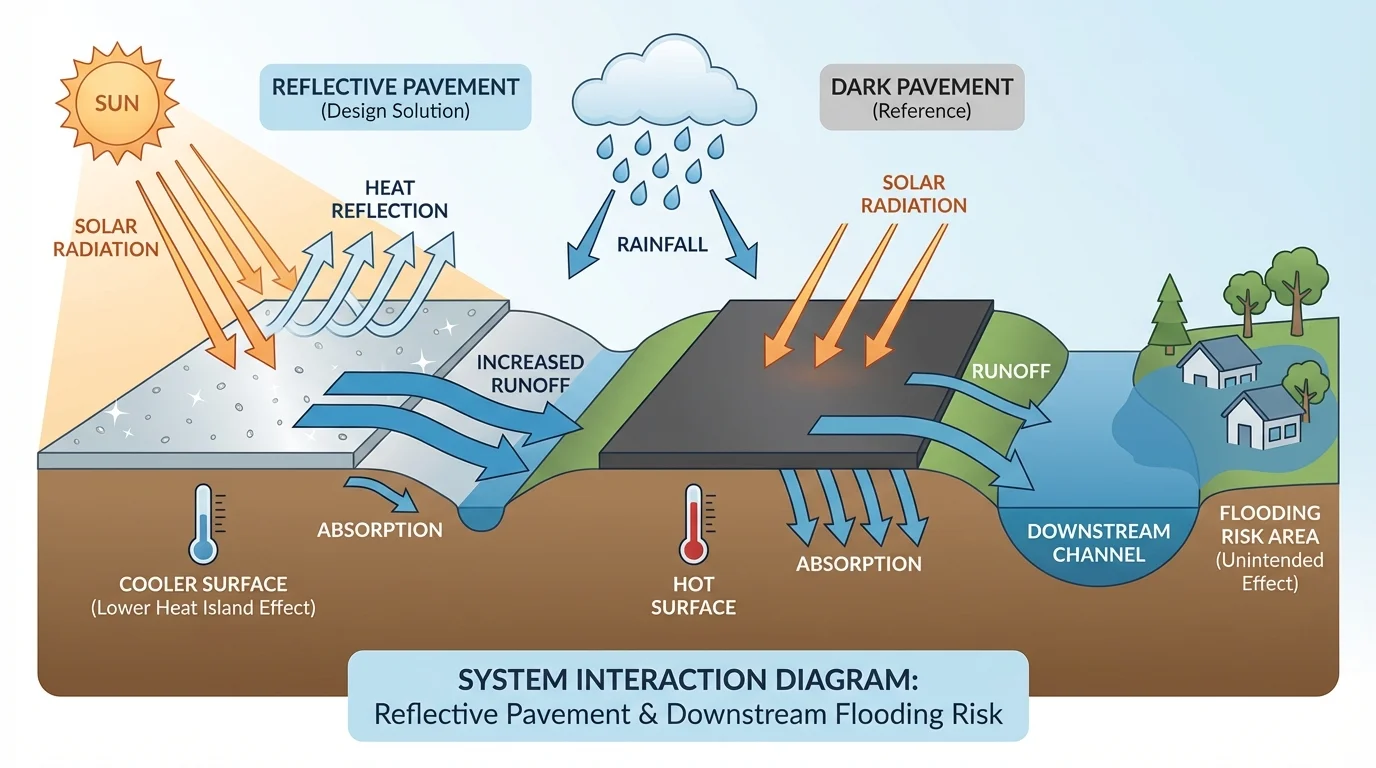
As [Figure 3] illustrates, one of the most important habits in design is asking what else might happen. In connected systems, a change often causes more than one result. Unanticipated effects are outcomes that were not intended or predicted at first. They may be harmful, helpful, or mixed.
These effects often appear because systems interact. A city adds more pavement to improve transportation, but the dark surface absorbs more solar energy and raises local temperature. A dam creates a water reservoir, but it also changes sediment flow and fish migration. A pesticide kills crop pests, but it may also select for resistant insects over time. None of these outcomes makes design impossible. They show why narrow thinking is risky.
Unanticipated effects may occur on different scales. Some are local, such as noise from a wind turbine. Some are regional, such as changes in water availability. Some are long-term, such as the buildup of persistent chemicals in food webs. Good design therefore considers both immediate performance and broader consequences.
Feedback loops make this even more complex. A feedback loop occurs when the output of a system influences the system itself. For example, if warmer temperatures lead to greater air-conditioning use, and that energy comes from fossil fuels, then additional emissions may contribute to further warming. Designers must think beyond a single cause-and-effect arrow.
Some solutions first celebrated as breakthroughs later required major redesign because of side effects. Leaded gasoline improved engine performance in the early twentieth century, but its long-term health and environmental damage eventually led to its phaseout.
Scientists try to detect such effects through longer testing, field observations, computer models, and comparison with similar systems. That is why evidence from only one short test is often not enough.
As [Figure 4] shows, cities are often warmer than surrounding rural areas because roofs, roads, and other surfaces absorb and store energy. The key property here is albedo, which refers to how much incoming light a surface reflects. Darker surfaces have lower albedo and usually absorb more energy, while brighter or reflective surfaces have higher albedo.
Suppose a city wants to reduce summer heat in a neighborhood. A proposed design solution is to install reflective roofs, plant more trees, and replace some dark pavement with lighter materials. Scientific ideas involved include radiation, heat transfer, evaporation from plants, and surface properties.
A simple energy comparison can help. If one roof absorbs \(80\%\) of incoming solar energy and another absorbs \(35\%\), then under \(1{,}000 \textrm{ W/m}^2\) of sunlight, the first absorbs \(0.80 \times 1{,}000 = 800 \textrm{ W/m}^2\), while the second absorbs \(0.35 \times 1{,}000 = 350 \textrm{ W/m}^2\). The difference is \(800 - 350 = 450 \textrm{ W/m}^2\). That is a major change in energy absorbed at the surface.
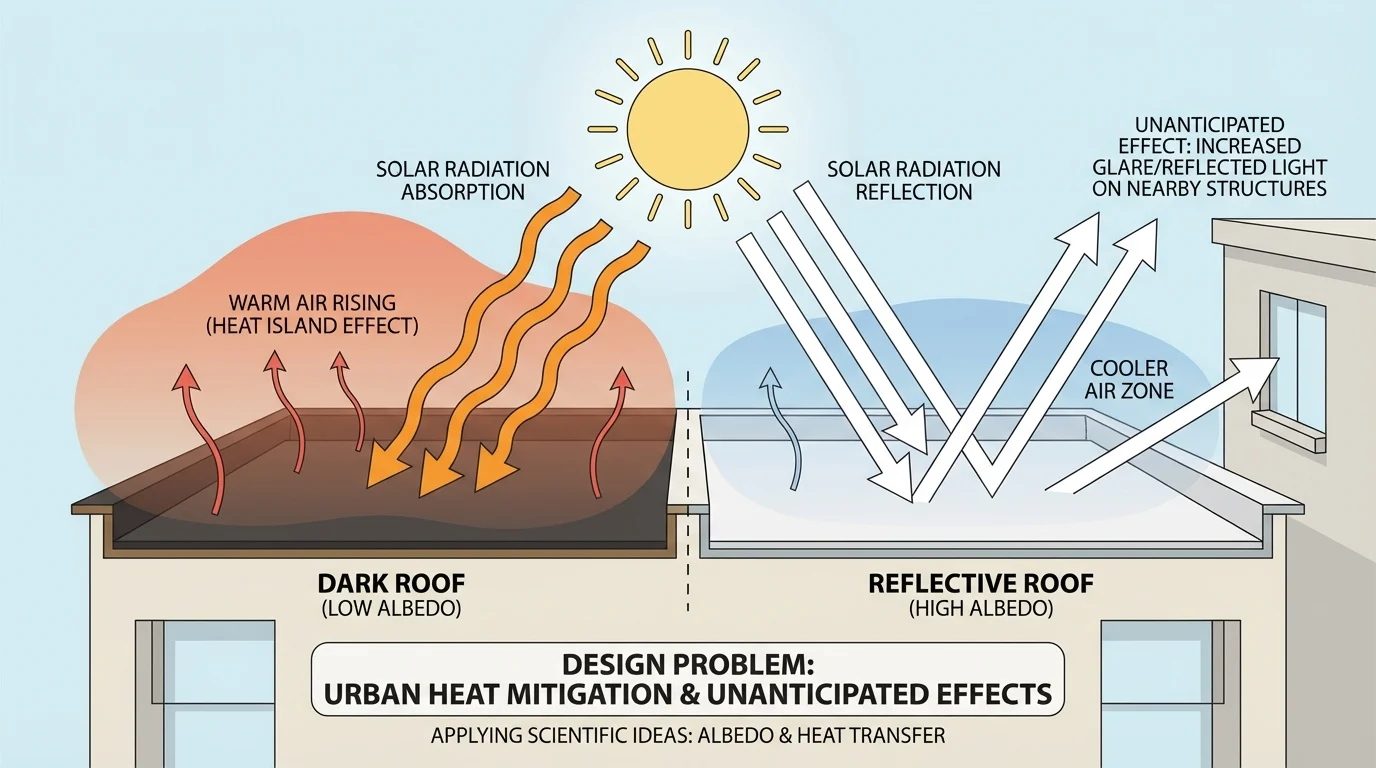
But unanticipated effects must be considered. Reflective surfaces may create glare. Some replacement materials may be expensive or require more energy to produce. Increased tree cover can reduce heat, but roots may disturb sidewalks or underground pipes if poor species are chosen. Watering young trees may also raise water demand in dry regions.
This is where evidence-based argument matters. A strong proposal would compare temperature changes, installation cost, maintenance needs, stormwater impacts, expected lifespan, and social benefits such as shaded walking areas. As seen earlier in [Figure 2], a solution that performs well in one category may create trade-offs in another.
Urban heat design comparison
A city compares two options for a parking lot: dark asphalt and lighter reflective paving.
Step 1: Identify criteria
Lower surface temperature, reasonable cost, durability, and safe visibility for drivers.
Step 2: Examine evidence
At midday, the asphalt surface measures \(57 \degree \textrm{C}\), while the lighter paving measures \(44 \degree \textrm{C}\).
Step 3: Compare numerically
The lighter paving is \(57 - 44 = 13 \degree \textrm{C}\) cooler.
Step 4: Look for unanticipated effects
Engineers also test glare and stormwater runoff. If runoff increases, drainage design may need revision.
The best decision depends on all the evidence, not only temperature.
As [Figure 5] shows, clean water systems are a classic design challenge because they combine chemistry, biology, materials science, and public health. In a layered filter, each material plays a different role: gravel removes large debris, sand traps smaller particles, and activated carbon can adsorb some dissolved substances and odors.
Suppose a community needs a low-cost gravity-fed filter for muddy water. Important criteria include reducing suspended particles, improving safety, maintaining useful flow rate, and keeping the design affordable. Constraints might include local materials, no electricity, and simple maintenance.
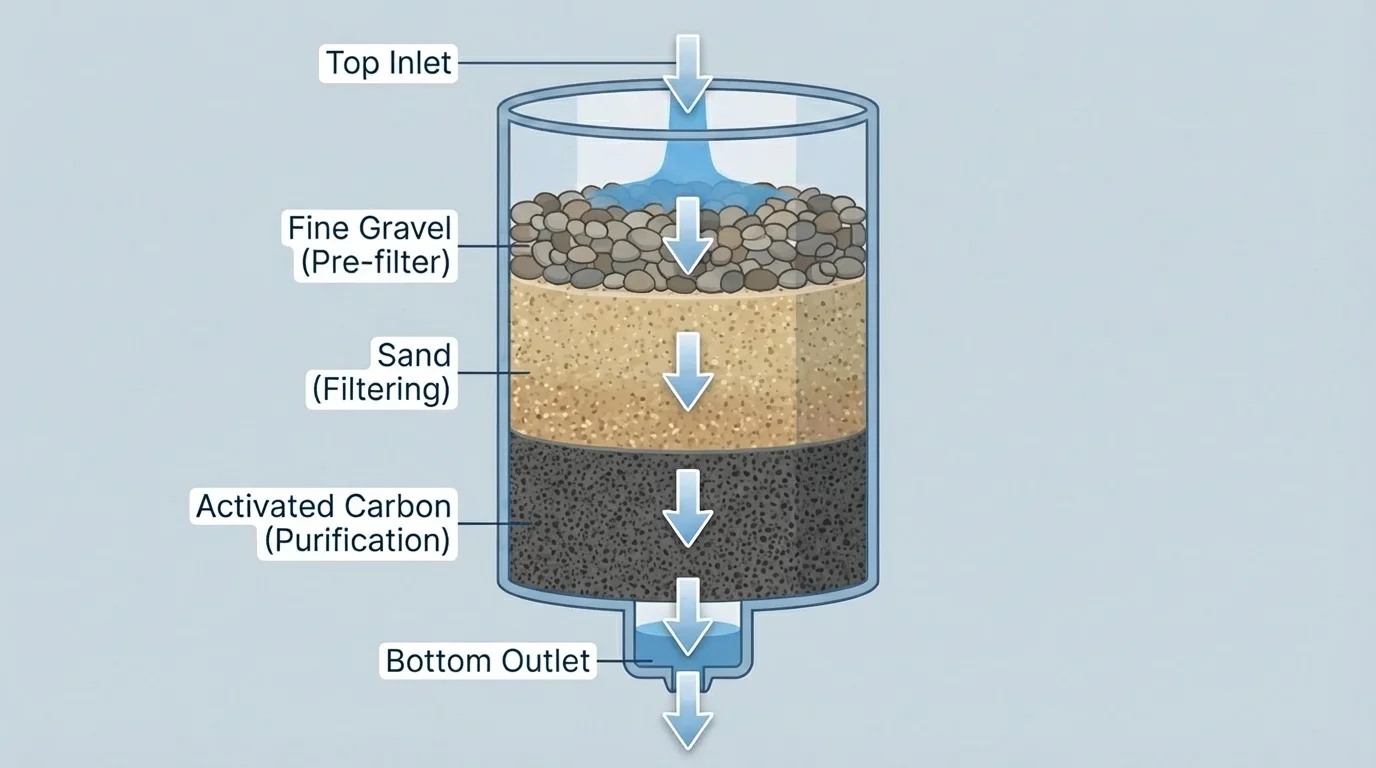
Science helps explain why the design works. Larger particles can be physically blocked by spaces between grains, while some contaminants stick to surfaces through adsorption. But no simple filter solves every problem. Viruses, dissolved salts, or certain chemicals may pass through unless additional treatment is used.
Flow rate is another design issue. If \(2 \textrm{ L}\) of water pass through a filter in \(10 \textrm{ min}\), then the average flow rate is \(\dfrac{2}{10} = 0.2 \textrm{ L/min}\). If widening the openings raises the rate to \(0.5 \textrm{ L/min}\), the water arrives faster, but contact time with filtering materials decreases. A faster design may therefore remove fewer contaminants. This is a classic trade-off.
Unanticipated effects can be serious. If users do not replace filter media, trapped microorganisms may grow. If a design gives people false confidence, they may drink water that still contains invisible pathogens. If activated carbon is difficult to obtain, the design may fail in practice even if it works in a lab. The filter structure in [Figure 5] is useful, but long-term use, maintenance, and local conditions matter just as much as initial performance.
Because real systems are complex, testing should occur under realistic conditions whenever possible. Lab tests are important, but field tests may reveal effects that controlled settings miss. Temperature changes over different seasons, user behavior, wear and tear, and local environmental conditions can all change results.
Iteration means using test results to revise the design. If a prototype water filter clogs too quickly, perhaps the particle size of the top layer must change. If a cooler roof reduces heat but creates dangerous glare, the surface finish may need adjustment. The design cycle in [Figure 1] remains important because evidence rarely supports a perfect first attempt.
Earlier science learning about energy transfer, ecosystems, forces, particle behavior, and chemical interactions provides the foundation for this topic. Design decisions become stronger when they are linked back to those core scientific principles.
Ethics also matters. A design can be scientifically effective and still raise questions about fairness, access, or environmental justice. Who benefits? Who carries the risks? Does a lower-cost solution expose one group to more pollution or danger? Responsible design uses science not only to improve performance but also to reduce harm.
A strong design proposal usually includes five parts: a clear problem statement, relevant scientific explanation, proposed solution, evidence from testing or research, and discussion of limitations and possible side effects. This makes the argument transparent and easier to evaluate.
For example, a student team might claim that planting shade trees and using reflective roofing is the best approach for reducing schoolyard heat. To defend this claim, they would present temperature data, explain radiation and evapotranspiration, compare cost and maintenance, and address concerns such as root damage, watering needs, or delayed benefits while trees grow.
Good argument from evidence also includes counterarguments. If another team argues for shade structures instead of trees, the first team should not ignore that option. They should compare durability, cooling effect, maintenance, biodiversity benefits, and cost. Scientific disagreement is productive when it is based on evidence and reasoning rather than personal preference.
"The best solution is not the one with no weaknesses, but the one whose strengths are supported by evidence and whose weaknesses are understood honestly."
When students learn to apply scientific ideas in this way, they are doing more than solving a classroom task. They are practicing how societies make decisions about energy, health, technology, cities, agriculture, and the environment. The real challenge is not only to design something that works today, but to design something that continues to work when the wider system responds.
