Your body can react to stress before your mind has fully put the situation into words. A late assignment, an argument in a group chat, a family problem, or a packed week of deadlines can trigger a real physical response: rapid heartbeat, tighter muscles, shallow breathing, racing thoughts. That matters because stress is not just a feeling. It can affect your health, the way you treat other people, and how well you do in school.
During adolescence, stress often shows up in ways that are easy to miss. You might call it being "tired," "annoyed," "unmotivated," or "done with everything." But when stress keeps building, it can change how you sleep, how you text people, how you handle frustration, and how you perform on quizzes, projects, and daily tasks. Learning to assess stress means learning to notice what it is doing to you and what you can do next.
Stress is a normal human response to challenge, pressure, uncertainty, or danger. Some stress is useful. It can help you wake up, pay attention, and respond quickly. For example, a small amount of pressure before a presentation or timed test can help you prepare. But stress becomes harmful when it is too intense, lasts too long, or starts controlling your choices.
In real life, stress is not always caused by a huge emergency. It can come from lots of smaller things stacking up: missing sleep, too many notifications, family tension, sports pressure, work responsibilities, friendship drama, or worrying about the future. When stress piles up, your system may act as if every new problem is urgent.
Stress response is your body and mind's reaction to a challenge, threat, or pressure. Acute stress is short-term stress that happens in the moment, while chronic stress is stress that lasts for weeks or longer and keeps wearing you down over time.
[Figure 1] One important life skill is separating normal challenge from constant overload. You do not need a stress-free life. You need skills for noticing stress early, regulating yourself, and responding in ways that protect your health and goals.
When a stressful trigger appears, your stress response affects your body, thoughts, emotions, and actions all at once. Your brain tries to protect you, but it does not always tell the difference between a real physical danger and a social or academic threat like a harsh message, an upcoming exam, or a missed deadline.
Common reactions include fight (getting angry or argumentative), flight (avoiding, escaping, procrastinating), freeze (shutting down, feeling stuck, unable to start), and sometimes fawn (people-pleasing to avoid conflict). None of these responses automatically make you a bad student or a bad person. They are signals that your nervous system feels overloaded.
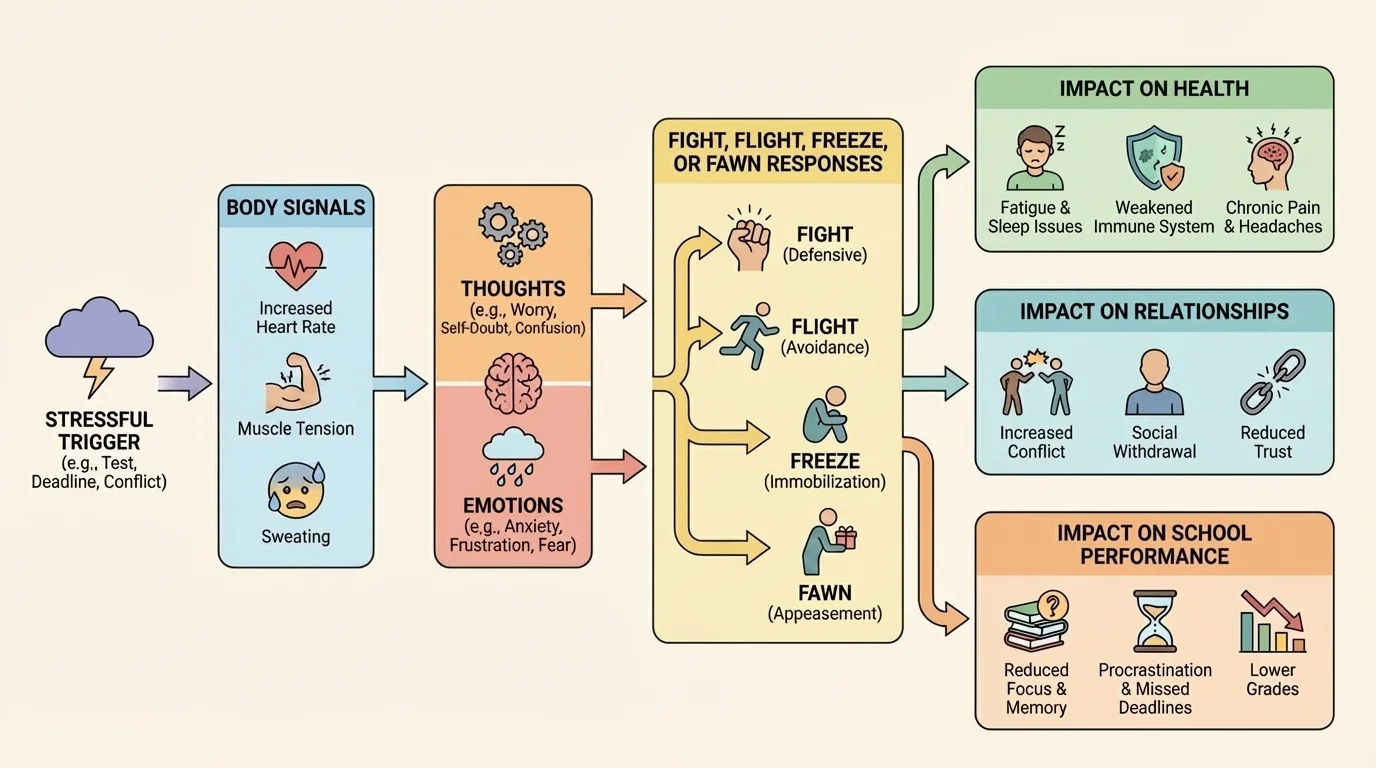
Physical signs can include sweaty hands, headaches, an upset stomach, a tight jaw, fatigue, or trouble sleeping. You may also notice thinking changes such as catastrophizing, assuming the worst, or feeling like one mistake means everything is ruined. Emotionally, stress can look like irritability, panic, numbness, sadness, or embarrassment.
This is where emotional regulation matters. Emotional regulation means managing your feelings in a healthy way so they do not completely take over your behavior. It does not mean pretending you are fine. It means noticing what you feel, understanding it, and choosing a useful response.
Why the same stressor affects different people differently
Two students can face the same deadline and react very differently. One may get organized and finish early. Another may panic and avoid the work. Stress responses are shaped by sleep, past experiences, self-talk, health, support systems, and how many pressures are happening at once. That is why assessing stress is personal. The key question is not "Should this bother me?" but "What is this doing to me right now?"
Later, when you assess your own reactions, think like an investigator: What happened? What did your body do? What thoughts showed up? What behavior followed? That kind of honest check-in is the first step toward change.
Stress can affect health in direct and indirect ways. Directly, it can raise tension in your body and make symptoms like headaches, stomachaches, jaw clenching, chest tightness, or trouble sleeping more common. Indirectly, it can push you into habits that make health worse, such as doomscrolling late at night, skipping meals, eating whatever is fastest, avoiding movement, or using caffeine to force yourself through exhaustion.
Sleep is one of the biggest stress-related health issues for teens. When you are stressed, it is harder to fall asleep, and poor sleep makes stress feel stronger the next day. That creates a cycle: more stress, less sleep, lower energy, weaker focus, then even more stress. If you keep repeating that cycle, your body and mind both pay the price.
Stress can also weaken your patience with your own body. You may ignore hunger, push through illness, or tell yourself you should just "deal with it." But self-management includes basic care. Drinking water, eating regularly, being physically active, and keeping a reasonable sleep routine are not extra tasks. They are part of how you handle stress well.
Long-lasting stress may also lower your motivation to do healthy things. That does not mean you are lazy. It may mean your system is overloaded. Still, overload needs a response. If stress is affecting your health for weeks, causing frequent panic, making sleep impossible, or leading to harmful coping behaviors, it is time to reach out for support.
Chronic stress can make small problems feel much larger because your brain starts scanning for threat more often. When that happens, even normal responsibilities can feel like emergencies.
As shown in [Figure 1], stress is not just an emotion. It changes the body first, and those physical changes can shape everything else you do afterward.
Stress changes how messages are sent and interpreted. When you are stressed, you may read neutral messages as rude, answer too quickly, go silent, cancel plans, or snap at people you care about. In online communication, this happens even more easily because tone is harder to read through text.
For example, suppose a friend sends, "Are you still working on your part?" If you are calm, you may read it as a simple question. If you are highly stressed, you may hear criticism in it and reply, "Why are you on my case?" The stress response has now changed the relationship, not just your mood.
Stress can also make you withdraw. You may leave messages unopened, avoid video calls, or stop replying because everything feels too heavy. Sometimes that protects your energy for a short time. But if people do not know what is happening, they may assume you do not care, which can damage trust.
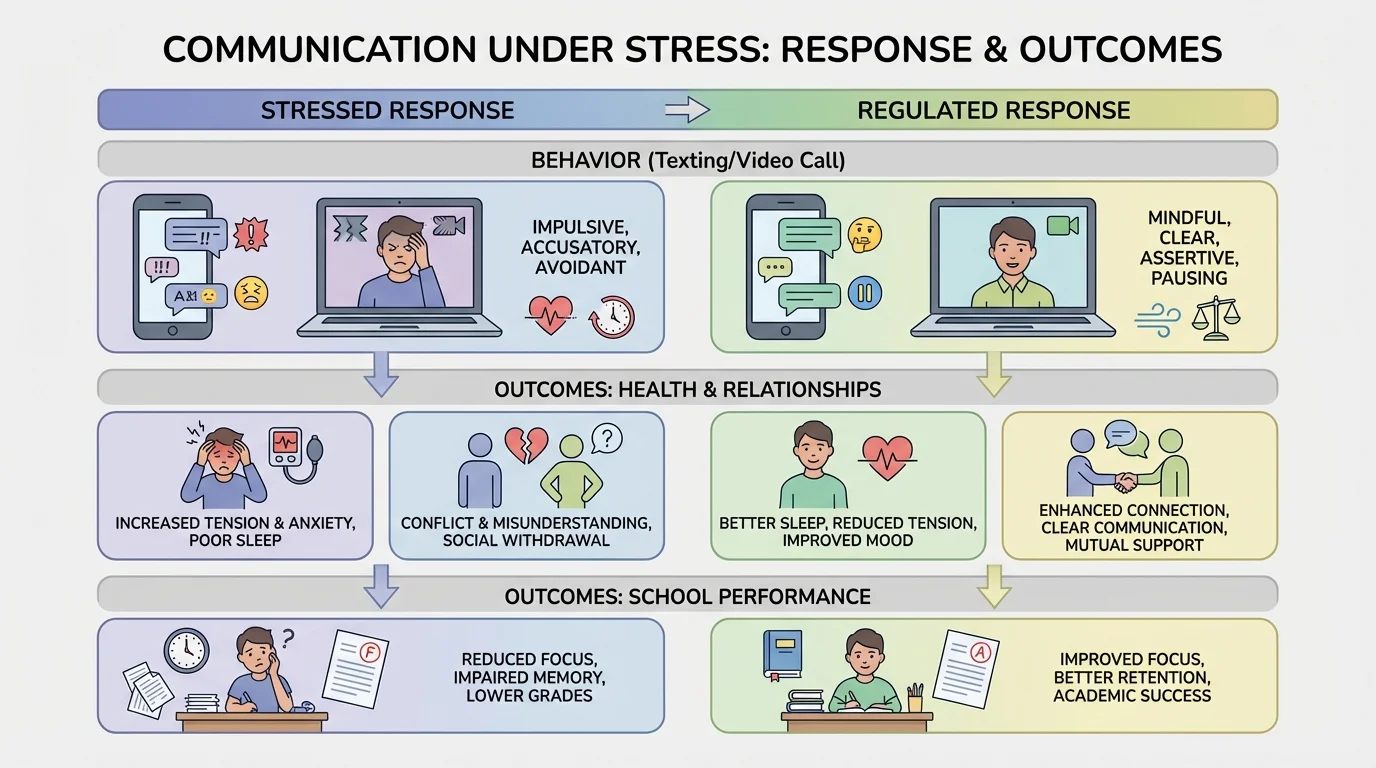
There is also a conflict side to stress. Someone under stress may become more defensive, impatient, or controlling. You might interrupt, over-explain, blame, or use harsh wording you would not normally choose. Once stress drives the conversation, the original issue often gets replaced by a second problem: hurt feelings.
Healthy relationships do not require you to be perfectly calm all the time. They require repair. Repair means noticing when stress affected your behavior and taking responsibility. A strong repair message can sound like this: "I answered sharply earlier. I was overwhelmed, but that was still unfair to you. Can we restart?" That kind of response protects the relationship.
Case study: Stress and a friendship
You have three overdue tasks and a family issue at home. A friend messages twice asking why you have not replied.
Step 1: Notice the stress signal
Your shoulders are tense, your breathing is fast, and your first impulse is to type something sarcastic.
Step 2: Pause before responding
Put the phone down for two minutes. Take slower breaths and name what is happening: "I am overloaded and defensive."
Step 3: Send a clear, respectful message
Try: "I'm stressed and slow to reply today. It's not about you. I'll respond later tonight when I can think clearly."
Step 4: Follow through
If you say you will reply later, do it. Reliability builds trust.
This approach protects both your energy and the relationship.
[Figure 3] Later, the communication patterns in [Figure 2] still matter. The difference between a stressed reaction and a regulated one is often only a short pause, but that pause can prevent a much bigger problem.
Stress can create a self-reinforcing cycle that hurts performance. In online school, stress often appears as low focus, procrastination, missed deadlines, incomplete assignments, or staring at the screen without being able to start. This is not always about ability. Often, it is about overload.
When you are stressed, executive functioning skills can weaken. Executive functioning includes planning, organizing, starting tasks, managing time, remembering directions, and shifting attention appropriately. Stress makes these skills harder to use, which means even simple school tasks may suddenly feel confusing or exhausting.
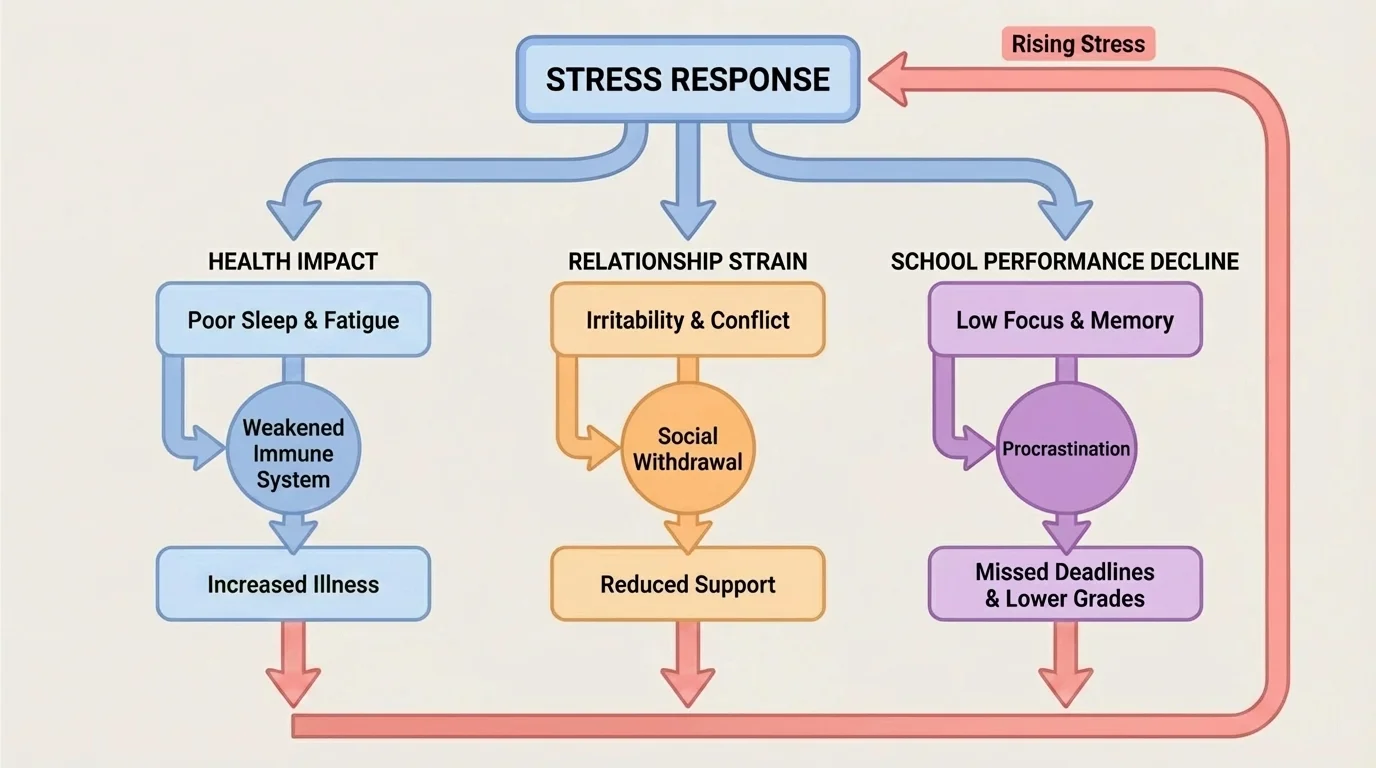
Memory is affected too. You may study material and then blank during a quiz because your brain is focused on threat, not recall. You may also make more careless mistakes, skip instructions, or underestimate how long work will take. Under stress, your brain often looks for quick escape, not long-term success.
Here are some common school-performance effects of stress:
| Area | What Stress Can Look Like | Real-World Result |
|---|---|---|
| Attention | Mind wandering, rereading the same page, checking notifications constantly | Work takes longer and understanding drops |
| Task initiation | Putting off starting, waiting until the last minute | Rush, errors, incomplete work |
| Memory | Forgetting instructions or what you studied | Lower quiz and assignment performance |
| Decision-making | Avoiding priorities, choosing easy tasks first | Important work stays unfinished |
| Motivation | Feeling numb, hopeless, or "what's the point?" | Falling behind becomes more likely |
Table 1. Common ways stress can affect school performance in an online learning environment.
Notice that stress can lead to two opposite mistakes. Some students overwork, obsess over every detail, and burn out. Others avoid, shut down, and fall behind. Both patterns can come from the same root problem: a nervous system that feels overloaded.
If this cycle sounds familiar, that is not a reason to judge yourself. It is information. It tells you what kind of support or strategy you need next.
Before you can manage stress well, you need to notice it earlier. A useful way to assess stress is to track four areas: body, emotions, thoughts, and behaviors.
Body signs might include headaches, stomach discomfort, racing heart, tight muscles, shakiness, low appetite, overeating, or exhaustion. Emotional signs might include anger, anxiety, sadness, numbness, embarrassment, or feeling easily overwhelmed. Thinking signs may include all-or-nothing thinking, assuming the worst, or difficulty concentrating. Behavior signs can include procrastination, isolating, arguing, overcommitting, or staying online to avoid responsibilities.
Self-management works best when you notice patterns, not just one bad moment. A rough day is normal. A repeating pattern is a sign that you need a plan.
Try keeping a short stress log for one week. You do not need a detailed journal. Just note: trigger, body reaction, thought, behavior, and result. For example: "Trigger: three assignments due. Body: tight chest. Thought: I'll never catch up. Behavior: watched videos for two hours. Result: more stress." Patterns become easier to see when they are written down.
[Figure 4] This kind of tracking strengthens your self-management skills. Self-management means handling your emotions, time, energy, and choices in ways that support your goals and well-being.
When stress spikes, use a simple reset routine. The goal is not to erase stress instantly. The goal is to lower the intensity enough that you can think and choose your next step.
Step 1: Pause. Stop typing, stop scrolling, or step away from the task for a minute.
Step 2: Breathe more slowly than you were breathing before. A longer exhale often helps your body settle.
Step 3: Name the feeling accurately: stressed, angry, embarrassed, panicked, overwhelmed, disappointed.
Step 4: Choose one next action, not ten. Open the document. Message the teacher. Drink water. Write the first sentence.
Step 5: Reconnect to the situation with a calmer body and clearer goal.
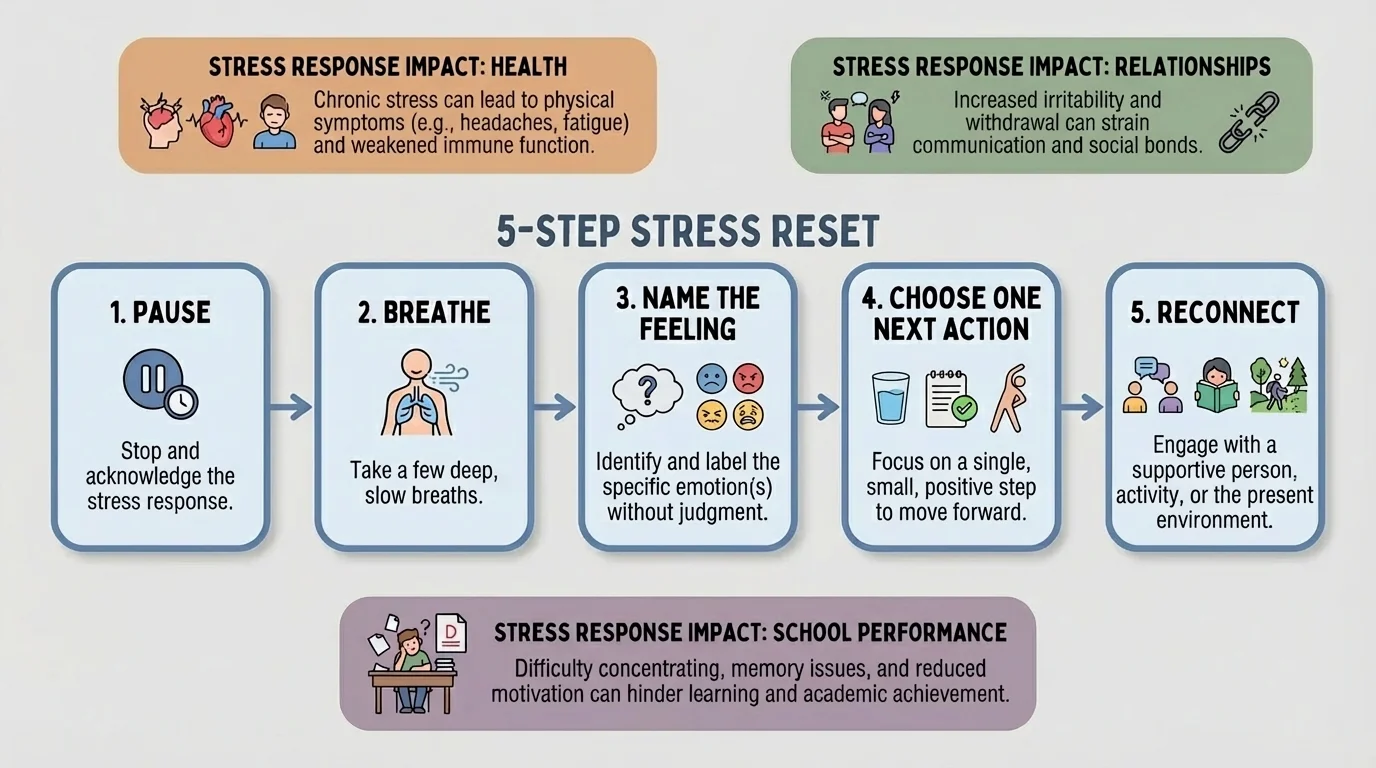
One reason this works is that stress often makes everything feel equally urgent. A reset routine narrows your focus. You stop trying to solve your whole life in one moment and deal with the next right thing.
Practical example: You are freezing before starting an assignment
You open your learning platform, see several tasks, and suddenly feel stuck.
Step 1: Pause and reduce noise
Close unrelated tabs and silence notifications for a short work block.
Step 2: Name the actual problem
Instead of "I can't do this," try "I feel overwhelmed because I don't know where to start."
Step 3: Make the task smaller
Change "finish the project" to "open the instructions and list three required parts."
Step 4: Work for one short interval
Commit to a brief focused period, then reassess. Starting often reduces stress more than waiting does.
This does not solve every problem, but it often breaks the freeze response.
Another useful tool is a communication pause. If you are upset, delay important messages until you can reread them calmly. Stress can push you to send the version of a message that creates more problems later.
Later in the day, the routine in [Figure 4] is still useful. Whether the stress comes from family conflict, deadlines, or social tension, the sequence stays the same: pause, regulate, choose, act.
Resilience is the ability to recover, adapt, and keep functioning after stress, setbacks, or challenges. It does not mean never struggling. It means you can bend without completely breaking, and you can rebuild after difficult moments.
Resilience grows through habits, not through one perfect day. Helpful habits include consistent sleep, regular meals, movement, realistic scheduling, and protecting some time without constant digital input. You do not need a perfect routine. You need a repeatable one.
Small habits are stronger than dramatic resets
Many people wait until stress becomes extreme and then try to change everything at once. That usually fails. A better approach is to build a few stable supports: a regular bedtime target, one calendar system, one homework start ritual, one person you check in with, and one calming strategy you actually use.
It also helps to improve your internal voice. Stressed thinking often sounds like "I'm failing," "I ruin everything," or "There's no point." A more useful voice sounds like "I'm overloaded," "I need to break this down," or "I can recover from a rough week." That shift is not fake positivity. It is accurate and functional.
Outside support matters too. Friends, family members, coaches, mentors, therapists, or trusted adults can help you regulate, problem-solve, and keep perspective. Strong self-management does not mean doing everything alone.
Sometimes stress moves beyond what you should handle by yourself. Reach out if stress is lasting for weeks, causing major sleep problems, making it hard to eat normally, leading to panic attacks, harming your grades significantly, damaging important relationships, or making you feel hopeless.
You should also get help right away if stress is leading to self-harm, suicidal thoughts, substance misuse, or an unsafe situation. In those situations, tell a trusted adult, parent, guardian, school counselor, healthcare provider, or crisis service immediately. Getting help is a strength, not a failure.
"You do not have to control every thought or feeling. You do need skills for what you do next."
A practical way to ask for help is to be specific. You can say, "I've been feeling overwhelmed for two weeks. I'm not sleeping well, I'm falling behind, and I need help making a plan." Specific information makes it easier for someone to support you.
The more honestly you assess stress, the more power you have to respond wisely. Stress may be automatic, but your next step can become more skillful with practice.
