Most people do more negotiating than they realize. The price of a phone plan, the pay for a job, the late fee on a bill, the terms of a repair, the cost of lessons, even who pays for what in a shared expense—these are all negotiations. The difference between someone who negotiates well and someone who avoids it can add up to hundreds or even thousands of dollars over time, but it also affects something less obvious: stress. When you know how to prepare, ask, and respond, you feel more in control.
Negotiation is not about being aggressive, manipulative, or "winning" at someone else's expense. It is about solving a problem between people who both have interests, limits, and choices. In adult life, strong negotiation skills help you protect your time, your money, and your dignity. They also help you build respectful relationships, because clear agreements prevent confusion and resentment later.
You will probably begin negotiating before you think of yourself as an adult. You might discuss pay for babysitting, tutoring, yard work, freelance design, or a part-time job. You may ask a company to remove a fee, request a better plan from a streaming or phone provider, or compare repair estimates before agreeing to service. If you never ask questions, you often accept the default terms. Default terms are not always fair terms.
Strong negotiators usually do three things well: they prepare, they stay calm, and they know their limits. That means they do not enter a conversation hoping to "just see what happens." They go in knowing what they want, what evidence supports their request, and what they will do if the answer is no.
Negotiation is a conversation where two or more people try to reach an agreement.
Fair terms are conditions that reasonably match the value, effort, cost, risk, and responsibilities involved.
Walk-away point is the point where a deal no longer works for you, so you choose not to accept it.
Being fair does not mean accepting whatever sounds polite. A deal can sound friendly and still be one-sided. For example, a client might praise your work but ask for a very low rate. A company might offer a discount but lock you into a long contract with expensive cancellation fees. Fairness depends on the full picture, not just one attractive detail.
One useful idea in negotiation is your BATNA. This stands for your best alternative if the deal does not happen. Your BATNA might be another job option, another service provider, waiting until next month, buying used instead of new, or simply saying no. The stronger your alternative, the more confident you can be.
Another important idea is an anchor. An anchor is an opening number or position that influences what people think is reasonable. If a repair shop first says a job will cost $900, a later offer such as $780 may feel better even if another shop would do it for $600. The first number affects your expectations.
You also need leverage, which means anything that strengthens your position. Leverage can come from research, skills, experience, multiple offers, timing, positive reviews, or being willing to wait. Leverage is not about power for its own sake. It is about having real options and useful information.
Negotiation is problem-solving, not conflict
A strong negotiation mindset might be: "Let's look at the facts, the value, and the options." A weaker mindset might be: "I hope they like me enough to give me a good deal." Respect matters, but results usually come from preparation and clarity more than personality alone.
When you think of negotiation as problem-solving, your language changes. Instead of saying, "That's too much," you might say, "Can you help me understand what is included in that price?" Instead of saying, "I need more money," you might say, "Based on the responsibilities and local rates, I'm looking for something closer to $18 an hour." Calm, specific language makes you easier to take seriously.
[Figure 1] Preparation gives you structure and shows the key parts: your target, your acceptable range, your walk-away point, your evidence, and the questions you need answered. If you skip this step, you are more likely to agree too fast, forget important details, or feel pressured by the other person's confidence.
Start by deciding three reference points. First, your target: the result you would be happy to get. Second, your acceptable range: what would still be okay. Third, your walk-away point: the lowest pay, highest price, or weakest terms you will accept before leaving. If you are discussing hourly pay, your target might be $17 an hour, your acceptable range might be $15 to $17, and your walk-away point might be anything below $15.
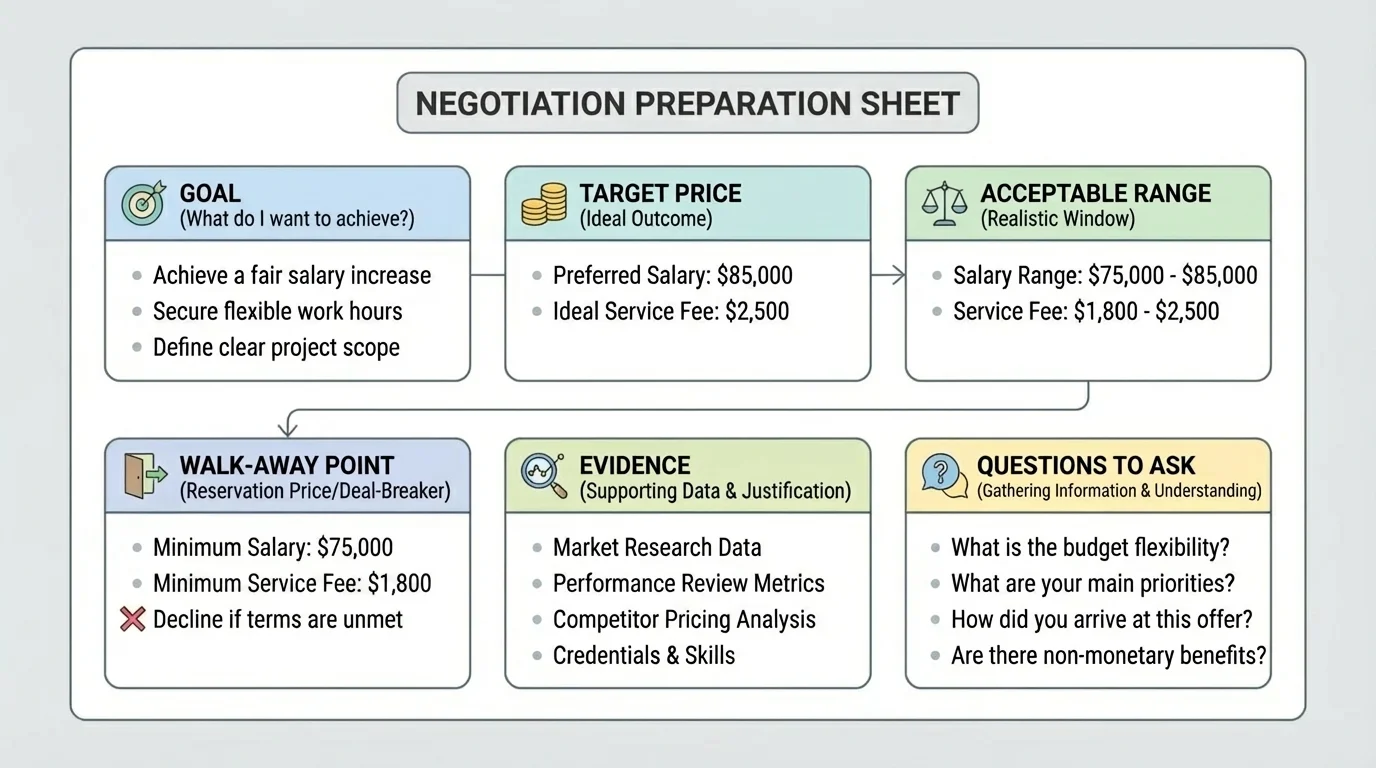
Next, gather evidence. Research typical pay, normal market prices, competitor offers, reviews, hidden fees, contract length, and the value you bring. If you are asking for higher pay, evidence might include your experience, certifications, schedule flexibility, strong attendance, or examples of responsibility. If you are comparing services, evidence might include quotes from three providers and the exact features each one includes.
Then prepare your questions. Good negotiators do not just make statements; they ask useful questions. Examples include: "What is included in this price?" "Is there flexibility on the rate?" "Are there setup fees or cancellation fees?" "How often is pay reviewed?" "Can this be put in writing?" Questions reveal information, slow down pressure, and give you time to think.
Finally, prepare your emotions. Negotiations can trigger nerves, especially if money is involved. Decide in advance that you will pause before answering, write down key details, and avoid making decisions under pressure. If needed, use a simple delay line: "Thanks for explaining that. I want to look at the full details before I decide."
[Figure 2] The first number in a negotiation often becomes a mental reference point, even when it is not the best number. That is why anchoring matters. If you hear a strong opening figure first, your brain starts adjusting around it. Skilled negotiators understand this and respond carefully rather than reacting emotionally.
If you are the one making the first offer, anchoring can help you set the discussion in a stronger range. But your anchor should still be realistic and defensible. An offer that is wildly unreasonable can damage trust. A strong anchor is ambitious but supported by facts.
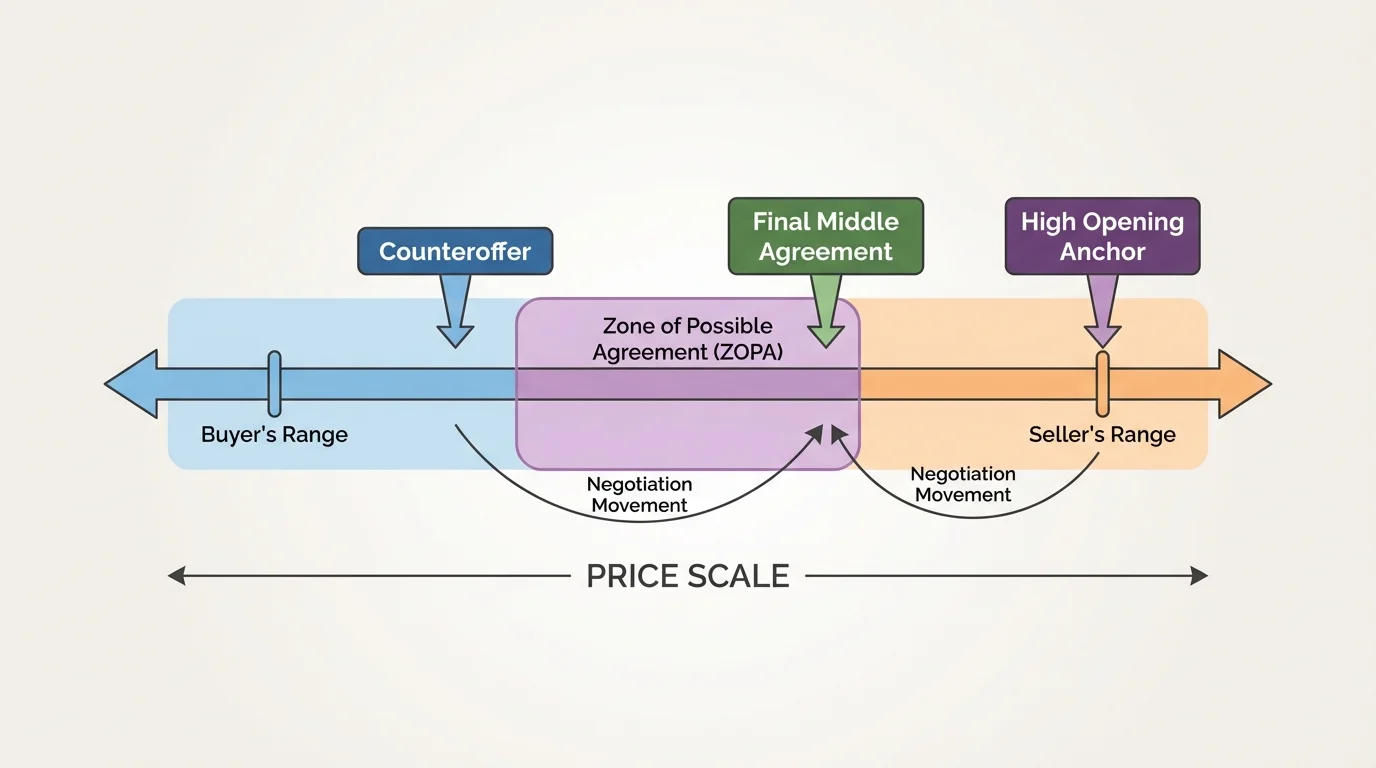
Suppose you are offered $13 an hour for a job, but your research shows similar jobs nearby usually pay $15 to $17. Instead of saying "okay" or blurting out "that's bad," you could say, "Based on the responsibilities and what similar roles are paying, I was expecting something closer to $16 an hour. Is there room to move on the rate?" Your $16 response is a counteroffer that sets a new anchor.
Anchoring also matters in purchases. If a seller starts at $500 and you hoped to pay $350, do not negotiate from $500 as if it is automatically reasonable. Bring in outside facts: "I've seen similar models listed between $340 and $380. If you can do $360, I'm ready to buy today." That shifts the conversation toward a more evidence-based range.
As shown earlier in [Figure 1], anchoring works best when you already know your target and limits. Without that preparation, the other person's first number can become your accidental plan.
Salary negotiation can feel intimidating because it connects to self-worth, but salary is not a personal compliment. It is a business decision about the value of your work. Treating it that way helps you stay calm and professional.
For many young adults, pay discussions may involve hourly work in retail or food service, as well as tutoring, pet sitting, youth coaching, creative gigs, or internships. The same basic steps apply in all of these situations.
Example: Negotiating pay for a part-time job
Step 1: Research the range
You check local listings and find that similar jobs pay between $14 and $17 an hour.
Step 2: Choose your numbers
Your target is $16 an hour, your acceptable range is $15 to $16, and your walk-away point is below $15.
Step 3: Prepare your reasons
You can work weekends, you already have customer service experience, and you have strong attendance from previous commitments.
Step 4: Respond clearly
If offered $14, you say, "Thank you for the offer. Based on the responsibilities and my experience, I was hoping for something closer to $16 an hour. Is there flexibility?"
Step 5: Broaden the conversation if needed
If pay cannot change, ask about paid training, scheduling stability, transportation support, review timing, or additional hours.
Notice what makes that response strong. It is respectful, specific, and calm. It does not apologize for asking. It does not demand. It shows that you understand your value and are open to discussion.
If a job application asks for your expected pay, avoid guessing blindly. Use research and a reasonable range. A range gives flexibility while still protecting you. For example, if you are comfortable with $15 to $17, writing that range is often better than locking yourself into one number too early.
Sometimes the best move is to negotiate the full package, not just pay. If a company cannot raise the rate now, can they offer earlier reviews, more predictable scheduling, remote work options, transportation reimbursement, or a signing bonus? A "no" on one part of the deal does not always mean "no" on everything.
Many adults lose money not because the price was high, but because the terms were unclear. A service agreement is a deal that explains what one person or business will provide, what it costs, and what rules apply. This can include phone plans, streaming bundles, internet service, tutoring, subscriptions, repairs, lessons, and freelance work.
When reviewing a service agreement, ask about the full cost, not just the headline price. A monthly plan advertised at $25 may actually become $25 plus $8 in fees plus a required setup charge. Over one year, the difference matters. If the total monthly cost is $33 instead of $25, then over 12 months you pay \(33 \times 12 = 396\), not \(25 \times 12 = 300\). That is a difference of \(396 - 300 = 96\), or $96 more than the ad first suggested.
Also ask what happens if something changes. Can you cancel early? Is there a late fee? What if the service is poor? What if the repair fails after one week? What if deadlines are missed? Good agreements answer these questions before problems happen.
| Question to Ask | Why It Matters |
|---|---|
| What exactly is included? | Prevents confusion about what you are paying for. |
| Are there any extra fees? | Protects you from hidden costs. |
| How long is the contract? | Shows how long you are committed. |
| What is the cancellation policy? | Helps you avoid expensive exit fees. |
| Is there a warranty or guarantee? | Protects you if the service is poor. |
| Can you send that in writing? | Creates a record you can rely on later. |
Table 1. Key questions to ask before agreeing to a service or contract.
If a company says, "This deal ends today," slow down. Artificial urgency is a common pressure tactic. A fair deal usually survives long enough for you to read it. If it does not, that alone may be valuable information.
Example: Negotiating a repair service
Step 1: Get multiple quotes
You receive estimates of $180, $240, and $260 for the same basic repair.
Step 2: Compare details
The $240 quote includes parts and a 90-day warranty. The $180 quote does not include warranty coverage.
Step 3: Negotiate using facts
You say, "I like your reviews and the warranty, but another quote came in lower. Is there any flexibility on the price?"
Step 4: Ask for alternatives
If the price stays the same, ask whether they can include a follow-up check, reduce the diagnostic fee, or shorten the payment timeline.
Negotiation is often not just about reducing the number. It can also improve quality, timing, guarantees, and clarity.
Some negotiations are really decisions about future money. These include buying a used device, financing a purchase, choosing a payment plan, or deciding whether a "deal" is actually worth it. A lower monthly payment is not always cheaper overall. You need to look at total cost, fees, and time.
For example, suppose one option is $40 a month for 24 months, and another is $55 a month for 12 months. The first feels cheaper each month, but the total costs are different. The first total is \(40 \times 24 = 960\). The second total is \(55 \times 12 = 660\). Even though $40 is lower each month, the total is $300 more.
When money is involved, ask these practical questions: "What is the total cost?" "How much do I pay if I miss a payment?" "Is there interest?" "Can I pay early without penalty?" "What happens if I cancel?" These questions protect you from agreeing to a plan that sounds manageable now but becomes expensive later.
If you are buying something used from an online marketplace, negotiation should include condition, risk, and verification. Ask for clear photos, exact model information, proof that the item works, and whether accessories are included. Then make your offer based on the item's real value, not just the seller's asking price.
Good negotiation is closely connected to communication. Your words matter, but so do your tone, pacing, and listening. If you sound uncertain, rush to fill silence, or start explaining too much, you may weaken your position without realizing it.
Be direct. Say what you are asking for in one clear sentence. Be calm. You do not need to argue. Be quiet when needed. After making a reasonable request, pause. Silence often feels uncomfortable, but it gives the other person space to respond.
Use assertive language, not passive or aggressive language. Passive: "Um, I was just wondering if maybe there's any chance..." Aggressive: "This is ridiculous, fix it." Assertive: "I'd like to discuss whether there's flexibility on the rate." Assertive communication is respectful and clear.
Listening is also a negotiation skill. If the other person says no, find out why. Is it a budget limit, a company policy, a timing issue, or something else? Once you know the real obstacle, you can respond better. For example, if the rate cannot change today because of policy, perhaps the start date, hours, review timeline, or responsibilities can change instead.
"The person who asks clear questions usually gets better answers."
Another useful move is labeling. That means calmly naming what seems to be happening: "It sounds like the timeline is the biggest concern," or "It seems like the price matters more than the extra features right now." This shows that you are listening and helps guide the conversation toward the real issue.
[Figure 3] Walking away is not failure. It is a decision, and a simple checklist can help: are the terms clear, are the terms fair, is there pressure, and do you still have a better alternative? If the answer keeps pointing toward risk or unfairness, leaving is often the strongest move.
Common red flags include unclear pricing, refusal to put terms in writing, pressure to decide immediately, changing the agreement at the last minute, guilt-based language, disrespect, and offers that seem too good to be true. Another red flag is when someone ignores your questions and keeps repeating the same sales script.
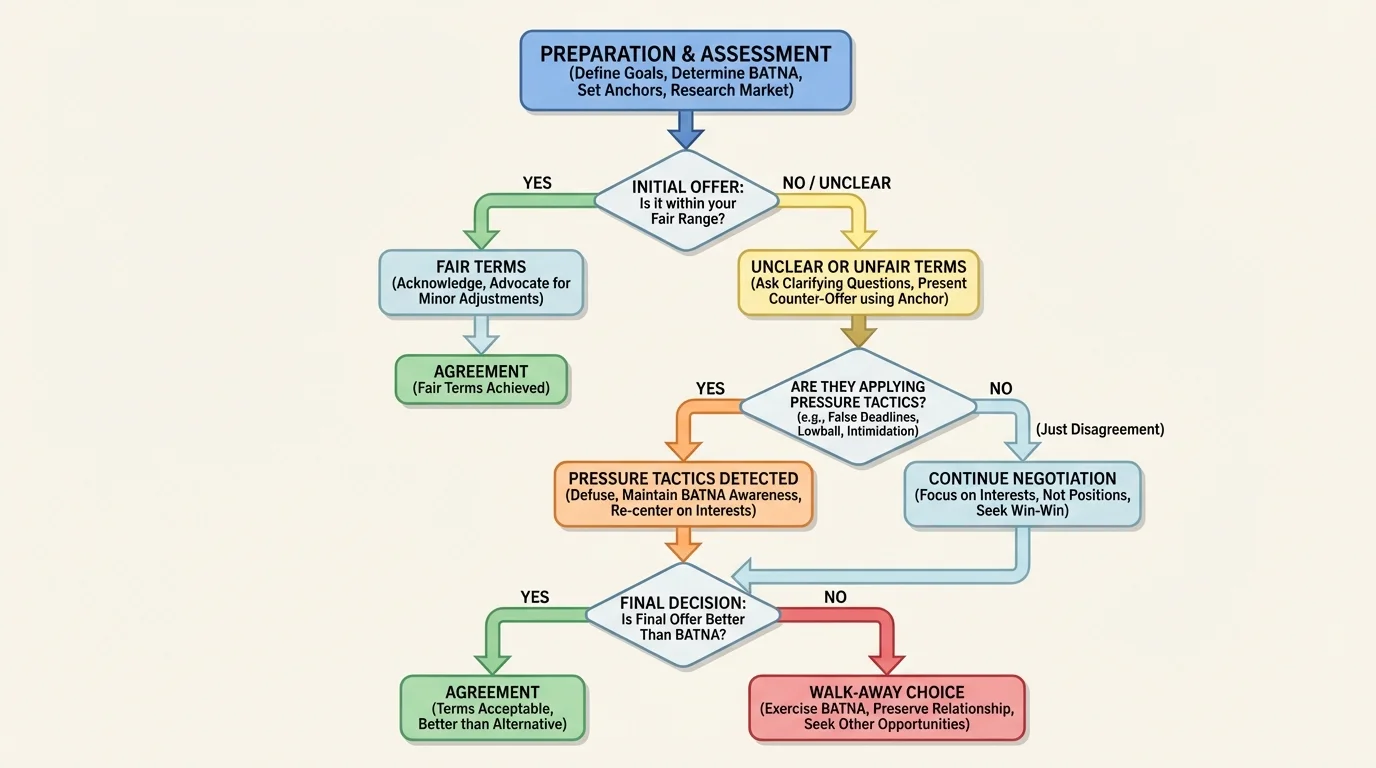
A strong walk-away line is simple: "Thanks for your time, but I'm not comfortable moving forward with these terms." You do not need a long defense. Overexplaining can invite more pressure. Short, calm, and final is often best.
Sometimes you do not need to leave permanently. You can pause instead. Say, "I'm going to review this and get back to you tomorrow." A pause protects you from emotional decisions. It also gives you time to compare options, read the fine print, or talk to a trusted adult or mentor.
Later, when you compare options, the decision process in [Figure 3] still applies. If one offer is clear, respectful, and within your limits while another relies on pressure and confusion, the better choice is often obvious.
Advocacy means speaking up for your needs, rights, and interests in a clear and respectful way. In negotiation, advocacy means you do not stay silent when terms are vague, unbalanced, or unfair.
Advocating for fair terms may mean asking for more pay, requesting a lower fee, changing a deadline, asking for written confirmation, removing an automatic renewal, or adding a warranty. It may also mean asking for equal treatment. If two people are doing similar work with similar responsibilities, it is reasonable to ask how pay decisions are being made.
One useful structure is: state the issue, give the reason, make the request. For example: "The cancellation fee is higher than I expected. Since I was not told about it clearly at sign-up, I'm asking whether it can be reduced or waived." This keeps your message organized and more persuasive.
Fair terms are not always identical terms. The goal is not that every deal looks the same. The goal is that the agreement makes sense for the responsibilities, risks, value, and alternatives involved. That is why evidence matters so much. If you can explain why your request is reasonable, you are far more effective than if you simply repeat what you want.
People often assume negotiation is mainly about confidence, but research and preparation usually matter more than sounding bold. A calm person with facts often does better than a loud person with no evidence.
When you advocate for yourself, keep the relationship in mind. You can protect your interests without burning bridges. Phrases like "I'd like to find a solution that works for both of us" or "I'm interested, but I'd need different terms" keep the conversation respectful while still holding your boundary.
One common mistake is accepting or rejecting too quickly. Fast decisions often happen because of nerves, not because of careful thinking. Another mistake is negotiating only one piece of the deal. A low price with bad terms can be worse than a slightly higher price with good protection and flexibility.
A third mistake is talking without enough information. If you do not understand the fees, time commitment, responsibilities, or risks, your first job is not to persuade. Your first job is to learn. Ask questions until the deal is clear.
A fourth mistake is taking "no" too personally. A no may simply mean the current offer is fixed, the timing is wrong, or the other person expects a counteroffer. Sometimes the right response to no is another question: "If the rate can't change, is there flexibility anywhere else in the package?"
If a conversation starts going badly, reset it. You can say, "Let me make sure I understand," and summarize the deal in simple terms. You can also say, "I'd like to take a step back and review the numbers." A reset slows the conversation, reduces emotion, and returns attention to facts.
The goal is not to become someone who argues about everything. The goal is to become someone who notices when terms matter, prepares thoughtfully, asks clearly, and protects their future self from expensive or unfair choices.
