Here's a hard truth that catches a lot of students off guard: after high school, nobody is going to care about your schedule as much as you do. Whether you plan to attend college, a trade program, military training, certification courses, or go straight into work while continuing education later, success depends less on raw intelligence and more on whether you can manage yourself consistently. That means building systems that still work when you are tired, distracted, stressed, or busy.
At this stage, you do not need a perfect planner, a fancy app, or a superhuman attention span. You need a practical approach to executive functioning: organizing tasks, estimating time, making decisions, following through, and adjusting when plans change. Those are the same skills that help you submit an online assignment on time, prepare for a certification exam, show up ready for a job interview, or keep up with multiple deadlines without panicking.
Study system means the set of tools and routines you use to learn, remember, and complete work. Planning system means the way you track deadlines, break down tasks, and decide what to do next. Postsecondary readiness means being prepared for life after high school, including the independence, time management, communication, and responsibility expected in college, career training, and work.
A strong system matters because motivation changes from day to day. Some days you feel focused. Other days you do not. If your whole life depends on "feeling productive," you will fall behind fast. A system protects you from that. It tells you what to do next even when your mood is unhelpful.
Motivation is helpful, but it is unreliable. Systems are different. A system is a repeatable process you follow consistently. For example, instead of thinking, "I should study chemistry sometime tonight," a system sounds like this: "At 6:30 p.m., I review flashcards for 20 minutes, then complete 2 practice problems, then check tomorrow's deadlines." Even though this topic is not about math class, the idea of breaking a task into smaller parts works like dividing a large total into manageable pieces: if a project needs 10 hours and you spread it over 5 days, that becomes \(\dfrac{10}{5} = 2\) hours per day.
Without a system, problems usually pile up in a predictable way. You miss one deadline because you forgot it. Then you avoid checking messages because you feel behind. Then small assignments become a crisis. With a system, you catch issues early. You know what is due, what matters most, and what can wait.
Students often overestimate what they can do in one evening and underestimate what they can finish in two weeks of steady effort. That is why good planning is less about heroic last-minute effort and more about realistic pacing.
This is especially important in online learning. Since you are learning from home, you are responsible for noticing deadlines, checking platforms, reading instructions carefully, and managing distractions in your own environment. No one is standing next to you reminding you what to do next. That independence is excellent practice for postsecondary life, but only if you use it deliberately.
[Figure 1] Your first move is to create one trusted command center for your academic work so you have one connected system instead of scattered reminders. A command center is not only a physical desk setup. It is your main system for capturing information, checking deadlines, and deciding your next actions. If your assignments are split across sticky notes, screenshots, random tabs, text messages, and memory, you are creating confusion for yourself.
A good command center has three parts: a calendar for events and due dates, a task list for action steps, and a quick capture space for ideas or reminders. Your calendar holds things tied to time, such as an exam date, a scholarship application deadline, a video advising appointment, or a work shift. Your task list holds things you need to do, such as drafting an essay outline, emailing a counselor, reviewing notes, or updating your resume. Your quick capture space is where you jot down anything that pops into your mind before you forget it.
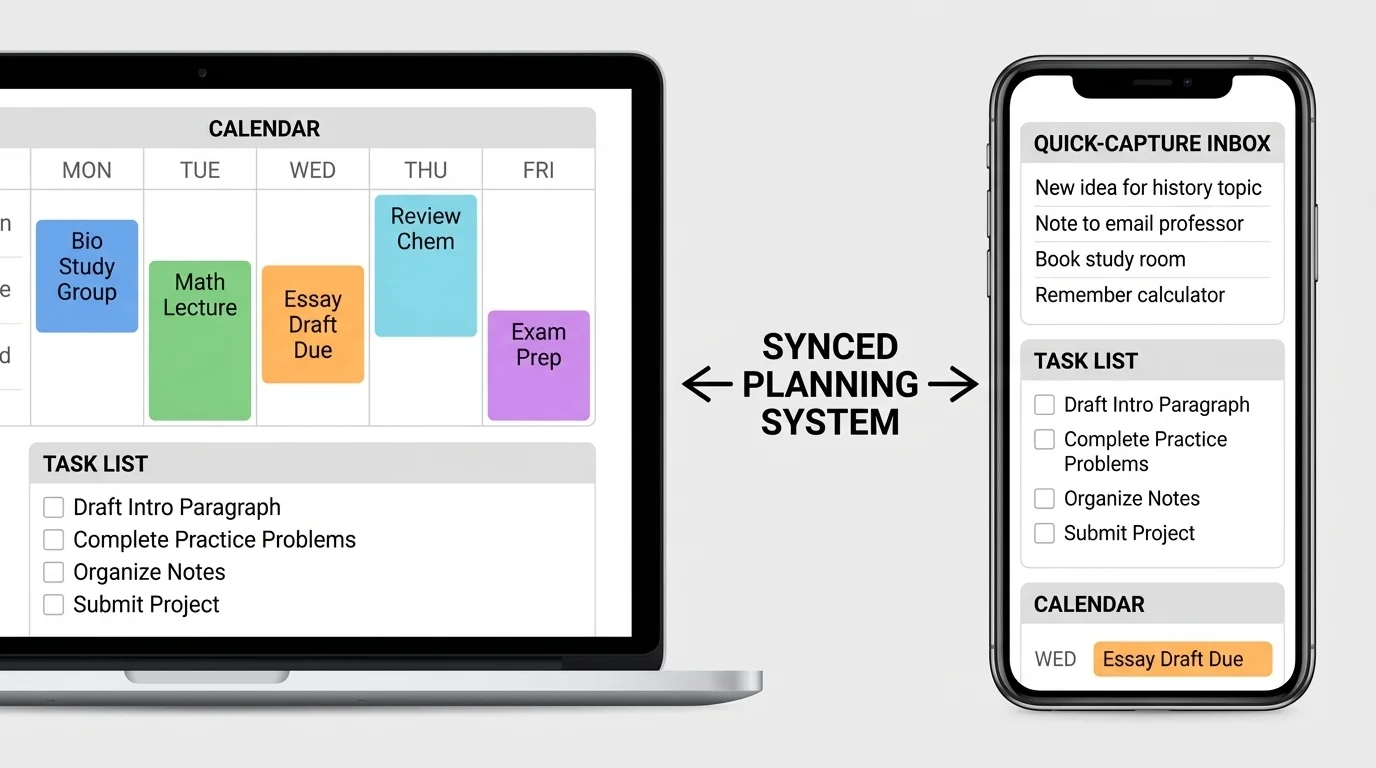
You can build this with digital tools, paper tools, or a mix. What matters most is simplicity and consistency. If you like digital tools, you might use a calendar app, a notes app, and one task manager. If you like paper, you might use a planner and one notebook page labeled "inbox." The mistake is using too many systems at once. If you track due dates in 4 different places, you will eventually trust none of them.
To keep your command center useful, do a short daily check and a longer weekly review. The daily check can take about 5 minutes: look at today, look at tomorrow, and confirm your top priorities. The weekly review can take about 20 to 30 minutes: clear your inbox, update deadlines, review upcoming responsibilities, and reset your plan. Later, when your schedule becomes more independent, the same habit helps you manage work hours, transportation, applications, and study deadlines at the same time.
Setting up a command center in one evening
Step 1: List every place where school information currently lives.
This may include your online platform, email, notes app, browser tabs, screenshots, and paper notes.
Step 2: Choose one calendar, one task list, and one inbox.
Keep it basic. The best system is the one you will still use next month.
Step 3: Move all deadlines into the calendar and all unfinished actions into the task list.
For example, a research project due in 12 days becomes separate tasks: choose a topic, find sources, create an outline, draft, revise, and submit.
Step 4: Set one daily check time.
You might choose after breakfast, after work, or before your evening study block.
One more rule: make your next actions visible. "Work on history project" is too vague. "Read source 1 and highlight evidence" is clear. The more specific the task, the less energy you waste deciding how to begin.
[Figure 2] Long-term success usually depends on backward planning, which means starting with the deadline and moving backward to smaller milestones. If you only think about the final due date, you may not notice how much work is hidden inside it. A college application essay, for example, is not just "write an essay." It includes brainstorming, drafting, editing, feedback, proofreading, and submission checks.
Start with the final deadline, then ask: what must be finished before that? Then ask the same question again for each milestone. This creates a chain of smaller deadlines. If an application is due on the 30th, maybe your draft needs to be done by the 20th, your outline by the 15th, and your topic decision by the 12th. You are turning one stressful event into several manageable actions.
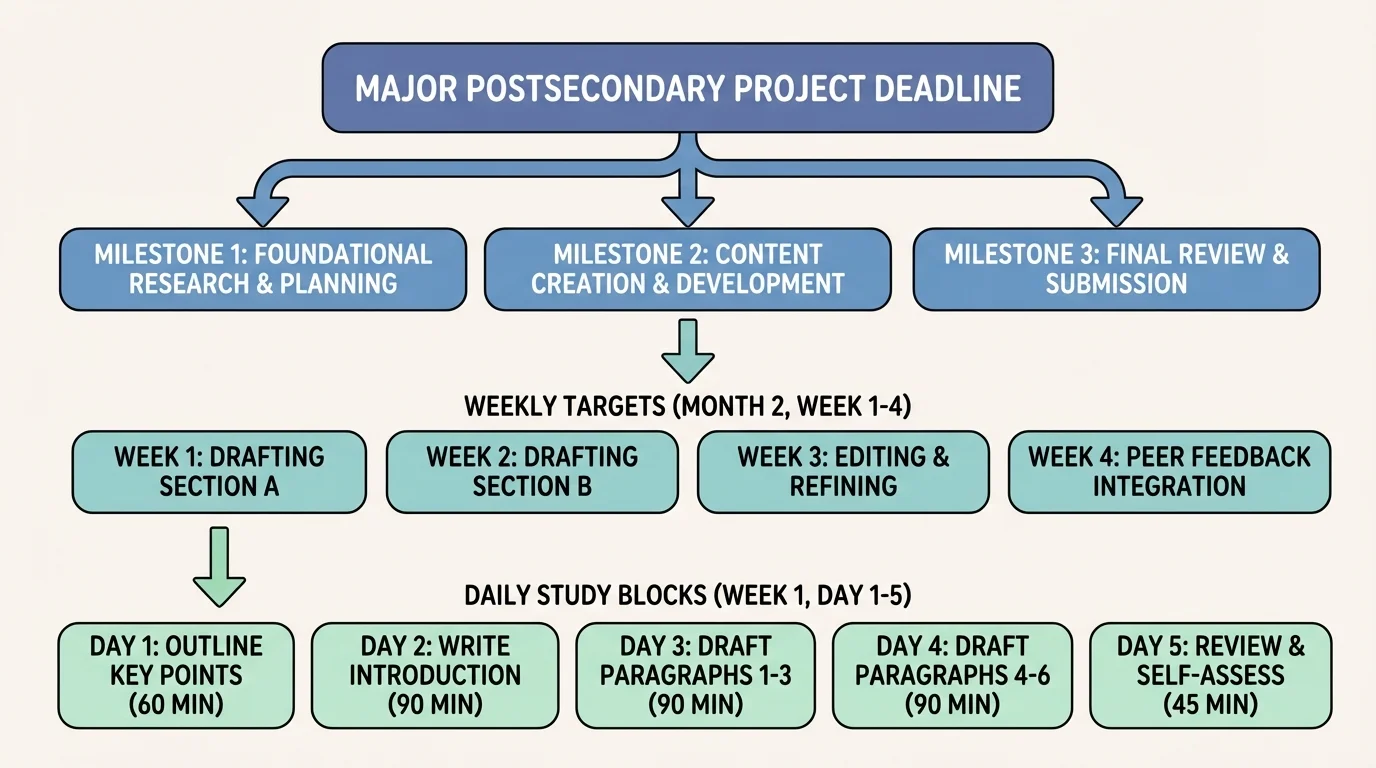
Once you know your milestones, build a weekly plan. A weekly plan answers three questions: What matters most this week? When will I work on it? What might get in the way? This is where time blocking becomes useful. Time blocking means assigning a specific job to a specific block of time instead of hoping you will "fit it in later."
For example, a realistic week might include online coursework, a part-time job, family responsibilities, exercise, and sleep. If you know you work Tuesday and Thursday evenings, do not pretend those are ideal study times. Put your hardest mental work when your energy is strongest. Some students focus better early in the day; others do better late afternoon. Build around reality, not fantasy.
A daily plan should be even simpler. Choose your top 1 to 3 priorities. Not 10. Not every possible task. Just the few actions that would make the day feel productive even if everything else got messy. That protects you from overwhelm. Daily wins connect to bigger goals only when they are specific and scheduled.
| Planning Level | Main Question | Example |
|---|---|---|
| Long-term | What is the final goal or deadline? | Submit nursing program application by October 15 |
| Weekly | What must move forward this week? | Draft personal statement and request recommendation |
| Daily | What exact action happens today? | Write an introduction paragraph from 4:00 to 4:30 p.m. |
When choosing what to do first, use a simple decision rule: urgent and important tasks come first; important but not urgent tasks get scheduled before they become urgent; low-value tasks wait. Checking a notification feels productive, but it rarely moves your life forward.
"You do not rise to the level of your goals. You fall to the level of your systems."
— James Clear
That quote matters because postsecondary life brings more freedom and more responsibility at the same time. Freedom without planning often turns into stress.
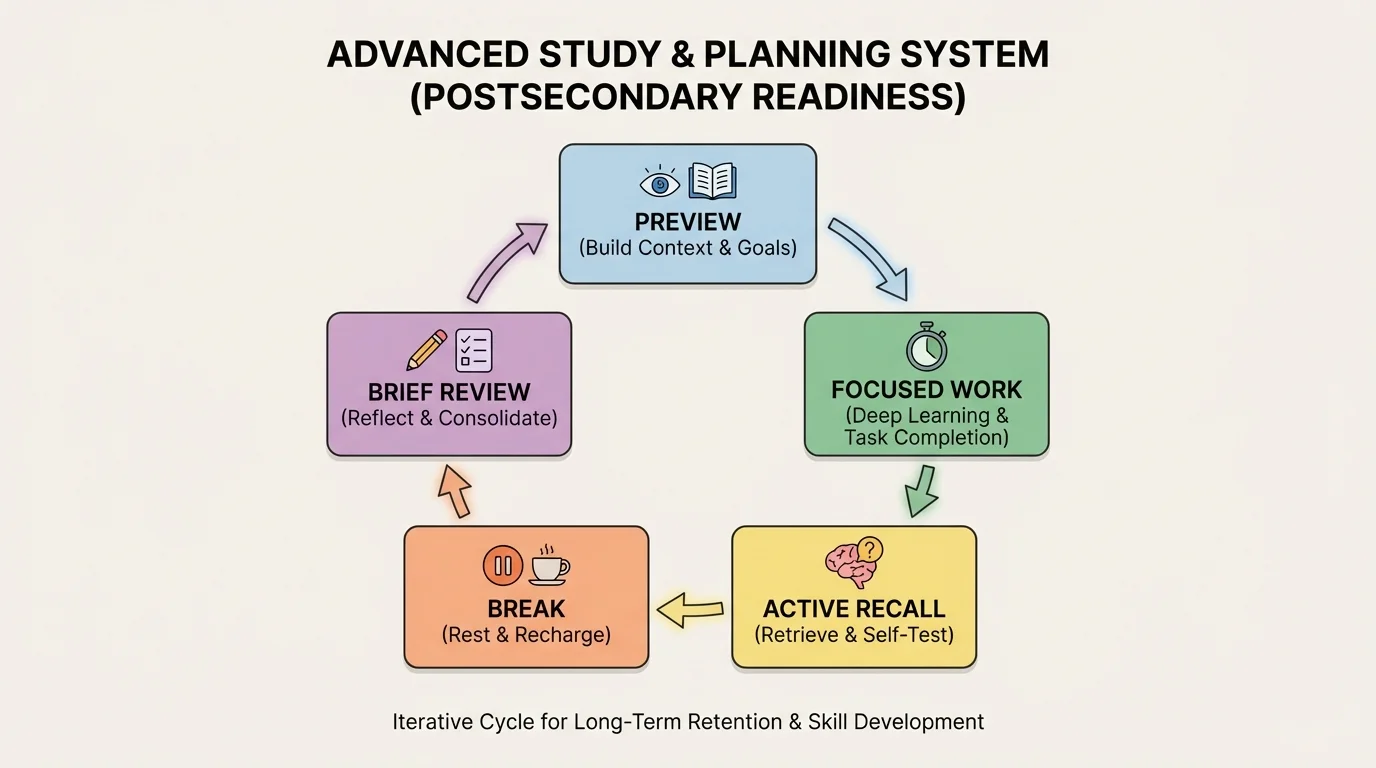
[Figure 3] Many students think good studying means staring at notes for a long time. It does not. Effective learning follows a repeatable cycle, and strong study sessions include preparation, focused work, retrieval, and review rather than passive rereading. A smart study system uses methods that help your brain remember and apply information later.
One of the most useful methods is active recall. That means pulling information out of memory instead of just looking at it. You might close your notes and explain a concept out loud, answer practice questions from memory, or write what you remember before checking accuracy. This feels harder than rereading, but that difficulty is often a sign that learning is actually happening.
Another powerful method is spaced repetition. Instead of cramming once for 3 hours, you review material several times over multiple days. A simple pattern might be review on day 1, day 3, day 7, and day 14. The exact schedule can vary, but the principle is consistent: short, repeated reviews beat one giant session.
You also need focused sessions. A study block does not have to be extreme. Often 25 to 45 minutes of concentrated work is stronger than a distracted 2-hour session. Put your phone out of reach, close unrelated tabs, and decide your goal before you begin. "Finish 10 flashcards and self-test" is far better than "study biology."
The focus-retrieval cycle works because learning has two parts: taking in information and proving you can use it without support. First, preview or review the material briefly. Next, work with full attention. Then test yourself without looking. Finally, correct mistakes and schedule the next review. This cycle is what turns short-term exposure into longer-term memory.
Match your study method to the type of task. For memorizing vocabulary, flashcards and self-testing work well. For solving problems, do practice problems without immediately checking answers. For writing, draft first and edit later instead of trying to create a perfect sentence every time. For reading difficult material, stop after a section and explain it in your own words.
As shown earlier in [Figure 3], breaks are part of the system, not proof that you are lazy. Short breaks protect attention, especially when your work requires concentration. But breaks need boundaries. A 5-minute stretch is different from accidentally spending 45 minutes scrolling.
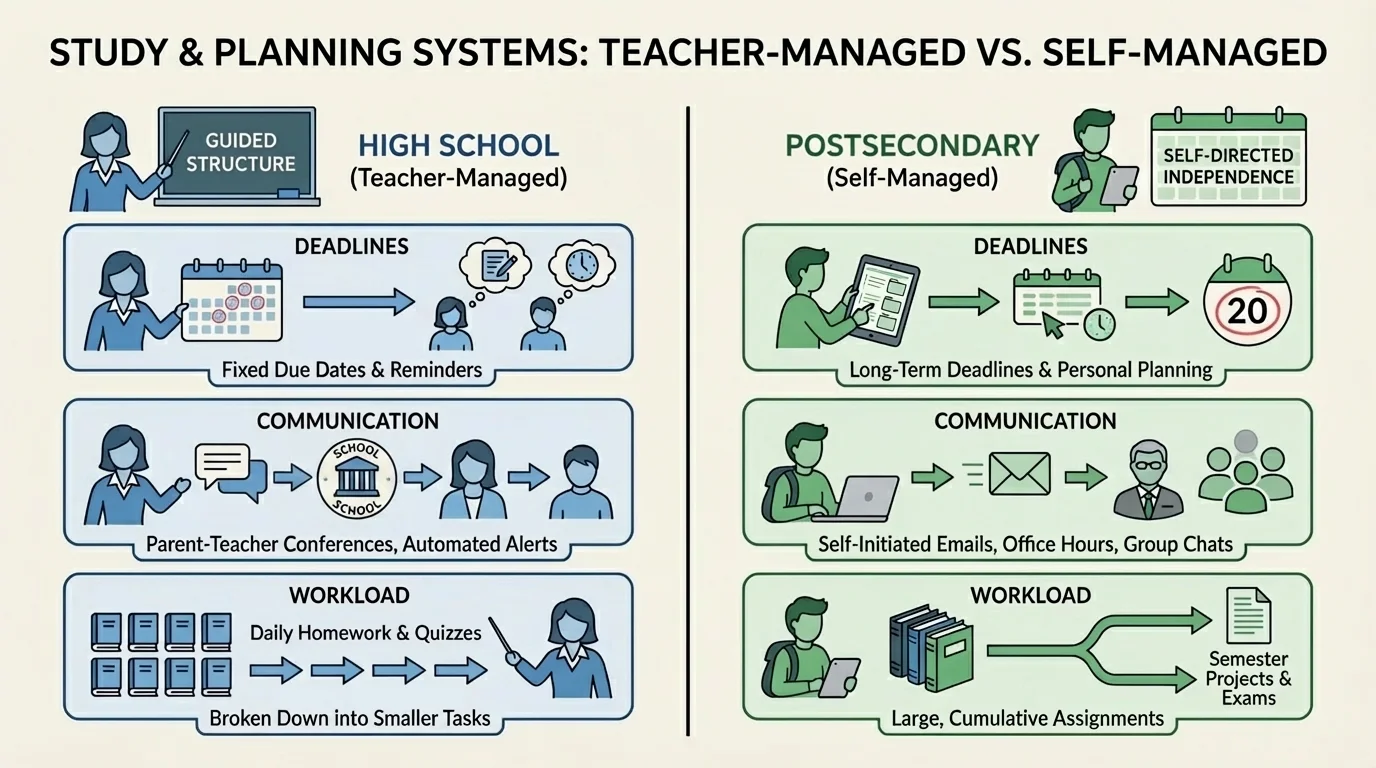
[Figure 4] Postsecondary readiness means preparing for a different level of independence, and the biggest change is often not harder content but fewer reminders. In many college and training settings, instructors may post deadlines once and expect you to track them. Employers expect punctuality, follow-through, and communication without repeated prompting. If you miss something, the consequence may be immediate.
Your system should include more than just school assignments. Add application deadlines, financial aid tasks, transcript requests, test dates, work shifts, volunteer hours, and personal responsibilities. If it matters, it belongs in your system. Real life does not sort responsibilities neatly for you.
Communication is part of readiness too. If you are confused, ask early. If you will miss a deadline, communicate before the deadline if possible. If you need a recommendation, request it respectfully and ahead of time. A planning system supports communication because it helps you notice needs before they become emergencies.
Another postsecondary reality is transition cost. New routines take energy. A schedule that worked in high school may not work if you are commuting, working, or taking asynchronous courses. The independence comparison in [Figure 4] matters because it reminds you to design for flexibility, not just structure. Your system should be able to stretch when life changes.
Preparing for a month with multiple responsibilities
Step 1: Put all fixed dates in one place.
Include assignment deadlines, work shifts, appointments, application dates, and family commitments.
Step 2: Identify heavy weeks early.
If 3 major tasks land in the same week, start one of them sooner.
Step 3: Protect your non-negotiables.
Sleep, meals, medication, and transportation planning are part of academic success, not separate from it.
Step 4: Prepare for communication.
Draft messages in advance for asking questions, confirming details, or requesting help.
Good planning also helps with money and time. If you know a certification test costs $85 and is due in 6 weeks, you can plan both your study schedule and your budget. That is a real-world skill adults use constantly.
No planning system works perfectly all the time. You will have weeks when you get sick, lose motivation, face family stress, or simply misjudge how long something will take. Strong planners are not people who never fall behind. They are people who notice quickly, adjust calmly, and restart efficiently.
When a week goes badly, avoid the all-or-nothing trap. Do not say, "I failed this week, so the whole plan is ruined." Instead, reset. First, identify what is still essential. Second, delay or cut low-priority tasks. Third, communicate where needed. Fourth, rebuild the next 2 to 3 days, not the next 2 months.
You have probably already used a basic version of this skill in everyday life. If dinner takes longer than expected, you adjust the evening. If your phone battery is low, you change your plan to charge it before leaving. Planning works the same way: notice, decide, adjust.
Burnout often comes from trying to run at maximum speed for too long. Protecting your energy is part of executive functioning. Sleep affects memory. Food affects concentration. Movement affects mood and attention. Rest is not a reward you earn only after perfect performance. It is part of the system that makes performance possible.
One practical strategy is to build a minimum-day version of your routine. On a strong day, maybe you study for 90 minutes. On a rough day, your minimum version might be 15 minutes of review, checking deadlines, and setting tomorrow's top task. That keeps the system alive even when you cannot do everything.
Consider a student named Maya. She learns online, works part-time on weekends, and wants to apply to a dental assistant training program. At first, she keeps everything in her head. She misses one assignment, forgets to request a transcript, and almost misses an application step. Nothing is wrong with her ability. The real problem is that she has no system.
So Maya creates one command center. She puts every deadline in one calendar. She keeps one task list with clear verbs like "email program advisor," "review anatomy terms," and "draft short response." On Sunday evening, she checks the whole week. Each morning, she chooses her top 3 priorities. For studying, she uses active recall and spaced repetition instead of only rereading. When her work schedule changes, she shifts her study blocks rather than giving up.
After a month, Maya is not suddenly stress-free. But she is in control. She misses fewer deadlines. She starts tasks earlier. She communicates faster when issues come up. Most importantly, she trusts herself more because she has evidence that her system works.
Confidence often grows after action, not before it. When you repeatedly keep promises to yourself, even small ones, your self-trust becomes stronger.
You can build the same kind of system. Start small, keep it simple, and make it repeatable. A complicated system you abandon is less useful than a basic one you actually use every day.
Try This: Tonight, do a 10-minute reset. Put every deadline you know into one calendar, list your unfinished tasks in one place, and choose tomorrow's top 3 priorities.
Try This: During your next study session, spend the last 5 minutes testing yourself from memory instead of rereading your notes.
Try This: Before the week starts, look at your schedule and mark your hardest mental tasks for the times when your attention is strongest.
Try This: Create a minimum-day routine for stressful days so you can keep moving even when life feels heavy.
