A lot of people think negotiation is about being persuasive and de-escalation is about being nice. In real life, especially under pressure, both skills are fundamentally about something harder: keeping control of your thinking when someone else is trying to control the situation. That might happen in a text argument, a customer dispute over something you sold online, a conflict with a roommate, a work scheduling problem, or a tense family conversation. If you can stay clear-headed when the pressure rises, you protect your time, money, safety, and self-respect.
High-pressure situations often push people into one of three mistakes: they freeze, they explode, or they give in. None of those responses usually leads to a good outcome. If you freeze, you may say nothing while your interests get ignored. If you explode, the conflict often gets worse and the other person may use your reaction against you. If you give in too quickly, you may agree to something unfair just to end the discomfort.
Strong communication in conflict is not about sounding perfect. It is about staying focused on your goal, understanding the other person's behavior, and choosing a response that serves you. Sometimes that means working toward agreement. Sometimes it means slowing things down. Sometimes it means ending the conversation and bringing in help.
Negotiation is a conversation where people with different goals try to reach an outcome.
De-escalation is reducing the intensity of a tense situation so better decisions become possible.
Power imbalance means one person has more status, information, money, authority, confidence, or social influence than the other.
Bad-faith tactics are moves meant to confuse, pressure, manipulate, or wear someone down instead of honestly solving the problem.
These ideas matter because conflict is not automatically dangerous, but unmanaged conflict can become expensive, stressful, and unsafe. A disagreement about shared expenses can turn into lost money. A tense exchange with a manager can affect your schedule. A manipulative conversation with someone close to you can wear down your boundaries over time.
Negotiation is not the same as arguing. Arguing often focuses on who is right. Negotiation focuses on what happens next. De-escalation is not the same as surrender. You can lower the temperature of a conversation without giving up your position.
A useful mindset is this: solve the problem, not the performance. When people are emotional, they often start performing for control. They interrupt, exaggerate, guilt-trip, or make dramatic statements. If you react only to the performance, you get pulled into their pace and tone. If you return to the problem, you stay grounded.
"Calm is not weakness. Calm is control."
That control matters online too. In messages, people can become harsher because they do not see your face or hear your tone. It is easier for them to misread your words, and easier for you to answer too fast. In digital conflict, slowing down is often one of the strongest moves you can make.
Pressure changes your thinking. Your attention narrows, your body speeds up, and you become more likely to react instead of choose. In a tense exchange, there is usually a decision point, as [Figure 1] shows, where the interaction can move toward escalation or de-escalation depending on what you do in the first few moments.
The first skill is noticing your own signs of activation. Maybe your chest tightens, your face gets hot, your jaw clenches, or you start typing a response immediately. Those are signals to pause. A pause is not passive. It is a tool.
Step 1: Stop yourself from reacting instantly. If the conversation is in text, wait before replying. If it is in person, take one breath before speaking.
Step 2: Lower your body's intensity. Unclench your hands, drop your shoulders, and slow your voice. People often mirror tone. If you stay steady, the interaction is less likely to spiral.
Step 3: Use short, neutral language. Say, "Let's slow down," "I want to understand the issue," or "I'm willing to talk, but not if we're insulting each other."
Step 4: Name the issue, not the attack. Instead of defending yourself against every accusation, say, "The issue seems to be the refund," or "We need to decide the schedule."
Step 5: Ask one clarifying question. Questions slow conflict and force specifics. "What exactly are you asking for?" is often stronger than a long defense.
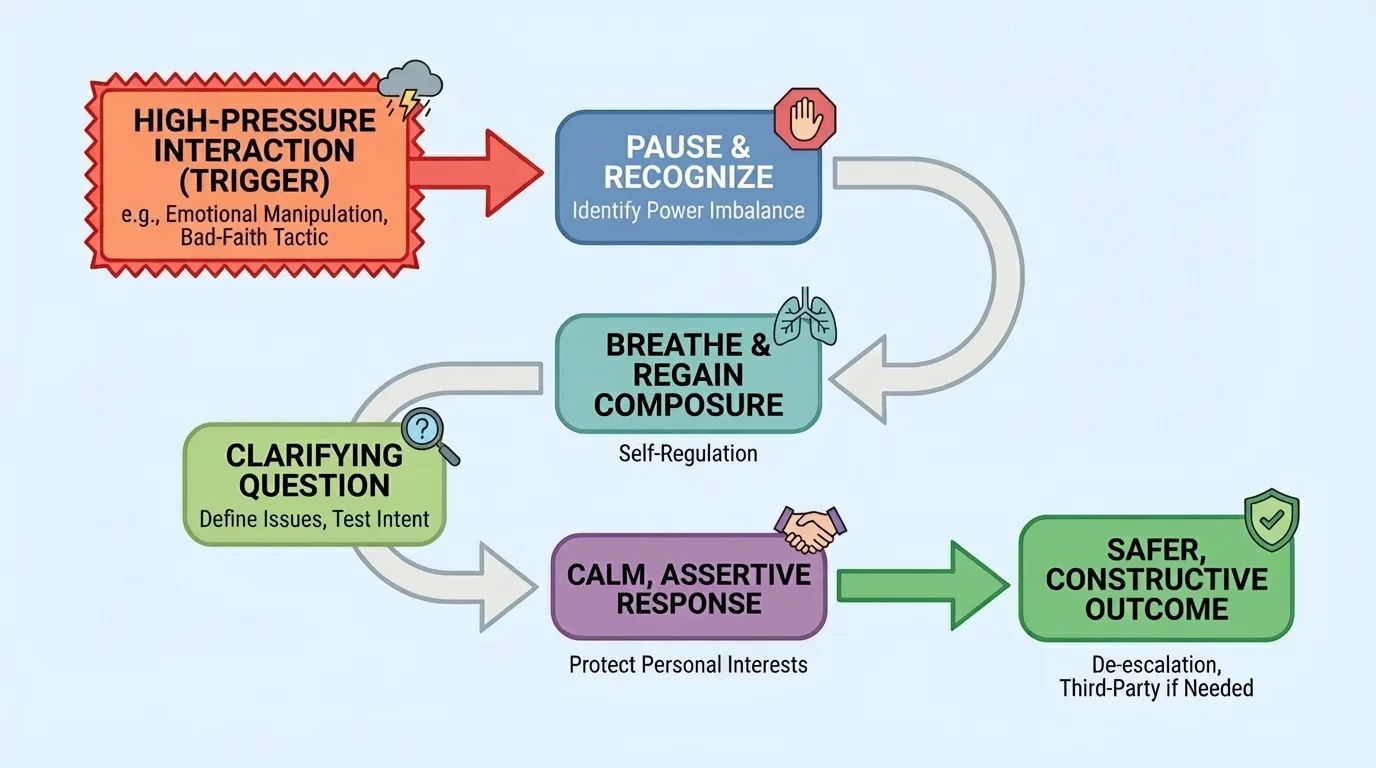
Emotional manipulation often works by making you feel you must answer the feeling instead of the issue. Someone might say, "If you cared, you'd do this," or "You're selfish for even asking." The goal is to shift you from problem-solving to guilt-management. When that happens, return to the facts: "I hear that you're upset. I'm still asking what solution you want."
Another common tactic is provocation. A person may insult you to make you lose control. If you snap back, they can claim you are the problem. This is why short, plain language matters. The less extra material you give them, the less they can twist.
The calm-and-clear rule
When pressure rises, aim to sound calm, clear, and brief. Calm lowers intensity. Clear reduces confusion. Brief limits opportunities for manipulation. You do not need the perfect speech. You need a response that protects your position.
You can also use a delayed response on purpose: "I'm not making a decision right now. I'll reply at 6 p.m." This protects you from being rushed and gives you time to think, check details, or ask for advice.
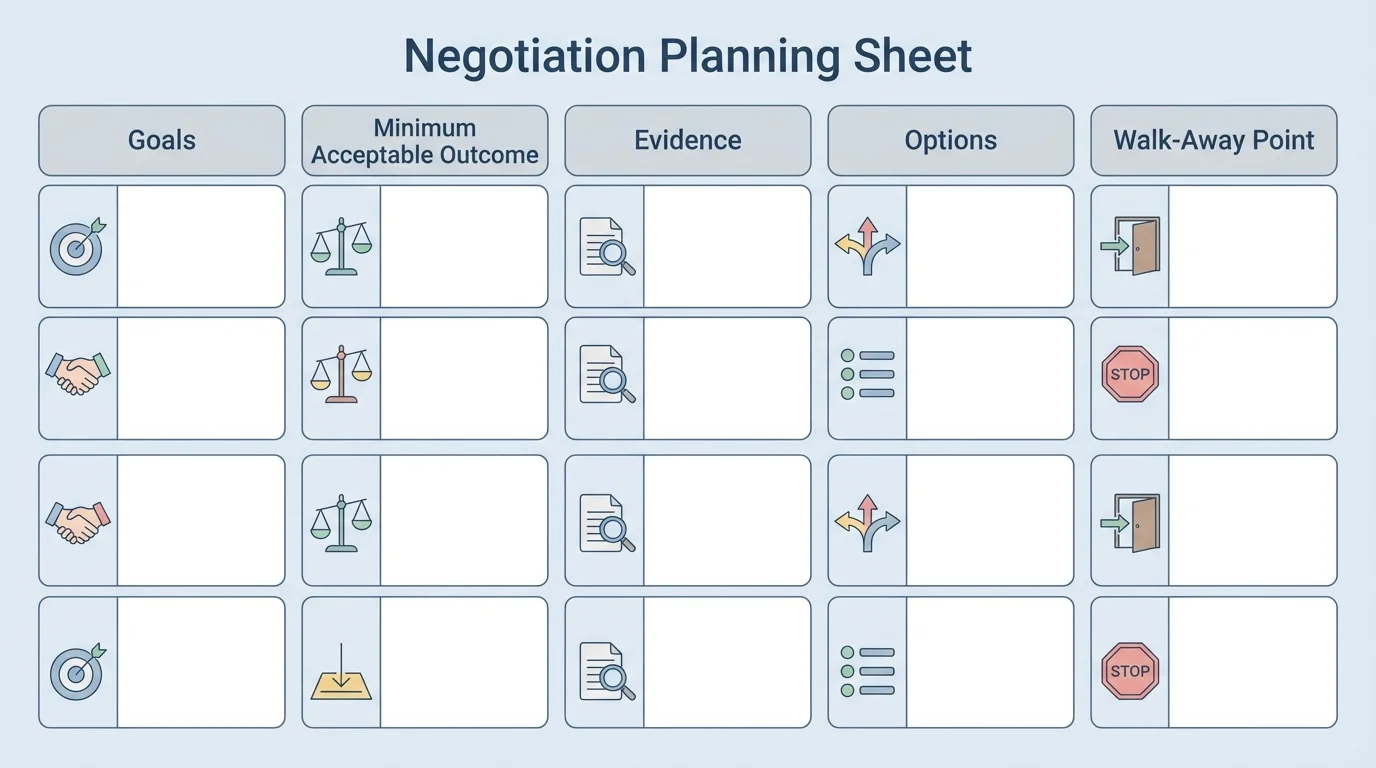
Good negotiation usually starts before the conversation starts. The strongest negotiators are often the people who prepared, not the people who talked the longest. A simple planning structure, like the one summarized in [Figure 2], helps you avoid getting pushed off track.
Before you negotiate, figure out five things: your goal, your minimum acceptable outcome, your reasons, your alternatives, and your walk-away point. If you do not know these, pressure can make you agree to almost anything.
1. Your goal: What do you want ideally?
2. Your minimum: What is the least you can accept and still feel okay?
3. Your reasons: What facts support your position?
4. Your alternatives: What will you do if no agreement happens?
5. Your walk-away point: At what point is continuing the conversation not worth it?
For example, suppose you are selling a used laptop online. A buyer agrees to pick it up for $300, then shows up and says they only brought $240. If you did not prepare, you might accept the lower amount because the situation feels awkward. If you did prepare, you know your minimum is $290 and your alternative is to keep the item listed. That makes your response easier: "The agreed price was $300. I can do $290, but not $240. If that doesn't work, I'll keep it listed."
This kind of response is effective because it is specific and unemotional. You are not debating your worth. You are stating terms.
Example: negotiating a work schedule conflict
You have a part-time job, and your supervisor keeps adding shifts without asking. You want to protect your time without sounding hostile.
Step 1: Define the issue.
The issue is not "My supervisor is unfair." The issue is "My schedule is being changed without notice."
Step 2: State the facts.
"I noticed my shifts were changed twice this week without checking with me first."
Step 3: State your need.
"I need at least 48 hours' notice for schedule changes unless there's an emergency."
Step 4: Offer a workable path.
"If you message me first, I can usually tell you quickly whether I'm available."
Step 5: Set a boundary if needed.
"If a shift is added without my agreement, I may not be able to work it."
Notice what this does: it avoids insults, stays factual, and makes the future process clear. That is often more persuasive than a long emotional explanation.
A power imbalance does not mean you are powerless. It means you need strategy. The other person might be older, louder, more experienced, wealthier, or in a position of authority. They may know the system better. Your job is to reduce the advantage they gain from that difference.
One way to do that is to shift the conversation from personal pressure to process. Instead of arguing about who deserves what, ask about policy, timeline, criteria, or written expectations. Process creates structure. Structure limits arbitrary pressure.
For example, if a landlord or service provider talks over you on the phone, you can say, "Please send that in writing," or "Can you tell me the exact policy you're using?" Written communication slows the interaction and creates a record. That matters later if there is a dispute.
Another strategy is bringing evidence. Screenshots, timestamps, receipts, prior messages, agreed terms, and saved emails reduce the other person's ability to rewrite the story. If your position is supported by records, you do not need to rely only on confidence.
In many disputes, the person who keeps the clearest record has a major advantage. Memory is easy to challenge; screenshots and written agreements are harder to dismiss.
If you feel intimidated, avoid trying to "match" the other person's aggression. You do not need to become louder, colder, or more aggressive. Instead, become more structured. Calm repetition can be powerful: "I understand your position. My question is still whether the original agreement will be honored."
As the planning tool in [Figure 2] suggests, knowing your alternatives is especially important when the power balance is uneven. If the other person senses you believe you have no options, they may pressure harder. Even a small alternative, like waiting, getting another quote, talking to support, or declining the deal, changes the conversation.
[Figure 3] Not every difficult person is acting in bad faith. Some people are simply stressed, disorganized, or poor communicators. But patterns matter.
Here are common bad-faith tactics:
These patterns do not prove bad faith by themselves, but when several appear together, they are a strong warning sign.
Fake urgency: "You need to decide right now." This is meant to stop you from thinking.
Moving the goalposts: Every time you meet a condition, they invent a new one.
Bait-and-switch: They agree to one set of terms, then change them once you are committed.
Guilt pressure: They make your boundary sound cruel or selfish.
Personal attacks: They criticize your character instead of addressing the issue.
Selective confusion: They suddenly "do not understand" clear points when understanding would require accountability.
Triangulation: They pull in other people to pressure you rather than resolve the issue directly.
Threat inflation: They exaggerate consequences to scare you into compliance.
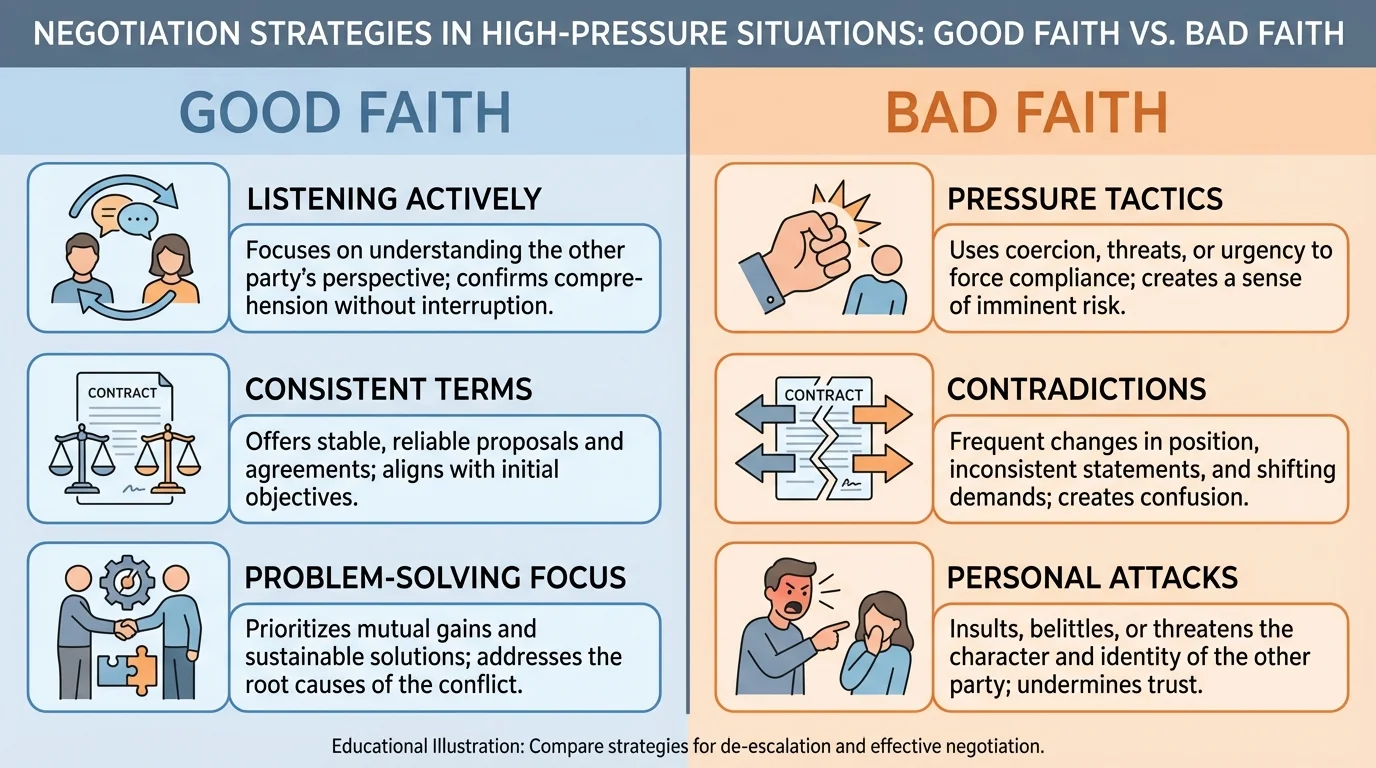
A person acting in good faith may disagree strongly, but they still engage with facts, stay relatively consistent, and show some interest in resolution. In bad faith, the terms keep shifting, pressure keeps rising, and clarity seems to make them less cooperative because confusion is helping them.
When you notice bad-faith tactics, stop trying to win through more explanation. More explanation usually gives manipulative people more material to twist. Shift instead to boundaries, documentation, and limited choices.
Example: recognizing moving goalposts
You and a roommate agree that they will pay you back $120 by Friday for a utility bill you covered. On Friday they say they can only send half. When you accept that, they say they will send the rest next week if you also cover another shared expense first.
Step 1: Name the original agreement.
"The agreement was $120 by Friday for the utility bill."
Step 2: Refuse the new unrelated condition.
"Repayment for the utility bill is separate from any future expense."
Step 3: Set the next step.
"Please send the remaining amount by Tuesday. If that doesn't happen, I'll need to keep future expenses separate."
This response avoids being dragged into a new debate. It keeps the issue narrow, which is one of the best ways to deal with manipulation.
Sometimes the other person is not interested in solving the problem at all. In that case, your goal changes. You are no longer trying mainly to persuade them. You are trying to protect yourself.
Start by reducing exposure. Keep communication in writing when possible. Save screenshots. Confirm spoken agreements by message: "Just to confirm, we agreed that you'll send the refund by Thursday." If the other person later denies it, you have a record.
Next, narrow the issue. Uncooperative people often try to expand the conversation into your attitude, past mistakes, side topics, or unrelated grievances. Pull it back: "I'm only discussing the missed payment right now."
Use short boundary statements. Good examples include: "I'm willing to discuss this respectfully," "I'm not responding to insults," "I need this in writing," and "If we can't resolve this directly, I'll use the formal process."
One useful method is the broken record technique. That means repeating the same calm boundary or request without getting pulled into new bait.
You repeat it. If they insult you, you repeat it. If they claim you are difficult, you repeat it. This works because it denies them momentum.
You should also protect your practical interests. Do not hand over an item before payment clears. Do not send extra personal information just because someone demands it. Do not agree "for now" if the agreement creates a bigger problem later. Temporary relief can lead to longer-term harm.
Protecting your interests does not require aggression
You can be firm without being hostile. Firmness means your words match your limits. Hostility adds heat without adding protection. In tense situations, the strongest position is often steady, documented, and enforceable.
If the interaction starts feeling unsafe, confusing, or impossible to verify, leave the situation. A deal that requires you to abandon your judgment is usually not a good deal.
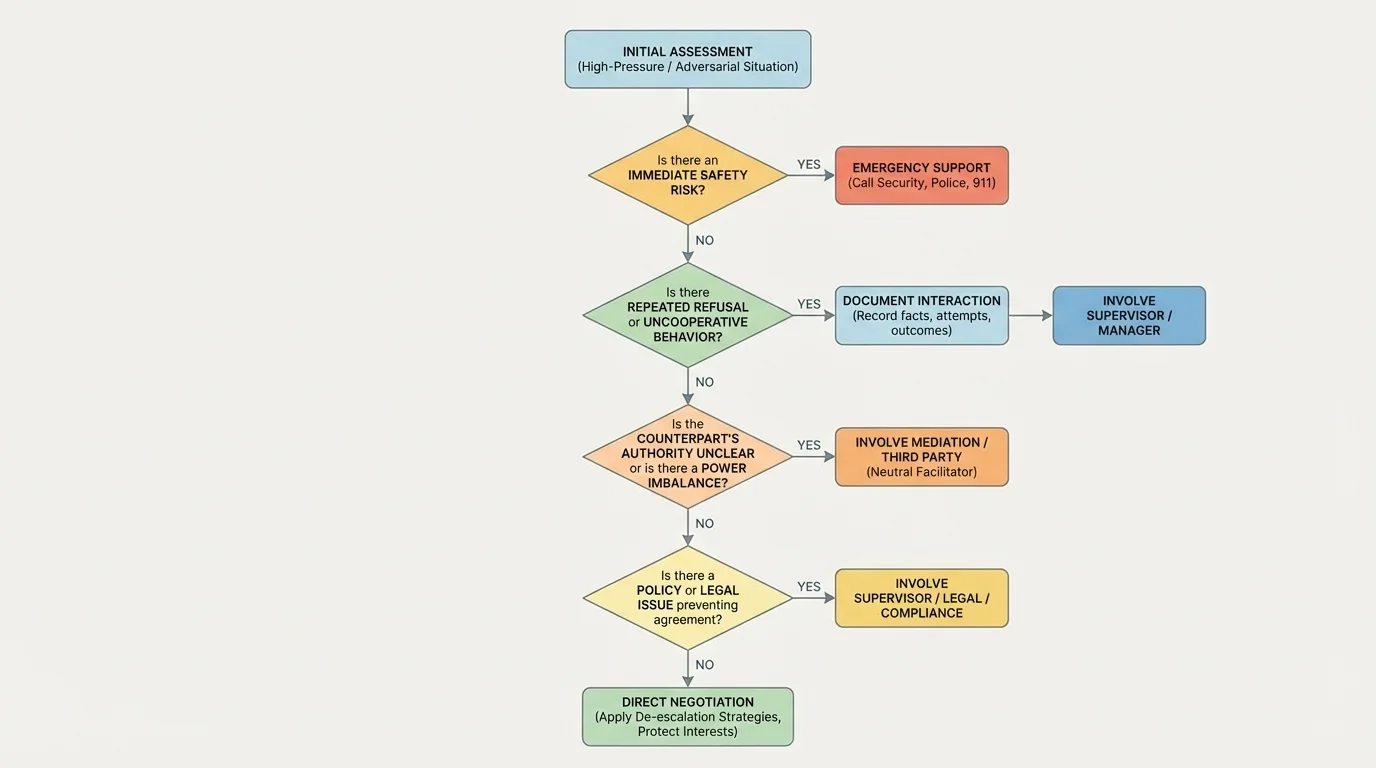
Knowing when to stop handling a conflict alone is a major life skill. Many people wait too long because they worry they will seem dramatic, weak, or incapable. But direct negotiation is not always the best tool. Sometimes the smartest move is escalation through the right channel. The decision path in [Figure 4] helps you separate situations that need more conversation from situations that need outside support.
Bring in a third party when one or more of these is true: there is a safety concern, the other person keeps violating agreements, the issue involves policy or authority you do not control, the power imbalance is too large to manage well alone, or the person is acting in clear bad faith.
A mediator can help when both sides are willing to talk but cannot get unstuck. A supervisor, platform support agent, landlord, parent, coach, manager, or community leader may be more appropriate when one person has authority over the process. If there is harassment, stalking, threats, coercion, or fear for your safety, involve a trusted adult, official support service, or emergency help immediately.
How you involve a third party matters. Be factual, concise, and organized. Do not send a giant emotional message if you can avoid it. Use a structure like this: what happened, what evidence you have, what you already tried, what outcome you want, and why the issue now needs support.
For example: "On Monday, we agreed in writing that the item would be refunded if it arrived damaged. I sent photos and requested the refund on Tuesday. The seller has stopped responding. I'm requesting platform support to process the refund."
This format works because it makes the decision easier for the third party. It also shows that you tried to resolve the issue directly first.
Later, if you find yourself hesitating about escalation, remember what [Figure 4] makes clear: the question is not whether you can endure more pressure. The question is whether the current process can realistically produce a fair and safe outcome.
Here are a few situations you may realistically face and stronger ways to respond.
Online sale dispute: The buyer says your item was "not as described" but refuses to provide photos and demands a partial refund immediately. You can say, "I'm willing to review the issue. Please send photos of the problem by tonight, and I'll respond after I see them." This slows fake urgency and asks for evidence.
Shared expense conflict: A roommate says, "You make more money than I do, so you should cover it." You can say, "I understand your situation, but our agreement was to split this equally. If that needs to change, we should discuss future expenses separately." This avoids guilt pressure and protects the original agreement.
Family pressure: A relative says, "After everything I've done for you, you owe me this." You can say, "I appreciate what you've done. I'm still not able to agree to that." This separates gratitude from compliance.
Workplace scheduling: A manager says, "If you were really committed, you'd take this shift." You can say, "I'm committed to doing my job well. I'm not available for that shift, and I can help if there's a future schedule issue with more notice." This counters emotional manipulation with a clear boundary.
Harassing messages: Someone keeps sending hostile texts after you have already answered. You can say once, "Do not contact me again except about the specific issue in writing." Then stop engaging and save the messages. If needed, report or block. This is where calm repetition helps you avoid being pulled into endless escalation.
If a conversation repeatedly leaves you confused, guilty, rushed, or afraid, that feeling is information. You do not need to ignore it just because the other person says you are overreacting.
In many real situations, your best script is simple: "Here is the issue. Here is what I need. Here is the deadline or next step. If that does not happen, here is what I will do next." That structure keeps the conversation grounded in action.
One mistake is escalation through overreaction. If someone is insulting, it is tempting to answer in kind. But insults usually weaken your position and reduce your options.
Another mistake is overexplaining. You do not need a ten-paragraph defense of your boundary. Long explanations often sound like uncertainty and give manipulative people more openings.
A third mistake is making threats you cannot or will not carry out. If you say, "I'm done," but keep arguing for two more hours, your words lose force. Boundaries work best when they are realistic and enforceable.
Also avoid agreeing just to end discomfort. Relief in the moment is not always a good decision. Before saying yes, ask yourself: "Will I still think this was reasonable tomorrow?" If the answer is no, pause.
Finally, do not confuse calmness with passivity. You can be direct, say no, repeat yourself, document everything, and involve support while staying calm. In fact, that is often the most effective combination.
