Many adult problems do not begin as dramatic disasters. They begin as tiny choices that feel harmless: staying up too late every night, ignoring stress because you are "handling it," dating someone who keeps crossing boundaries, skipping medical appointments, taking every work shift because you want quick money, or letting your space become so chaotic that daily life feels harder than it should. Long-term wellness is about learning to notice those patterns early, before they turn into bigger problems.
At this stage of life, you are likely to make more independent decisions about relationships, money, transportation, sleep, meals, and healthcare. That freedom is real, but so is the responsibility that comes with it. The goal is not to become perfect. The goal is to make choices that keep you functional, safe, stable, and able to enjoy your life over time.
Wellness is not just "being healthy" in the narrow sense of not being sick. It includes your energy, stress level, emotional stability, physical health, sense of safety, social support, and ability to manage everyday responsibilities. A choice can feel good in the moment and still be bad for your long-term wellness. A choice can also feel inconvenient now and protect your future self.
For example, taking extra shifts at a part-time job might raise your paycheck this week. But if it causes chronic sleep loss, missed meals, rising anxiety, and no time for schoolwork or recovery, the long-term cost may be much higher than the short-term gain. On the other hand, setting a work limit, planning meals, and protecting sleep might feel less exciting in the moment, but it usually leads to more stable performance and better health.
Long-term wellness is the overall condition of your physical, mental, emotional, and social well-being over an extended period of time. It depends on repeated habits, the environments you choose, and the people and responsibilities you allow into your life.
Burnout is a state of emotional, mental, and physical exhaustion caused by ongoing stress, especially when you feel overworked and under-rested.
Boundary is a limit you set to protect your time, energy, body, privacy, and emotional well-being.
One useful way to assess a choice is to ask, "If I repeat this for six months, what happens?" That question is powerful because adult life is built more by patterns than by single events. One late night is usually manageable. A pattern of late nights can damage concentration, mood, immune function, and work reliability.
Long-term wellness has several connected parts. If one area starts falling apart, the others often feel it too. Poor sleep can raise stress. High stress can lead to conflict. Conflict can reduce motivation. Low motivation can make chores, meals, and appointments harder to manage. Wellness is connected, not separate.
When you assess a choice, look at more than one area. A job, friendship, living arrangement, or daily habit may affect your body, mood, schedule, finances, and safety all at once.
| Area of wellness | What it includes | What supports it | What harms it over time |
|---|---|---|---|
| Physical | Sleep, nutrition, movement, medical care | Regular sleep, meals, exercise, appointments | Sleep loss, skipped meals, substance misuse, inactivity |
| Mental and emotional | Stress, focus, coping, mood | Breaks, support, routines, therapy, reflection | Chronic stress, isolation, overload, untreated anxiety |
| Social | Friendships, dating, family dynamics, support | Respect, honesty, boundaries, communication | Control, manipulation, constant drama, disrespect |
| Practical | Housing, transportation, budgeting, scheduling | Planning, habits, backup plans, organization | Disorganization, missed deadlines, unsafe choices |
| Safety | Personal security, digital safety, health protection | Awareness, privacy settings, emergency contacts | Risky situations, oversharing, ignoring warning signs |
Table 1. Major areas of wellness and the habits that commonly support or weaken them over time.
This broad view matters because some choices look fine if you only examine one area. A cheap apartment may help your budget but hurt your safety or sleep. A relationship may feel exciting but damage your concentration, confidence, and peace. A job may improve income but worsen your physical and emotional health if the demands are unsustainable.
Chronic sleep loss affects judgment in ways people often underestimate. When you are tired for long periods, you may feel "used to it," but your attention, reaction time, and emotional regulation can still decline.
[Figure 1] That is why strong adult decision-making means asking not just, "Can I do this?" but also, "What will this cost me if I keep doing it?"
Your burnout risk at work usually comes from patterns, not one busy day. Work choices create a chain reaction: sleep affects focus, meals affect energy, breaks affect stress, and stress affects performance and mood. If your work routine constantly pushes your body and mind past recovery, your health and reliability usually drop together.
A healthy work life is not only about getting hired. It is also about choosing habits that let you keep working without damaging yourself. That includes enough sleep, regular meals, hydration, movement, realistic scheduling, safe transportation, and time to recover after demanding days.
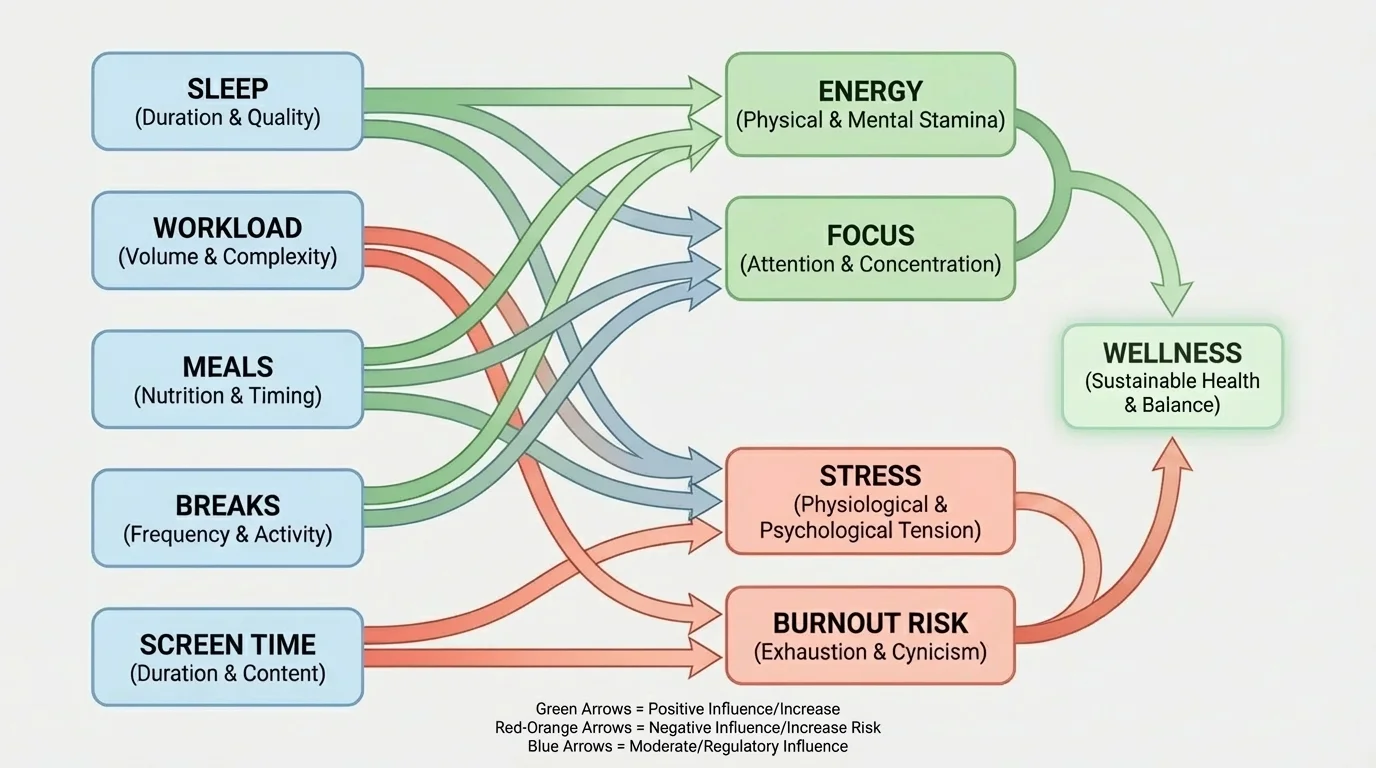
Watch for signs that a work situation is becoming unhealthy: you dread every shift, your sleep schedule is falling apart, you are using caffeine or other substances just to function, you cannot focus, your mood is getting worse, and your relationships are suffering because you are always exhausted or irritable. Those are not signs of "grinding harder." They are signs that the situation may be unsustainable.
Jobs can also affect wellness through the environment they create. Some workplaces encourage basic respect, training, and safety. Others normalize chaos, disrespect, or pressure to ignore your needs. If a manager punishes you for taking a legal break, mocks you for being sick, or pressures you to stay in unsafe conditions, that is a warning sign. Income matters, but protecting your health and safety matters too.
Digital habits matter here as well. If you work, study, and unwind on screens all day, your mind may never feel fully off-duty. Constant notifications, late-night scrolling, and replying to messages at all hours can blur the line between work time and recovery time. Setting app limits, turning off notifications during sleep, and protecting a wind-down routine can improve wellness more than people expect.
Work wellness is about sustainability. A sustainable routine lets you earn money, meet responsibilities, and still maintain sleep, nutrition, emotional regulation, and basic enjoyment of life. If a routine only works when you ignore your body or emotions, it probably will not hold up long-term.
You should also think about the math of time and energy, even if it is simple. If a part-time job, commute, and preparation time take about \(6 + 1 + 1 = 8\) hours on a workday, that leaves fewer hours for school responsibilities, meals, hygiene, exercise, family obligations, and sleep. If you need about \(8\) hours of sleep and already spend \(8\) hours on work-related tasks, you only have about \(24 - 8 - 8 = 8\) hours left for everything else. That is why overscheduling catches up with people fast.
Later, when you compare different job options, remember what [Figure 1] makes clear: a higher hourly wage is not automatically the better choice if the schedule destroys your health, relationships, or ability to function consistently.
A relationship can support your growth or slowly drain your stability. In this area, patterns matter more than one isolated good day or one isolated argument. As [Figure 2] illustrates, healthy relationships are usually built on respect, honesty, trust, communication, and boundaries, while unhealthy ones often involve control, guilt, fear, confusion, or constant instability.
This includes dating relationships, friendships, family interactions, roommates, and online connections. Someone does not have to be physically violent to be harmful. They can damage your wellness by isolating you, monitoring you, humiliating you, pressuring you, manipulating your emotions, or making you feel responsible for their behavior.
Healthy relationships usually allow you to say no without fear. You can have privacy. You can keep other friendships. You can disagree without being threatened or degraded. You are not required to prove loyalty by giving up your peace, safety, or identity.
Warning signs include repeated disrespect, pressure for sexual activity, guilt-tripping when you set limits, jealousy framed as love, invasion of privacy, controlling who you talk to, explosive reactions to small issues, and making you feel like everything is always your fault. If you constantly feel anxious before replying, afraid to be honest, or relieved when the person is not contacting you, pay attention to that.
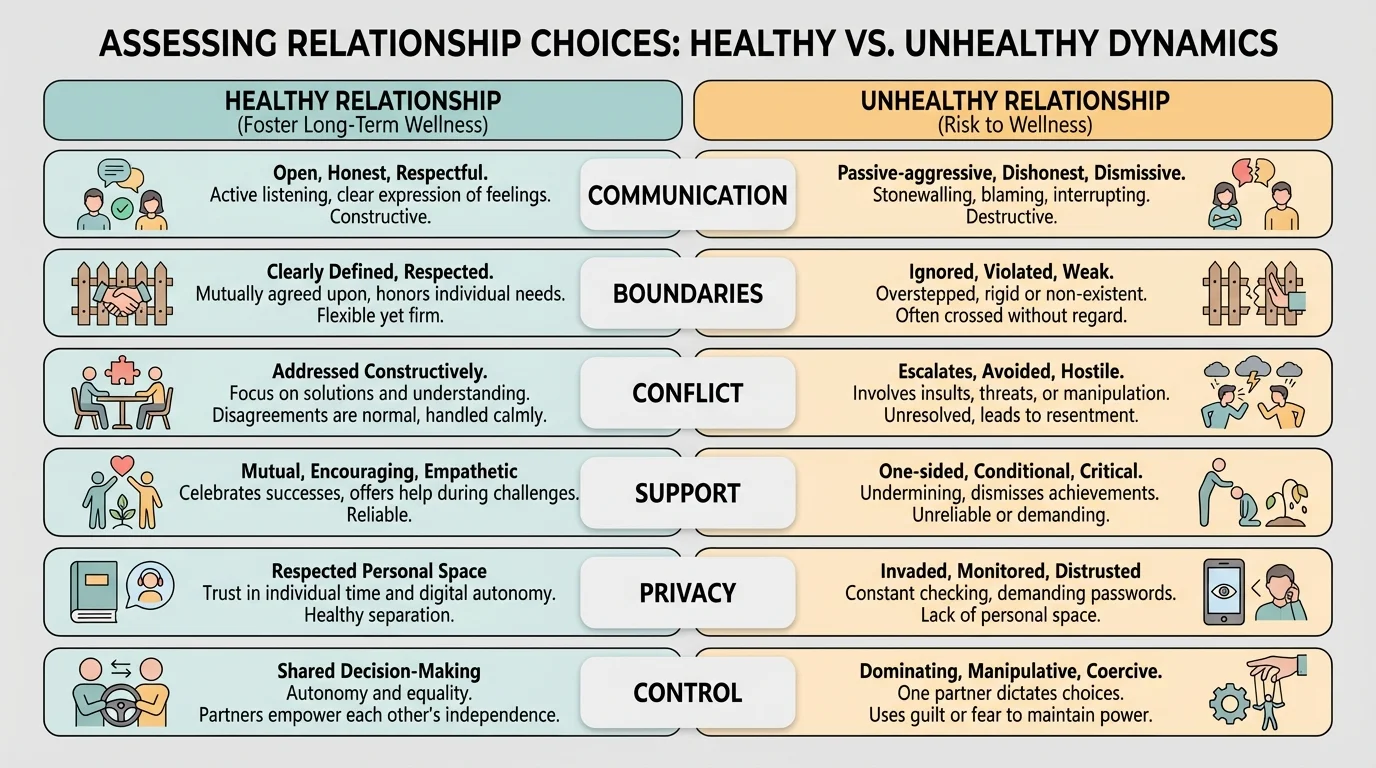
Relationship wellness also involves your own behavior. Long-term wellness is not only about spotting other people's warning signs. It is also about asking whether you communicate clearly, respect consent, manage anger without intimidation, and take responsibility when you make mistakes. A strong relationship is not conflict-free. It is repair-capable.
Social media and messaging can complicate this. Constant location-sharing, pressure for immediate replies, posting private arguments, or checking someone's accounts without consent are not signs of closeness. They are often signs of poor boundaries and low trust. Digital behavior is still relationship behavior.
Case study: assessing a friendship
You have a friend who is fun and supportive sometimes, but they also mock you in group chats, pressure you to ignore responsibilities, and get angry when you spend time with other people. You feel drained after talking with them.
Step 1: Look at the pattern, not the best moments.
Ask whether the friendship usually leaves you feeling respected, safe, and supported.
Step 2: Notice the cost.
If the friendship raises stress, lowers confidence, and causes conflict in other parts of your life, the cost is real even if the person is sometimes kind.
Step 3: Set a clear limit.
You might say, "I'm not okay with being joked about like that in group chats. If it keeps happening, I'm stepping back."
Step 4: Watch the response.
A healthy response includes listening, adjusting, and respecting the limit. An unhealthy response includes mocking, rage, guilt, or retaliation.
That response tells you a lot about whether the relationship supports your long-term wellness.
Much later, when you are deciding whether to stay close to someone, return to the comparison in [Figure 2]. It helps you judge the overall pattern instead of getting distracted by occasional apologies or dramatic highs.
Independent living sounds exciting because it gives you more control. It also means your daily systems matter more. If no one else is making sure you eat, sleep, clean, pay attention to health issues, or refill essentials, those responsibilities become yours. Small habits start shaping your quality of life very quickly.
Independent living wellness includes keeping a functional space, having basic food available, managing laundry and hygiene, knowing your transportation options, paying bills on time, protecting your documents, handling medical appointments, and preparing for emergencies. These are not separate from wellness. They are part of wellness.
For example, if your room or apartment becomes so disorganized that you cannot find important items, your stress rises. If you do not keep basic groceries around, you may skip meals or rely only on expensive convenience food. If you avoid medical care because scheduling feels annoying, a minor issue can become a major one. Good systems reduce stress before stress begins.
Your budget affects wellness too. Running out of money for food, medication, transportation, or basic supplies creates pressure that can harm your physical and emotional health. If you earn $300 in a week and spend $90 on rideshares, $80 on takeout, $60 on entertainment, and $50 on impulse purchases, that totals \(90 + 80 + 60 + 50 = 280\). You would have only $20 left. That may not cover necessities. The issue is not that spending is bad; it is whether your spending choices support a stable life.
Routines are not about being rigid. They are about lowering the number of crises you have to solve. When the basics are handled automatically, you have more energy for work, goals, and relationships.
Another key part of independent living is preventive care. Preventive care means handling health needs before they turn into emergencies. That includes dental checkups, annual physicals, managing prescriptions, getting enough sleep, noticing changes in mood, and taking symptoms seriously when they persist. Waiting until a problem becomes severe usually costs more time, money, and stress.
Safety is part of independence too. Know who has access to your location. Be cautious about posting where you live or your full schedule online. Lock doors and vehicles. Keep emergency contacts easy to reach. If you use public transportation or rideshare services, share trip details with a trusted person when appropriate. Personal freedom works best with personal awareness.
One of the smartest adult skills is using a repeatable process instead of making every choice based on mood. A good decision framework helps you pause, compare options, and think beyond the next hour. This is especially useful when the short-term reward of a choice is strong but the long-term cost may be hidden.
Use the following process whenever you are evaluating a job schedule, friendship, spending decision, living arrangement, or habit.
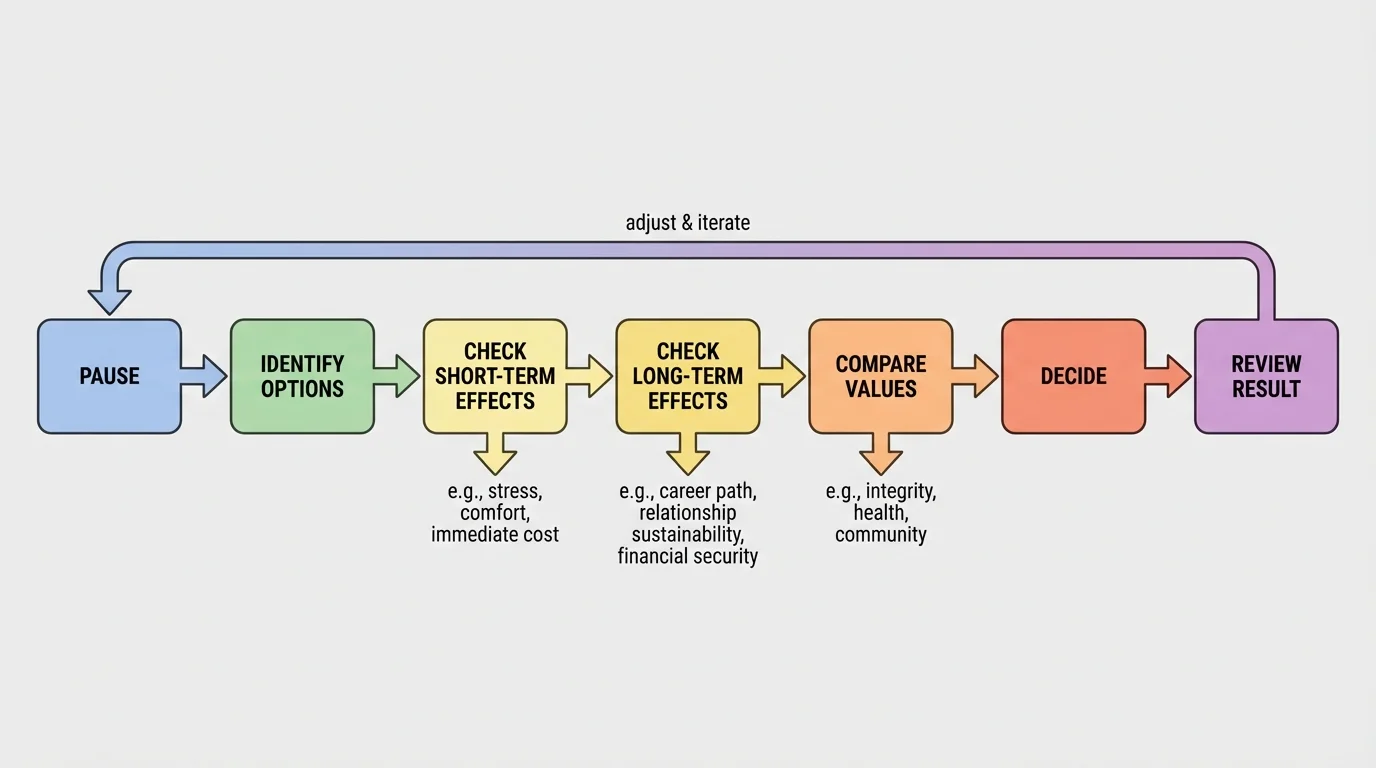
Step 1: Pause. If possible, do not decide while overwhelmed, angry, lonely, sleep-deprived, or rushed. Those states can narrow your thinking.
Step 2: Name the options clearly. Instead of "I have no choice," list the real options. For example: accept all shifts, accept fewer shifts, ask for different hours, or look for another job.
Step 3: Check the short-term benefits. What do you gain right away? Money, relief, attention, convenience, excitement, comfort, or approval?
Step 4: Check the long-term effects. Ask what happens if you repeat this choice for weeks or months. Does it help your health, safety, stability, and goals? Or does it slowly weaken them?
Step 5: Compare the choice to your values. If you value peace, financial stability, trust, and health, a decision that repeatedly harms those things probably needs to be reconsidered.
Step 6: Notice red flags and green flags. Red flags are warning signs like secrecy, chaos, control, exhaustion, and unsafe pressure. Green flags are signs like respect, consistency, recovery time, and honest communication.
Step 7: Review the result. Good decision-makers adjust. If a plan is not working, changing course is a strength, not a failure.
"Your future is heavily influenced by what you repeat."
— Practical wellness principle
When you revisit a decision later, [Figure 3] still applies. The point is not to predict everything perfectly. The point is to stop treating major choices like random reactions.
Here is what long-term assessment looks like in everyday life.
Scenario 1: Choosing between two jobs
Job A pays slightly more, but the shifts end late, the commute is long, and the manager regularly texts workers after hours. Job B pays a little less, but the schedule is predictable and the workplace respects time off.
Step 1: Compare immediate rewards.
Job A offers more money right away.
Step 2: Compare hidden costs.
Late shifts, poor sleep, transportation stress, and no real off-time may reduce your school performance and energy.
Step 3: Assess sustainability.
Job B may support stronger long-term wellness even with a lower paycheck, because it protects consistency and recovery.
The better choice is not always the highest number. It is often the option you can maintain without harming yourself.
Another common situation involves living with others. Roommate choices can strongly affect your sleep, safety, finances, and stress level.
Scenario 2: Evaluating a roommate setup
You are considering living with someone who is fun and social, but they are often late on payments, bring strangers over without warning, and dismiss concerns as "being dramatic."
Step 1: Focus on patterns.
Unreliable payments and disregard for safety are not minor personality quirks.
Step 2: Project forward.
If these patterns continue for \(6\) months, your stress, sleep, and financial stability may all suffer.
Step 3: Decide based on long-term livability.
If the setup is not safe and stable, it is probably not worth the convenience or social appeal.
Independent living works better when peace and predictability are built in.
One more scenario: self-care often fails when people treat it like an extra instead of a system.
Scenario 3: Repairing an overloaded week
You notice you are skipping breakfast, sleeping about \(5\) hours a night, forgetting assignments, and snapping at people. You keep telling yourself things will calm down soon, but the pattern has lasted three weeks.
Step 1: Name what is happening.
This is not just "a busy week." It may be the start of chronic stress or burnout.
Step 2: Stabilize the basics first.
Protect sleep, eat regular meals, reduce unnecessary commitments, and ask for support where needed.
Step 3: Rebuild with realistic habits.
A simple plan you can keep is better than an ideal plan you abandon after two days.
Wellness improves when you stop trying to survive on emergency mode.
Most people do better when wellness is visible and scheduled. A weekly routine that includes work, sleep, meals, movement, chores, appointments, and rest is easier to maintain than trying to remember everything in your head. Structure reduces decision fatigue.
Your plan does not need to be impressive. It needs to be realistic. Start with non-negotiables: sleep, food, hygiene, transportation, deadlines, medication if needed, and a basic cleaning routine. Then add support habits like exercise, downtime, social connection, and planning time.
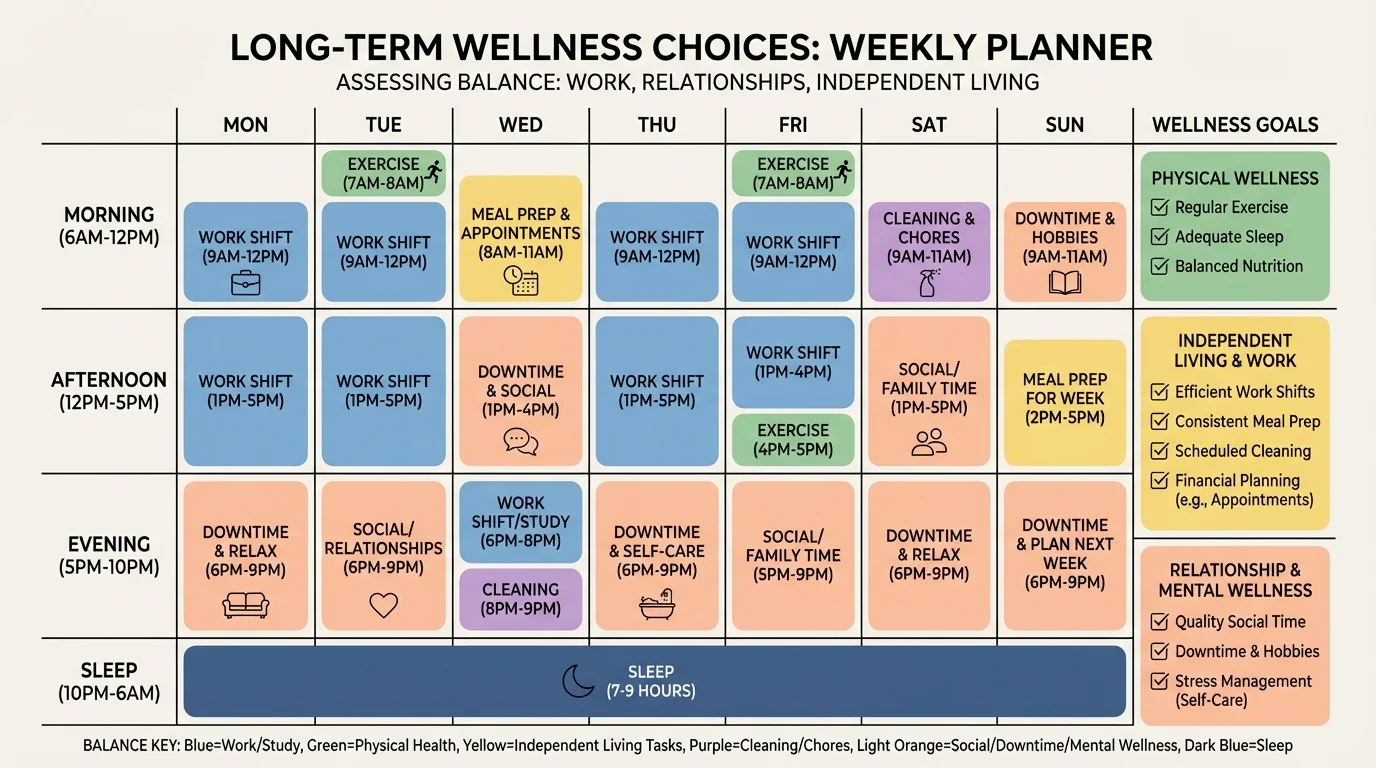
A strong plan also includes backup options. What will you eat if you are too tired to cook? How will you get home safely if a ride falls through? Who can you contact if you feel overwhelmed? What will you cut first if your week becomes too crowded? Having backup plans is a form of wellness, not pessimism.
Check in with yourself regularly. You might rate major areas of life from \(1\) to \(5\): sleep, stress, relationships, workload, living space, money stability, and mood. If several categories drop to \(2\) or lower, that is a signal to adjust. The exact numbers are less important than the pattern they reveal.
Sustainable self-care is practical, not performative. It is less about buying products or posting routines online and more about doing the ordinary things that keep your life functional: sleeping enough, keeping appointments, eating regularly, setting boundaries, asking for help, and leaving unhealthy situations when needed.
Over time, what seems small becomes powerful. Drinking water, charging your phone, filling your gas tank before it is empty, preparing tomorrow's clothes, limiting late-night scrolling, and getting to bed on time are not glamorous choices. But they protect your future self. That is what long-term wellness is: repeated care, repeated awareness, and repeated choices that make life more stable instead of more chaotic.
As you move into adulthood, you will not control everything. Jobs change, people disappoint you, bills show up, and some weeks are hard. But you can learn to assess what supports your life and what slowly breaks it down. When you make choices through that lens, you build a life that is not just busy, but actually workable.
