Turning 18 does not just mean more freedom. It also means that choices you make online, at work, on the road, with money, and in your community can carry real legal and civic consequences. You may now be old enough to vote, sign some contracts, serve on a jury if called, or be fully responsible for violations that once might have been handled differently. That shift matters because adulthood is not only personal independence; it is also public responsibility.
Being an adult in a community means more than "staying out of trouble." It means understanding how rules affect your life, how your actions affect other people, and how you can influence the places where you live, work, and spend time. Whether you are registering to vote, signing an apartment lease, responding to a workplace issue, or speaking up about a neighborhood concern, civic knowledge and legal awareness help you protect yourself and contribute responsibly.
Civic knowledge is an understanding of how government, laws, rights, and public systems work in everyday life.
Legal awareness is knowing the laws, rules, and legal consequences that apply to common situations so you can make informed decisions.
Community participation means taking part in improving, supporting, or influencing the groups and places you belong to.
Your role as an adult citizen starts with a simple idea: rights and responsibilities go together. You have rights such as free expression, due process, privacy in certain situations, and equal protection under the law. At the same time, you have responsibilities such as following laws, respecting others' rights, providing accurate information on official forms, paying required taxes, and participating honestly in public life.
A citizen is a member of a country with legal rights and responsibilities. Even before you do things like vote or serve on a jury, your daily choices already shape civic life. For example, reporting dangerous road conditions, reading reliable information before reposting a claim online, or helping a local nonprofit are all forms of civic participation.
Many people think civic engagement only means politics. It includes politics, but it is broader than that. It also includes volunteering, helping solve local problems, supporting fair treatment in workplaces, joining public discussions respectfully, and understanding how laws affect ordinary decisions. If a park in your area becomes unsafe, civic engagement might mean documenting the issue, contacting the right local department, attending a virtual city meeting, and encouraging others to use the same facts rather than spreading rumors.
Local decisions often affect your routine more directly than national headlines do. Street lighting, public transportation routes, trash pickup, zoning, library funding, and many recreational programs are usually shaped close to home.
Good citizenship also includes knowing your limits. Civic participation does not mean arguing about everything, posting personal attacks, or acting like every disagreement is a rights violation. It means using facts, understanding process, and choosing actions that actually fit the situation.
As you enter adulthood, some legal topics become immediately relevant. One major area is the contract. A contract is a legally enforceable agreement. You may encounter contracts when signing a phone plan, accepting a job offer, buying a car, subscribing to a service, or renting an apartment. If you agree to terms without reading them, you can still be held responsible.
Another important concept is consent. In legal settings, consent means a clear, voluntary agreement. Consent matters in healthcare, sharing information, digital privacy, physical boundaries, and many personal interactions. It must be informed and freely given. Pressure, threats, or deception can make supposed "consent" invalid or unethical.
You also need to understand identification and records. Government-issued ID, voter registration records, tax forms, employment documents, and lease agreements all matter because they prove who you are and what you agreed to. Losing track of these documents can create delays, missed opportunities, or legal headaches. A practical habit is to store paper copies in one secure place and digital copies in a protected folder.
Taxes may feel far away, but if you work, earn tips, freelance, or sell items online, taxes can become your responsibility. You do not need to become a tax expert right now, but you do need to know that income may need to be reported, deadlines matter, and ignoring official tax notices is risky. If you earn money from multiple sources, keep a simple income record instead of guessing later.
Some responsibilities depend on where you live. Jury duty, voter registration deadlines, driver responsibilities, required insurance, or selective service registration for eligible individuals are examples. The key life skill is not memorizing every rule in advance. It is knowing that legal duties exist, checking official sources, and responding promptly when something applies to you.
Legal responsibility in everyday life
Most adult legal trouble does not begin with dramatic crime. It often begins with small careless decisions: ignoring a bill, skipping insurance, signing something unread, posting threats online, driving without understanding the rules, or missing a court or agency deadline. Legal awareness protects you by helping you slow down, ask questions, keep records, and respond early instead of waiting until a problem grows.
Think about consequences in realistic terms. If you sign a lease and fail to pay, that may hurt your credit, lead to fees, and affect future housing options. If you drive without valid documents, the cost is not just a ticket; it can include court time, higher insurance costs, and stress. If you spread false accusations online, you may damage someone else and expose yourself to school, workplace, platform, or legal consequences.
[Figure 1] Public decisions come from different levels of government, and understanding that structure helps you direct your energy effectively. If you complain to the wrong office, nothing may happen—not because the issue is unimportant, but because you contacted the wrong level.
Local government usually handles issues closest to your daily routine: roads, water service, local policing, parks, libraries, some housing codes, and city or county services. State government often deals with statewide education rules, licensing, state taxes, and many transportation laws. Federal government handles areas such as immigration, federal taxes, interstate regulation, and national defense.
Knowing the difference helps you make smarter choices. If a crosswalk near your home is dangerous, a city council office or public works department may be more useful than a national representative. If your driver's license issue involves state rules, a local neighborhood group may not be able to fix it. Local government often affects your daily life most directly, even if it gets less attention in the news.
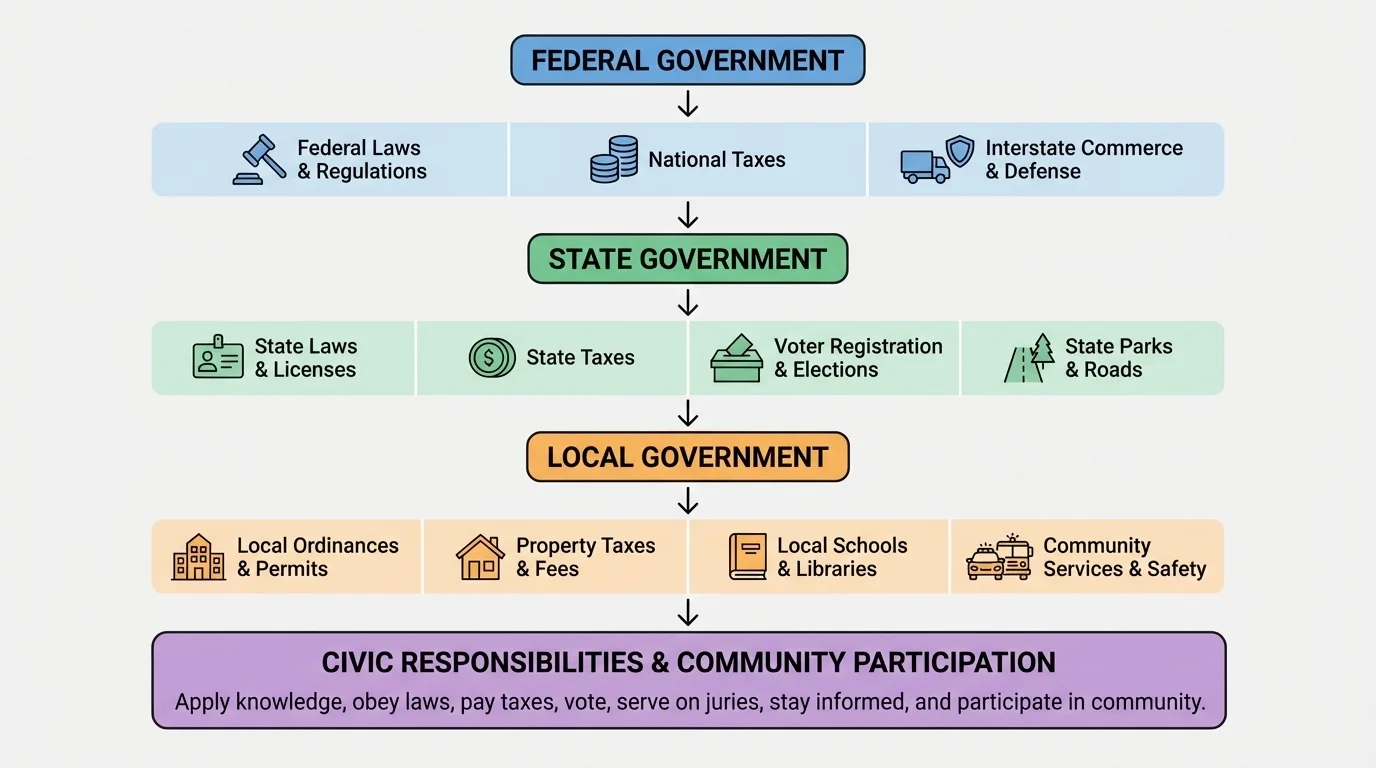
This matters for community participation because effective action starts with accurate targeting. The same problem-solving energy works much better when you know which level of government actually has the power to act.
[Figure 2] Strong civic participation is not random. It follows a process that lays out a practical path from noticing a problem to taking useful action. The best participants are not always the loudest; they are often the most informed, organized, and persistent.
Start by identifying the issue clearly. What exactly is happening? Who is affected? Is it a safety issue, a service issue, a policy issue, or a misinformation issue? Then gather facts from reliable sources such as official websites, public notices, local records, and established news organizations. Screenshots, dates, and names can matter.
Next, choose the right form of action. Some situations call for voting. Others call for a respectful email, public comment, petition, community meeting, mutual aid effort, or report to an agency. If the problem is specific and fixable, direct contact often works better than a vague social media post.
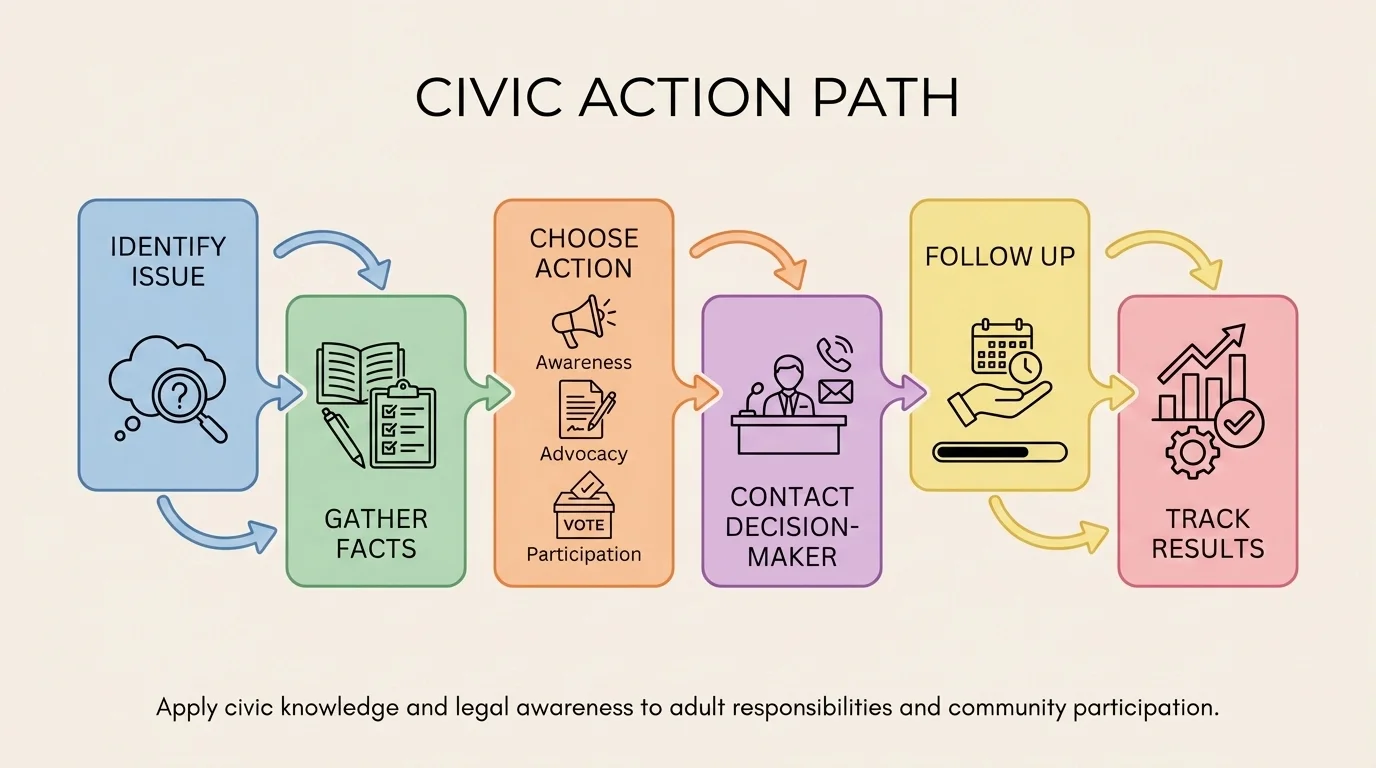
Following up is one of the most overlooked skills in community participation. If you report a safety issue and never check back, you may assume nothing happened when the office actually requested more information. Keep a basic record of when you contacted someone, what you sent, and whether you received a response.
Voting is one important tool, but not the only one. If you are eligible, learn registration rules early, verify your status before deadlines, and research candidates and measures using multiple sources. Do not vote based only on one viral clip or one comment section. Read what offices actually oversee. A mayor, governor, judge, school board member, or local council member can affect your life in different ways.
Contacting officials works best when you are concise and specific. Say what the issue is, where it is happening, how it affects people, what action you want, and how they can follow up. A message like "Please support safer lighting at the bus stop on Oak Street because several evening commuters cannot see the curb clearly" is stronger than "Do something about safety."
Example: Writing an effective message to a public office
Step 1: State the issue clearly.
"The crosswalk at Pine Avenue and 3rd Street has faded markings and poor lighting."
Step 2: Explain the impact.
"People walking there after sunset are harder for drivers to see, especially during rain."
Step 3: Request a specific action.
"Please inspect the location and consider repainting the markings and improving lighting."
Step 4: Add useful details.
Include dates, times, photos if appropriate, and your contact information.
This kind of message is respectful, practical, and easier for an office to act on.
Community participation also includes collaboration. You may work with neighbors, volunteer groups, online community boards, youth councils, faith communities, or advocacy organizations. Productive collaboration means listening, checking facts, dividing tasks, and respecting that not everyone agrees on methods.
Much of your civic life now happens online. You may discuss public issues on social media, sign digital petitions, attend livestreamed meetings, donate to causes, or organize events in group chats. That means digital citizenship is part of responsible adulthood.
Free expression matters, but online speech still has consequences. Threats, harassment, defamation, impersonation, fraud, and sharing private information without permission can violate rules or laws. Even when a post is not illegal, it can still damage your reputation, affect jobs, harm relationships, or weaken your credibility in public discussions.
Misinformation spreads fast because it is easy to share before thinking. Before reposting a claim, ask: Who posted it? What is the original source? Is there evidence? Is the image old or taken out of context? If a claim makes you instantly angry or triumphant, that is often a signal to slow down.
Reliable information usually comes from sources that can be checked, corrected, and held accountable. Anonymous posts, edited clips, and dramatic screenshots may point to a real issue, but they are not enough by themselves.
Privacy also matters. Read platform settings, use strong passwords, enable multi-factor authentication, and think before posting location details, legal disputes, or personal documents. A digital record can last much longer than you expect. Employers, landlords, scholarship committees, and public agencies may all care about how you present yourself online.
If you want to advocate online, do it responsibly. Share verified information, credit sources, avoid mob behavior, and know the purpose of your post. Are you informing people, requesting action, fundraising, or documenting harm? Clear goals make your digital participation more effective and less risky.
Community participation is strongest when it moves beyond opinions and into action. You do not need a formal title to contribute. You can volunteer, help at local drives, join cleanup projects, support food distribution efforts, mentor younger students online, translate information for families, or help people understand public resources.
Some communities rely on mutual aid, which means people directly supporting one another by sharing resources, information, or assistance. Mutual aid can be valuable, especially during emergencies, but it should be organized responsibly. Transparency, safety, and respect for privacy still matter.
At work, in housing, and in local organizations, you may also see fairness issues. Maybe schedules are changed without notice, safety concerns are ignored, or a landlord fails to address a serious maintenance problem. Community participation can include documenting the issue, learning the proper reporting path, and seeking support from lawful and appropriate channels instead of escalating recklessly.
"The way to make change is to organize, not to agonize."
— Common civic principle
Service and advocacy both matter. Service helps meet immediate needs; advocacy helps address the rules and systems behind those needs. If a local pantry runs short on supplies, service might be donating food. Advocacy might mean speaking up about transportation access, wages, or policy barriers affecting families in that area.
[Figure 3] When a situation feels confusing, a decision framework helps you slow down and act wisely. Many mistakes happen when people react fast, rely on rumors, or assume that being upset automatically makes them legally right.
Use these five questions: What happened? What rule or law might apply? Who has authority here? What evidence do I have? What deadline or risk exists? This approach works for issues involving jobs, housing, school records, online conflicts, traffic matters, or public complaints.
If the issue involves safety, threats, large amounts of money, official notices, court dates, identity theft, or possible discrimination, do not handle it casually. Urgent situations may require contacting a trusted adult, a government agency, legal aid, emergency services, or a licensed attorney depending on the problem.
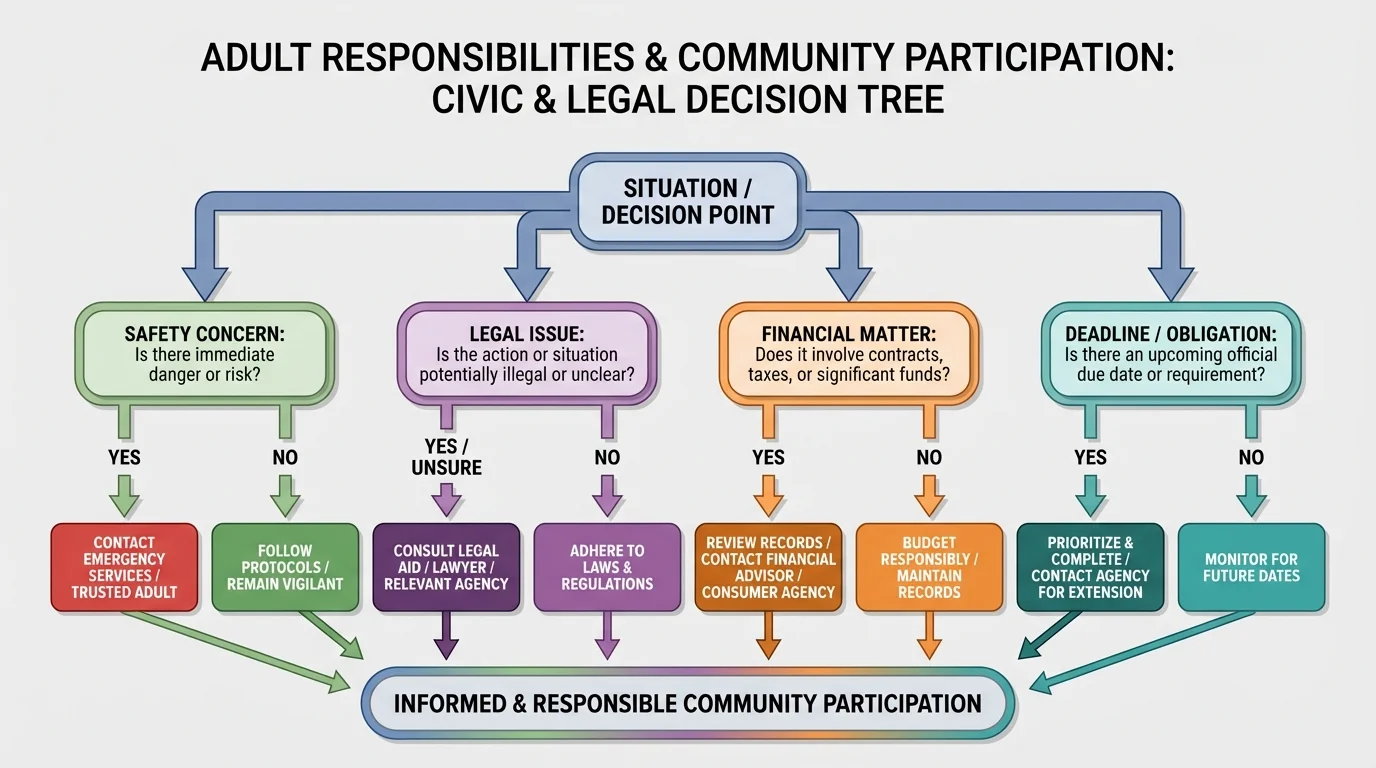
It is also smart to know where to get trustworthy help. Official agency websites, legal aid groups, election offices, consumer protection offices, labor departments, and public libraries can all be useful starting points. Be careful with random advice on social media. A confident answer is not always a correct answer.
Keep records. Save emails, take screenshots, photograph conditions when relevant, write down dates, and store official documents. Good records strengthen your position if you need to explain what happened. As shown in [Figure 3], evidence and deadlines are often the difference between a solvable problem and a much harder one.
These situations show how civic knowledge and legal awareness connect to everyday adult life.
Scenario 1: Signing a lease with friends
Step 1: Read the full agreement.
Check rent amount, due date, late fees, repairs, deposit terms, guest rules, and how the lease ends.
Step 2: Find out who is legally responsible.
If all tenants sign, each person may be responsible for the full rent in some agreements, not just "their share."
Step 3: Document move-in conditions.
Take dated photos so you are not blamed later for existing damage.
Step 4: Keep copies.
Save the signed lease, payment confirmations, and maintenance requests.
This is legal awareness in action: slow down, read carefully, and keep records.
If you skip those steps, a small misunderstanding can turn into lost money, conflict, or damage to your rental history. Civic responsibility here includes being honest with roommates, following agreed rules, and communicating early when a problem appears.
Scenario 2: A misleading post about a local issue goes viral
Step 1: Pause before sharing.
Look for the original source, date, and whether the image or clip is being used out of context.
Step 2: Check official information.
Review statements from the agency, meeting notes, or multiple credible news reports.
Step 3: Respond constructively.
If the claim is false, do not pile on with insults. Share the correction and the source.
Step 4: Choose a better action.
If the underlying issue is real, contact the office involved or join a verified community discussion.
This is responsible digital citizenship and civic participation at the same time.
Notice how both scenarios involve the same habits: verify facts, understand rules, document details, and respond through the correct channel. Those habits protect both your rights and your credibility.
Scenario 3: A workplace problem
Step 1: Identify the issue precisely.
Is it unpaid time, unsafe conditions, discrimination, scheduling confusion, or a personality conflict?
Step 2: Check written policies and records.
Review your schedule, pay stubs, handbook, and any messages from supervisors.
Step 3: Report through the right path.
Start with the appropriate supervisor or human resources contact unless the situation requires outside reporting.
Step 4: Escalate responsibly if needed.
If rights or safety are involved, contact the relevant labor or safety agency, legal aid, or another appropriate authority.
Knowing when to use internal channels and when to seek outside help is a major adult life skill.
Civic knowledge and legal awareness are not one-time lessons you finish and forget. Adult life keeps presenting new situations: new jobs, new communities, new technologies, new policies, and new responsibilities. The goal is not to memorize every rule. The goal is to become the kind of person who notices what matters, checks facts, understands process, asks for help when needed, and participates in ways that improve your community instead of adding confusion.
That kind of participation builds trust. People learn that you are reliable, informed, and serious. Over time, those qualities matter in every part of life—housing, employment, relationships, public discussions, and service to others. You do not need to be famous, wealthy, or highly connected to make a civic difference. You need awareness, judgment, and the willingness to act responsibly.
