Have you ever seen two children learn the same thing in different ways? One might ask lots of questions. Another might keep trying quietly. Another might listen very carefully and copy each step. All of them can learn because each one is using a strength.
Your personal strengths are the positive qualities and helpful habits that help you learn, solve problems, and keep going. A strength is not about being perfect. It is a quality you can use to help yourself try.
Personal strengths are the helpful parts of who you are, like being curious, kind, brave, patient, or a good listener. These strengths can support you when you are learning something new.
Everyone has strengths, but not everyone has the same ones. You may be very patient when building with blocks. Someone else may be brave about trying a new sport. Another person may be great at listening during a video lesson. Different strengths can all lead to learning.
It is also okay if you are still finding your strengths. Sometimes you notice them when a task is easy for you. Sometimes you notice them when a task is hard, but you do not give up.
Some strengths are especially helpful for learning new things. Different strengths help in different ways, as [Figure 1] shows with simple examples from everyday life. You do not need every strength all at once. Even one strength can help you begin.
Curiosity helps you wonder, ask questions, and want to know more. If you are learning how to bake cookies, curiosity might make you ask, "What happens if I stir slowly?" If you are learning a game, curiosity helps you ask how the rules work.
Patience helps you stay calm when something takes time. Learning to zip a coat, ride a scooter, or type on a keyboard may not happen fast. Patience helps you keep going instead of quitting right away.
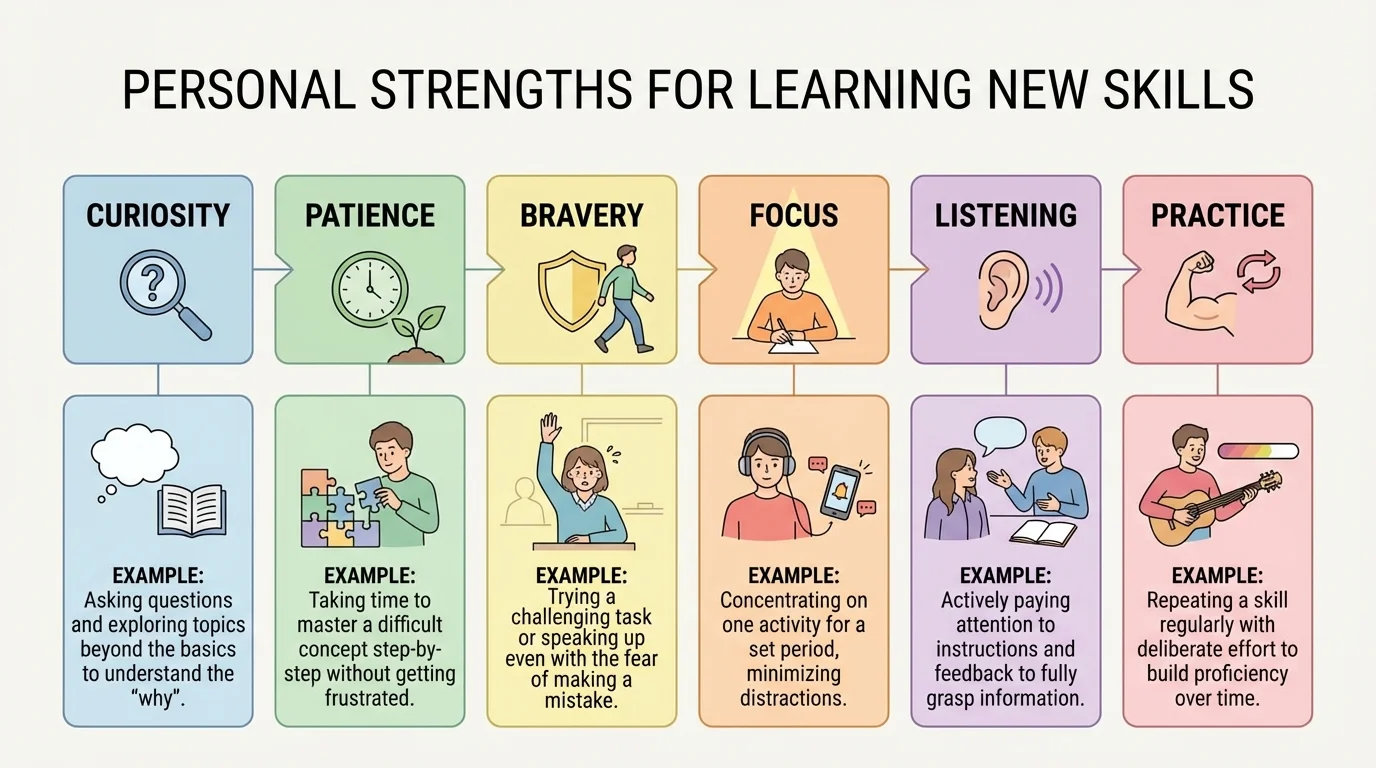
Bravery helps you try even when you feel a little nervous. Maybe you feel shy speaking during an online club meeting. Bravery helps you unmute, say hello, and try.
Focus helps you pay attention to the job you are doing. If you are learning to fold clothes, draw a cat, or follow a recipe, focus helps your brain stay with the steps.
Listening helps you hear directions and understand what to do next. Good listening matters when a parent, coach, or teacher in a video or online lesson explains a new skill.
Practice means doing something again and again so you can get better. Practice is powerful because skills grow over time. Even strong learners need practice.
Another important strength is asking for help. Some children think asking for help means they are weak. That is not true. Asking for help is smart because it helps you learn safely and correctly. If you are learning to cut food with a kid-safe knife or log in to a new program, getting help can save time and prevent mistakes.
Your brain gets stronger at a skill when you keep practicing it. That is one reason something hard at first can feel easier later.
You may also have strengths like being organized, being careful, being creative, or staying cheerful. These can help too. For example, a creative child may think of a fun way to remember dance moves. A careful child may notice small steps others miss.
Sometimes it can be hard to name your strengths because you are used to being yourself all day. But there are clues. Think about what you do when something is new.
Ask yourself simple questions like these: "Do I ask good questions?" "Do I keep trying?" "Do I listen closely?" "Am I calm when things take time?" "Do I like solving problems?" Your answers can help you notice strengths.
Finding a strength in real life
You are learning how to make a sandwich by yourself.
Step 1: Notice what you do first.
Maybe you watch carefully while an adult shows you.
Step 2: Name the strength.
If you watched carefully, one strength might be good listening or focus.
Step 3: Connect it to learning.
Because you listened well, you remembered to put the bread, filling, and plate in the right order.
This helps you see that a strength is something you already use.
You can also notice your strengths by thinking about compliments you hear. If people often say, "You are really calm," "You keep trying," or "You ask great questions," they may be noticing your strengths.
Be honest and kind to yourself. You do not have to say, "I am the best." You can say, "I am a careful learner," or "I am brave when I try new things." That is called self-awareness, which means noticing your own thoughts, feelings, and strengths.
Learning often works best when you take small steps, as [Figure 2] illustrates. If a new skill feels big, break it into little parts and choose one of your strengths to help you.
Here is a simple way to do that. First, pick one skill. Maybe you want to learn to tie your shoes, jump rope, help cook scrambled eggs, draw a cartoon face, or send a polite message in a kids' online group.
Next, ask, "Which strength can help me?" If the skill has lots of directions, use listening. If it feels scary, use bravery. If it takes many tries, use patience and practice. If it is confusing, use curiosity and ask questions.
Then try one small part at a time. For shoe tying, maybe you first learn how to cross the laces. For cooking, maybe you first learn how to crack one egg with help. For drawing, maybe you start with the head shape before the eyes and mouth.
After that, notice what went well. Maybe your knot was loose, but you remembered the first step. That still counts as progress. Progress means moving forward, even in a small way.
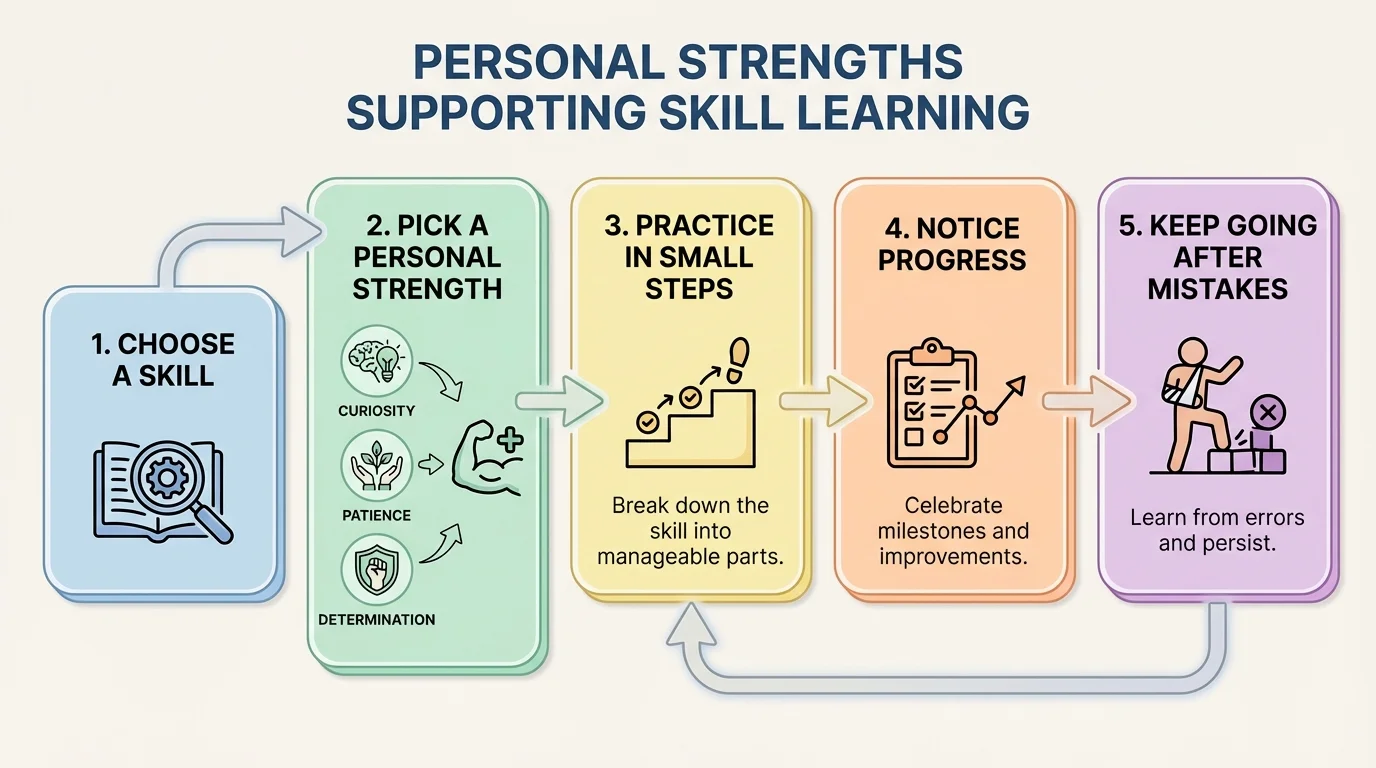
Last, try again. Skills grow with time. If something takes you 5 tries today, that is okay. Tomorrow it may take 4 tries. Small changes matter.
Strengths are tools
You can think of your strengths like tools in a toolbox. You do not use the same tool for every job. In the same way, you do not use the same strength for every skill. Good learners notice which strength fits the job.
Suppose you want to learn how to water a plant correctly. Curiosity helps you ask how much water the plant needs. Listening helps you hear the directions. Focus helps you pour slowly. Patience helps you remember that plants grow over many days, not right away.
Sometimes children think, "If I were good at this, it would be easy." That is not true. Many useful skills feel tricky at first. Even strong learners make mistakes.
Mistakes are information. If your pancake breaks when you flip it, you learn that you may need to wait a little longer or turn it more gently. If your drawing looks different from what you wanted, you learn which part to practice next.
When you feel frustrated, stop and take a breath. You might say, "This is hard right now, but I can keep trying." That kind of self-talk helps you stay ready to learn.
"I can't do it yet" is stronger than "I can't do it."
If a skill is unsafe to do alone, ask for help. Cooking on a stove, using sharp tools, or going online in a new space are times when adult support matters. Being safe is part of being a strong learner.
Many times, strengths act like teammates. One strength helps you start, and another helps you continue. This is useful because not every task needs just one kind of help.
[Figure 3] For example, bravery may help you start a swimming lesson, but practice helps you improve. Curiosity may help you ask how a craft works, but focus helps you follow the steps. Listening may help you learn the rule, but patience helps you stick with it.
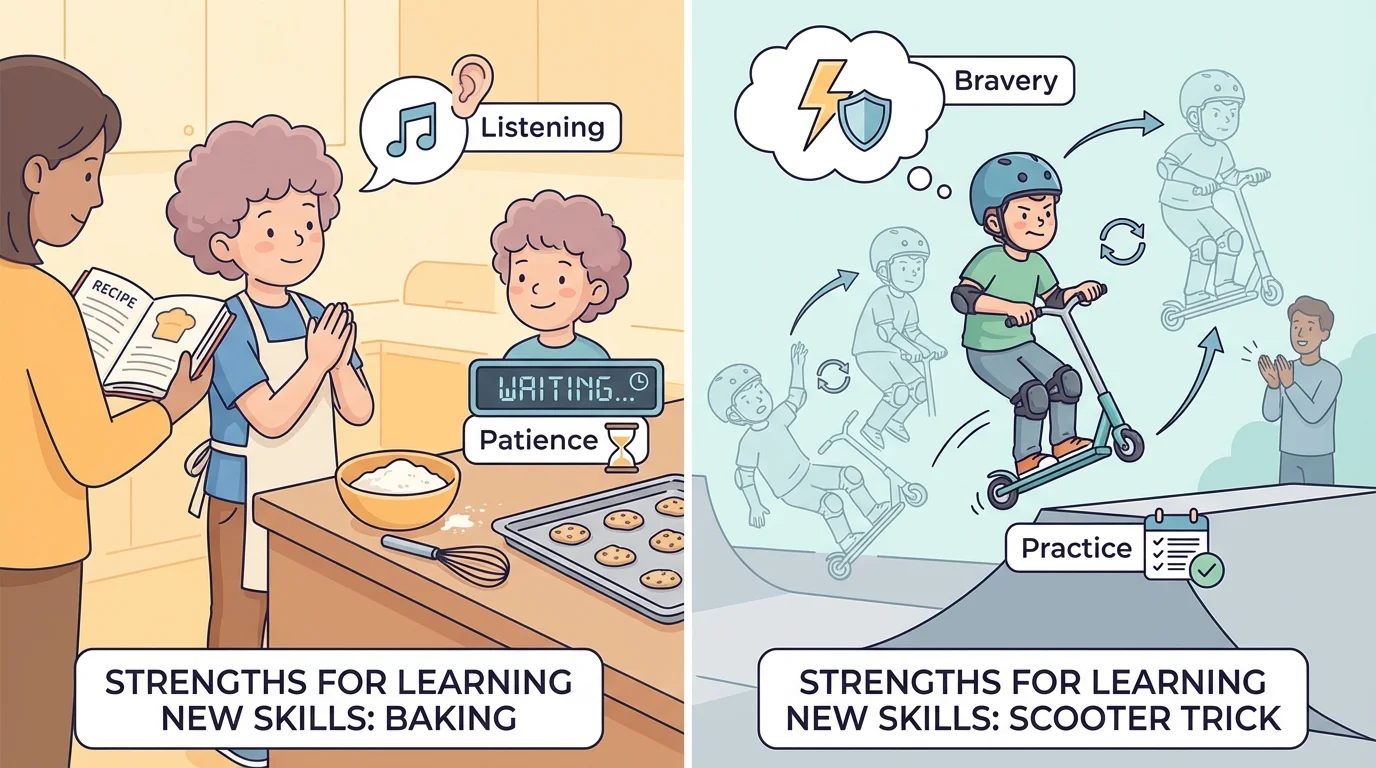
Think about learning a simple recipe at home. You use listening to hear the steps. You use focus to measure carefully. You use patience while waiting for food to cook. You use practice when you make it again another day. Strengths often work better together than alone.
The same thing happens online. If you are learning how to use a new app for art or music, curiosity helps you explore buttons, focus helps you follow directions, and bravery helps you try a new tool without worrying about making a mistake.
Strengths can grow stronger when you use them. You are not stuck with only the strengths you notice now. You can build more.
To grow curiosity, ask one new question each day. To grow patience, stay with a task a little longer before asking someone else to finish it. To grow listening, look at the speaker and sit or stand still while directions are given. To grow bravery, try one safe new thing, even if it feels a little uncomfortable.
It can help to keep a simple "I tried" habit. At the end of the day, think of one thing you tried, one strength you used, and one thing you want to try again. This helps your self-awareness grow.
| Strength | What it looks like | How it helps learning |
|---|---|---|
| Curiosity | Asking questions | Helps you understand more |
| Patience | Waiting and trying again | Helps when a skill takes time |
| Bravery | Trying while nervous | Helps you begin new things |
| Focus | Paying attention | Helps you follow steps |
| Listening | Hearing directions carefully | Helps you know what to do |
| Practice | Doing it again | Helps you improve over time |
Table 1. Common strengths that support learning and the ways they help.
Try This: The next time you learn something new, say: "My goal is to learn ____. A strength I can use is ____." Then pick one small step and begin.
Try This: If you get stuck, do three things: stop, breathe, and ask, "Which strength do I need right now?" You might need patience, listening, or help from a trusted adult.
Try This: After a task, say one true sentence about yourself, such as "I was brave," "I stayed focused," or "I kept practicing." This helps you notice your growth.
