Have you ever tried to do something better, but you were not sure exactly what to do first? That happens to lots of people. A goal can help, but only if the goal is easy to understand. When a goal is clear and specific, your brain knows what to do next.
A goal is something you want to do, finish, or improve. Goals can be big or small. You might want to put away your toys each day, practice reading, help feed a pet, or save money for a game or book.
Goals are important because they give you a direction. They are like a little map. Without a map, it is easy to wander. With a map, you know what to do next.
Clear means easy to understand. Specific means exact, not unclear or confusing. A clear and specific goal tells you exactly what you will do.
When your goal is clear, you can get started faster. You do not waste time guessing. You know what to do, when to do it, and how much to do. That makes the goal feel more possible.
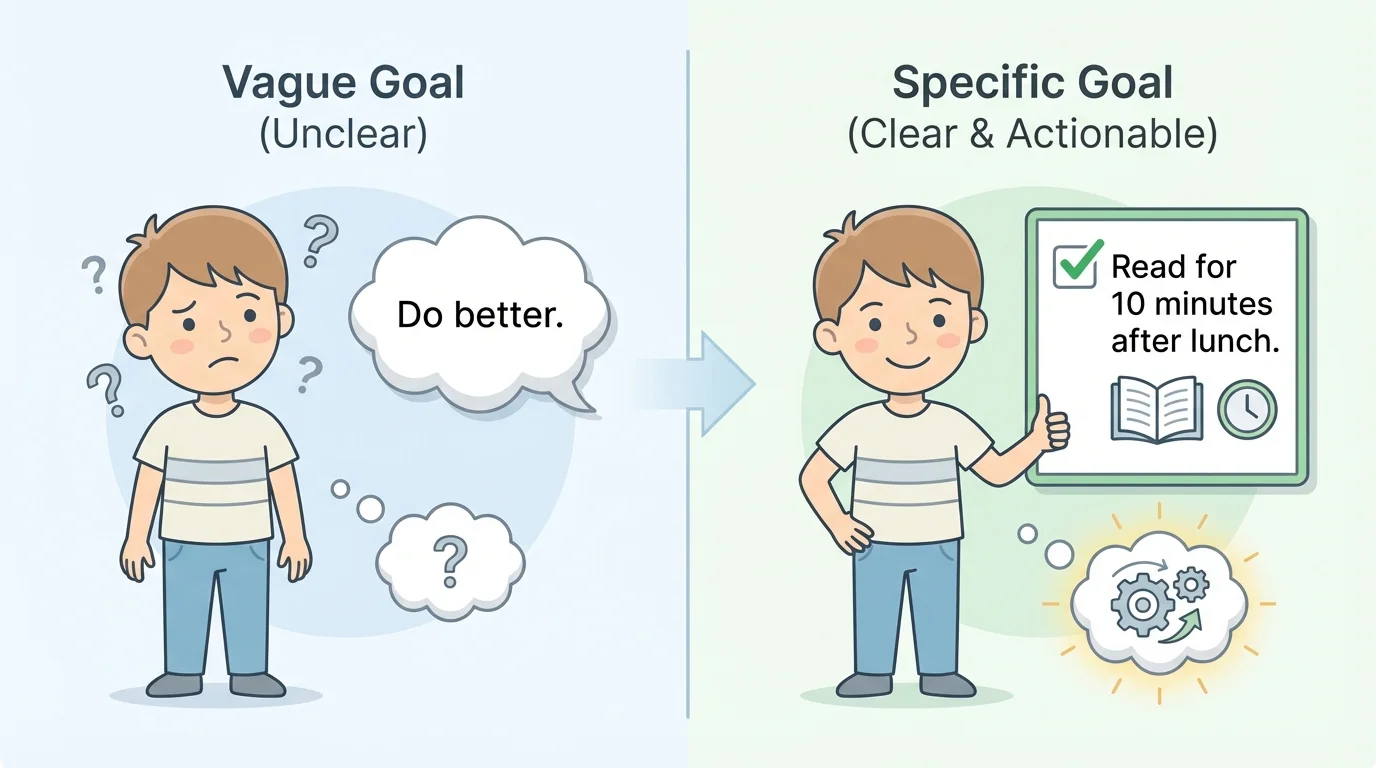
An unclear or vague goal is hard to follow, as [Figure 1] shows with one confusing goal and one easy-to-follow goal. If you say, "I want to be better at reading," that sounds nice, but what does it mean? Better how? When? For how long?
Vague goals can make you feel stuck. You may want to do well, but you do not know your first step. That can lead to forgetfulness, waiting too long, or giving up because the goal feels too big.
Look at these examples:
| Vague Goal | Why It Is Hard | Better Goal |
|---|---|---|
| Be kinder | You may not know what action to take. | Say one kind thing to my brother each morning. |
| Read more | You do not know when or how long. | Read for 10 minutes after lunch. |
| Help at home | The job is not named. | Put dirty clothes in the basket every night. |
Table 1. This table compares vague goals with clearer goals that are easier to do.
When a goal is too fuzzy, it is also hard to tell if you finished it. If you say, "I will clean my room better," you might not know when you are done. But if you say, "I will put books on the shelf and toys in the bin before dinner," you can check when it is finished.
Why your brain likes clear directions
Your brain works better when it gets simple directions. A clear goal tells your brain what action to take. A vague goal makes your brain do extra work trying to guess the plan.
This is one reason clear goals help with responsibility. Responsibility means doing what you are supposed to do. If you know exactly what you are supposed to do, it is easier to remember and easier to complete.
A clear goal answers important questions. It tells what you will do. It may also tell when you will do it, how much you will do, or how often you will do it.
Here are some strong goals for a second grader:
These goals work better because they are not guesses. They are actions you can see. You can say, "Yes, I did it," or "Not yet, I still need to do it." That is very helpful.
Clear goals can also be small. A goal does not have to be huge to matter. Small goals help you build good habits, and good habits help you later in life.
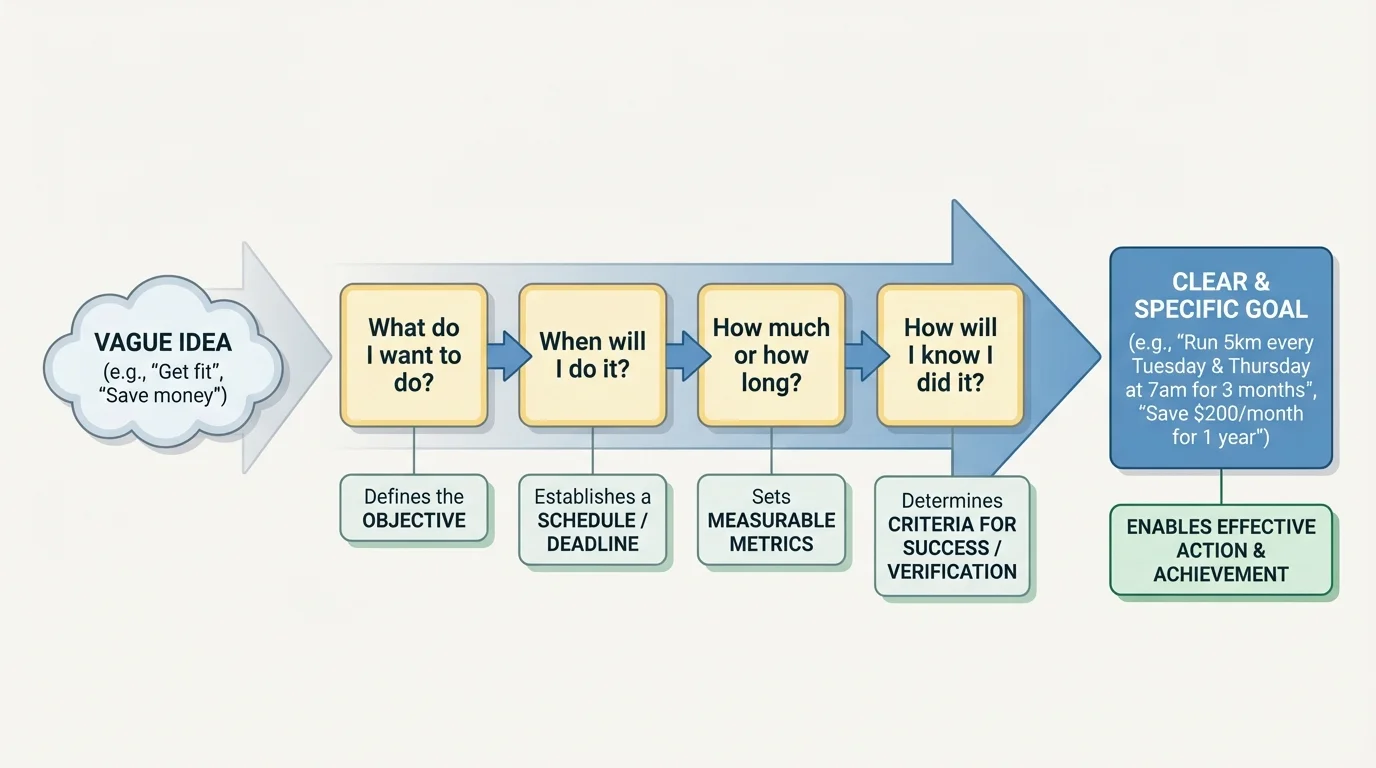
You can build a clear goal by asking yourself a few simple questions, as [Figure 2] shows. These questions help turn an unclear idea into a real plan you can follow.
Ask these questions to turn a general idea into a clear plan:
Turning a vague goal into a clear goal
Step 1: Start with the fuzzy goal.
"I want to help more."
Step 2: Pick one real action.
"I will feed the dog."
Step 3: Add time or place.
"I will feed the dog after breakfast."
Step 4: Make it easy to check.
"I will feed the dog after breakfast every day this week."
Now the goal is clear. You know the job, the time, and how often to do it.
Here is another one. "I want to save money" is a start, but it is still broad. A clearer goal is "I will put $1 in my jar every Saturday for 6 weeks." Now you can count your progress. After 6 weeks, you will have $6 because \(1 + 1 + 1 + 1 + 1 + 1 = 6\).
If a goal still feels too hard, make it smaller. "Read 30 minutes every day" may feel too big at first. "Read 10 minutes after lunch" may be easier. Small and clear is often better than big and confusing.
Many people are more likely to finish a goal when they decide the exact time and action first. A plan like "after breakfast, I will pack away my pajamas" is stronger than just "I should clean up."
You can even say your goal out loud or write it on a note. Seeing the goal helps you remember it. A simple checklist can help too.
Clear goals help you progress. Progress means moving forward little by little. When your goal is specific, you can notice each small success.
For example, if your goal is "Put my shoes on the rack after I come home," you can check every day if you did it. After several days, you may notice that you are remembering on your own. That feels good because you can see your improvement.
Clear goals also help you ask for help. If you tell a parent or caregiver, "My goal is to read for 10 minutes after dinner," they know how to support you. They can remind you, listen to you read, or help you find a book.
As we saw earlier in [Figure 1], the difference between "do better" and a real action matters a lot. One gives you a cloudy idea. The other gives you a path.
Another good thing about clear goals is that they build confidence. When you finish a specific job, you can feel proud because you know exactly what you did. Pride grows when success is easy to see.
"A goal is a promise you make to yourself."
That promise is easier to keep when you understand it clearly. If the promise is confusing, it is harder to keep. If the promise is simple and exact, it is easier to remember and easier to do.
As [Figure 3] shows, clear goals help in many parts of life. They help you at home, in your community, and when you think about the future.
At home, a clear goal can help with chores and routines. Instead of saying, "I will help in the kitchen," you might say, "I will put my plate in the sink after dinner." That is easy to understand and easy to do.
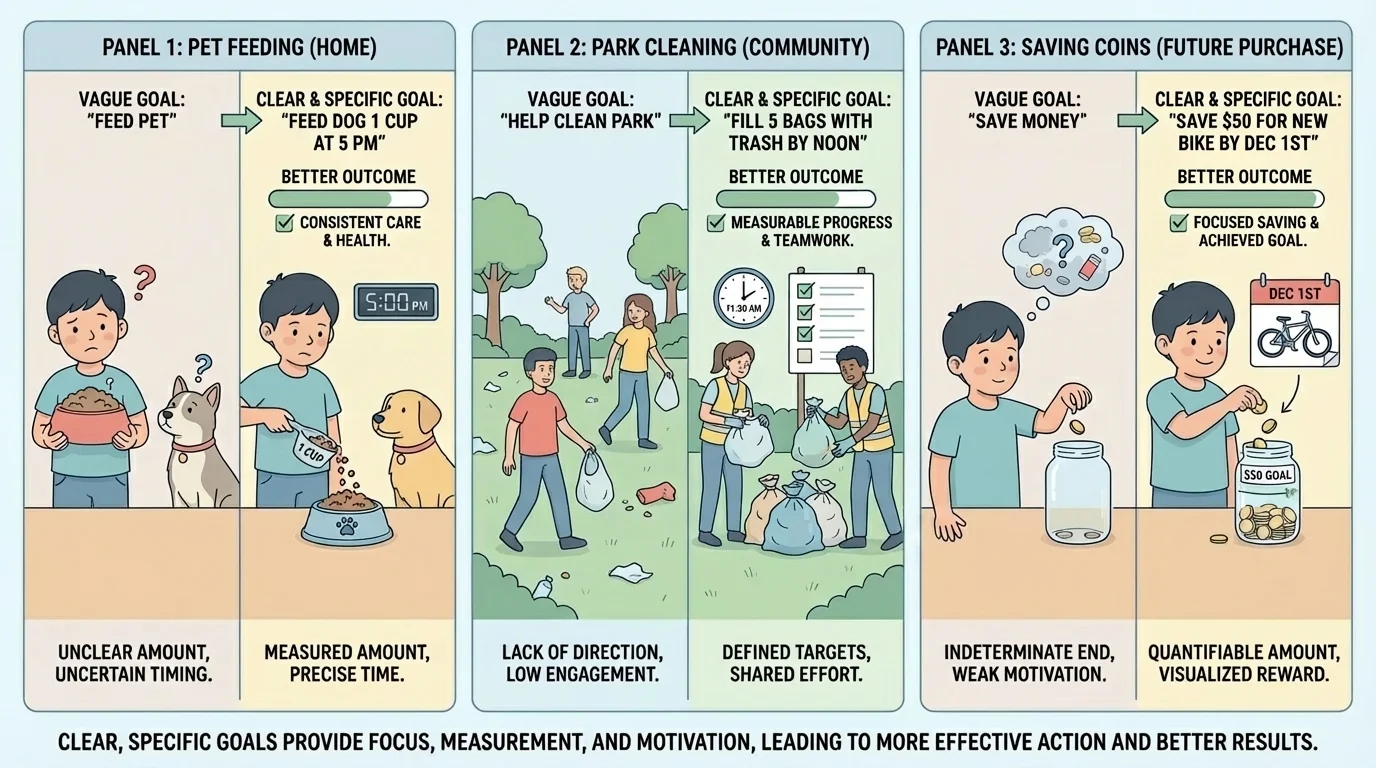
In your community, clear goals can help you be helpful and kind. Instead of "I will be nice online," you might say, "I will use kind words in my messages" or "I will wait my turn to speak during my club video call." These goals help you become a person others can trust.
For the future, clear goals can help you prepare for something you want. Maybe you want to buy a craft kit. A clear plan could be, "I will save $2 each week for 5 weeks." Then you can figure out the total: \(2 + 2 + 2 + 2 + 2 = 10\). You will save $10.
Goals for the future do not have to be about money. You may want to learn to ride a bike, memorize a song, or get ready for a sports class. A clear goal might be "I will practice balancing on my bike for 10 minutes with an adult on Saturday and Sunday."
| Area of Life | Unclear Goal | Clear Goal |
|---|---|---|
| Home | Help more | Make my bed every morning. |
| Community | Be nice online | Write one kind message to a friend this week. |
| Future | Save up | Put $2 in my jar every Friday for 5 weeks. |
Table 2. This table shows how specific goals can be used at home, in the community, and for future planning.
Later, when you make bigger plans, the same idea still works. As shown in [Figure 3], different kinds of goals still need clear actions. Whether you are helping at home, serving others, or getting ready for something you want, specific steps make success more likely.
First, pick one goal at a time if possible. Too many goals can feel overwhelming. One clear goal is easier to remember than five fuzzy ones.
Second, keep the goal where you can see it. You can put it on paper, a family board, or a simple checklist. Looking at it helps your mind stay on track.
Third, tell a trusted adult. Sharing your plan can give you support. They may help remind you or celebrate with you when you finish.
Fourth, make the goal realistic. If it is too big, break it into smaller parts. Instead of "clean the whole play area," try "put blocks in the bin before snack."
Fifth, notice your effort. If you forget one day, do not quit. Start again the next day. A missed day is not the end. It is just one day.
Try This
Use this simple sentence pattern to make a stronger goal:
"I will do an action at a time for an amount of time."
For example: "I will read at 7 o'clock for 10 minutes."
Or: "I will put away crayons after art time."
When you use clear and specific goals, you are not just wishing. You are making a plan. Plans help you act. Actions help you grow.
