Have you ever been in a group where one small comment changed everything? A sentence like "That idea won't work" can make people feel upset and quiet. But a sentence like "I see your idea. What if we try one small change?" can help the whole group improve. The words you choose matter. In online school, clubs, games, family projects, and community activities, knowing how to give helpful feedback and disagree kindly can turn a challenging group task into a strong team effort.
Group work is not just about finishing a task. It is also about listening, sharing, solving problems, and treating people with respect. Sometimes your group will have different ideas. That is normal. In fact, different ideas can help a group make better choices. What matters most is how people talk to each other when they agree and when they disagree.
When group work goes well, everyone feels heard. People share ideas, fix mistakes, and build something better together. When group work goes badly, people may interrupt, ignore others, or say hurtful things. Then the group can get stuck.
In online school, group work can feel extra tricky. You may be typing in a chat, talking on a video call, or adding ideas to a shared document. Without seeing every face clearly or hearing everyone's voice equally clearly, it is easier to misunderstand someone. That is why clear feedback and respectful disagreement are such important life skills.
Feedback is information you give to help improve work, actions, or ideas.
Respectful disagreement means saying you think differently in a calm, kind way while still showing respect for the other person.
Group work means working with other people toward the same goal.
Good feedback and respectful disagreement do not mean pretending everything is perfect. They mean being honest in a way that helps. You can say what you really think and still be kind.
Helpful feedback is about the work, not the person. If you say, "You are bad at this," that attacks the person. If you say, "This slide needs a bigger title so people can read it," that helps improve the work. One hurts. The other guides.
Respectful disagreement means you do not have to say "yes" to every idea. You are allowed to think differently. But instead of using rude words, eye-rolling, all-caps typing, or blaming, you explain your thinking clearly and listen to the other person too.
Sometimes students think disagreement means the group is failing. That is not true. A group can become stronger when members share different ideas kindly. Different thoughts can help the team notice mistakes, think more carefully, and choose the best plan.
Different ideas can make the work better. If everyone agrees too fast, the group may miss problems. Respectful disagreement helps the group test ideas. Feedback helps the group improve them. Together, these skills make teamwork stronger.
A useful way to think about this is: Be kind, be clear, be helpful. Kind words protect relationships. Clear words avoid confusion. Helpful words move the group forward.
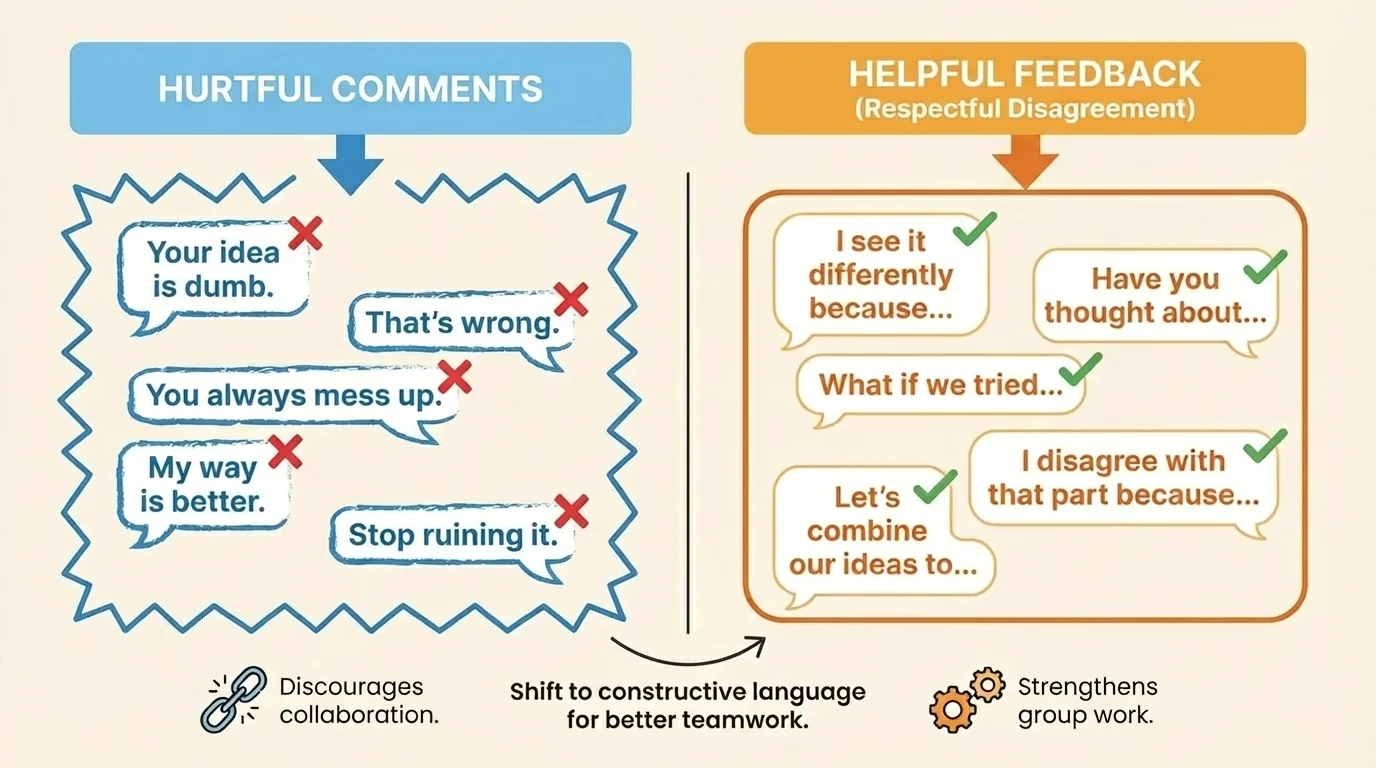
When you give feedback, your job is not to sound smart or to point out every flaw. Your job is to help the group do better, as [Figure 1] shows through the difference between hurtful comments and useful ones. Helpful feedback is specific, calm, and focused on what can change.
Here is a simple way to do it. First, notice something that is working. Next, name one thing that could be better. Then offer a suggestion. For example: "I like the pictures you chose. Maybe we can add labels so the ideas are easier to understand." That sounds much better than "This is confusing."
You can use sentence starters like these: "I like how you...," "Maybe we could...," "What if we try...," "I noticed that...," and "This part might be clearer if..." These sentence starters help your words sound friendly and useful.
Avoid feedback that is too vague. Saying "good job" may feel nice, but it does not tell the person what helped. Saying "Your opening sentence grabbed my attention" is much more useful. Specific words help people know what to keep doing.
Avoid feedback that is too harsh. Online, typed words can seem stronger than you mean. "No. This is wrong." may feel sharp and embarrassing. A better version is "I think this part may need another look. Can we check it together?"
Also think about timing. If someone is already upset, they may not be ready to hear a lot of advice. You can wait for a calmer moment or ask, "Would you like a suggestion?" That shows respect.
Helpful feedback in action
Your group is making a short video about recycling. One teammate reads so quietly that it is hard to hear.
Step 1: Start with something positive.
"Your facts are really good, and you sound prepared."
Step 2: Say what needs to improve.
"It is a little hard to hear your voice in the recording."
Step 3: Offer a clear suggestion.
"Could you stand closer to the microphone or speak a little louder?"
This feedback is kind, specific, and helpful.
Another helpful habit is to keep your face, voice, and words consistent. If your words sound polite but your voice sounds annoyed, people may still feel hurt. In a typed message, read your sentence once before sending it. Ask yourself: "Would I want someone to say this to me?"
Later, when your group improves a project using suggestions, the value of strong feedback becomes easy to see. Just as [Figure 1] compares weak and strong comments, your group can learn that the best feedback is not the loudest comment. It is the clearest and kindest one.
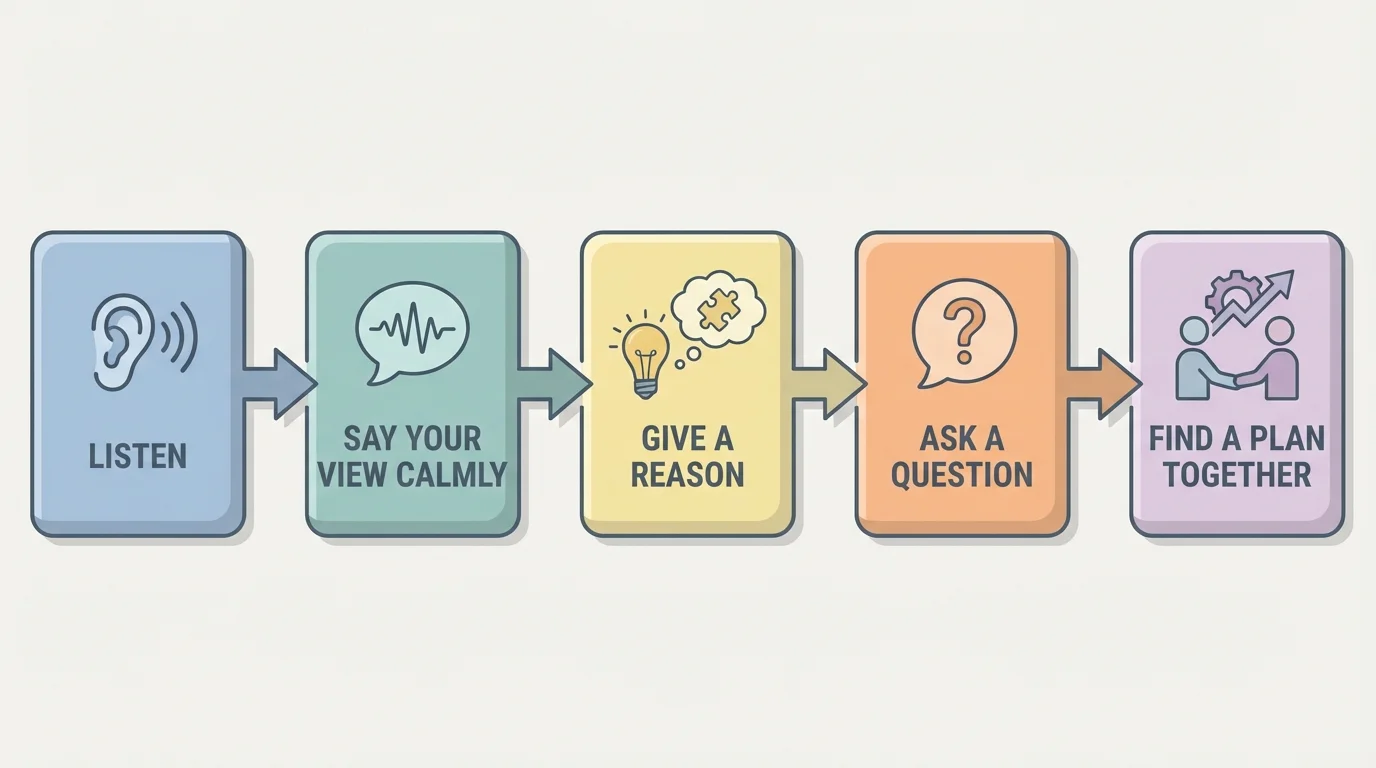
Respectful disagreement is a skill, not a fight, and [Figure 2] lays out a simple path you can follow. You can disagree without being rude, and you can stand up for your idea without putting someone else down.
A good pattern is this: listen first, say your view calmly, give a reason, ask a question, and look for a plan together. This helps the group stay focused on solving the problem instead of trying to win.
For example, you might say, "I see why you picked that topic. I think the other topic may work better because we found more facts for it. What do you think?" That response shows respect, gives a reason, and invites teamwork.
Notice what this does not sound like. It does not sound like: "That is a bad idea." It does not sound like: "You never listen." It does not sound like: "Mine is better." Those phrases make people defensive, which means they focus on protecting themselves instead of solving the issue.
When you disagree, use I-statements when possible. Say "I think...," "I noticed...," or "I am worried that..." This keeps the focus on your thoughts instead of blaming the other person.
You should also show that you heard the other idea. Try saying, "I understand your point," "I see why you think that," or "That makes sense to me, but I see it a little differently." People are more willing to listen when they feel heard.
"You can be honest and kind at the same time."
Sometimes the best answer is a compromise. That means each person gives a little so the group can move forward. Maybe one student wants lots of pictures and another wants more words. The group might choose a balanced slide with both.
At other times, the group may test both ideas and choose the one that works best. This is another reason disagreement can be useful. It can lead to better decisions instead of bigger arguments, just as the step-by-step path in [Figure 2] keeps the group moving toward a solution.
Even kind students can get frustrated. Maybe you worked hard on an idea and someone rejects it. Maybe someone interrupts you. Maybe a message in chat feels mean. Strong feelings are normal. What matters is what you do next.
Start by pausing. You do not have to answer right away. Take a breath. Relax your shoulders. Read the message again, or wait a moment before unmuting on a call. A small pause can stop a big problem.
Then name the feeling to yourself: angry, embarrassed, disappointed, confused. When you know what you feel, it is easier to choose a smart response. You might say, "I feel frustrated because I want my idea to be heard." That is much more helpful than snapping back.
Remember that online messages do not include tone of voice very well. A short reply may mean the person is busy, not rude. Before assuming the worst, ask a calm question.
If you need help, ask an adult or group leader. Getting support is not tattling when the goal is to solve a problem safely and respectfully. This is especially important if someone is being cruel, is mocking others, or is refusing to let anyone else speak.
It also helps to separate the problem from the person. The problem might be "we have two different plans" or "we do not understand the directions." The problem is not "this person is impossible." When you focus on the real problem, it is easier to fix.
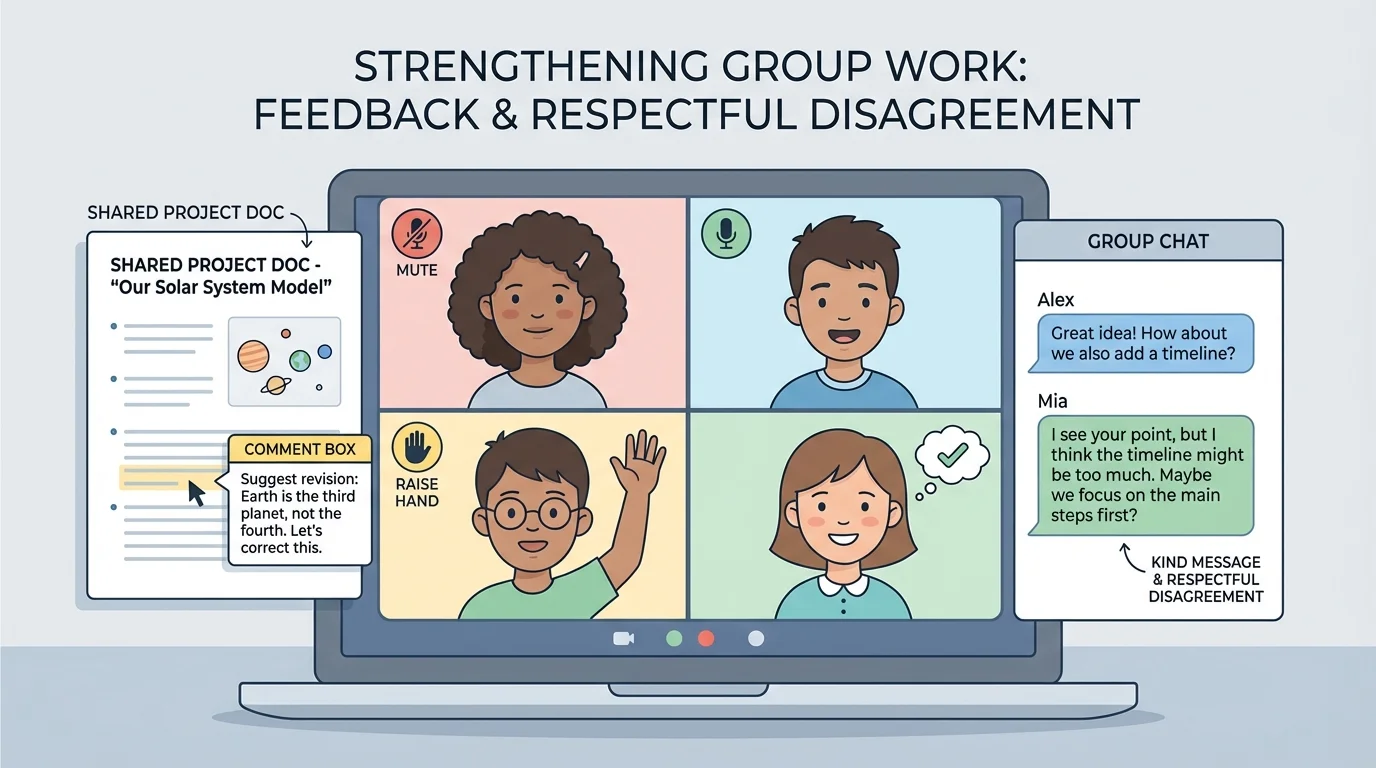
Group work online uses tools like video calls, chat boxes, voice messages, and shared documents, and [Figure 3] highlights places where good communication matters most. Because you may not be in the same room, you need to be extra clear and respectful.
On a video call, do not talk over people. Wait your turn, use the raise-hand tool if there is one, and let others finish. In a shared document, do not erase someone's work without talking first. In chat, avoid typing in a way that looks angry, such as using lots of exclamation marks or all capital letters.
Good online teamwork also means checking for understanding. You can say, "Just making sure I understand," or "Do you mean we should change the title?" That can prevent arguments caused by confusion.
Use comments and messages wisely. A comment like "Fix this" is not very helpful. A better comment is "Can we move this picture down so the title is easier to read?" The second one gives a clear next step.
Be dependable too. If you promised to finish one part by a certain time, try your best to do it. When each person does their part, trust grows. Trust makes feedback and disagreement easier because people know the team is working toward the same goal.
Online groups also need patience. Internet connections can freeze. People may speak at the same time by accident. Someone may need extra time to type. Staying calm during these moments shows maturity.
Later, when your group uses better chat messages and clearer speaking turns, the value of strong online teamwork becomes clear. The tools shown in [Figure 3] are only helpful when the people using them are patient, clear, and respectful.
Think about a group making a digital poster about animals. One student says, "Your writing is boring." That comment may hurt feelings and does not explain what to change. A better comment is, "Maybe we can add one surprising fact near the top so readers get interested right away." Now the group knows what to do.
Here is another example. Two kids in a community club are planning a food drive flyer. One wants bright colors. The other wants simple colors. A respectful disagreement might sound like this: "I like your bright design. I am wondering if simpler colors might make the words easier to read. Could we compare both versions?" That keeps the conversation open.
From conflict to teamwork
A group is choosing a title for a presentation. One student says, "My title is the best." Another student feels ignored.
Step 1: Pause and reset.
"Let's slow down and hear both ideas."
Step 2: Let each person explain.
"Can you each tell us why you chose that title?"
Step 3: Compare the ideas.
"Which title is clearer? Which one matches our topic best?"
Step 4: Choose together.
The group votes or combines the strongest parts of both titles.
The group moves from arguing about people to thinking about the work.
These examples show an important truth: strong groups are not groups with zero problems. Strong groups are groups that know how to handle problems well.
You do not need perfect words every time. What helps most is building simple habits. Before speaking or typing, think: Is it true? Is it kind? Is it helpful? If the answer is no, change your words.
Use short routines in every group project. At the start, agree on who is doing what. During the work, check in kindly. At the end, thank people for their effort and mention one thing the group did well. These small habits can make a big difference.
| Situation | Unhelpful Response | Helpful Response |
|---|---|---|
| Someone has a different idea | "No, that is wrong." | "I see it differently. Can I explain why?" |
| A teammate's part is unclear | "This makes no sense." | "Can we make this part clearer by adding labels?" |
| You feel upset | Send an angry message right away | Pause, breathe, then reply calmly |
| The group is stuck | Blame one person | Ask, "What is the problem we need to solve?" |
Table 1. Helpful and unhelpful ways to respond during group work.
Another helpful habit is showing appreciation. If someone changes their idea after hearing feedback, thank them. If someone listens carefully during a disagreement, notice it. Positive words help build a team where people feel safe sharing ideas.
Groups often do better when members feel safe to speak honestly. When people are not afraid of being laughed at or ignored, they share more useful ideas and catch more mistakes.
Finally, remember that these skills are not only for school assignments. They help in sports teams, clubs, family planning, online gaming groups, and future jobs. Learning to give useful feedback and disagree respectfully now will help you in many parts of life.
