Have you ever done something that felt great right away, but later made your day harder? Maybe you stayed up too late because a game or video felt exciting. In the moment, it felt fun. The next morning, getting up felt awful. That is an important life skill: learning that choices often have more than one result.
When you make a decision, the result is called a consequence. Some consequences happen fast. Others take longer to show up. Being able to notice both kinds helps you make smarter choices, solve problems, and take care of yourself and others.
Consequences are not always punishments. A consequence is simply what happens because of a choice. If you water a plant, the consequence may be that it grows. If you forget to charge a tablet, the consequence may be that it turns off during a lesson or activity. Some consequences feel good, and some feel bad. Some are small, and some are big.
When you understand consequences, you become better at decision-making. You stop acting only on what feels easy right now. You begin to ask, "What will happen next?" and "What might happen later?" That kind of thinking helps you with friendships, money, health, honesty, safety, and time.
Consequence means the result of an action or choice.
Short-term consequence means a result that happens soon, often right away or within a short time.
Long-term consequence means a result that happens later, after more time has passed.
Sometimes the short-term and long-term consequences of the same choice are very different. A choice might feel helpful now but cause trouble later. Or a choice might feel hard now but lead to something better later.
A short-term consequence happens soon. It might happen in a few seconds, a few minutes, or the same day. A long-term consequence happens after more time. It may show up tomorrow, next week, or even much later. One choice can lead to both kinds, with one decision leading to a "now" result and a "later" result.
Think about staying up late. The short-term consequence may be extra fun because you keep watching videos or playing. The long-term consequence may be feeling tired, cranky, or unable to focus the next day. The same choice gives you one result now and another result later.
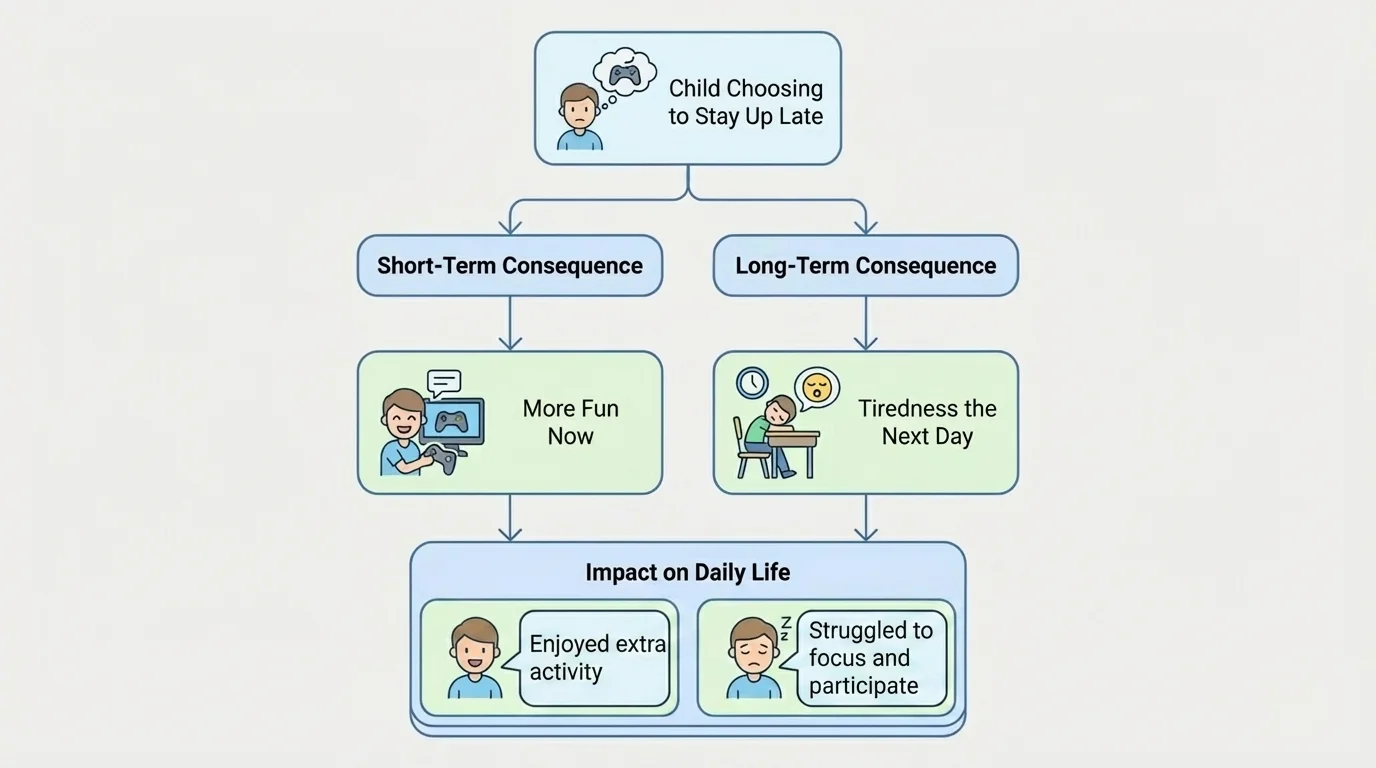
Here is another example. If you put your dirty dish in the sink right after eating, the short-term consequence is that you spend a little time cleaning up. The long-term consequence is that your space stays neat and the job does not pile up. A tiny action now can prevent a bigger problem later.
It helps to compare these two kinds of consequences side by side.
| Choice | Short-term consequence | Long-term consequence |
|---|---|---|
| Stay up late | More fun right now | Tired the next day |
| Finish chores early | Less free time now | More time later and less stress |
| Spend all your money at once | Get something immediately | No money left for something important later |
| Tell the truth | May feel scary or embarrassing | Builds trust |
Table 1. Examples of choices with short-term and long-term consequences.
You do not need a complicated system to make better choices. A simple thinking process works well and gives you a step-by-step way to slow down before acting. This is especially useful when you feel excited, upset, angry, or rushed.
Step 1: Stop for a moment. Take a breath. Do not choose too fast.
Step 2: Ask, "What might happen right away?" That helps you spot the short-term consequence.
Step 3: Ask, "What might happen later today, tomorrow, or next week?" That helps you spot the long-term consequence.
Step 4: Think about who may be affected. Will this choice help only you, or could it hurt someone else too?
Step 5: Choose the action that is safe, kind, and responsible.
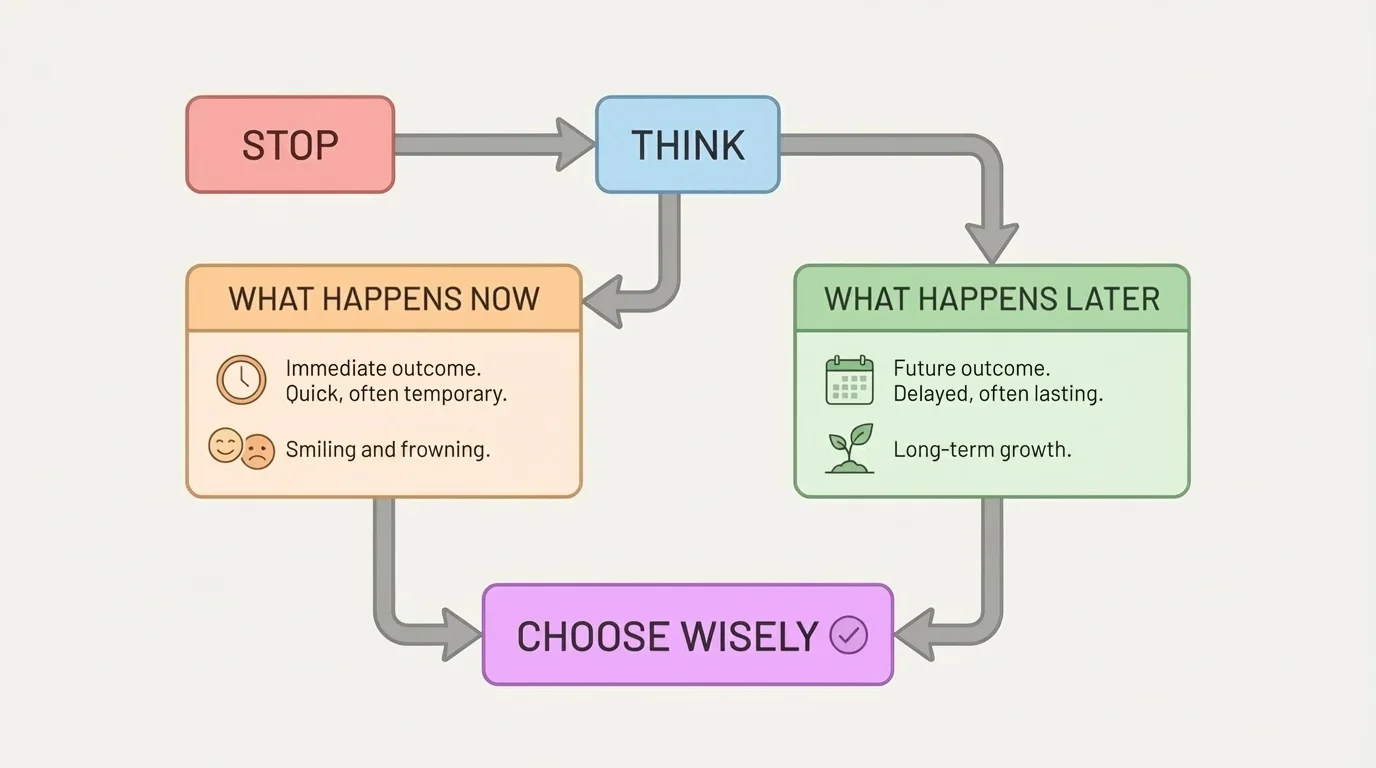
This short pause can make a huge difference. Many poor choices are made when people think only about the initial feeling: fun, anger, excitement, or relief. Good problem-solvers look one step farther ahead.
Using the thinking steps
You want to spend your whole allowance on candy.
Step 1: Stop and breathe.
You pause instead of buying right away.
Step 2: Think about now.
The short-term consequence is that the candy tastes good and feels exciting to buy.
Step 3: Think about later.
The long-term consequence is that you may have no money left for a toy, a gift, or something you really need.
Step 4: Make a wiser choice.
You might spend part of your money and save the rest.
This does not mean candy is always wrong. It means wise choices look at both now and later.
The same process works when you are deciding whether to rush through a task, post a comment online, ignore a responsibility, or tell the truth after making a mistake.
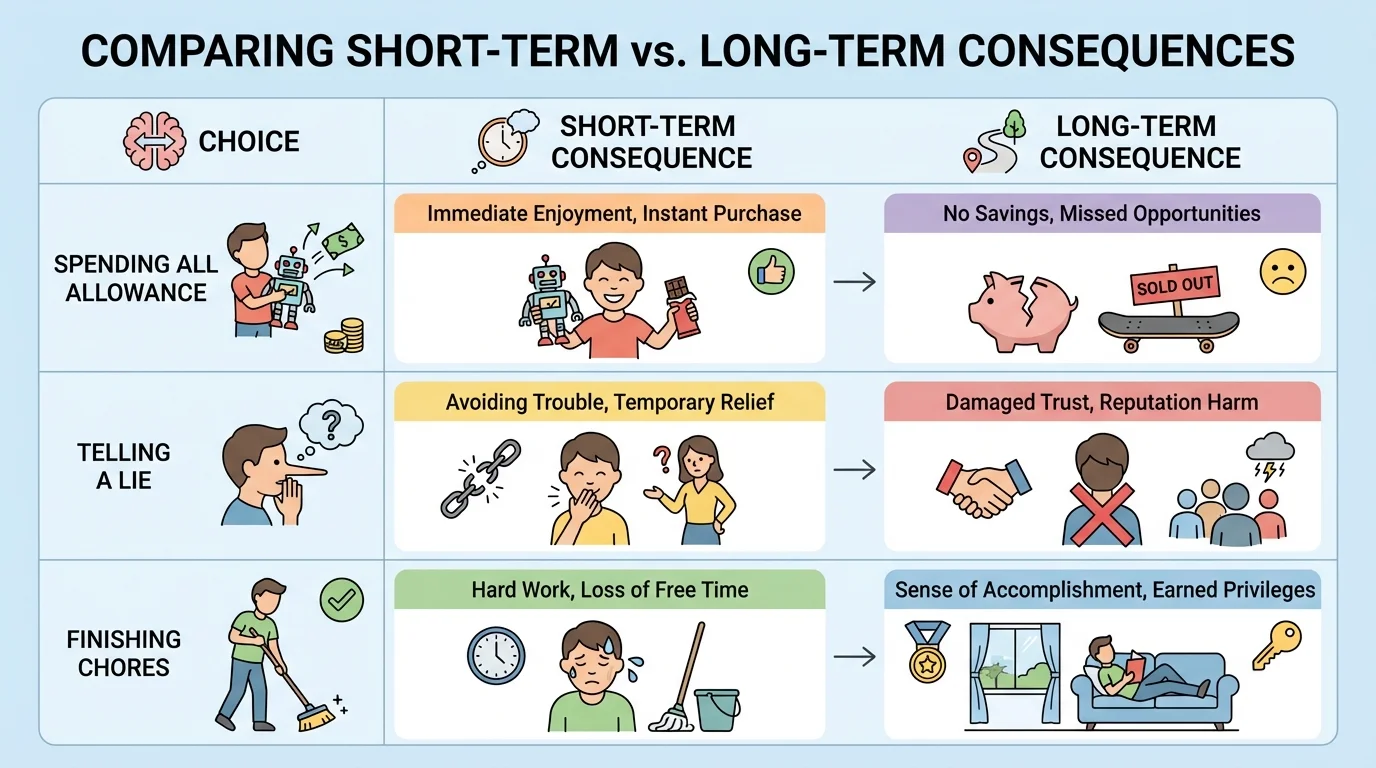
Many everyday choices can be sorted by what happens soon and what happens later, as a simple choice chart compares. Looking at examples helps you practice noticing patterns.
Screen time: If you keep watching videos instead of getting ready for bed, the short-term consequence is more entertainment. The long-term consequence may be poor sleep, trouble focusing, and a grumpy mood.
Homework or daily tasks: If you finish your work early, the short-term consequence is that you give up some play time now. The long-term consequence is more free time later and less worry hanging over you.
Money: If you spend all your birthday money on the first day, the short-term consequence is excitement and a new item right away. The long-term consequence is that when something more important comes up, you may not be able to buy it.
Honesty: If you break something and hide it, the short-term consequence may be escaping trouble for a little while. The long-term consequence can be bigger trouble later, plus lost trust. Trust is hard to rebuild once it is damaged.
Being kind online: If you post a mean comment because you are upset, the short-term consequence may be that you feel powerful for a moment. The long-term consequence may be hurting someone, damaging a friendship, or getting blocked from a group. Online choices can spread fast and last a long time.
Safety: If you share personal information with a stranger online because they seem friendly, the short-term consequence may be feeling included or noticed. The long-term consequence could be serious safety problems. Safe choices often protect you from dangers you cannot see yet.
Health: If you never brush your teeth before bed, the short-term consequence is saving a few minutes. The long-term consequence may be cavities, pain, or more dentist visits. A small healthy habit now can prevent a big problem later.
Your brain often notices fast rewards more easily than future problems. That is one reason why pausing and thinking is such an important life skill.
Notice that some short-term consequences feel good, but that does not always make them the best choice. In the same way, some short-term consequences feel annoying, but that does not mean the choice is bad.
Long-term results can be hard to notice because they are not standing right in front of you. If something fun is available now, your brain may focus on now and ignore later. That is normal, especially when you are excited, upset, bored, or under pressure.
Another reason is that long-term consequences sometimes build slowly. One messy room may not seem like a big deal. But if you never clean up, the mess grows. One skipped practice may not matter much. But many skipped practices can keep you from improving. Small choices repeated over time become habits.
This is why critical thinking matters. Critical thinking means looking carefully at a situation instead of reacting without thinking. It helps you ask smart questions, notice patterns, and solve problems before they grow.
One choice can create a chain of consequences. A single action often leads to another result, and then another. For example, staying up late can lead to tiredness, tiredness can lead to irritability, and irritability can lead to arguments or mistakes. Thinking ahead helps you notice the whole chain, not just the first link.
You can use the same idea when solving problems. If you are upset with a friend, you might want to send an angry message right away. But if you pause, cool down, and choose calm words, you can protect the friendship. The short-term consequence of waiting may be that you do not get instant relief. The long-term consequence may be a much better outcome.
When you are unsure what to do, ask yourself these quick questions:
1. Is this safe?
2. Is this kind?
3. What happens right away?
4. What happens later?
5. Would I feel okay telling a trusted adult about this choice?
6. Am I choosing because it is wise, or just because it is easy?
This tool is helpful at home, online, during sports or clubs, and in your neighborhood. It works for big choices and small ones.
Quick case study: sending a message when angry
Step 1: Notice your feeling.
You are angry because someone said something rude during a group chat.
Step 2: Think about the short-term consequence.
If you send a mean message back, you may feel better for a minute.
Step 3: Think about the long-term consequence.
The argument may get bigger, more people may join in, and the friendship may be harmed.
Step 4: Choose a better action.
You wait, calm down, and send a respectful message or ask a trusted adult for help.
Choosing the calmer action protects you and others.
Try This: Before one decision today, silently ask yourself, "What happens now? What happens later?" Even using these two questions one time can help you practice wiser thinking.
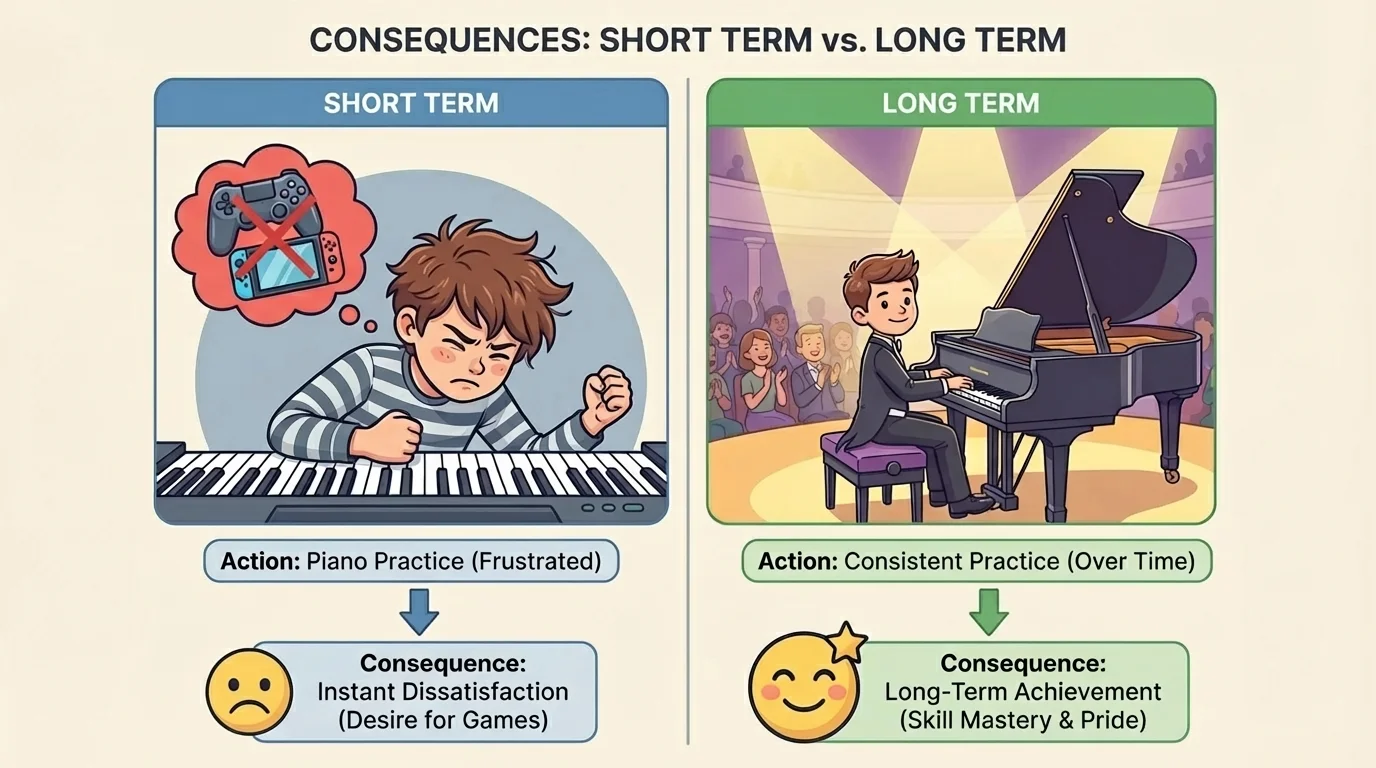
Not every short-term consequence is bad. Sometimes the best choices feel hard at first. Practicing piano, finishing a tough task, saving money instead of spending it, or going outside for exercise may not be your favorite thing in the moment. But those actions can lead to strong long-term benefits, with practice now leading to pride and skill later.
This is important because some students think, "If it feels hard now, it must be the wrong choice." That is not true. Hard work, patience, honesty, and self-control often feel uncomfortable in the short term. Later, they can bring confidence, skill, trust, and success.
For example, telling the truth after a mistake may feel scary right away. That short-term consequence is discomfort. But the long-term consequence may be trust, support, and a chance to fix the problem honestly. In many situations, the brave choice is not the easiest choice right now.
"Wise choices are not always the easiest choices."
As you saw earlier in [Figure 1], one decision can branch into different results over time. The goal is not to avoid every hard feeling. The goal is to choose what leads to the healthiest, safest, and kindest outcome overall.
The more you practice thinking about consequences, the easier it becomes. At first, you may need reminders. Later, your brain gets stronger at looking ahead. This is how good habits are built.
Helpful habits include packing what you need the night before, logging off on time, saving part of your money, speaking respectfully online, and finishing small responsibilities before they grow. These habits protect you from negative long-term consequences and make daily life smoother.
It is also okay to make mistakes. Everyone does. The important part is to learn from them. Ask yourself: What happened right away? What happened later? What would I do differently next time? That turns mistakes into lessons.
Problem-solving often starts with noticing the problem clearly. In this topic, the problem is not just "What do I want right now?" but also "What result do I want later?"
When you think in both time directions, you become stronger at making choices. You protect your future self, treat other people better, and solve problems before they become bigger.
Try This: Pick one habit this week that helps your future self, such as cleaning up after a snack, charging a device after use, or putting part of your money aside. Small actions repeated many times create powerful long-term results.
