Sometimes a person does not look scary at all. They may smile, joke, send friendly messages, or act nice at first. But a person can still be unsafe if they try to make you do something that feels wrong, rushed, secret, or uncomfortable. Knowing how to spot those warning signs is a practical life skill that helps protect your body, your feelings, and your privacy.
You talk to people in many places: at home, in your neighborhood, in sports or clubs, on video calls, in online games, in group chats, and in messages. Most people are safe. But sometimes someone may try to push you, trick you, or break your personal rules. When you learn to notice that early, you can act quickly and get help.
It is important to recognize unsafe behavior because the sooner you notice it, the easier it is to protect yourself. If you ignore warning signs, the situation can become more confusing. If you notice them early, you can stop, leave, block, and tell a trusted adult.
Boundary means a rule about what feels okay and not okay for your body, space, feelings, and private information.
Consent means giving permission. If you do not want something, feel unsure, feel scared, or say no, that is not consent.
Trusted adult means a grown-up who listens, takes your safety seriously, and helps you.
One important thing to remember is this: you are allowed to be safe even if someone else is upset. A safe adult or safe friend will not ask you to give up your safety just to make them happy.
Pressure is when someone keeps pushing you to do something. They may ask again and again, rush you, tease you, dare you, or say things like, "Come on, just do it."
Manipulation is trickier. It is when someone tries to control your choice by confusing you, making you feel guilty, or acting in a sneaky way. They may try to make you think you are the problem when you are not.
Unsafe behavior is any action that could hurt your body, feelings, or safety. It can include breaking safety rules, asking for private information, telling you to keep dangerous secrets, or making you feel trapped or scared.
Your boundary matters even if the other person says your rule is silly. Your rules about your body, your room, your screen, and your information deserve respect.
Pressure often sounds like repeated pushing, guilt, or secrecy. A person using pressure wants you to stop thinking and just do what they want.
[Figure 1] Pressure often sounds like repeated pushing, guilt, or secrecy. A person using pressure wants you to stop thinking and just do what they want.
Here are common signs of pressure: asking over and over after you already said no, saying "everyone is doing it," daring you, calling you rude for having a rule, offering a reward to make you break a safety rule, or saying you must keep it secret.
Pressure can also sound like this: "If you were really my friend, you would do it." "Don't be a baby." "Hurry up." "No one will know." "You have to." These words are warning signs because safe people respect your answer.
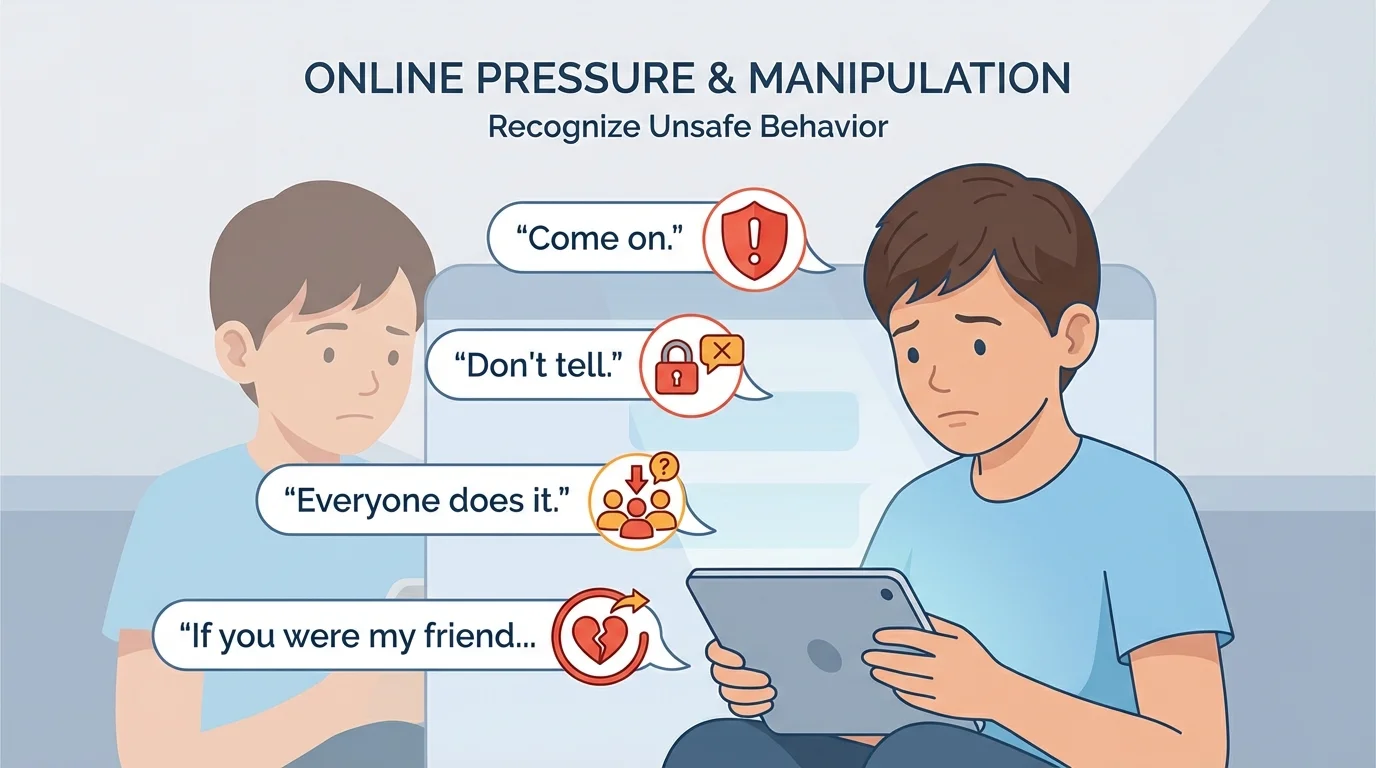
A person may pressure you in person, in a game chat, during a video call, or in messages. The place can change, but the warning signs stay similar. If someone keeps pushing after you say no, that is not respectful behavior.
Many unsafe situations do not start with obvious meanness. They often begin with small tests, like seeing if a child will keep a secret, break a rule, or stay quiet.
Another clue is when the person acts like there is no time to think. Rushing is a trick. Safe choices can wait. If someone says you must decide right now, that is a good reason to pause and get an adult.
Manipulation can be harder to notice because it may look like kindness at first. Someone might give lots of compliments, special attention, or gifts, then expect you to do something in return. Kindness is good, but kindness used to control you is not safe.
Manipulation can include lying, changing the story, blaming you for their choices, or making you feel guilty for saying no. A person might say, "You made me sad," or "This is your fault," when really they are upset because you would not do what they wanted.
Sometimes manipulation makes you doubt yourself. You may think, "Maybe I am overreacting," or "Maybe it is my fault." But if your body and feelings are telling you something is wrong, it is smart to listen and tell a trusted adult.
Tricks manipulators use
People who manipulate often try to get control without saying it directly. They may use guilt, fear, flattery, lies, or secrets. The goal is to make you feel stuck. The best answer is not to argue for a long time. The best answer is to leave the situation and tell a trusted adult.
A safe person does not make you responsible for their feelings. You are not in charge of fixing an older kid's anger, a neighbor's sadness, or an online friend's disappointment.
Unsafe behavior can look different in different situations. It may be someone trying to get too close to your body, telling you to go somewhere private, asking for private pictures, asking for your address, asking you to turn off safety settings, or telling you not to tell your parent or caregiver.
It can also be unsafe if someone wants you to break a family safety rule, such as opening the door when you are alone, meeting online without permission, sharing passwords, or leaving the house without telling an adult.
Sometimes unsafe behavior comes from a child, teen, or adult. Sometimes it comes from someone you know well. Being familiar does not automatically make a person safe. Safe behavior is what matters.
Another red flag is when someone wants privacy in a way that feels wrong. Privacy for using the bathroom or changing clothes is healthy. But asking a child to hide in a room, keep certain touches secret, or have secret chats away from safe adults is not okay.
Your body can help warn you before your mind has all the words. You might feel a tight stomach, a fast heartbeat, shaky hands, a hot face, or a frozen feeling. You may also feel confused, trapped, worried, or suddenly very quiet.
These clues do not always mean danger, but they do mean "Pay attention." If your body feels uncomfortable and someone is pressuring you, that is a strong sign to stop and get help.
Instinct is your quick inner warning feeling. You do not have to prove that something is wrong before you leave or tell. Feeling unsafe is enough reason to get help.
"If it feels wrong, you can pause, leave, and tell."
You never have to stay in a situation just because you do not want to seem rude. Safety is more important than politeness.
When something feels wrong, there is a simple order to follow. You do not need a perfect speech. You just need simple actions that help you get safe.
[Figure 2] When something feels wrong, there is a simple order to follow. You do not need a perfect speech. You just need simple actions that help you get safe.
Step 1: Pause. Do not answer right away if someone is pressuring you online or in person.
Step 2: Say no or stop. You can say, "No." "Stop." "I'm not doing that." "I need to go." Short answers are enough.
Step 3: Leave. Walk away, close the app, leave the chat, end the video call, or move toward safe people.
Step 4: Save evidence if it is online. Show a screenshot to an adult if it is safe to do so. Do not keep talking to the person.
Step 5: Tell a trusted adult. Tell what happened, what the person said, and how it made you feel.
Step 6: Keep telling until someone helps. If the first adult does not understand, tell another trusted adult right away.
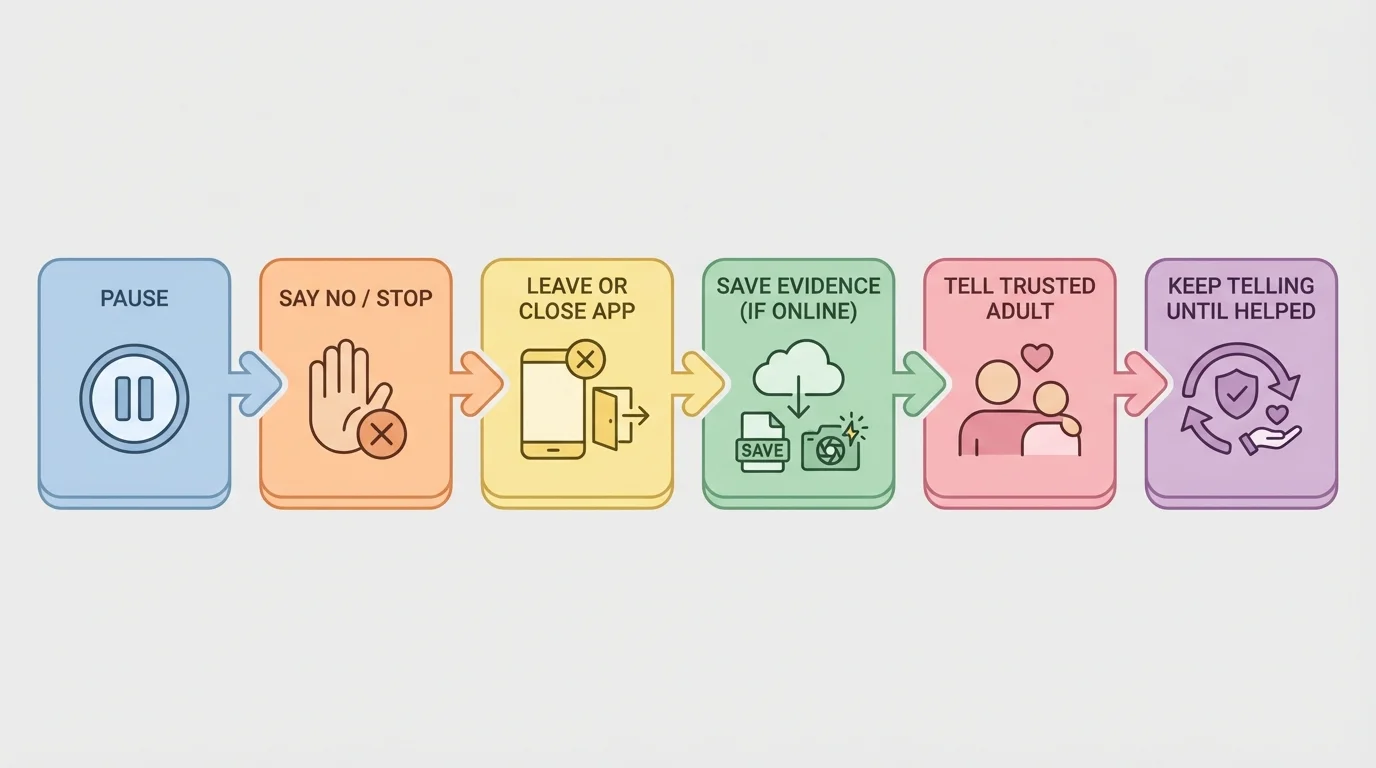
If you are online, you can also block and report the person with an adult's help. The safety order in [Figure 2] works because it helps you stop the contact, protect proof, and get real support.
Example: An unsafe game chat
You are playing an online game and another player says, "Send me a picture of yourself. If you don't, I'll tell everyone you're mean."
Step 1: Notice the warning signs.
The player is using pressure and a threat. They are trying to control you.
Step 2: Do not argue.
You can stop responding, leave the chat, or close the game.
Step 3: Save and tell.
Take a screenshot if possible and show a trusted adult.
The safest choice is not to send anything and not to keep the conversation going.
Simple safety phrases are powerful. You can practice saying: "No." "Stop." "I'm leaving." "That is not okay." "I need an adult." These short words help when your brain feels busy or scared.
Here are some age-appropriate situations you might really face.
Situation 1: An older kid in the neighborhood says, "Come with me behind the building. Don't tell your parent. I want to show you something." This is unsafe because of secrecy, isolation, and pressure to hide it.
Situation 2: A person in a group chat keeps asking for your full name, address, and school information. This is unsafe because private information should not be shared without a trusted adult's permission.
Situation 3: A family friend wants a hug, and you do not want one. You are allowed to step back and say, "No thank you." A safe adult will respect your boundary.
Situation 4: A friend says, "If you don't break this rule with me, I won't be your friend." That is pressure. Real friendship should not require you to make unsafe choices.
Example: Secret message from someone you know
A person you know messages, "This is our secret. Don't tell your mom or dad. Promise first."
Step 1: Notice the secret rule.
Unsafe people often test whether you will keep secrets from safe adults.
Step 2: Do not promise.
You never have to promise to keep a secret that makes you uneasy.
Step 3: Tell right away.
Show the message to a trusted adult even if the person said not to.
Secrets that block you from getting help are not safe secrets.
Notice how each example has a pattern: the person tries to get power by using secrecy, guilt, pressure, or fear. Once you see the pattern, the next step is easier: leave and tell.
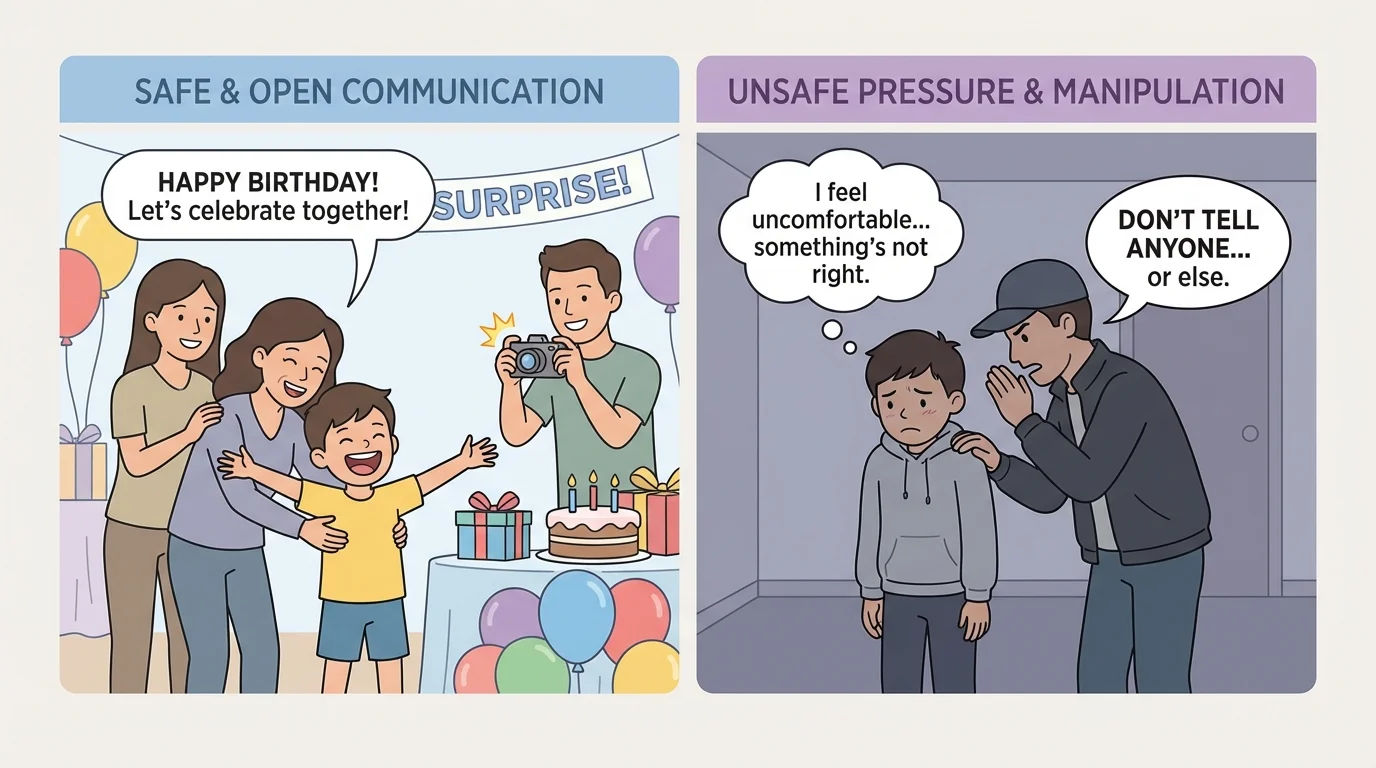
A surprise has an ending, and an unsafe secret keeps you worried. A birthday gift hidden for a few days is a surprise. A secret about a rule being broken, a body boundary being crossed, or someone saying "don't tell" is not a safe secret.
[Figure 3] A surprise has an ending, and an unsafe secret keeps you worried. A birthday gift hidden for a few days is a surprise. A secret about a rule being broken, a body boundary being crossed, or someone saying "don't tell" is not a safe secret.
Good boundaries help you stay safer. Examples include: no sharing private pictures, no sharing passwords, no going with someone without adult permission, no keeping secrets about safety, and no opening the door when home alone unless your family rule says it is okay.
Boundaries are not mean. They are protective. They help you know what to do before a problem happens.
| Safe | Unsafe |
|---|---|
| A surprise party that will be shared later | A secret that makes you feel scared or confused |
| An adult who accepts "no" | A person who keeps pushing after "no" |
| A friend who respects your rules | A friend who dares or threatens you |
| Online chatting with family rules and adult knowledge | Private chats that you are told to hide from adults |
Table 1. Comparison of safe situations and unsafe warning signs.
Later, if you are unsure whether something is "just a surprise" or something more serious, remember the worried child in [Figure 3]. Feeling trapped, scared, or told not to tell are strong clues that you should get help.
This can be one of the hardest parts to understand: a person can be familiar and still behave unsafely. They might be a neighbor, coach, older kid, family friend, or relative. You do not have to decide whether they are a "good" or "bad" person. You only need to notice whether the behavior is safe or unsafe.
If someone you know breaks your boundary, it still matters. If someone nice sometimes also pressures you, that still matters. If someone says, "No one will believe you," they are trying to scare you into silence. Tell anyway.
You are never to blame for another person's unsafe choices. It is the job of adults to protect children, and it is okay to ask for help over and over until you get it.
Your safety team is a small list of trusted adults you can go to. It might include a parent, caregiver, grandparent, aunt, uncle, counselor, club leader, doctor, or another grown-up who listens carefully and acts to help.
It helps to know exactly what to say. You can use these sentence starters: "Something happened and I need help." "Someone told me to keep a secret." "A person online asked for something private." "I said no and they kept pushing." "I do not feel safe."
If the first adult does not listen well, tell another one. Keep going until someone helps. That is not tattling. That is protecting yourself.
You already know basic safety rules like asking permission, staying where adults know you are, and protecting private information. This lesson adds another layer: noticing when a person tries to pressure you to break those rules on purpose.
Being safe does not mean being scared of everyone. It means noticing patterns, trusting your warning feelings, and using strong actions when something is not right. That helps you stay prepared, not afraid.
Try This: Choose three short safety phrases you can remember easily, such as "No," "Stop," and "I need an adult." Practice saying them in a calm, strong voice.
Try This: Make a private list with your family of at least three trusted adults you can tell if something feels wrong.
Try This: Ask your family what your rules are for game chats, video calls, sharing pictures, and opening the door at home so you know the plan before a problem happens.
