Have you ever felt fine one minute and then suddenly very angry, nervous, or deeply disappointed the next? That can happen when a game goes wrong, a family plan changes, or someone sends a mean message online. Big feelings can show up fast. The good news is that you can learn how to manage them. You do not have to let anger, stress, or sadness take over your choices.
Emotional regulation means noticing your feelings and managing them in a safe, helpful way. It does not mean pretending you are never upset. It means learning what to do when you are upset. This matters at home, during video calls, in group chats, during sports practice, in clubs, and anywhere else you interact with others and handle change.
When you regulate your emotions well, you are more likely to solve problems, keep friendships healthy, and feel proud of your choices. When emotions take over, you might yell, quit, slam a device shut, send a rude message, or say something you wish you could take back.
Think about two different moments. In one, you lose an online game and type, "You cheated! I'm never playing again!" In the other, you pause, take a breath, and type, "I'm frustrated. I need a minute." The feeling is still real in both moments. The difference is what you do with it.
Emotional regulation is the skill of managing your feelings so you can make safe and respectful choices.
Conflict is a disagreement or problem between people.
Disappointment is the feeling you get when something does not go the way you hoped.
Resilience is the ability to recover, adjust, and keep going after something hard happens.
These skills do not make life perfect. They help you handle real life better. You still may feel angry during conflict, nervous during change, or sad after disappointment. What changes is that you become better at steering yourself through those moments.
A trigger is something that sets off a strong feeling. Triggers are different for different people. One child may get upset when plans change. Another may get upset when a sibling touches their things. Someone else may feel stressed when they do not understand directions right away.
Knowing your triggers helps because it gives you a head start. If you know that being rushed in the morning makes you snappy, you can prepare. If you know that losing in games makes your body heat up and your thoughts get harsh, you can make a plan before you even begin playing.
Feelings are messengers, not bosses. Your emotions give you information. Anger may tell you something feels unfair. Worry may tell you something feels uncertain. Sadness may tell you something mattered to you. The feeling gives a message, but it should not be the boss of your actions. You still get to choose what happens next.
This is important to remember: all feelings are okay, but not all behaviors are okay. You can feel furious and still choose not to insult someone. You can feel disappointed and still choose not to give up forever. You can feel nervous and still ask a question.
Your body often gives clues before your behavior escalates. You might feel your face get hot, your stomach tighten, your fists clench, or your heart beat faster. Some kids feel shaky. Some feel like they want to cry. Some feel like they need to stomp away.
[Figure 1] Your thoughts give clues too. You might start thinking, "This is so unfair," "Nobody listens to me," "I can't do this," or "Everything is ruined." These thoughts can make feelings grow even bigger.
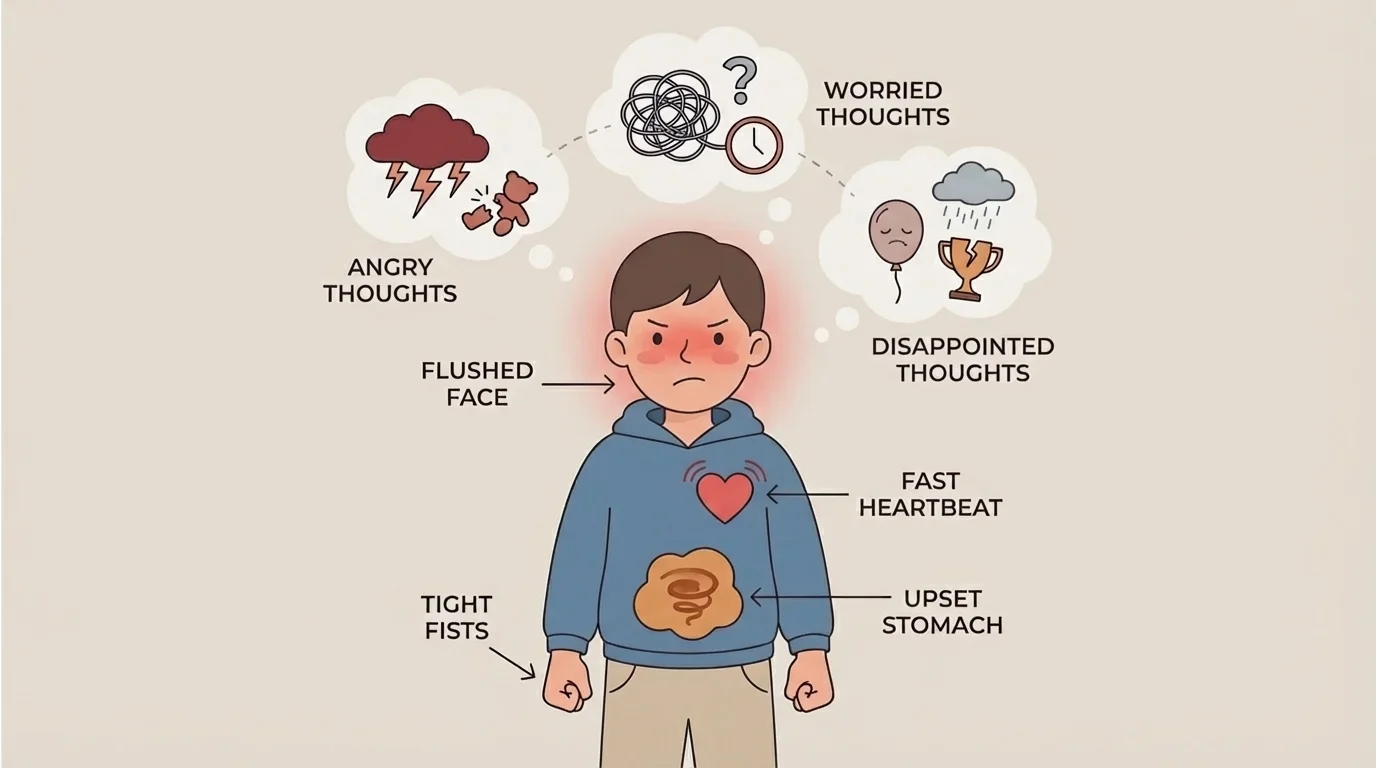
When you notice these clues early, you have a better chance of calming down before the problem gets bigger. That is why self-awareness matters. It is easier to steer a bike when it is wobbling a little than when it is already crashing.
Try this: the next time you get upset, ask yourself three quick questions. What is my body doing? What am I thinking? What happened right before this feeling? Those answers help you understand what is going on and notice common body and thought clues.
Strong emotions are not just "in your head." They affect your whole body. That is why calming your body can help calm your mind too.
[Figure 2] When feelings get big, it helps to follow a strategy instead of guessing. A good plan works like a path you can follow. You do not have to remember lots of complicated ideas. Just remember a few clear steps.
A simple plan is: pause, breathe, name the feeling, choose a tool, decide what to do next. You can use this during conflict, change, or disappointment.
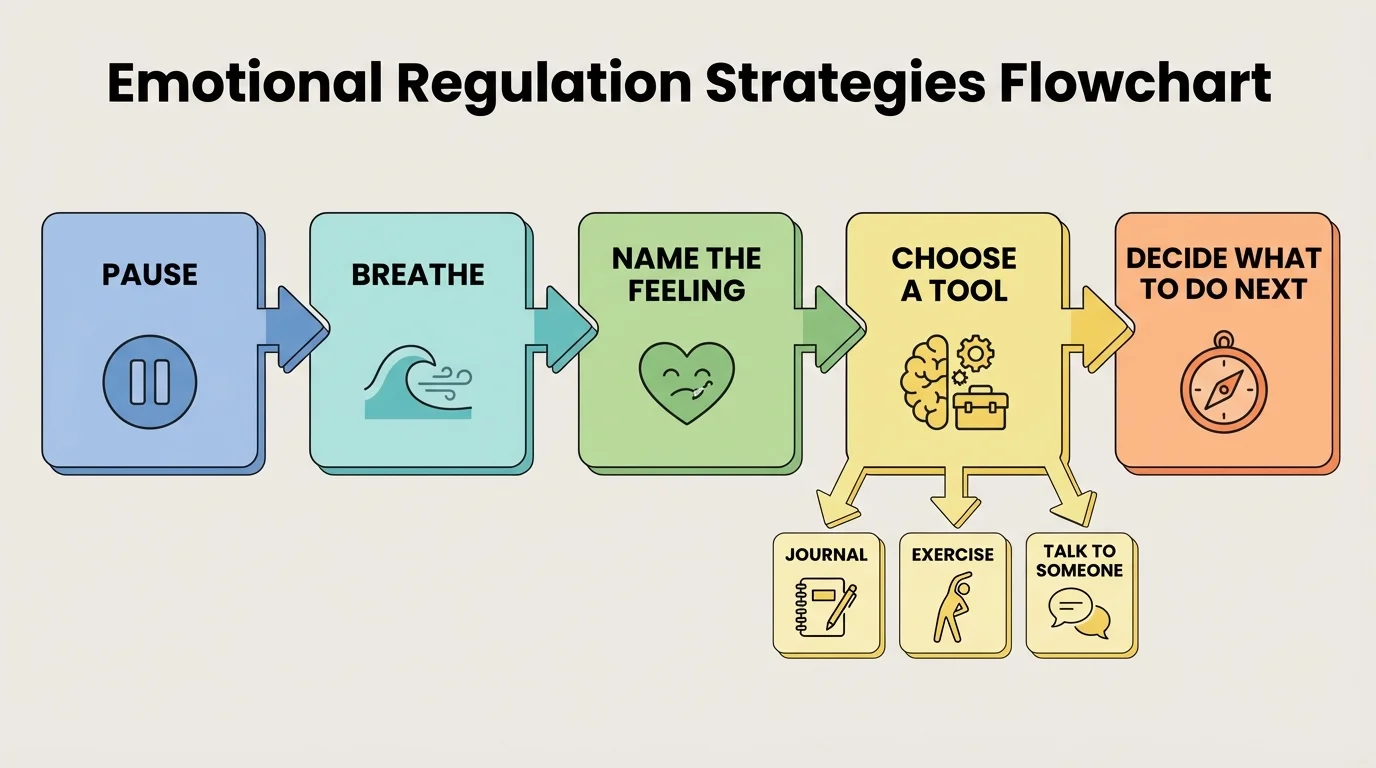
Step 1: Pause. Stop yourself before you react. Put the device down. Step away from the chat. Turn your body away from the argument. Count slowly to 5. Even a short pause can stop a bad choice.
Step 2: Breathe. Slow breathing sends your body a message that you are safe. Breathe in through your nose, hold for a moment, and breathe out slowly. You can do this three to five times.
Step 3: Name the feeling. Say to yourself, "I feel angry," "I feel embarrassed," "I feel worried," or "I feel disappointed." Naming the feeling can help you think more clearly.
Step 4: Choose a tool. Your tool might be getting a drink of water, stretching, drawing, squeezing a pillow, writing your thoughts, or asking for a short break. Different tools work for different people.
Step 5: Decide what to do next. When your body is calmer, choose your next step. You might apologize, ask a question, explain your feelings, make a new plan, or ask an adult for help.
Real-life example: A frustrating game
You are playing a game online and lose after trying hard.
Step 1: You notice your hands are tight and you want to shout.
Step 2: You pause and take four slow breaths.
Step 3: You tell yourself, "I am frustrated, but I do not want to make this worse."
Step 4: You set the device down for two minutes and get water.
Step 5: You come back and decide whether to play again calmly or stop for now.
You still feel disappointed, but you stay in control.
The calm-down path in [Figure 2] is useful because it gives you something to do instead of letting the emotion choose for you. A plan turns a hard moment into a series of manageable steps.
Conflict happens when people disagree, feel hurt, or want different things. One small choice can either grow or shrink a conflict. This is especially true online, where messages can sound harsher than you meant them to sound.
If someone sends a rude text or comment, your first feeling may be to fire back right away. But fast replies often make conflict bigger. Online messages are easy to misunderstand because you cannot always hear tone of voice or see facial expressions.
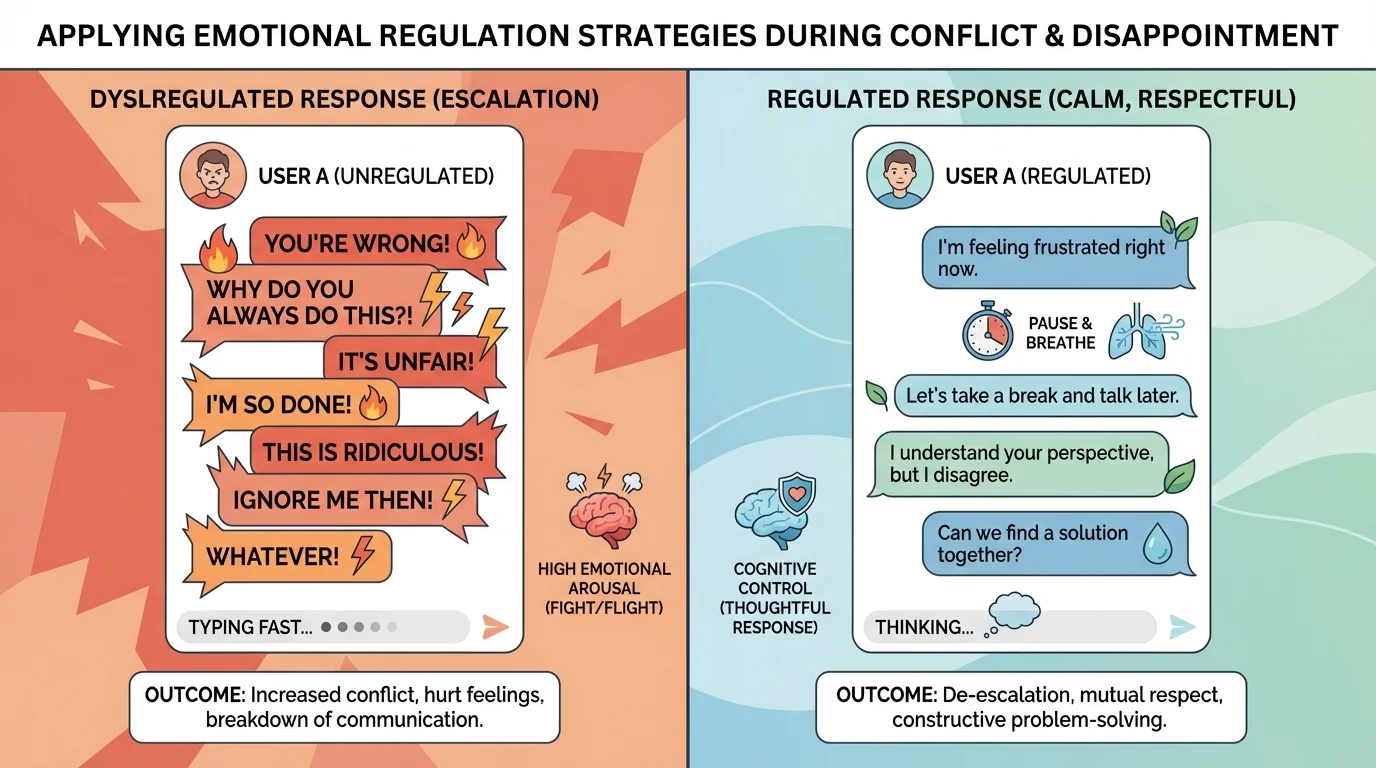
Here are some helpful conflict moves:
Use a calm start. Try: "I did not like that message." "I need a minute before we talk." "Can you explain what you meant?"
Speak about yourself. Use "I" statements like "I felt left out" instead of "You are mean." This lowers blame.
Stick to the problem. Talk about the one issue instead of bringing up every old problem.
Take a break if needed. If you feel out of control, it is okay to pause and come back later.
Know when to get help. If the conflict includes threats, bullying, or repeated meanness, tell a trusted adult.
| Unhelpful Response | Helpful Response |
|---|---|
| Replying instantly when furious | Pausing before typing |
| Saying, "You always ruin everything" | Saying, "I feel upset about what happened" |
| Trying to win | Trying to solve the problem |
| Sending more rude messages | Asking to talk later when calm |
| Keeping a serious problem secret | Telling a trusted adult |
Table 1. Comparison of unhelpful and helpful choices during conflict.
The split-screen in [Figure 3] makes an important point: the same conflict can go in two very different directions. Your words, timing, and tone can help calm the situation or make it much worse.
Your brain gets better at emotional regulation with practice. The more often you pause and choose a calm response, the easier that response becomes over time.
If you make a mistake in conflict, that does not mean you failed forever. You can repair it. You can say, "I was too upset and I spoke in a rude way. I'm sorry." Repairing a mistake is a strong choice, not a weak one.
[Figure 4] Change can be exciting, but it can also feel uncomfortable. Maybe a schedule shifts, a favorite activity gets canceled, a parent changes a plan, or you have to learn a new app or routine. Some changes are expected. Others happen suddenly.
Flexible thinking helps you move from the old plan to the new one. It means being able to adjust instead of getting stuck on only one way things can go.
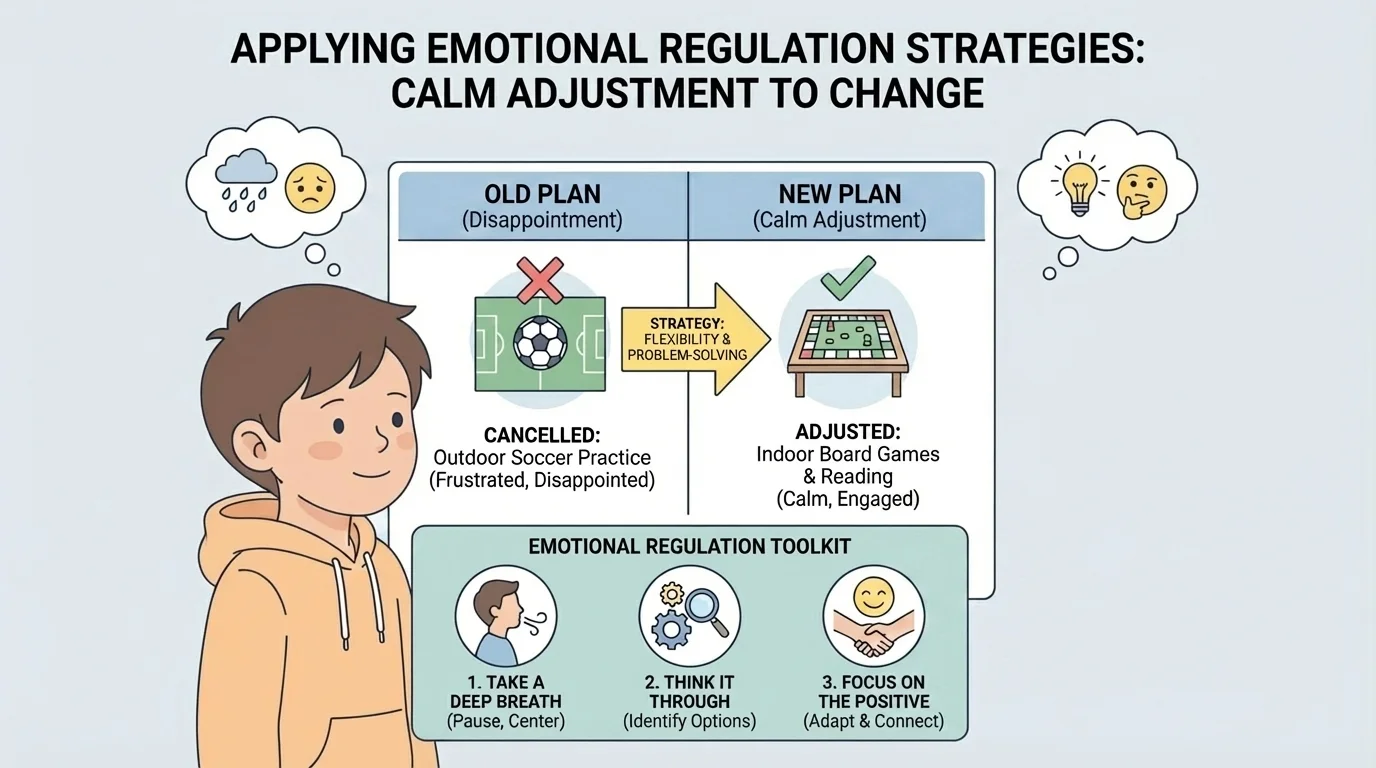
When change happens, try this:
First, name the change. "The plan changed."
Next, name the feeling. "I feel annoyed," "I feel nervous," or "I feel disappointed."
Then, ask what stays the same. Maybe the time changed, but the activity is still happening. Maybe the place changed, but you still get to see people you enjoy.
Finally, make a new mini-plan. Ask, "What do I do now?" A new plan helps your brain stop spinning.
Suppose you were told that a community class you like is canceled today. You may feel upset because you were ready for it. A helpful response is: pause, feel the feeling, ask what your choices are, and decide on a new activity. An unhelpful response is yelling, "Everything is ruined!" and refusing to do anything else.
The old-plan and new-plan picture in [Figure 4] reminds you that change does not always erase everything. Often, it means you need a new route, not a total shutdown.
Real-life example: A changed plan
You were going to visit a friend, but the visit gets moved to another day.
Step 1: You notice you feel upset and disappointed.
Step 2: You say, "I do not like this change, but I can handle it."
Step 3: You ask, "What is my new plan for today?"
Step 4: You choose another activity and mark the new visit day on a calendar.
The change is still real, but you recover faster.
Being flexible does not mean you have to like every change. It means you can adapt without letting the change take over your whole day.
Resilience matters when you feel let down. Disappointment hurts in the moment, but it does not decide what happens next. You may feel disappointed when you do not make a team, do not get invited somewhere, do not win, or do not get the result you hoped for.
Sometimes disappointment makes kids want to quit instantly. Sometimes it makes them blame others. Sometimes it makes them say, "I'm just bad at this." Those reactions are understandable, but they are not very helpful.
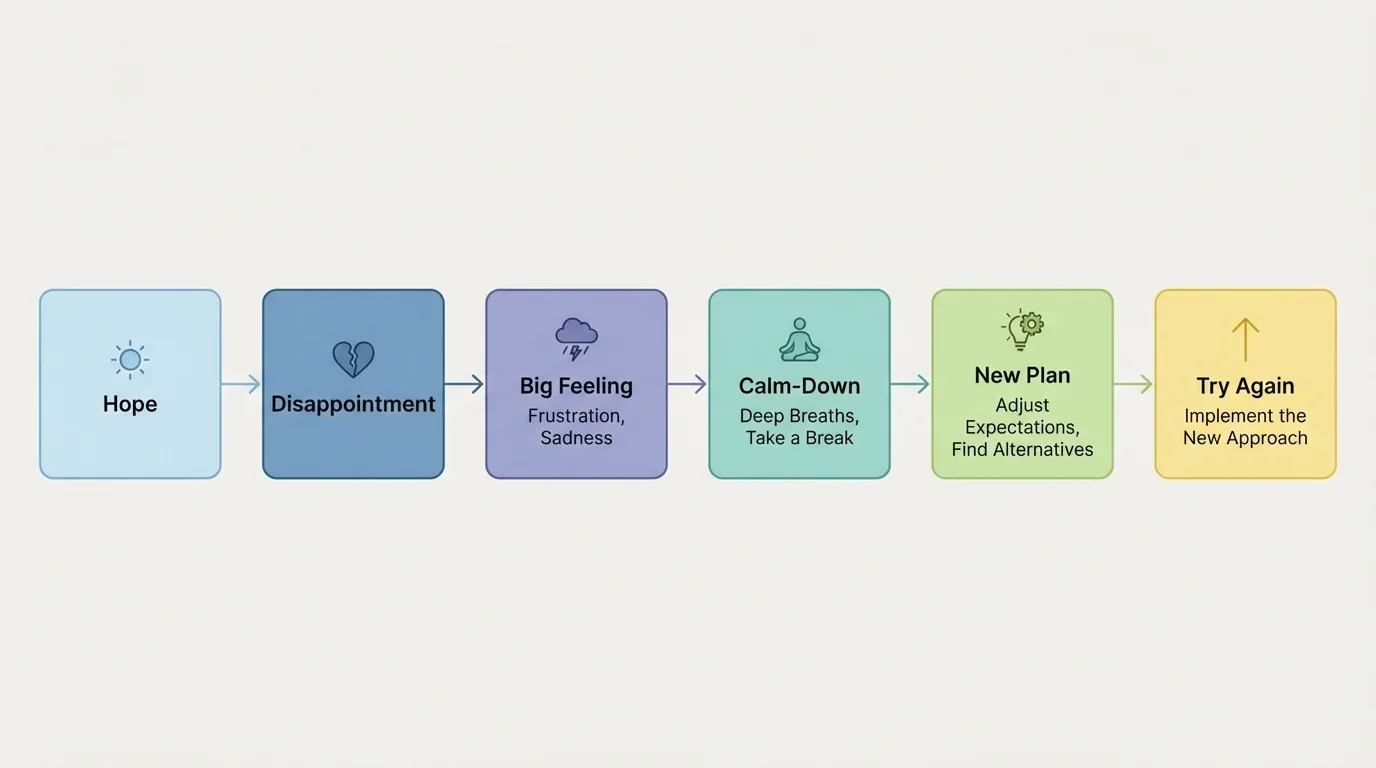
Here is a better way to handle disappointment:
Let yourself feel it. You do not need to pretend it does not hurt.
Avoid harsh self-talk. Instead of "I'm terrible," try "I'm disappointed, and I can improve."
Look for what you can learn. Ask, "What can I do differently next time?"
Choose your next step. Rest, practice, ask for feedback, or try again later.
For example, if you worked hard on a project and did not get the response you wanted, you might feel embarrassed and upset. A resilient response is to calm down, ask what could improve, and keep going. A less helpful response is deciding never to try again.
The recovery path in [Figure 5] shows that disappointment is not the end of the story. There is a path forward after the big feeling.
"You can feel upset and still make a strong choice."
That idea is powerful because it reminds you that feelings and actions are not the same thing. You may not control the first feeling that pops up, but you can learn to control what you do next.
The words you say to yourself matter. Self-talk can either fuel the problem or help calm it. If your self-talk sounds like "This is awful," "Nobody cares," or "I can't handle this," your feelings may get even bigger.
Try replacing those thoughts with calmer, truer thoughts. For example:
Instead of "This will never get better," try "This is hard right now."
Instead of "I ruined everything," try "I made a mistake, and I can fix part of it."
Instead of "I can't do this," try "I can do the next small step."
This does not mean forcing fake happy thoughts. It means choosing thoughts that help you stay steady and solve problems.
Support is a strategy, not a weakness. Sometimes emotional regulation means knowing when you need another person. A trusted adult can help you calm down, think clearly, and stay safe. Asking for support is a smart decision when your feelings are too big to manage alone.
You might ask for help when a conflict keeps repeating, when a change feels overwhelming, when disappointment lasts a long time, or when you feel so upset that you might hurt yourself, someone else, or damage things. In those moments, get a trusted adult right away.
Helpful ways to ask include: "I'm too upset to handle this alone." "Can you help me calm down?" "I need to talk about something that happened." "I'm not ready to text back yet. Can you help me decide what to say?"
Emotional regulation gets stronger with practice. You do not build it only during huge problems. You build it in small, regular ways every day.
Here are habits that help:
Get enough rest. Tired brains have a harder time staying calm.
Eat and drink regularly. Hunger and dehydration can make emotions feel bigger.
Move your body. Walking, stretching, dancing, or sports can release stress.
Keep routines. Predictable routines make change easier to handle.
Take small breaks from screens. Constant noise and fast messages can make it harder to stay steady.
Practice when calm. Breathing and self-talk work best when you have practiced before a hard moment happens.
Create a quick personal plan
You can make a simple emotional regulation plan for yourself.
Step 1: Write down two common triggers, such as losing a game or having plans change.
Step 2: Write down your body clues, such as hot face or tight shoulders.
Step 3: Pick three tools that help you calm down, such as breathing, water, or taking a break.
Step 4: Choose one helpful sentence you can tell yourself.
Step 5: Decide which trusted adult you can go to if you need support.
When a hard moment comes, you already know what to do.
You do not need to be perfect at this skill. Everyone has messy moments. What matters is learning, practicing, repairing, and trying again. That is what self-management looks like in real life.
