Have you ever wanted something good to happen fast, like finishing your homework early, and also wanted something big to happen later, like becoming great at art, coding, or soccer? Those are both goals, but they are not the same kind. Some goals can happen in a day, a week, or a month. Others take many months or even years. Learning the difference helps you make better choices every day.
Goals matter because they give your time a job to do. When you know what you are working toward, it is easier to decide what to do now, what to do later, and what to skip. This is especially helpful in online school, where you often manage your own time at home. Goals can help you with schoolwork, family responsibilities, friendships, hobbies, health, and future dreams.
A goal is something you want to do, get, improve, or become. Good goals help you focus. Without goals, it is easy to forget assignments, quit when something feels hard, or spend all your time on things that do not help you grow.
Think about two students learning online. One student says, "I'll just do whatever I remember." The other says, "Today I will finish my reading and tomorrow I will practice multiplication facts for ten minutes." The second student is more likely to feel calm, prepared, and proud. Goal setting does not make life perfect, but it gives you a path to follow.
A short-term goal is a goal you can reach soon, often within a day, a week, or a few weeks.
A long-term goal is a goal that takes a much longer time to reach, often months or years.
Both types of goals are important. Short-term goals help you act now. Long-term goals help you think ahead. When you use both, you are practicing responsibility because you are taking charge of your choices instead of just hoping things work out.
[Figure 1] The biggest difference between a short-term goal and a long-term goal is time, but time is not the only difference. Short-term goals are usually smaller and closer, while long-term goals are bigger and farther away. A short-term goal might be to read for twenty minutes each day this week. A long-term goal might be to become a strong reader by the end of the year.
A short-term goal often answers the question, "What can I do soon?" A long-term goal answers, "What am I building toward over time?" Short-term goals are like steps on a staircase. Long-term goals are like reaching the top floor.
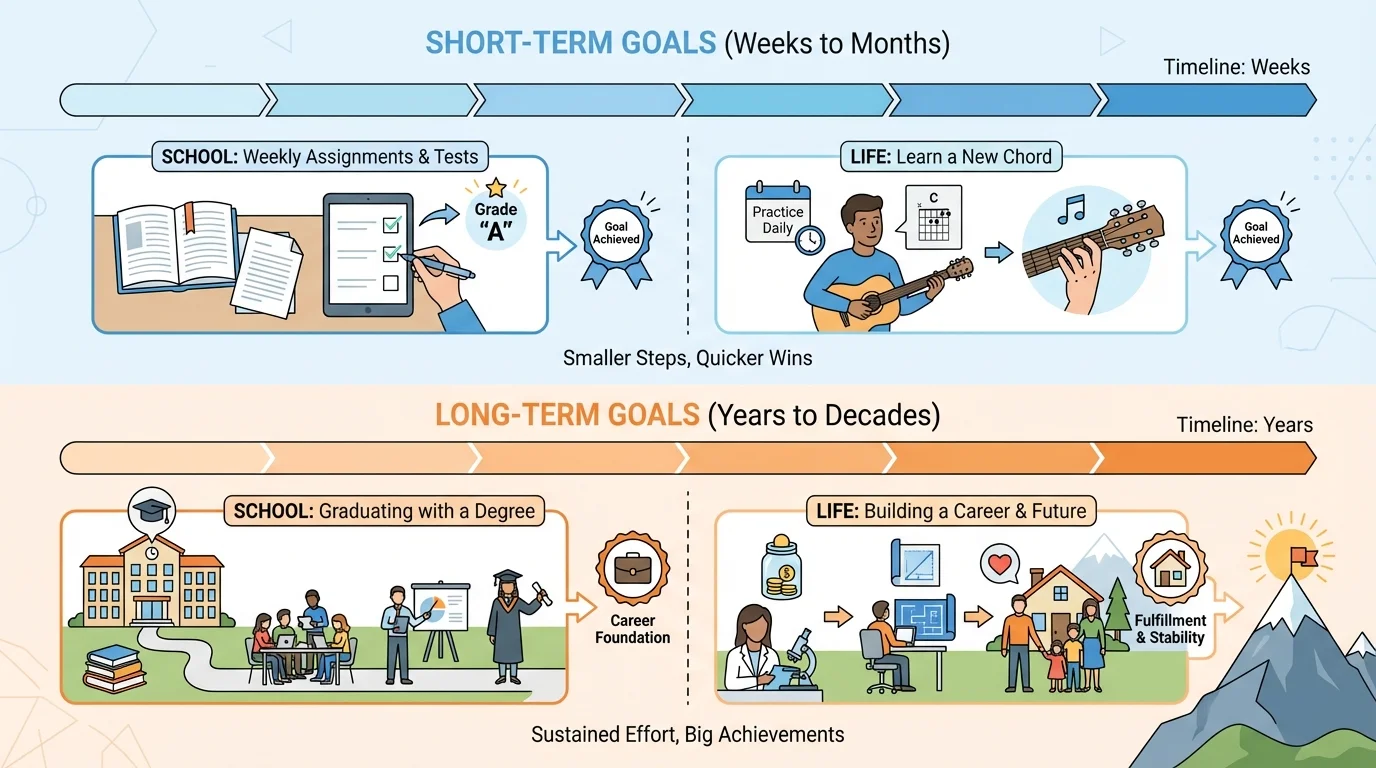
Here are some examples. A short-term school goal could be finishing all your assignments by Friday. A long-term school goal could be improving your writing over the whole semester. A short-term life goal could be remembering to feed a pet every morning this week. A long-term life goal could be becoming responsible enough to take care of a pet every day without reminders.
Neither kind of goal is better than the other. They do different jobs. If you only have short-term goals, you may stay busy but forget your bigger dreams. If you only have long-term goals, your dreams may stay too big and feel hard to start.
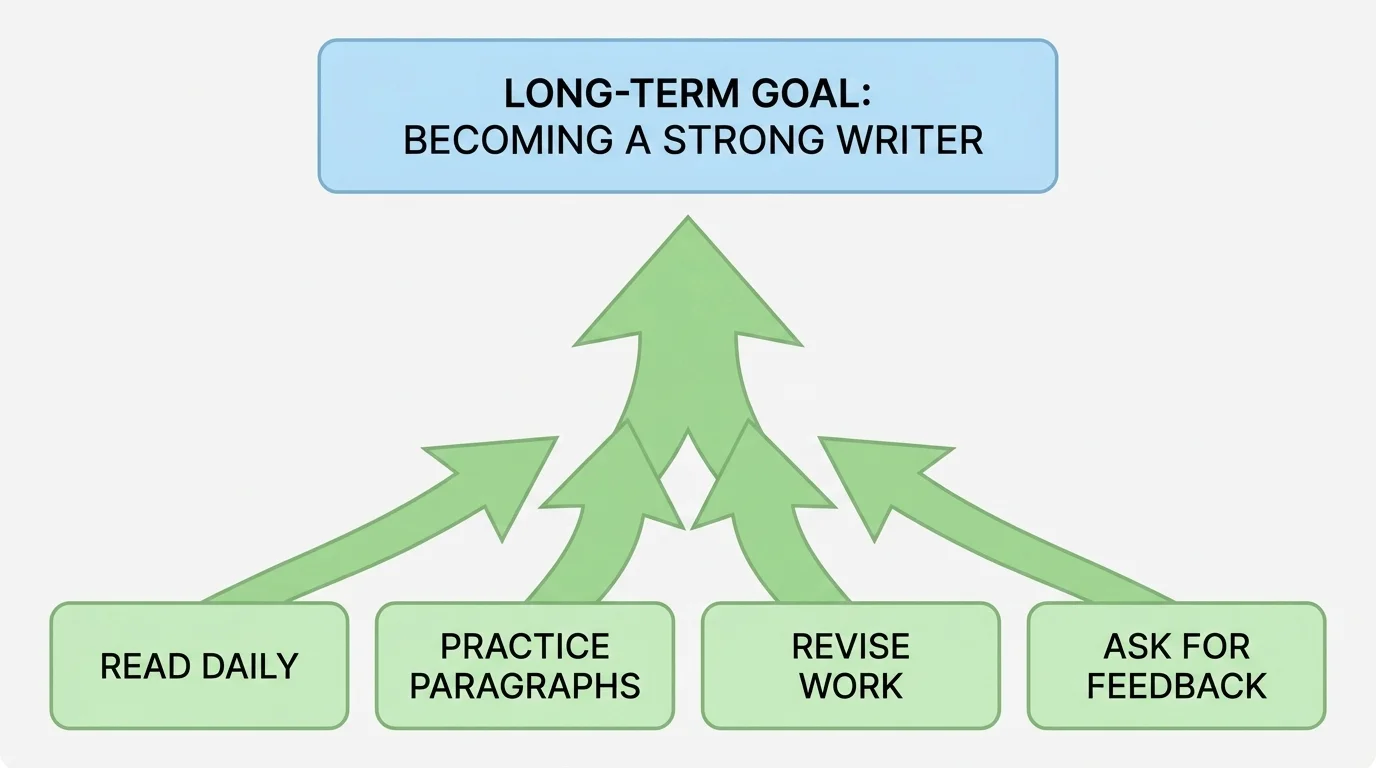
[Figure 2] A goal plan works best when one big goal is broken into smaller actions. This is one of the smartest ways to make progress. A long-term goal gives you direction. Short-term goals tell you what to do next.
Suppose your long-term goal is to get better at typing by the end of the year. That sounds big. You might not know where to begin. But if you break it apart, your short-term goals could be: practice typing for ten minutes three times this week, learn the home row keys this month, and track your speed once each week.
Those small goals act like stepping-stones. Each one is manageable. Each one helps you move forward. Over time, many small actions add up to a big change.
This idea is true in many parts of life. If your long-term goal is to save money for a game or a gift, your short-term goals might be putting some money in a jar each week, avoiding small impulse buys, and checking how much you have saved every weekend. If your long-term goal is to be more organized, your short-term goals might be cleaning your workspace each evening and checking your task list every morning.
Big goals need small steps. A long-term goal can feel exciting, but it can also feel too far away. Short-term goals turn a faraway idea into actions you can do today, tomorrow, and this week. That is why successful goal setting usually uses both kinds together.
You can also think of it this way: long-term goals help you choose the right direction, and short-term goals help you keep moving. If one short-term goal does not work, you can change the step without giving up on the bigger dream.
In online school, goals are very useful because you often need to manage your own schedule. You may need to remember live sessions, finish assignments, study, and ask for help online when something is confusing. A short-term goal could be, "I will complete my science assignment by Thursday afternoon." A long-term goal could be, "I will become more confident at speaking during online class meetings by the end of the term."
School goals can be about grades, but they do not have to be only about grades. They can also be about habits. For example, a short-term goal might be to check your learning platform at the same time each morning for one week. A long-term goal might be to become an independent learner who does not need many reminders.
Here are some helpful school goal pairs:
| Area | Short-Term Goal | Long-Term Goal |
|---|---|---|
| Reading | Read for twenty minutes each day this week | Become a stronger reader by the end of the year |
| Writing | Use complete sentences in today's paragraph | Write clear multi-paragraph pieces by the end of the term |
| Math | Practice facts for ten minutes after lunch | Feel more confident solving math problems this year |
| Organization | Put supplies away after each lesson this week | Stay organized without reminders most days |
| Participation | Ask one question during a video lesson this week | Speak up more confidently in online discussions |
Table 1. Examples of short-term and long-term goals for online school.
Notice that the short-term goals are specific and doable now. The long-term goals are wider and take more time. As you saw earlier in [Figure 1], the time difference is important, but the size of the goal matters too.
Goals are not only for school. They help in daily life too. You can set goals for chores, hobbies, sports, kindness, health, and community service. A short-term goal might be to help set the table every night this week. A long-term goal might be to become someone your family can count on for regular help at home.
You can set friendship goals too. A short-term goal could be to send one kind message to a friend or relative this week. A long-term goal could be to build strong, healthy friendships by being a good listener and a trustworthy person over time.
Health goals also use both types. A short-term goal might be going to bed on time for five nights. A long-term goal might be creating healthy sleep habits. If you enjoy music, art, coding, or sports, your short-term goal might be to practice three times this week, while your long-term goal could be becoming skilled enough to perform, compete, or create something you are proud of later.
Many people who achieve big dreams do not reach them all at once. They usually repeat small actions over and over. Tiny habits may look unimportant on one day, but after many weeks they can make a huge difference.
Community goals matter too. Maybe you want to help neighbors, care for animals, keep a park clean, or support a local cause with your family. A short-term goal might be helping with one community project this month. A long-term goal might be growing into someone who regularly helps others.
Some goals fail because they are too fuzzy. If you say, "I want to do better," that sounds nice, but it does not tell you what to do. A better goal is clear. It says what you will do, when you will do it, and how often.
Here is a simple way to build a strong goal:
Step 1: Pick one area. Choose school, home, health, friendship, hobby, or community.
Step 2: Decide what you want to improve. Be honest and specific.
Step 3: Choose whether your goal is short-term or long-term. Ask how long it should take.
Step 4: Make the action clear. Instead of saying "read more," say "read for twenty minutes after breakfast on school days."
Step 5: Check if it is realistic. A realistic goal fits your age, time, and energy. A huge goal can be turned into smaller ones.
Step 6: Track your progress. Use a notebook, checklist, or calendar.
Step 7: Celebrate effort, not just results. Finishing each step matters.
Goal-building example
A student wants to become better at drawing.
Step 1: Choose the long-term goal.
"I want to improve my drawing skills by the end of the summer."
Step 2: Turn it into short-term goals.
"I will practice drawing for fifteen minutes on Monday, Wednesday, and Friday this week."
Step 3: Add a way to track it.
The student marks each practice day on a calendar and keeps drawings in one folder to notice improvement.
This plan is much easier to follow than simply saying, "I want to be amazing at art."
Try This: Look at one thing you already do each day. Ask yourself whether it helps a short-term goal, a long-term goal, both, or neither. That quick check can help you use your time more wisely.
Even good goals can hit problems. You might forget. You might get distracted by games or videos. You might feel tired or frustrated. That does not mean you failed forever. It means you need a new plan.
An obstacle is something that gets in the way of your goal. Obstacles can be inside you, such as feeling unmotivated, or outside you, such as a busy family schedule. Strong goal setters expect obstacles and plan for them.
If you miss one day, start again the next day. If your goal is too hard, make it smaller. If your goal is too easy, make it a little more challenging. If you keep forgetting, put up a note, set an alarm, or ask an adult to remind you at first.
For example, if your short-term goal is to practice piano for thirty minutes every day but you keep skipping it, you might change the plan to fifteen minutes four days a week. That is still progress. Changing a plan is not quitting. It is being smart.
"A little progress each day adds up to big results."
Another helpful idea is to notice what works. If you read more effectively in the morning than at night, use that information. Goals are not just about trying hard. They are also about learning what helps you succeed.
[Figure 3] Goals are personal, but they also affect other people. Your daily choices can help you, support your family, strengthen your community, and shape your future. When you follow through on a goal, people learn they can trust you. That is part of responsibility.
If your goal is to finish your schoolwork on time, you may feel less stressed and need fewer reminders. That can make home life calmer. If your goal is to help with chores, others can depend on you. If your goal is to volunteer or be kind online, your community becomes stronger too.
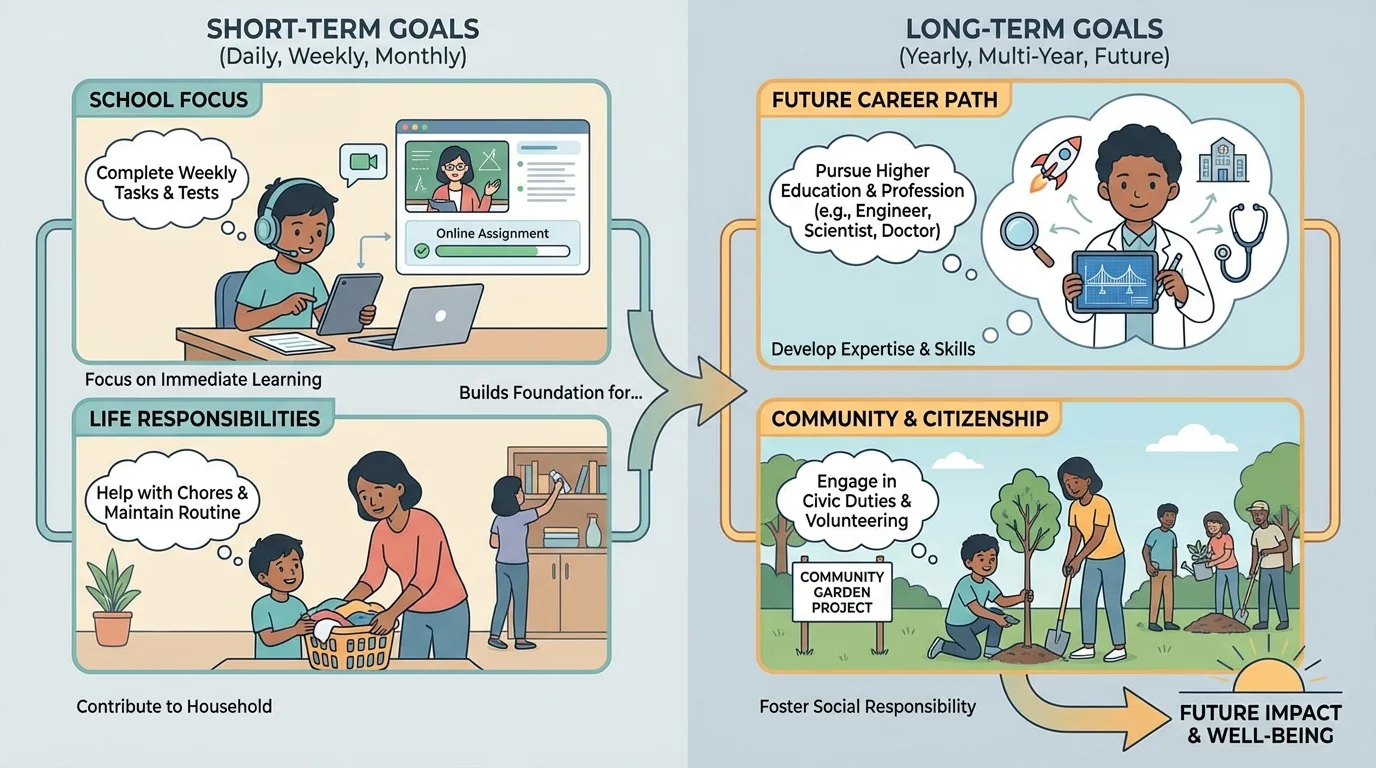
Long-term goals also connect to your future. You may not know exactly what job or role you will have as an adult, and that is okay. But the habits you build now matter. Learning to manage time, keep promises, ask for help, and stick with hard tasks can help you in almost any future path.
If you want to be a veterinarian someday, your long-term goal might involve studying animal care and science over many years. One short-term goal could be reading one book about pet care this month. If you want to be a game designer, your short-term goal might be practicing basic coding each week. Big futures grow from repeated small actions.
Community goals are powerful because they remind you that success is not only about yourself. Helping siblings, respecting others online, joining a cleanup event, or writing thank-you messages are all ways goals can make life better for many people, not just one person.
Let's compare one short-term goal and one long-term goal in one practical plan. Suppose you want to become more confident speaking during online class discussions by the end of the semester. That is a long-term goal. It will take time and practice.
Now you need short-term goals to support it. You might decide that this week you will turn on your microphone once during a live lesson and answer one question in the chat. Next week, you might ask one question during a lesson. These are smaller, quicker goals that help the bigger one.
One long-term goal with matching short-term goals
Long-term goal: Become more confident speaking in online class by the end of the semester.
Step 1: Choose the first short-term goal.
Speak one time during a live class this week.
Step 2: Add another short-term goal.
Write down one idea before class so you are ready to share it.
Step 3: Track progress.
After each class, place a check mark on your list if you spoke or asked a question.
Step 4: Adjust if needed.
If speaking feels too hard at first, start by typing one question in chat, then build from there.
This shows how short-term goals make a long-term goal less scary and more doable.
Try This: When you make a goal, ask yourself two questions: "What do I want later?" and "What can I do this week?" The first answer often gives you a long-term goal. The second answer often gives you a short-term goal.
When you compare short-term and long-term goals, the key idea is not just that one is short and one is long. The deeper idea is that they need each other. Short-term goals help you act. Long-term goals help you aim. Together, they help you grow in school, in daily life, and in the kind of person you are becoming. The stepping-stone idea from [Figure 2] and the wider impact shown in [Figure 3] both remind us that your future is built from the small choices you make again and again.
