Have you ever noticed that some days feel smooth and easy, while other days feel rushed, messy, and stressful? The difference is often not how hard the day is. The difference is how well you planned for it. When you budget your time, materials, and tasks, you make a plan for what you need, when you need it, and what to do first. That helps you become more confident and more independent.
Independence means being able to do things for yourself in a responsible way. It does not mean you never need help. It means you can handle many daily jobs on your own because you are prepared. At home, that might mean getting ready for the day, helping with chores, packing what you need for an activity, or finishing homework without someone repeating directions over and over. In online school, it might mean logging in on time, having your supplies ready, turning in work, and managing breaks wisely.
When you do not budget, small problems can pile up fast. You may forget a pencil, start late, waste time looking for headphones, or leave a job half done because you skipped an important step. But when you budget well, you can begin on time, stay calmer, and finish more successfully. Good planning gives you more control over your day.
Budgeting means planning how to use something wisely. You can budget money, but you can also budget time, materials, and tasks. Time is how long something takes. Materials are the items you need, such as paper, chargers, ingredients, or cleaning supplies. Tasks are the jobs or actions you must complete.
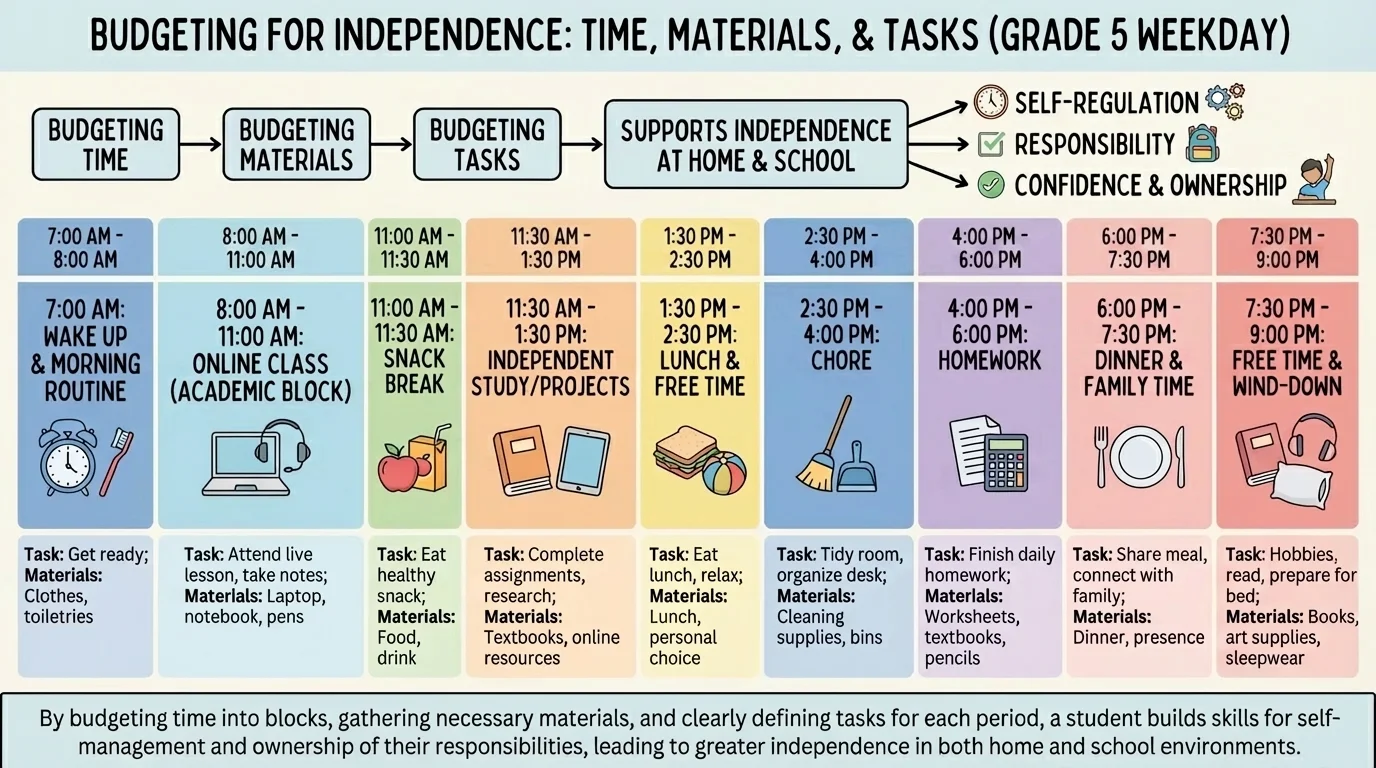
[Figure 1] Think of budgeting like being the manager of your own day. A good manager does not just jump in and hope everything works out. A good manager checks what needs to be done, what tools are needed, and how long it will take. You can do the same thing, even when you are young.
A schedule helps you see your day clearly with time blocks for different activities. When you know what is coming next, you are less likely to feel surprised, rushed, or distracted. Budgeting time means deciding how much time each job needs and placing it in your day.
Start by naming the things you must do. For example, your list might include online class, reading, a chore, lunch, exercise, and free time. Then estimate how long each one takes. If reading usually takes about \(20\) minutes and your chore takes about \(15\) minutes, you can plan around that. Your estimates do not have to be perfect. They just need to be close enough to help you prepare.
One smart habit is to leave buffer time between activities. Buffer time is extra time in case something takes longer than expected. For example, if you think a writing assignment will take \(30\) minutes, you might budget \(40\) minutes instead. That extra \(10\) minutes protects you if the internet is slow, you need a short break, or you have to fix a mistake.
Another important part of budgeting time is priority. A priority is something that matters most and should be done first. If you have an online class at \(9{:}00\) and want to play a game, the class is the priority. If you need to feed a pet before free time, feeding the pet comes first. Priorities help you make wise choices instead of choosing only what feels fun in the moment.
Example: Planning one after-school afternoon at home
Step 1: List the jobs.
You need to eat a snack, attend one online lesson, fold laundry, do math practice, and have free time.
Step 2: Estimate the time.
Snack: \(15\) minutes, lesson: \(45\) minutes, laundry: \(15\) minutes, math practice: \(25\) minutes, free time: \(30\) minutes.
Step 3: Add the total.
\[15 + 45 + 15 + 25 + 30 = 130\]
Step 4: Add a little buffer time.
Add \(10\) extra minutes for transitions. Now you need \(140\) minutes total.
Because you know the total time, you can start early enough and avoid getting behind.
Time budgeting also helps you avoid a common problem: underestimating. That means guessing too low. If you keep telling yourself a task will only take \(5\) minutes when it really takes \(15\), your whole day can become stressful. Looking back at [Figure 1], notice how each activity has its own space. That space helps you be realistic instead of guessing wildly.
Materials planning matters because you cannot work smoothly if you keep stopping to search for things. In many daily situations, being prepared with the right items is what makes you look and feel independent. Budgeting materials means checking what you need, gathering it ahead of time, and taking care of it so it is ready next time.
For online school, materials might include a charged device, headphones, a notebook, pencils, a login password, and a water bottle. For home tasks, materials might include dish soap, a sponge, towels, trash bags, ingredients, or a laundry basket. Before you start, ask yourself, What do I need for this job?
[Figure 2] A great way to budget materials is to make a short checklist. If you are about to join a live lesson, your checklist could be: device charged, charger nearby, notebook ready, pencil sharpened, headphones found, and assignment tab open. If you are making a sandwich, your checklist could be: bread, filling, plate, knife, napkin, and cleanup supplies.
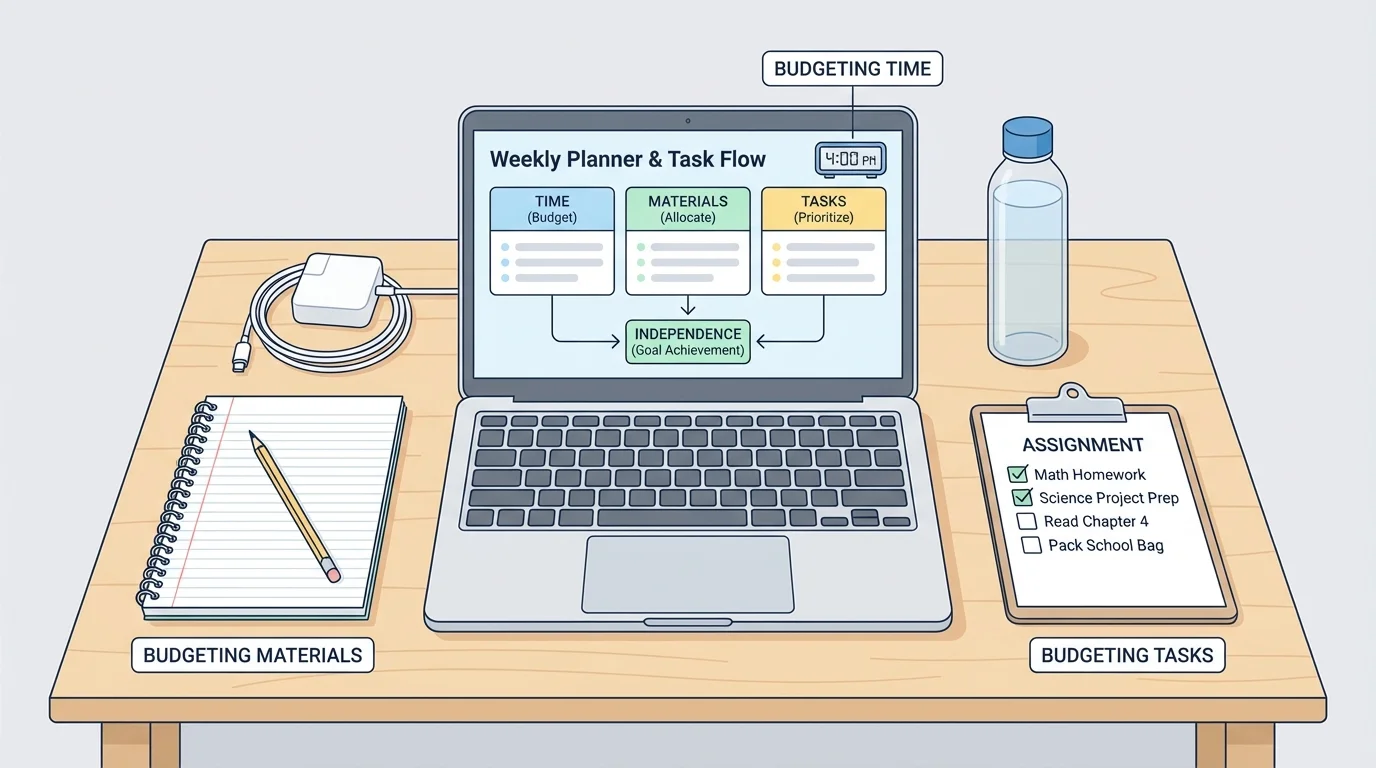
Organizing materials also saves time later. If your headphones always go in one drawer and your notebooks always go on one shelf, you do not waste minutes searching. That may sound small, but many tiny delays can add up. For example, if you waste \(5\) minutes looking for supplies four times in one day, that is \[5 + 5 + 5 + 5 = 20\] minutes lost.
Budgeting materials also means avoiding waste. If you use too much paper, forget to close markers, or leave food out, you may run out of supplies sooner. Being independent includes using what you have carefully. That shows responsibility and respect for your home and your learning tools.
Prepare before you begin
One of the simplest ways to be independent is to set up before a task starts. This means you do not wait until the last second to find what you need. Preparation makes work smoother, helps you focus, and lowers stress because fewer problems pop up in the middle.
This skill matters outside school too. If you are helping cook dinner, you can check ingredients before mixing. If you are cleaning your room, you can gather a trash bag, laundry basket, and cleaning cloth first. The more often you prepare ahead, the less you rely on reminders from adults.
Later, when you pack for an activity or get ready for a community event, the same idea still works. Just like the setup in [Figure 2], a prepared space and a prepared bag help you start confidently.
Some jobs feel hard not because they are impossible, but because they are too big to think about all at once. Task budgeting solves that problem. It means breaking one big job into smaller steps. This makes the job feel more manageable and helps you keep going.
For example, "clean your room" sounds huge. But if you split it up, the task becomes clearer: put dirty clothes in the basket, throw away trash, put books on the shelf, make the bed, and vacuum the floor. Now you have a series of smaller actions instead of one giant command.
[Figure 3] Task budgeting also includes putting steps in the right order. If you try to vacuum before picking up toys, the floor is still blocked. If you try to submit an assignment before finishing it, you are not done. Order matters because some steps prepare for the next ones.
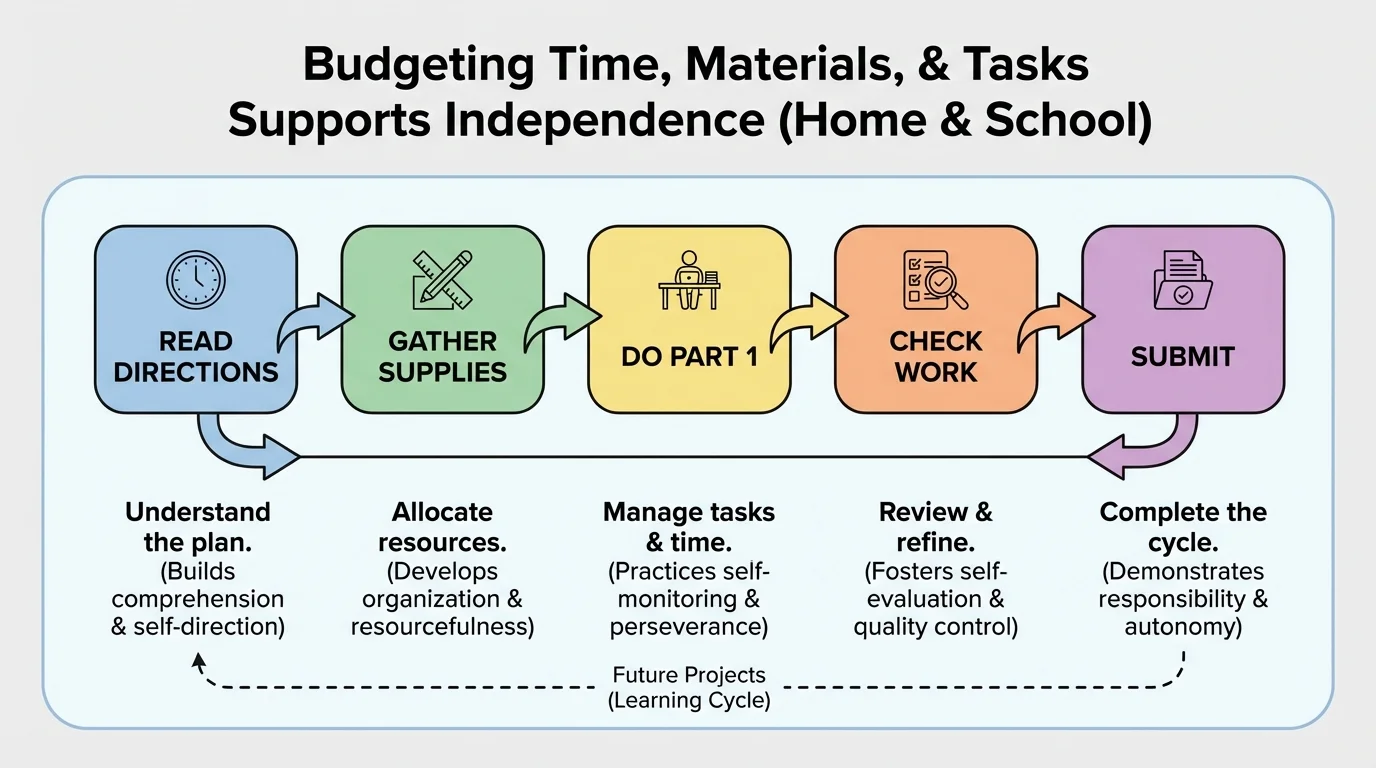
A checklist is a powerful tool for task budgeting. You can cross off each step as you complete it. That helps your brain stay focused and gives you proof that you are making progress. Even adults use checklists for travel, work, shopping, and home projects.
When a task feels boring or difficult, promise yourself to do just the first step. Often, starting is the hardest part. Once you begin, the next steps feel easier. This is why small steps are such a strong independence tool.
Example: Breaking down a writing assignment
Step 1: Read the directions carefully.
Step 2: Open the document and type your name.
Step 3: Write three main ideas.
Step 4: Turn each main idea into a sentence or paragraph.
Step 5: Check spelling and punctuation.
Step 6: Submit the assignment.
Instead of staring at one big task, you follow a path step by step.
If you skip task budgeting, you may bounce around, forget steps, or quit halfway through. Notice that each step leads to the next one. That is what good planning does: it gives your effort a direction.
Real independence grows when time, materials, and tasks work together. If one part is missing, the whole plan gets weaker. You might know the steps but not have the supplies. You might have the supplies but not enough time. You might have time and supplies but no clear order for the task.
[Figure 4] Suppose you need to complete a science activity at home. Your time budget tells you when you will do it and how long it should take. Your materials budget tells you to gather paper, scissors, glue, and instructions first. Your task budget tells you to read directions, cut pieces, assemble them, check your work, and clean up. Using all three means you are much more likely to succeed on your own.
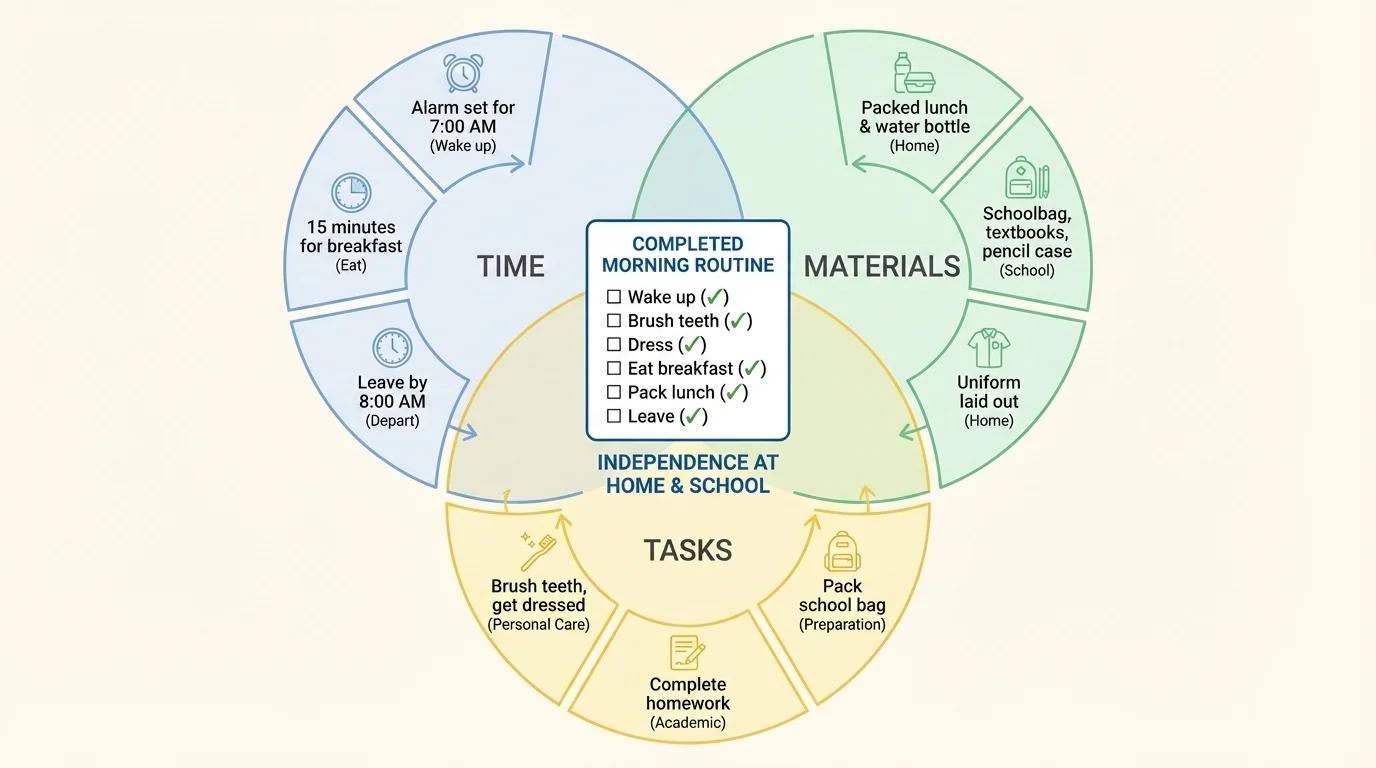
Think of these three parts like the legs of a stool. If one leg is missing, the stool wobbles. If all three are strong, the stool stands steady. That is how planning supports independence. It keeps your day balanced.
This matters in a morning routine too. You need time to get dressed, eat breakfast, and log in. You need materials like your device and charger. You need tasks in order: wake up, wash up, get dressed, eat, gather supplies, and log in. The connected-circle idea helps show why these pieces belong together.
No one budgets perfectly every day. Sometimes plans go wrong. The important skill is learning how to fix problems instead of giving up. Independent people adjust.
Here are some common problems and smart responses:
| Problem | What may happen | Smart response |
|---|---|---|
| You start late | You feel rushed and may miss part of a lesson | Set an alarm and prepare materials the night before |
| You cannot find supplies | You waste time searching and get frustrated | Store important items in the same place every time |
| A task feels too big | You avoid it or stop halfway | Break it into smaller steps and do the first one |
| You planned too little time | Your schedule gets crowded | Add buffer time next time |
| You forget a step | Your work may be incomplete | Use a checklist |
Table 1. Common planning problems, likely results, and practical solutions.
Here is another useful idea: check your plan before you begin. Ask three quick questions. Do I have enough time? Do I have what I need? Do I know the steps? If the answer to any question is no, fix that problem first.
Your brain uses less energy deciding what to do when you already have a plan. That is one reason routines and checklists can make hard days feel easier.
Sometimes independence means asking for help the right way. For example, you might say, "I made my checklist, but I am not sure what step comes after this," or "I have \(20\) minutes left and two steps to finish. Which one should I do first?" That is very different from waiting and doing nothing. Responsible help-seeking is part of independence because you are still thinking and solving.
Example: Solving a rushed morning
Step 1: Notice the problem.
You keep logging in late because you search for your charger every morning.
Step 2: Identify which budget needs fixing.
This is mainly a materials problem, but it also affects time.
Step 3: Make one small change.
Put the charger in the same spot every night.
Step 4: Check the result.
The next morning, you save time and start with less stress.
One small habit can improve your independence a lot.
Planning once is helpful. Planning regularly is powerful. The goal is to turn budgeting into a habit. A habit is something you do so often that it becomes part of your routine.
You can build this habit by doing a short daily reset. At the end of the day, put away materials, charge your device, check tomorrow's assignments, and choose one important task for the next day. This might take only \(10\) minutes, but it can save much more time later.
It also helps to reflect. Reflection means thinking about what worked and what did not. Maybe your reading assignment took longer than expected. Maybe you forgot an ingredient while cooking. Maybe your checklist helped a lot. Reflection helps you improve your next plan.
"Being prepared is a way of taking care of your future self."
You do not need a perfect system. You need a system you can actually use. Some students like a paper planner. Some like sticky notes. Some like a whiteboard. Some use a simple digital calendar. The best tool is the one that helps you remember and follow through.
As you grow, your jobs will get bigger. You may manage longer assignments, bigger chores, or more activities. The same basic skills will still help you: budget your time, gather your materials, and break tasks into steps. Those are life skills, not just school skills.
When you practice these habits, you become someone who can be trusted to handle responsibilities. That trust leads to more freedom, more confidence, and more independence both at home and in online school.
