People notice responsibility faster than you might think. They notice when you show up on time for a video lesson, when you feed a pet without being reminded, when you return something you borrowed, and when you admit a mistake instead of hiding it. Responsibility is not about being perfect. It is about being someone others can count on.
Responsibility means doing what you are supposed to do, taking ownership of your choices, and understanding that your actions affect other people. It includes finishing tasks, telling the truth, being careful with rules and safety, and fixing problems when you cause them.
Responsibility is the habit of doing your part, making careful choices, and accepting the results of your actions. A responsible person does not wait for someone else to solve every problem.
Being responsible helps build trust. Trust grows when people see that you usually do what you say you will do. If you say you will finish your work before playing a game and then you do it, people learn they can believe you. If you often make excuses or ignore tasks, trust gets weaker.
Responsibility also connects to consequences. A consequence is what happens because of a choice. Some consequences are positive. If you remember your assignment, you feel prepared and less stressed. Some consequences are negative. If you ignore a chore, someone else has to do extra work. Responsible habits help create better consequences for you and for others.
"The best way to be trusted is to act in a trustworthy way, even when no one is watching."
One important truth: responsibility is not the same as doing everything alone. Responsible people ask for help when they need it. They do not hide confusion. They speak up early, before a small problem becomes a big one.
Online school gives you freedom, but that freedom works best when you use routine. A simple daily plan helps you stay prepared instead of rushing at the last second. [Figure 1] Responsible online students know when their classes begin, check messages, gather supplies, and log in ready to learn.
Being responsible in online school means more than just clicking into a lesson. It means charging your device if needed, having your notebook nearby, staying focused, and completing work on time. If the internet stops working or something goes wrong, a responsible student tells the teacher or adult as soon as possible instead of waiting until much later.
Another big part of responsibility is deadline management. A deadline is the time by which something must be done. Missing one assignment once might not seem huge, but repeated late work can create stress and confusion. A good habit is to check your task list at the start and end of the day. In the morning, you see what matters most. At the end of the day, you make sure nothing important is forgotten.
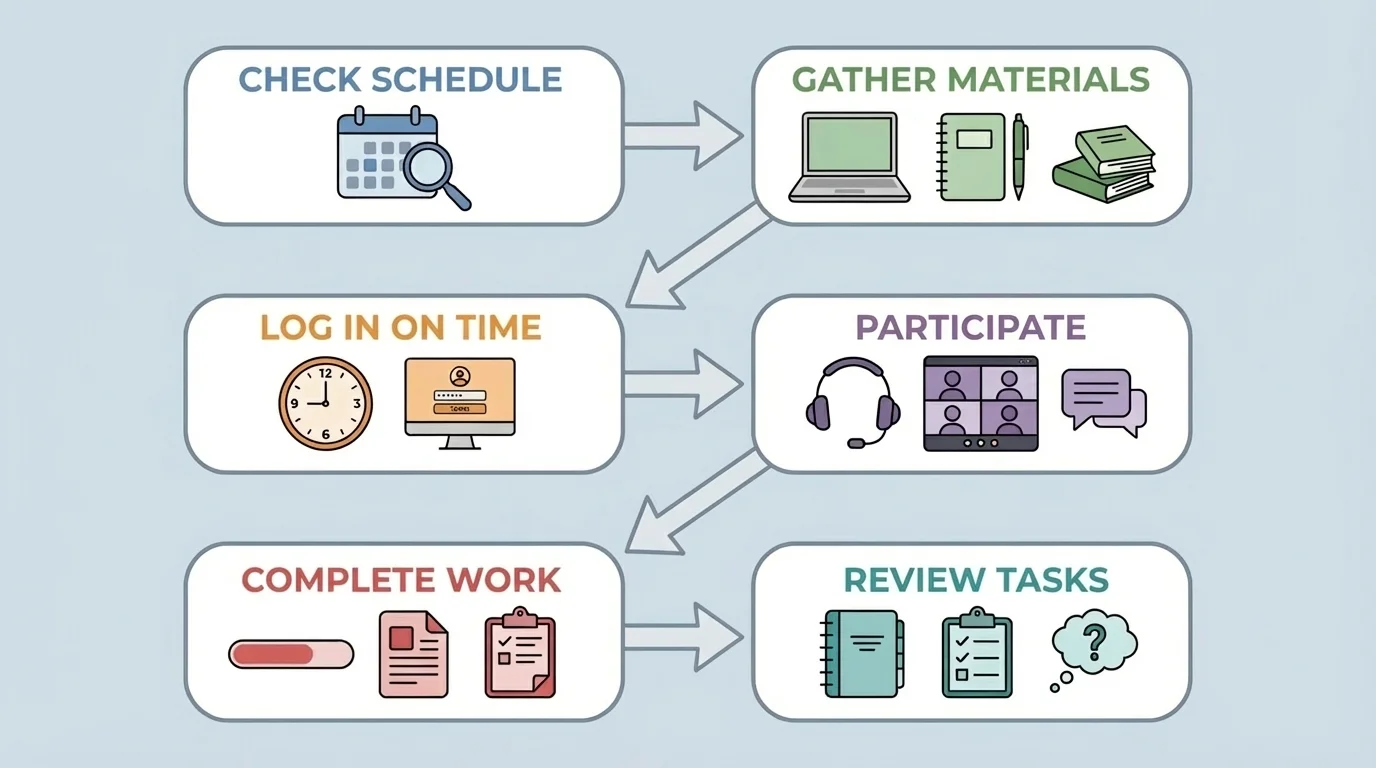
Responsible online behavior also includes how you communicate. In chats, emails, and video calls, use respectful words, answer clearly, and think before sending. Your digital actions shape your reputation and affect how others see you.
If you do not understand directions, ask. If you forgot something, admit it. If you need extra time because of a real problem, communicate early. Those choices show maturity. As we saw in [Figure 1], responsibility works best when it is built into a routine, not saved for emergencies.
Example: A responsible online school morning
Step 1: Check your schedule.
Look at what classes, assignments, or meetings happen today.
Step 2: Prepare your space.
Get paper, pencils, water, and any materials you need before class starts.
Step 3: Log in a few minutes early.
This gives you time to handle small tech problems without panicking.
Step 4: Write down tasks.
Keep a short list so you do not rely only on memory.
Step 5: Finish and review.
Before free time, check that your work is submitted and messages are answered.
Try This: Tonight, place tomorrow's school materials in one spot. Then tomorrow morning, check your schedule before doing anything else online.
Home is one of the first places where responsibility matters every day. [Figure 2] Small actions at home create big effects. When you put away your things, clean up after yourself, or help with a household job, you make life easier for everyone around you.
At home, responsibility can include chores, caring for pets, helping younger siblings safely, managing your own belongings, and following family routines. It also means noticing what needs to be done. If your shoes are blocking the doorway, move them. If you spill something, wipe it up. If the trash is full and that is your job, take it out without pretending not to notice.
Responsible behavior at home also includes honesty. If you broke a cup, forgot to feed the dog, or used the last of something, tell the truth. Hiding a mistake may seem easier for a few minutes, but it usually makes the problem worse. People can handle accidents more easily than dishonesty.
Another part of home responsibility is caring for shared spaces and shared items. If everyone leaves messes for someone else, the home becomes stressful. But when each person does a fair share, the home runs more smoothly. That is part of being a good family member.
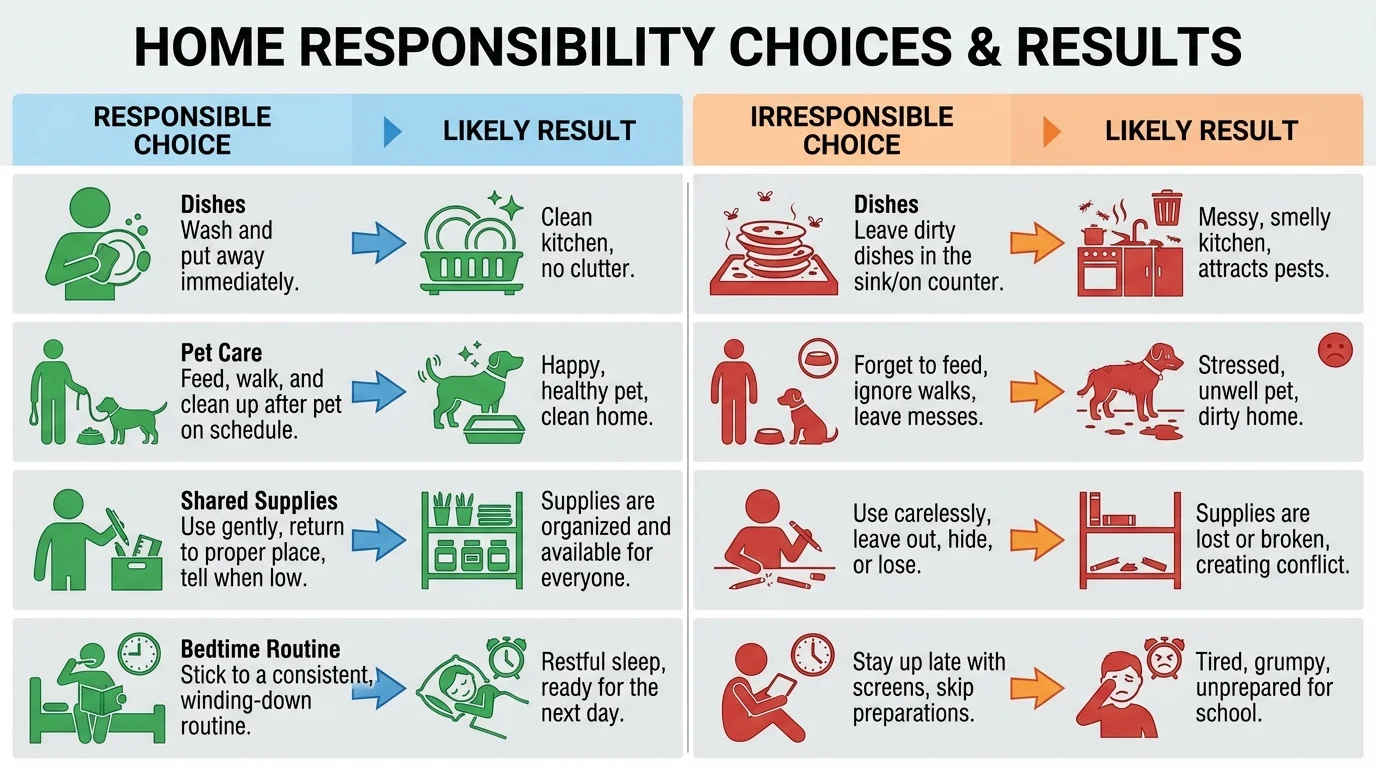
Responsible habits at home also support your future independence. If you learn now how to make your bed, organize your materials, follow a bedtime routine, and complete basic chores, you are practicing skills you will use for years. These habits may seem small, but they teach self-control, planning, and follow-through.
Think about the difference between these two situations. In one home, a child finishes a snack and leaves the plate on the couch, the wrapper on the floor, and crumbs behind. In another, the child throws away trash, puts the plate in the sink, and wipes the table. The second choice takes only a little more effort, but it shows respect for the people sharing the space. The patterns in [Figure 2] remind us that responsible choices usually save time and stress later.
Habits get easier when they happen at the same time or in the same order each day. Your brain starts to expect the routine, which means you spend less energy deciding what to do next.
Try This: Choose one home habit to strengthen this week, such as putting away laundry, checking your pet's water, or cleaning up your workspace before dinner.
Your community includes places and people beyond your home. It may include neighbors, parks, libraries, sports teams, clubs, faith groups, stores, and online spaces where people gather. In all of these places, responsibility means acting in ways that are safe, respectful, and helpful.
Community responsibility can look like throwing trash in a bin, returning borrowed library books, following rules at a recreation center, waiting your turn, and speaking kindly to workers and neighbors. It can also mean being careful online: not posting hurtful comments, not sharing private information, and not spreading rumors.
Why community responsibility matters
When people act responsibly in shared spaces, everyone benefits. Places stay cleaner, people feel safer, and trust grows between neighbors. When people act carelessly, others often have to spend time, money, or energy fixing the damage.
Responsibility in the community often means thinking beyond yourself. For example, if you are at a park and leave a bottle on the ground, someone else must clean it up, or an animal might get hurt. If you ride a bike carelessly near others, someone could get injured. If you send a mean message online, the hurt can spread quickly because digital messages move fast and can be shared.
Being a responsible community member does not mean doing huge, dramatic things. Often it means doing ordinary things well. Hold the door if someone is carrying items. Put equipment back where it belongs. Follow safety instructions. Keep promises when you join a group project or team outside school. Show up when someone is depending on you.
You can also practice responsibility through service. That might mean helping a neighbor bring in groceries, participating in a cleanup day, or collecting donations for a local cause. Service is one way responsibility turns into action for the good of others.
Responsible people are not born with perfect self-control. They build systems that help them remember and follow through. A few strong habits can make a huge difference.
First, use checklists. A checklist can help with morning tasks, homework tasks, chores, or packing for an activity. Second, keep supplies in the same place. When your charger, notebook, headphones, or pencil move around constantly, you waste time looking for them. Third, break bigger jobs into smaller steps. "Clean your room" can feel overwhelming, but "put clothes away, clear desk, make bed, throw away trash" feels possible.
Fourth, set reminders. You can use a calendar, sticky note, or alarm. Fifth, do the hardest important task earlier if you can. Waiting too long often makes responsibility feel heavier. Sixth, pause before saying, "I'll do it later." Sometimes later turns into forgotten.
| Habit | How it helps | Simple example |
|---|---|---|
| Checklist | Keeps tasks from being forgotten | List: log in, complete math, read, submit work |
| Routine | Makes good choices automatic | Clean desk after each lesson |
| Reminder | Supports memory | Alarm for pet feeding time |
| Break it down | Makes big jobs manageable | Clean room in four mini-tasks |
| Honest check-in | Helps you notice problems early | Ask: "Did I really finish this?" |
Table 1. Practical habits that make responsibility easier in daily life.
A strong habit related to responsibility is accountability. Accountability means owning your actions instead of blaming everyone else. If you forgot, say you forgot. If you need support, ask for support. If you made a poor choice, admit it and work on a better one next time.
Good habits usually start small. Repeating one useful action every day often works better than making a giant plan that is hard to keep.
Try This: Make a checklist with only three things you want to do responsibly each day for one week. Keep it simple enough that you can actually follow it.
Everyone makes mistakes. Responsibility does not disappear when you mess up. [Figure 3] In fact, this is when responsibility matters most. A repair process helps you move from "I made a mistake" to "I am fixing it."
Start by noticing the problem clearly. Then tell the truth. Next, apologize without making excuses. After that, fix what you can. Finally, make a plan so the same mistake is less likely to happen again. This process builds respect because it shows you care about your actions and their effects.
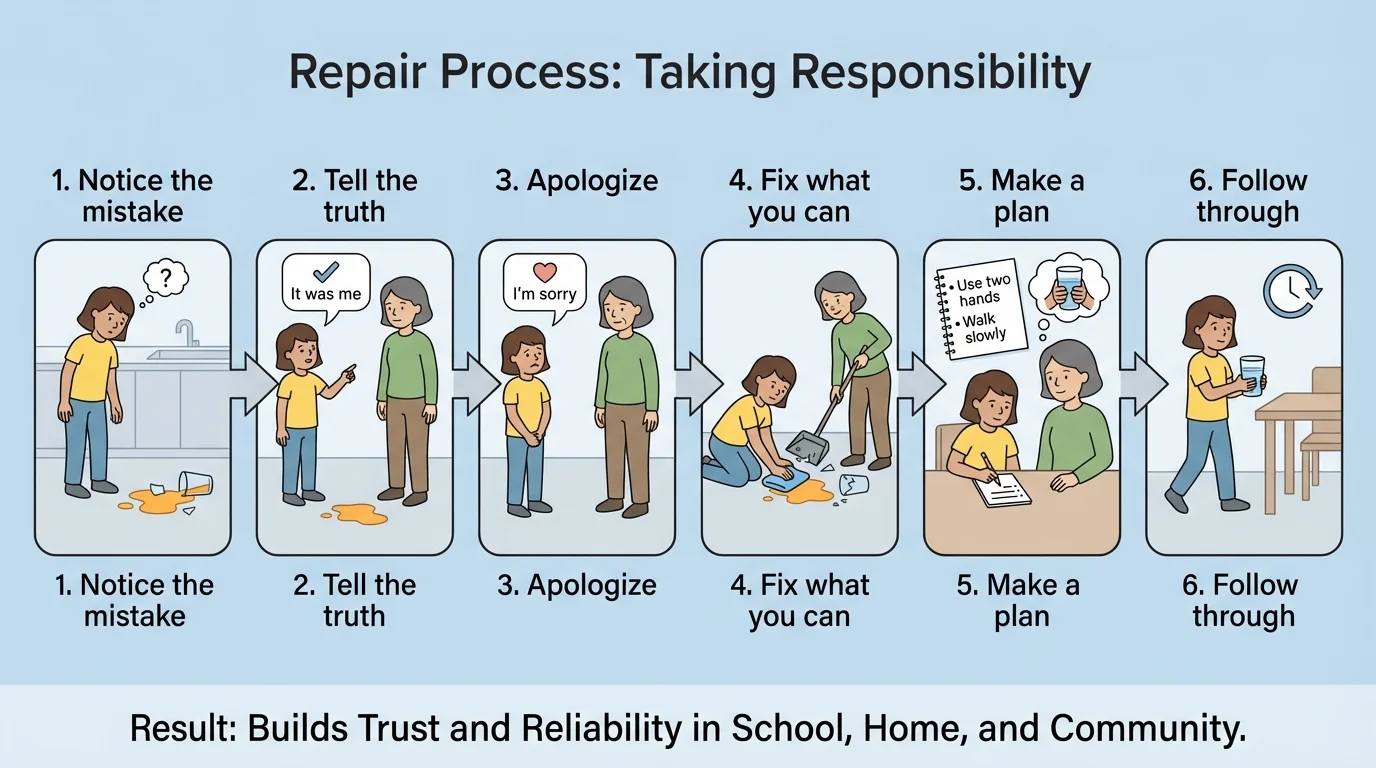
For example, maybe you promised to help wash dishes but forgot because you started a game. An irresponsible response would be, "It's not a big deal," or "I forgot, so it doesn't count." A responsible response would be, "I forgot my job. I'm sorry. I'll do the dishes now, and next time I'll set a reminder."
Example: Repairing trust after a mistake
Step 1: Say what happened honestly.
"I missed the deadline for my assignment."
Step 2: Acknowledge the effect.
"Now my teacher does not have my work, and I am behind."
Step 3: Apologize simply.
"I'm sorry."
Step 4: Repair the problem.
"I will complete it tonight and send a message explaining what happened."
Step 5: Prevent it next time.
"I will write all deadlines in my planner and check them after lunch each day."
Sometimes trust returns quickly. Sometimes it takes time. If people are still upset, keep doing the right thing. As [Figure 3] shows, repair is not just words. It includes follow-through.
The habits you build now affect your future more than you may realize. Responsible students are often more ready for bigger freedoms because adults see they can handle them. If you regularly finish tasks, care for your belongings, speak honestly, and respect others, people may trust you with more independence.
Responsibility also helps in friendships. Friends want someone they can count on. If you promise to join a video call, help with a project, or keep something private and safe, following through matters. Being reliable makes relationships stronger.
Later in life, responsibility matters in jobs, teamwork, money decisions, transportation, health, and safety. The person who shows up prepared, keeps agreements, and fixes mistakes is often the person others want to work with. These adult skills start with childhood habits.
Small habits create a strong character
Character is the pattern of choices you make over time. Every time you tell the truth, finish a task, or repair a mistake, you strengthen the kind of person you are becoming.
You do not need to change everything at once. Pick one area: school, home, or community. Build one habit. Practice it until it feels normal. Then add another. Responsibility grows through repetition.
Try This: Ask yourself one question tonight: "What is one thing someone should not have to remind me about tomorrow?" Then do that thing on your own.
