Some students stay silent because they think asking for help will make them look weak. In real life, the opposite is often true. People who understand themselves and speak up clearly usually get better support, solve problems faster, and feel more in control. That skill is called self-advocacy, and it matters when you are messaging a teacher in online school, talking with a parent about study space, or telling a coach you need clearer instructions.
Self-advocacy is not about complaining, demanding, or making everything go your way. It is about noticing what you need, understanding what helps you do well, and communicating that in a respectful, honest way. When you can do that, you are more likely to meet deadlines, manage stress, and make progress toward your goals.
Think about two students in an online class. One is confused about a project, misses the deadline, and says nothing until the grade drops. The other notices the confusion early, sends a clear message, asks for an example, and makes a plan to finish the work. Both students had a problem. Only one used self-advocacy to deal with it.
"Speaking up for yourself is not being difficult. It is being responsible for your own success and well-being."
Self-advocacy also helps outside school. You may need to tell a family member that you work better with fewer distractions, ask a group leader to explain directions more clearly, or let a friend know that a joke crossed a line. These moments can feel awkward, but avoiding them usually makes the situation harder.
Self-advocacy means speaking up for your needs, rights, ideas, and goals in a respectful and effective way. It starts with self-awareness. If you do not know what is helping you or blocking you, it is hard to explain what you need.
Needs are things required for you to function, learn, or feel safe and supported. Strengths are the abilities, habits, and qualities that help you succeed. Goals are the results you are working toward. A support system is the people, tools, and resources that can help you reach your goals.
A good self-advocacy plan connects all three: your needs, your strengths, and your goals. For example, if you need more time to process instructions, one of your strengths might be staying organized by writing things down, and your goal might be turning in assignments on time. Your plan would help you ask for written directions early and then use your organization skills to stay on track.
[Figure 1] Many problems become easier once you can name them clearly. Your needs may fit different categories: learning needs, emotional needs, communication needs, time-management needs, and environmental needs. If you only say, "School is hard," people do not know how to help. If you say, "I lose focus when there is noise in the room, and I need a quieter place during live lessons," that is specific and useful.
Examples of needs you might notice in daily life include needing written directions after a video lesson, needing a short break after concentrating for a long time, needing reminders before deadlines, needing extra clarification before starting a group project, or needing a calm place to complete work. Needs are not excuses. They are information.
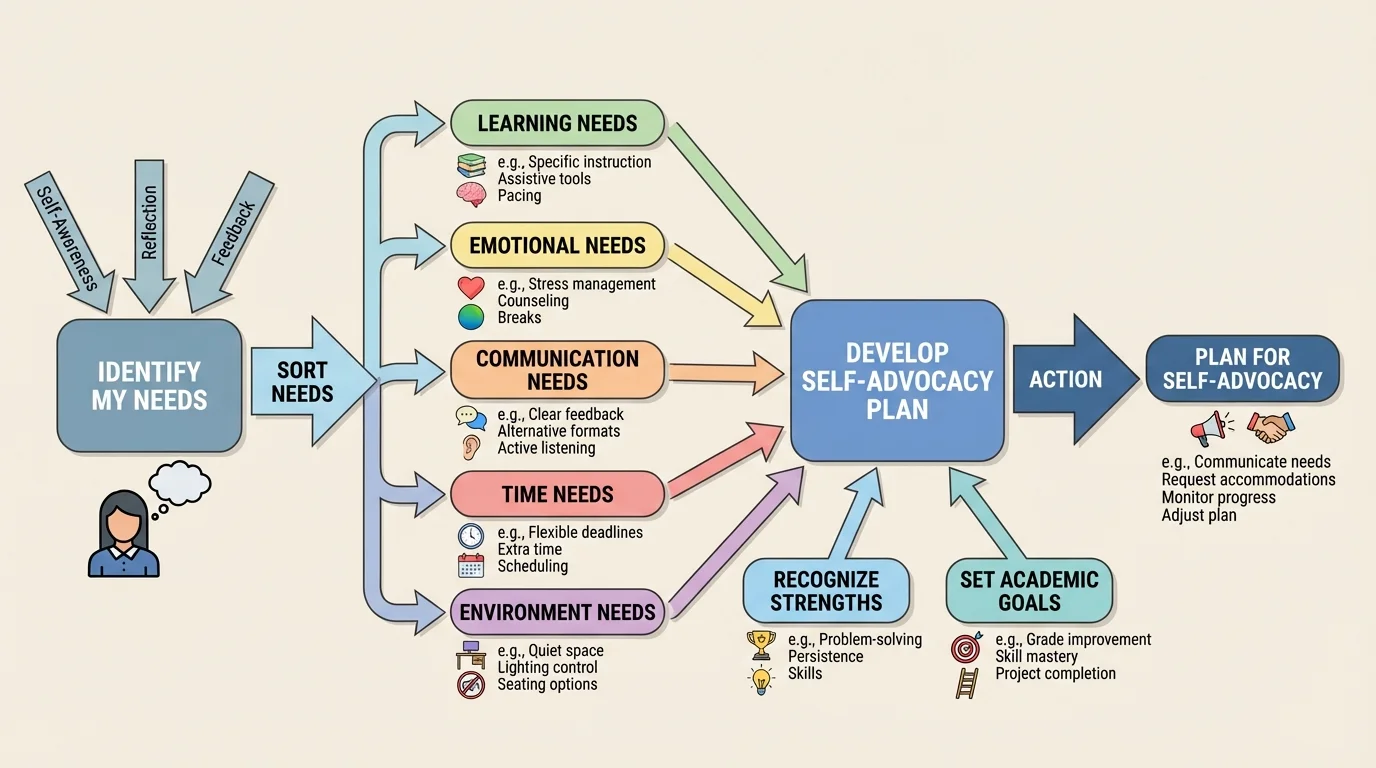
One way to spot your needs is to look for patterns. Ask yourself: When do I get stuck? When do I feel stressed, frustrated, or overwhelmed? What conditions help me do my best work? You can also notice what happens before a problem. For example, if you often turn in work late, the real issue might not be laziness. You may need clearer steps, fewer distractions, or a better reminder system.
Another useful question is: "What would make this situation easier or more successful?" That question turns your attention away from blame and toward solutions. Instead of thinking, "I am bad at math," you might realize, "I need examples worked out step by step," or "I need to ask questions sooner."
Needs are specific, not personal flaws. Saying "I need instructions in smaller steps" is different from saying "I am just bad at this." Self-advocacy becomes stronger when you describe the situation, the obstacle, and the kind of support that would help.
Your needs can also change. What you need during a busy week, family emergency, or difficult unit may not be the same as what you need during a normal week. That is why self-advocacy is a skill, not a one-time decision.
Your strengths matter because self-advocacy is not only about what is difficult. It is also about what you can use to move forward. Strengths can be skills, habits, personality traits, or resources. Maybe you are persistent, creative, calm under pressure, good at asking questions, comfortable with technology, or strong at making checklists.
Sometimes students focus so much on their struggles that they forget what they already do well. But your strengths are the tools that help your plan work. If one of your strengths is writing clearly, email may be your best way to ask for help. If one of your strengths is being honest, you may be good at explaining what is confusing. If you are good at routines, you can build support into your schedule.
To identify strengths, think about times you succeeded. What helped? Did you stay organized? Did you keep trying? Did you ask a smart question? Did you notice details other people missed? You can also ask trusted adults what strengths they see in you. Sometimes other people notice your strengths before you do.
As you continue building self-awareness, think back to the categories in [Figure 1]. A need and a strength can work together. For example, if you need reminders and one of your strengths is using digital tools well, you can set calendar alerts and task notifications instead of relying only on memory.
Goals give your self-advocacy plan direction. Without a goal, you may know what is wrong but not what you are trying to change. A goal answers the question: "What am I working toward?"
Some goals are short-term: finish assignments on time this week, participate once in each live class, ask for clarification before starting a project. Some goals are long-term: become more independent, manage stress better, improve communication with adults, or build confidence when asking for support.
Strong goals are clear. "Do better in school" is vague. "Turn in all assignments on time for the next two weeks" is clear. "Be more organized" is broad. "Check my task list at the start and end of each school day" is easier to measure.
Turning a vague goal into a clear goal
Step 1: Start with the vague version.
"I want school to feel less stressful."
Step 2: Ask what specific change would reduce stress.
Maybe late work, confusion, and rushing are the main problems.
Step 3: Rewrite the goal so it is specific.
"For the next 10 school days, I will check assignment directions before I begin and message my teacher within 24 hours if I am confused."
This goal is much easier to act on because it names a behavior you can actually do.
When choosing goals, make sure they fit your real situation. A useful goal should challenge you, but it should still feel possible. If your goal is too huge, you may avoid starting. If it is too easy, it may not change much.
[Figure 2] A self-advocacy plan is a simple action guide that helps you move from awareness to action. It works like a sequence of decisions: notice the issue, define the need, connect it to a goal, choose the right person, make the request, and follow up.
Your plan does not need to be fancy. It just needs to be clear enough that you can use it when you are stressed, confused, or unsure. A strong plan usually answers five questions: What do I need? Why does it matter? What strength can I use? Who can help? What exactly will I say or do?
You can organize your plan using this structure:
1. Situation: What is happening?
2. Need: What support, change, or information do you need?
3. Strength: What personal strength can help you handle this?
4. Goal: What result are you trying to reach?
5. Action: Who will you contact, and what will you say?
6. Follow-up: When will you check back if the issue is not solved?
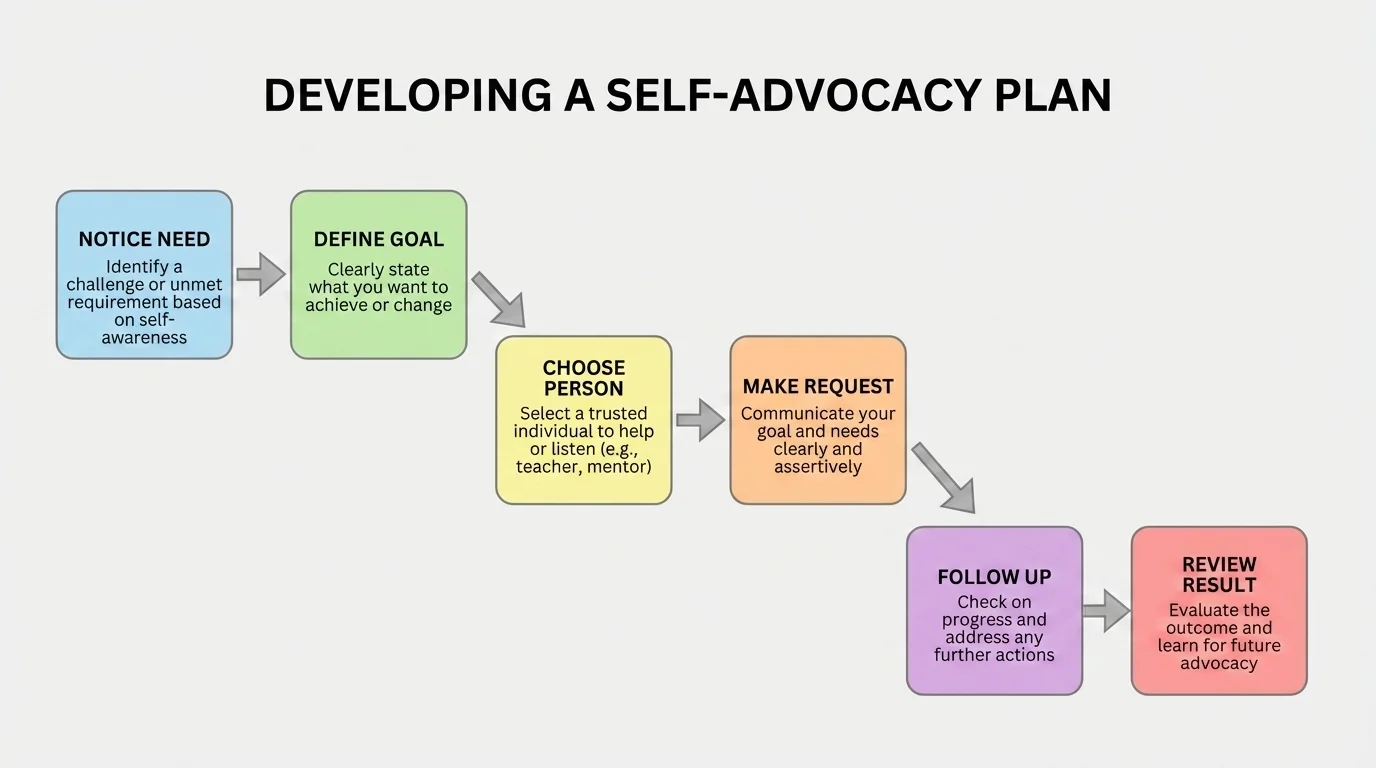
Here is what that can look like in real life: Situation: You are confused by project instructions in an online course. Need: You need an example and a chance to ask questions. Strength: You write thoughtful emails. Goal: Finish the project correctly and on time. Action: Send your teacher a respectful message with one or two specific questions. Follow-up: If there is no reply in two days, send a polite follow-up message.
Notice that this plan is focused and realistic. It does not say, "Fix everything." It says what the problem is, what help is needed, and what action to take. That is what makes self-advocacy useful.
| Part of the Plan | Helpful Question | Example |
|---|---|---|
| Situation | What is going on? | I miss details during long live lessons. |
| Need | What would help? | I need written notes or time to review directions afterward. |
| Strength | What can I use? | I am good at making organized checklists. |
| Goal | What am I aiming for? | I want to complete tasks without missing steps. |
| Action | What will I do? | I will ask for written instructions and create a checklist. |
| Follow-up | What if it is still not working? | I will update my teacher and ask for another strategy. |
Table 1. The main parts of a practical self-advocacy plan with guiding questions and examples.
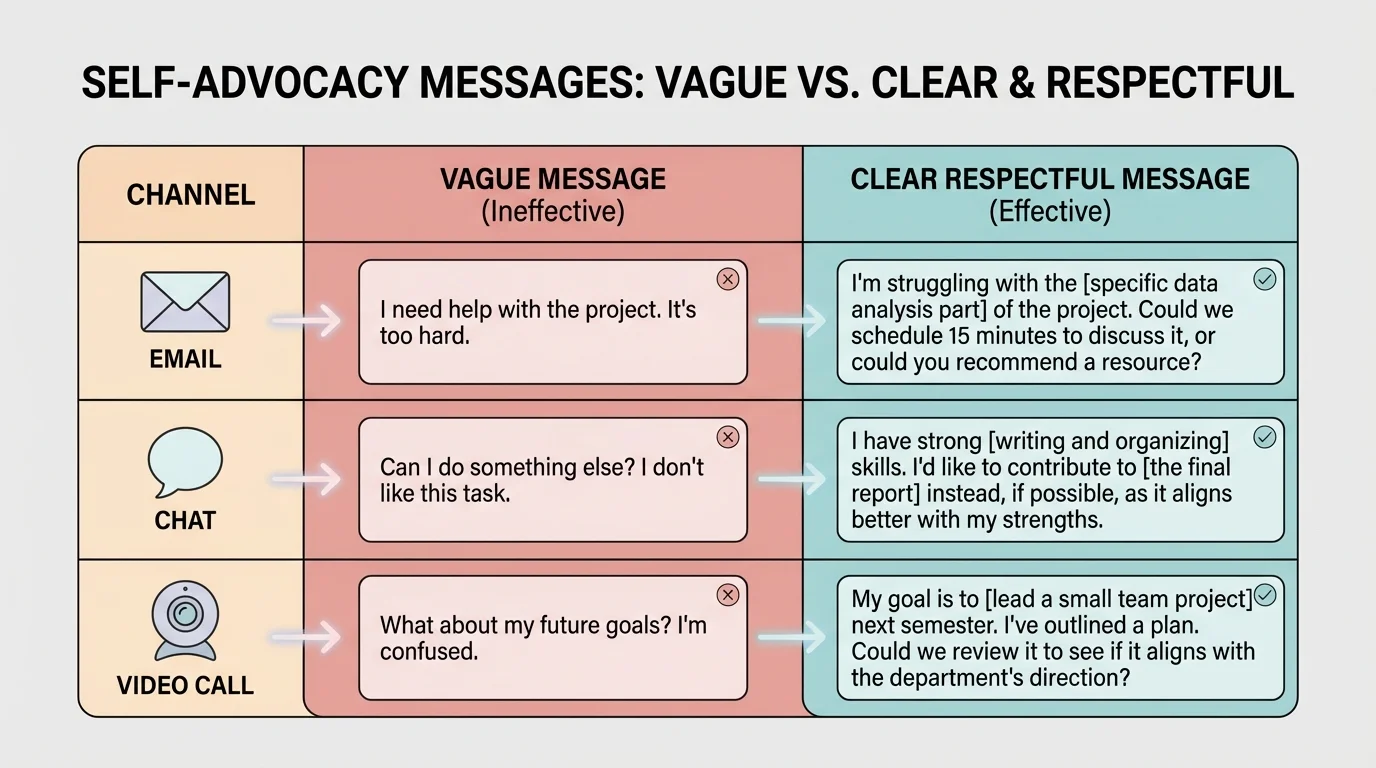
[Figure 3] Clear communication is one of the most important parts of self-advocacy. You do not need perfect words. You do need honesty, respect, and enough detail for the other person to understand your situation. The basic pattern is simple: state the situation, explain the need, and make a clear request.
This pattern becomes clearer in a simple example. Instead of writing, "I don't get this," you might write, "I reviewed the directions for the essay, but I am confused about how many sources I need. Could you clarify that part?" That message is specific, polite, and easier to answer.
A useful script is: "I am having trouble with ____. I understand ____, but I need help with ____. My goal is to ____. Could we try ____?" You can use this in email, chat, text, or during a video call.
Another helpful script is: "I do my best when ____. Right now, ____. Would it be possible to ____?" This works well when you are asking for a change in environment or routine, such as needing a quieter place to work or needing instructions broken into steps.
Message examples you can adapt
Step 1: To a teacher
"Hi, I am reviewing the assignment and I am confused about the final part. I want to complete it correctly. Could you explain what the last section should include?"
Step 2: To a parent or caregiver
"I have a live class at 1:00, and I focus better with less noise. Could I use the quieter room during that time?"
Step 3: To a club leader or coach
"I want to keep up with the team expectations, but I am unclear about the practice schedule changes. Could you send the update in writing?"
Good self-advocacy is respectful, but it is also direct. Avoid dropping hints and hoping someone guesses what you need. If it matters, say it clearly.
Sometimes people will not understand right away. They may be busy, may need more details, or may suggest something that does not actually solve the problem. This does not mean you failed. It means the conversation is still going.
If someone seems confused, restate your need more clearly. If they say no to one idea, ask about another option. If they do not respond, follow up politely. This is where your plan helps. Instead of reacting with panic or anger, you can return to your goal and decide on your next step.
For example, if a teacher says, "Just do your best," but you still need clarification, you might respond, "Thank you. I am trying to do that, but I am still not sure what the last step requires. Could you give one example?" If a family member says the house is too busy to be quiet all day, you might ask for one quieter hour during your most important class.
Flexibility makes self-advocacy stronger. The first request is not always the final answer. Sometimes the best solution comes from adjusting the request while staying focused on the real need and the goal.
Also remember that timing matters. If you wait until a problem becomes huge, people have fewer options to help. Speaking up early is usually easier and more effective.
A good plan is not permanent. You should review it and ask: What worked? What did not work? What changed? This process is called reflection, and it helps you improve your choices over time.
Maybe your first plan was to ask for reminders, but later you realize a digital checklist works better. Maybe you thought you needed more time, but the real need was clearer instructions. Maybe a goal that seemed important no longer fits your situation. Adjusting your plan is smart, not weak.
Think of self-advocacy as a cycle. You notice a problem, take action, learn from the result, and improve your plan. The cycle shown in [Figure 2] repeats as you grow more independent.
Here are a few realistic examples of self-advocacy in action.
Case study 1: Online class confusion
A student keeps missing points on science assignments because the directions in the course page feel unclear.
Step 1: Identify the need
The student needs examples and clearer directions before starting.
Step 2: Identify the strength
The student is good at writing respectful emails and reviewing notes carefully.
Step 3: Set the goal
Submit the next three assignments correctly and on time.
Step 4: Take action
The student messages the teacher with two specific questions and asks whether there is a sample assignment to review.
This works because the student does not just say, "I'm lost." The student explains the problem and asks for something useful.
In that example, the clearer message pattern from [Figure 3] makes the request easier to understand and answer.
Case study 2: Study environment at home
A student struggles to pay attention during live lessons because younger siblings are loud in the same room.
Step 1: Identify the need
The student needs a quieter space during two daily classes.
Step 2: Identify the strength
The student stays calm and can explain problems respectfully.
Step 3: Set the goal
Attend both classes with fewer distractions for the next week.
Step 4: Take action
The student asks a caregiver, "Could I use the bedroom desk from 10:00 to 11:30 so I can focus during live lessons?"
This request is specific about time and need, which makes it easier to work out a solution.
Self-advocacy also matters in friendships and activities. If a friend pressures you to respond instantly to every message, you can say you need time away from your phone while studying. If a club organizer changes plans often, you can ask for updates in one clear message thread instead of several scattered posts.
People often think confidence comes first, but in many situations confidence grows after you practice a skill. Self-advocacy usually feels easier after you use it a few times and see that clear communication gets results.
The goal is not to control other people. The goal is to understand yourself well enough to ask for what helps you learn, function, and grow.
To make your self-advocacy plan stronger, keep it simple enough to remember. Use short notes if needed: my need, my strength, my goal, my action, my follow-up. You can store this in a planner, notes app, or private document.
Be honest with yourself. If something is not working, name it. If you need support, ask early. If one strategy fails, try another. Self-advocacy is not about having no problems. It is about responding to problems in a smart, steady, respectful way.
Over time, this skill helps you become more independent. You learn how to notice what affects your performance, explain your needs clearly, and take action that matches your goals. That is a life skill you will use far beyond school.
