History often looks simple from a distance: one law passes, one protest happens, one court case changes everything. But when you look closer, the past becomes much more complicated. A single event can bring hope to one group, fear to another, and new problems that nobody expected. That is especially true in United States history from Reconstruction to the present, when debates over freedom, equality, citizenship, security, and national identity repeatedly reshaped the country.
To analyze history well, students need to think beyond a list of dates. Historians look for cause and effect, but they also examine continuity and change. Some ideas survive for decades, even when laws change. Other shifts happen quickly, especially during war, economic crisis, or mass protest. Historical events also reveal both unity and diversity: Americans often appeal to shared national ideals such as liberty and equality, yet different groups experience those ideals very differently.
Continuity means things that stay the same over time. Change means developments that transform society, law, culture, or politics. Cause and effect explains why events happen and what results follow. Complexity means that events usually have more than one cause, more than one consequence, and more than one perspective.
For example, a new law may expand rights in theory but leave barriers in practice. A war may unite people around patriotism while also increasing discrimination. A Supreme Court decision may settle one legal question but spark new political conflict. Looking at these layers helps us understand the United States as a nation shaped by argument as much as agreement.
The modern struggle for equality did not follow one straight path. It moved through different communities, different goals, and different strategies, as [Figure 1] illustrates through linked milestones from World War II to the late 1960s. African Americans, women, Native activists, Latinos, Asian Americans, and LGBTQ Americans all challenged exclusion, but they did so in different historical settings and with different language.
One important example was the Double V Campaign during World War II. African American newspapers, especially the Pittsburgh Courier, promoted the idea of victory abroad against fascism and victory at home against racism. This was a powerful argument because Black Americans were being asked to serve a country that still enforced segregation, allowed voter suppression, and tolerated racial violence. The campaign exposed a contradiction: how could the United States claim to defend democracy overseas while denying full democracy to many of its own citizens?
The Double V Campaign had several effects. It encouraged military service and patriotic participation, but it also fueled demands for change. Black veterans returned from the war expecting greater respect and access to rights. At the same time, the federal government became more aware that racial discrimination damaged the country's image during the war. That pressure contributed to later civil rights reforms, although progress remained slow and uneven.
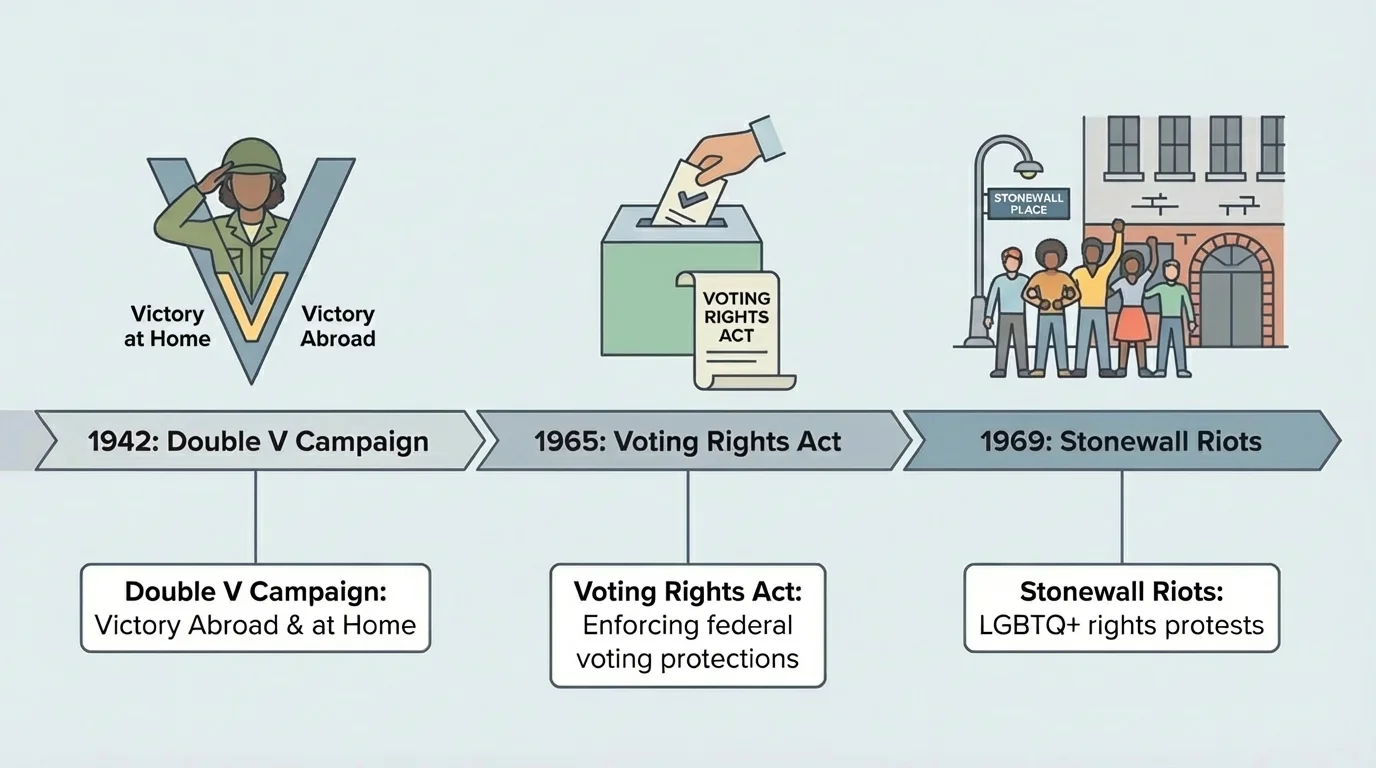
The Voting Rights Act of 1965 marked one of the most important legal victories of the Black freedom struggle. The law came after generations of African Americans faced literacy tests, poll taxes, intimidation, violence, and other barriers designed to block voting, especially in the South. Events in Selma, Alabama, where peaceful marchers were attacked on the Edmund Pettus Bridge, shocked many Americans and helped push Congress to act. Here we can see cause and effect clearly: local activism and televised violence influenced national legislation.
Yet even this major victory shows historical complexity. The act greatly increased federal enforcement of voting rights and led to dramatic rises in Black voter registration and political representation. But it did not end all efforts to limit voting access. Debates over district lines, voter identification laws, felony disenfranchisement, and polling place access continued long after 1965. In other words, the law changed the rules, but the struggle over political power continued.
Another major turning point came with the Stonewall Riots of 1969 in New York City. After a police raid on the Stonewall Inn, many patrons and neighborhood residents fought back. LGBTQ Americans had long faced harassment, job discrimination, censorship, and criminal penalties. Stonewall did not begin the gay rights movement, but it became a symbol of a more public and confrontational phase of activism. Like earlier civil rights struggles, it transformed private suffering into organized political action.
Case study: Why Stonewall mattered
Step 1: Identify the long-term background.
Before 1969, many states criminalized same-sex relationships, and police often targeted LGBTQ spaces.
Step 2: Identify the immediate trigger.
A police raid at Stonewall sparked resistance instead of silent compliance.
Step 3: Trace the effects.
The riots inspired new organizations, annual pride marches, and a more visible movement for equal rights.
This case shows how one event can become historically important because it connects to deeper patterns already in place.
Seen together, the Double V Campaign, the Voting Rights Act, and Stonewall show both unity and diversity. Each appealed to American promises of freedom and citizenship. But each emerged from different experiences of discrimination and used different tactics, from newspaper campaigns to courtroom battles to direct confrontation in the streets. The sequence in [Figure 1] also shows that civil rights history is not one single movement but a set of overlapping movements that influenced one another.
Who gets to belong in the United States has been a central question in modern history. The answer has never been simple. Laws, court decisions, wars, labor demands, and racial ideas all shaped migration and citizenship. This section includes immigrants entering the country, citizens being displaced within it, and Native nations defending their authority against federal and state pressure.
Immigration and citizenship legislation shows how the nation changed over time. In the late nineteenth and early twentieth centuries, laws such as the Chinese Exclusion Act and national-origins quotas restricted entry and reflected racial hierarchies. The Immigration and Nationality Act of 1965 changed that system by ending the old quota structure that favored northern and western Europe. This opened new migration patterns from Asia, Latin America, Africa, and the Middle East. That change increased the country's diversity, but debates over borders, refugee policy, undocumented immigration, and citizenship continued.
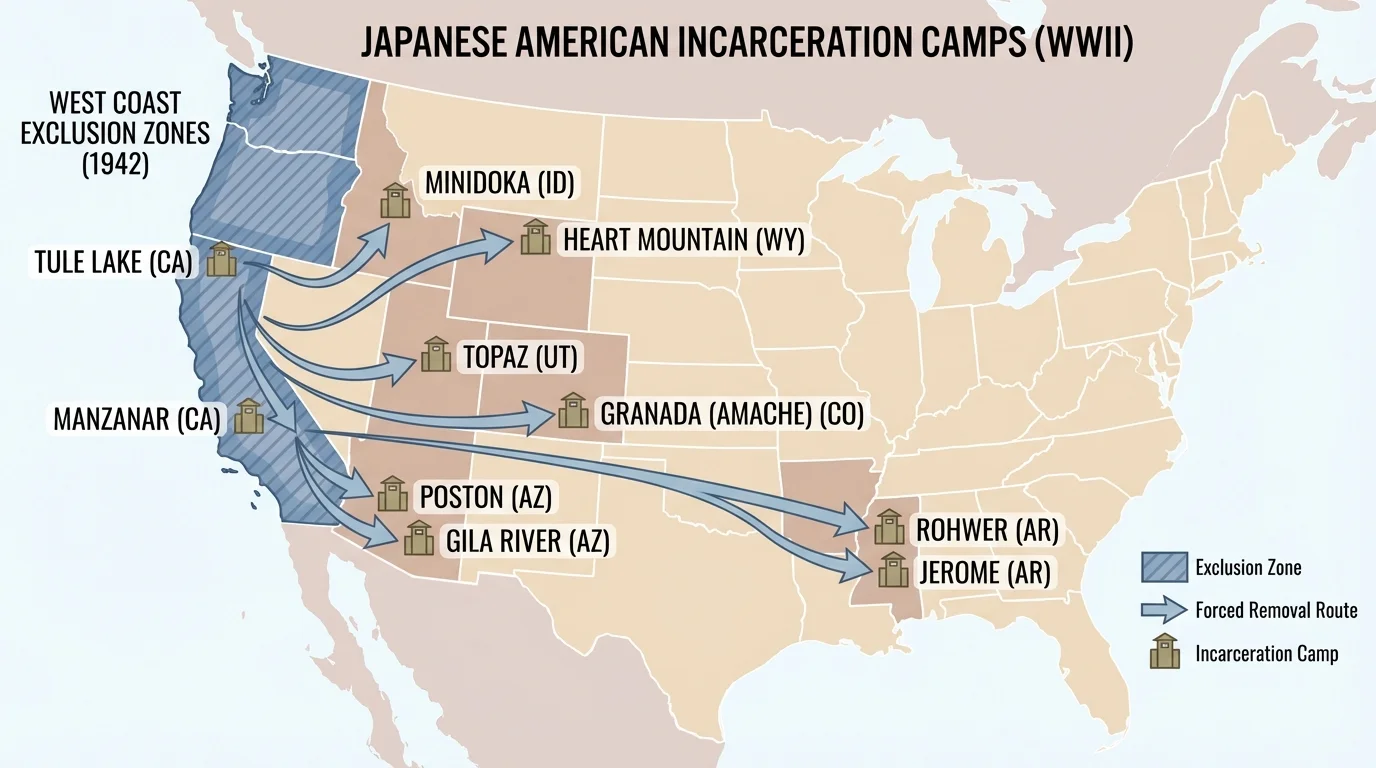
Displacement can also happen to people already inside the nation. [Figure 2] During World War II, the forced removal of Japanese Americans reveals how fear, racism, and war powers could combine through the geography of exclusion and relocation. After Japan attacked Pearl Harbor in 1941, the federal government issued Executive Order 9066, leading to the incarceration of about 120,000 people of Japanese ancestry, most of whom were U.S. citizens. Families lost homes, businesses, and community ties even though there was no evidence of widespread disloyalty.
Japanese American incarceration demonstrates the danger of treating an entire population as suspicious because of ancestry. Government officials justified the policy as military necessity, but many historians and later government investigations concluded that racism, war hysteria, and failed political leadership played major roles. This is a strong example of complexity: wartime fear was real, but fear alone does not explain why one group was targeted so broadly while others were not.
The Supreme Court case Korematsu v. United States upheld the exclusion policy in 1944, showing that courts do not always protect civil liberties during crisis. Decades later, the federal government formally apologized through the Civil Liberties Act of 1988. That apology matters because it shows how public memory can change: a policy once defended as necessary was later acknowledged as unjust.
Debates over tribal sovereignty add another layer to the story of displacement and belonging. Tribal sovereignty is the right of Native nations to govern themselves, maintain political authority, and manage relations with federal and state governments. These debates involve land, natural resources, criminal jurisdiction, water rights, and cultural survival. Native nations are not immigrant groups; they are Indigenous peoples with longstanding political identities that predate the United States. That is why tribal sovereignty cannot be understood simply as a minority-rights issue. It is also a question of nation-to-nation relationships.
Belonging in U.S. history is not just a cultural question; it is also a legal and political one. Immigration law decides who can enter and become a citizen. Wartime policy can determine who is treated as suspect. Federal Indian law affects whether Native nations can exercise power over land and people. These issues all ask who has rights, who has authority, and who gets to define national identity.
The map in [Figure 2] shows one key point clearly: displacement is not abstract. It happens across real distances, through forced movement, and with lasting effects on families and communities. That same insight helps explain why migration history is about more than statistics. It is about homes, laws, fear, opportunity, and power.
The Supreme Court often appears to settle national arguments, but in practice court decisions usually open new chapters of conflict. The cases in [Figure 3] show how judges interpreted equality in different eras and how those interpretations shaped schools, marriage, and civil rights enforcement.
Brown v. Board of Education in 1954 ruled that racial segregation in public schools was unconstitutional. The Court rejected the idea that "separate but equal" schools were truly equal. This was a historic break with Plessy v. Ferguson, the 1896 case that had upheld segregation. Brown is often remembered as a triumph, and it was. But it did not instantly desegregate schools. Many states resisted, some communities closed schools, and actual integration proceeded slowly. The decision changed constitutional principles, yet practice lagged behind law.
Keyes v. School District #1 Denver, decided in 1973, expanded the school desegregation struggle beyond the South. The case came from Denver, Colorado, and addressed segregation affecting Latino and Black students. Unlike some Southern systems with explicit segregation laws, Denver's segregation operated through district decisions, attendance zones, and school policies. Keyes mattered because it recognized that segregation could be intentionally created even where no formal Jim Crow law existed. That broadened national understanding of how inequality worked.
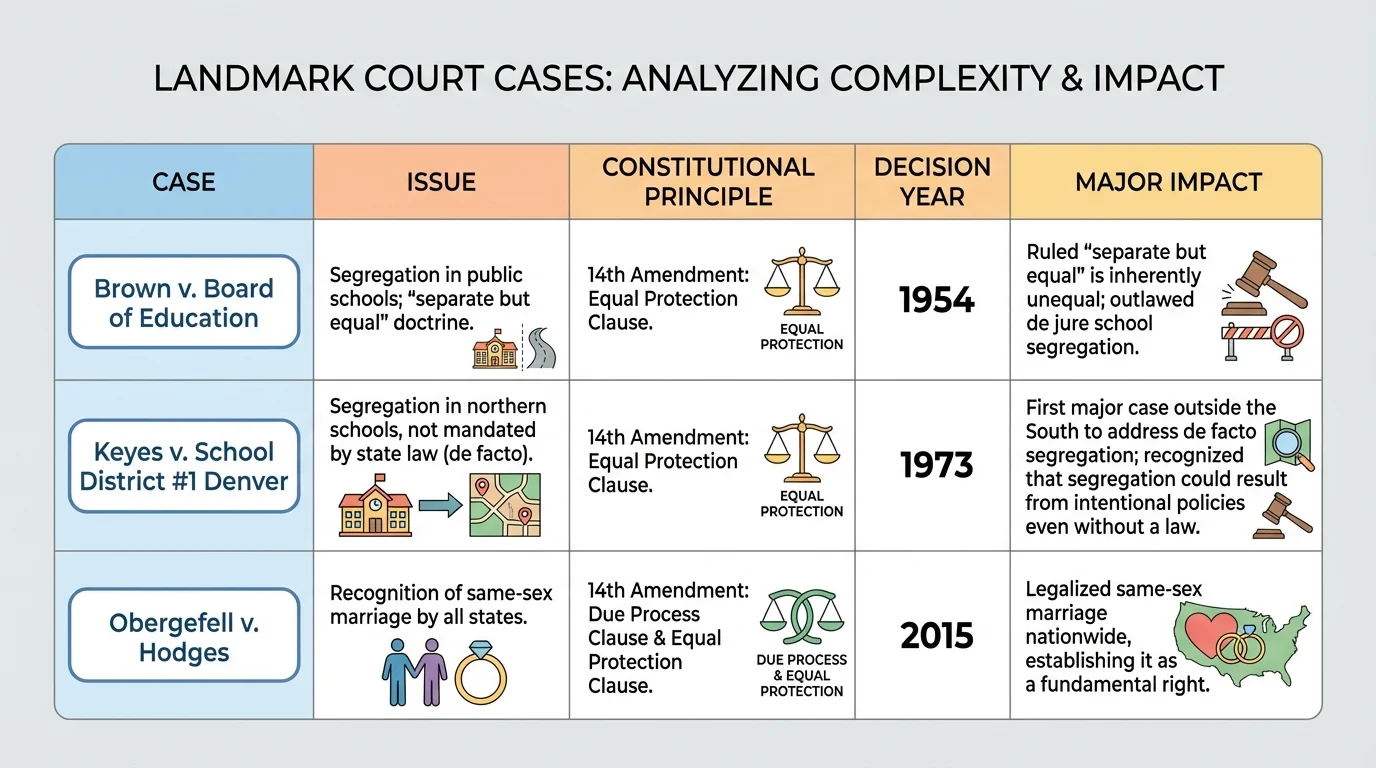
Obergefell v. Hodges, decided in 2015, held that same-sex couples have a constitutional right to marry. The ruling represented a major shift in legal recognition of LGBTQ relationships. Like Brown, it showed the Court using constitutional principles to expand rights. Like other major rulings, however, it did not end debate. Questions about religious liberty, public accommodation, and the boundaries of equality remained contested in politics and culture.
These court cases reveal continuity as well as change. Across decades, Americans repeatedly turned to the Constitution to challenge exclusion. But the kinds of exclusion changed, and so did public language around rights. Brown focused on race and education, Keyes on hidden or indirect segregation, and Obergefell on marriage and sexual orientation. The comparison in [Figure 3] helps show that equality is not one fixed idea. It is interpreted and reinterpreted as society changes.
| Case | Year | Main Issue | Historical Importance |
|---|---|---|---|
| Brown v. Board of Education | 1954 | School segregation | Declared segregated public schools unconstitutional |
| Keyes v. School District #1 Denver | 1973 | School segregation outside the South | Recognized intentional segregation without explicit segregation laws |
| Obergefell v. Hodges | 2015 | Same-sex marriage | Established a constitutional right to same-sex marriage nationwide |
Summary of the comparison: Major court cases show how the meaning of equality expanded and changed over time.
[Figure 4] This section traces how the United States moved from the shock of 9/11 to wars abroad and long-term changes in security policy at home.
The attacks of 9/11 transformed U.S. policy, military action, and public life with remarkable speed. On September 11, 2001, al-Qaeda terrorists hijacked airplanes and killed nearly 3,000 people in New York, Virginia, and Pennsylvania. The shock was immediate and national. Many Americans experienced a powerful sense of unity and grief. At the same time, fear drove demands for stronger security and retaliation.
The United States invaded Afghanistan in 2001 to overthrow the Taliban government that had sheltered al-Qaeda. In 2003, the United States invaded Iraq, arguing that Saddam Hussein possessed weapons of mass destruction and posed a threat. Those claims became deeply controversial when such weapons were not found. The Afghanistan and Iraq wars demonstrate how one event can produce consequences that extend far beyond its original cause. The wars affected military families, foreign civilians, federal spending, veterans' health, global alliances, and American political trust.
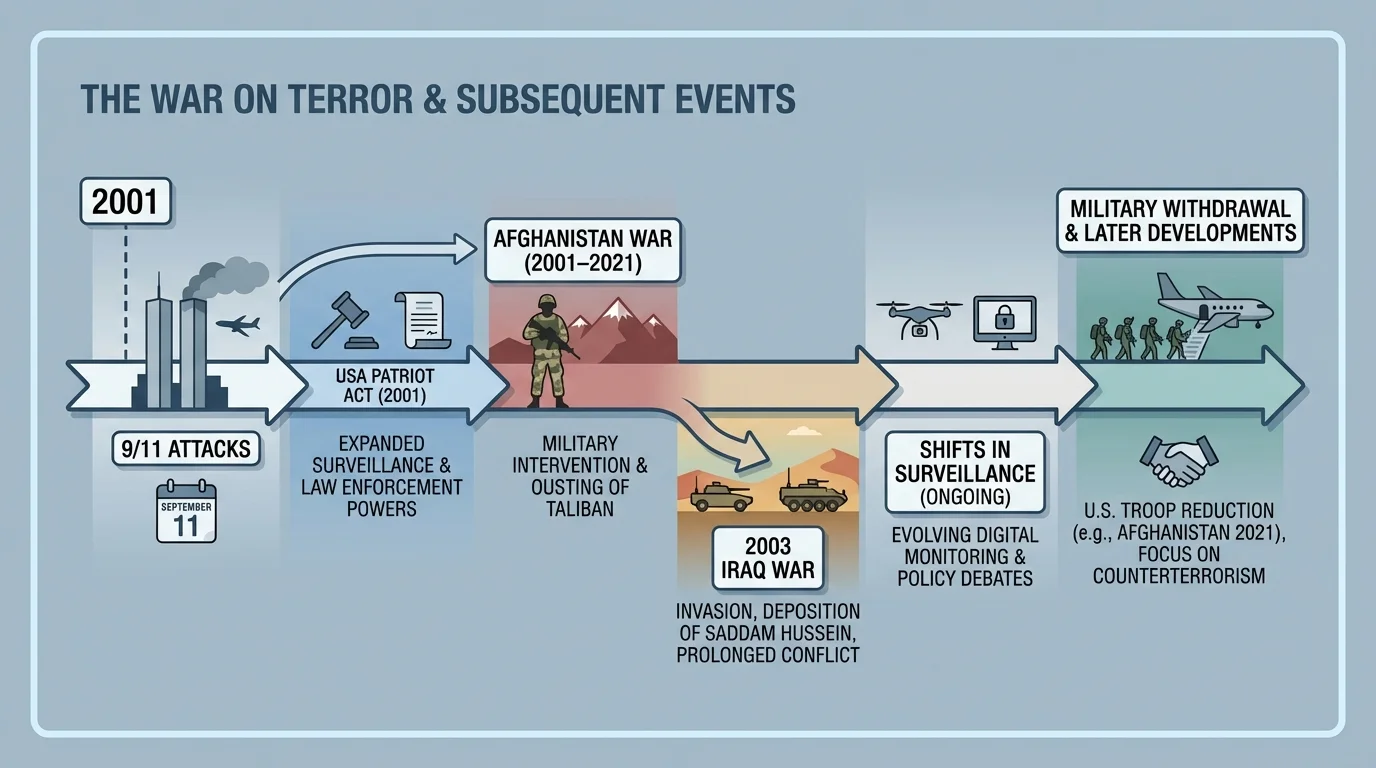
The domestic response included the USA PATRIOT Act, expanded surveillance, and reorganization of federal security agencies. Supporters argued these changes were necessary to prevent further attacks. Critics warned that civil liberties could be weakened when government power expands during emergencies. This tension between liberty and security is one of the oldest patterns in U.S. history, and it reappeared strongly after 9/11.
The war on terror also shaped everyday life through discrimination against many people perceived as Middle Eastern, Arab, Muslim, or South Asian. Some faced hate crimes, workplace discrimination, school bullying, airport profiling, and intrusive surveillance. Here again, unity and division existed at the same time. The nation came together in mourning, yet some communities paid a special price for the fear that followed.
Many Sikh Americans were targeted after 9/11 even though Sikhism is a different religion from Islam. This shows how prejudice often operates through appearance and stereotype rather than actual knowledge.
Over time, U.S. counterterrorism policy evolved. Early responses emphasized large military invasions and emergency legislation. Later approaches relied more on intelligence sharing, special operations, drones, cybersecurity, financial tracking, and international cooperation. Some policymakers argued this was more flexible and effective; others raised concerns about secrecy, civilian casualties, and weak public oversight. The long arc in [Figure 4] shows that the war on terror was not a single war with a clear endpoint but an evolving set of strategies and debates.
When we compare civil rights struggles, migration debates, court decisions, and the war on terror, several patterns stand out. First, the federal government plays a changing role. Sometimes it protects rights, as with the Voting Rights Act or Brown. Sometimes it restricts rights, as with Japanese American incarceration or expanded surveillance after 9/11. Government is not automatically a force for justice or injustice; its role depends on leaders, laws, courts, and public pressure.
Second, protest matters. Grassroots action helped produce many of the changes discussed here. The Double V Campaign used journalism and wartime rhetoric. Civil rights organizers risked violence to secure voting rights. LGBTQ activists turned police repression into a national movement after Stonewall. Native activists and tribal governments continue to challenge threats to sovereignty through protest, legal action, and negotiation. Change rarely arrives on its own.
Third, rights expand unevenly. A victory in one area does not guarantee progress in all others. Brown did not end school inequality. The Voting Rights Act did not end conflict over voting access. Obergefell did not end all debates about LGBTQ rights. The end of exclusionary quotas did not end disputes over immigration. Historical progress is real, but it is rarely smooth or permanent.
"The arc of the moral universe is long, but it bends toward justice."
— Martin Luther King Jr.
That quotation is powerful, but historians would add an important warning: the arc does not bend by itself. People organize, vote, protest, litigate, write, testify, and sometimes risk their lives to change the country. At the same time, resistance to change is also part of the story. That is why complexity matters. History is not a simple march forward. It is a struggle over who counts, who belongs, and whose rights are protected.
To understand these events fully, historians use both primary sources and secondary sources. Primary sources include speeches, court opinions, photographs, newspaper articles, letters, oral histories, protest posters, and government orders created at the time. Secondary sources are later interpretations written by historians and scholars. Reading both kinds of sources helps students avoid oversimplified conclusions.
For example, a student studying the Double V Campaign might read wartime newspaper editorials and compare them with later historical analyses. A student examining Japanese American incarceration might use photographs by Dorothea Lange, government records, and survivor testimony. A student researching Brown or Obergefell might read parts of the Court's majority opinion and also review historians' arguments about long-term effects. For the war on terror, news footage, presidential speeches, military reports, and civil liberties critiques all reveal different sides of the same history.
Good historical analysis asks hard questions: Who created this source? What perspective does it reflect? What does it leave out? How did people at the time understand the event, and how has interpretation changed since then? Those questions are essential because complexity is not a problem to eliminate. It is the reality historians must explain.
