How can one country produce both the promise of opportunity and the reality of exclusion at the same time? That tension runs through United States history since Reconstruction. The nation industrialized rapidly, experienced conflicts at home and wars abroad, endured booms and crashes, and saw powerful movements both for conformity and for protest. To investigate significant events in this period, historians do more than list dates. They ask what caused an event, who benefited, who suffered, what changed immediately, and what effects lasted for decades.
Historical events almost never have just one cause. A war might begin because of economic competition, political ambition, racism, fear, and a single triggering incident all at once. In the same way, one event can have many effects. Some are immediate, such as deaths, laws, or elections. Others unfold more slowly, such as migration patterns, changes in public memory, or shifts in national identity.
Historical causation is complex. Historians distinguish between long-term causes, such as industrialization or segregation, and short-term causes, such as a newspaper campaign, a court ruling, or a financial collapse. They also examine intended consequences and unintended consequences. A policy designed to create order may deepen inequality. A protest meant to challenge injustice may inspire broader democratic reform.
Another key idea is continuity and change. Some things transform dramatically, while others persist. For example, the places where Americans lived changed from farms to industrial cities and then to suburbs, but conflict over race, citizenship, labor, and land continued. Understanding this mixture of continuity and change helps explain why old problems can reappear in new forms.
Continuity means elements of life that remain over time. Change means developments that alter society, politics, the economy, or culture. Cause and effect refers to relationships between events, actions, and their consequences. Counterculture refers to a movement whose values challenge mainstream social norms.
When historians investigate the United States from Reconstruction to the present, they also pay attention to unity and diversity. Americans often claim national ideals such as freedom and equality, yet different groups have experienced those ideals very differently. That contrast is central to understanding the period.
[Figure 1] Putting events in sequence helps reveal patterns of change over time through a timeline linking war, migration, crisis, suburbanization, and protest. The late nineteenth and twentieth centuries were not separate stories. They were connected developments in which one event often set conditions for the next.
In the late 1800s, the United States completed continental expansion through military force and coercive policy against Indigenous nations. In 1898 the Spanish-American War marked a new phase of overseas expansion. In the early 1900s, industrial jobs and racial violence helped drive the Great Migration. In 1921, white mobs destroyed the Greenwood district of Tulsa, Oklahoma, in one of the deadliest episodes of racial violence in U.S. history. The Great Depression transformed politics and expectations of federal responsibility in the 1930s. After World War II, suburbanization expanded, symbolized by places like Levittown. In the 1950s through the 1970s, civil rights activism and counterculture movements challenged existing power structures. In 2008, the Great Recession again exposed deep inequalities and weaknesses in the economy.
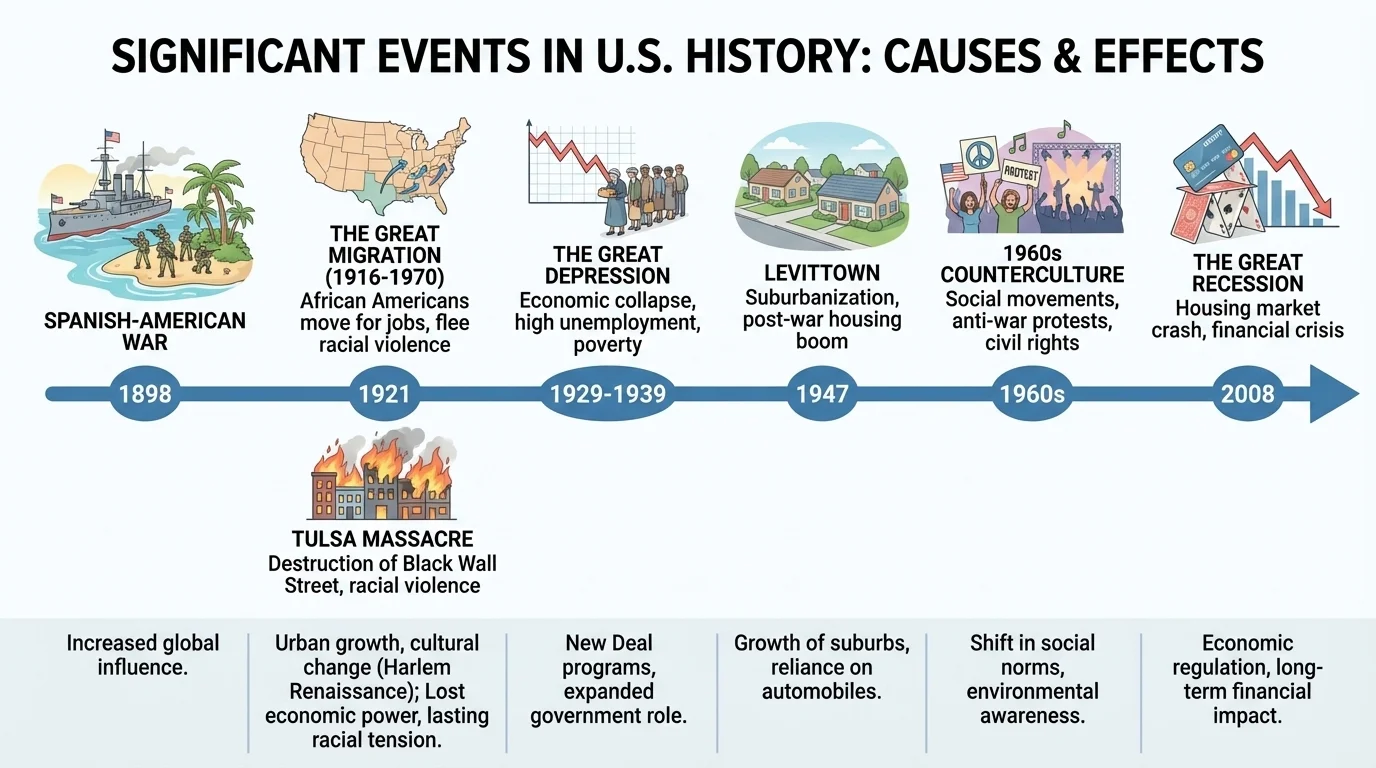
This timeline does not mean history moves in a straight line. Progress in one area can exist beside violence or exclusion in another. A period of economic growth may coincide with segregation. A war fought in the name of liberty may deny liberty to some people at home or abroad.
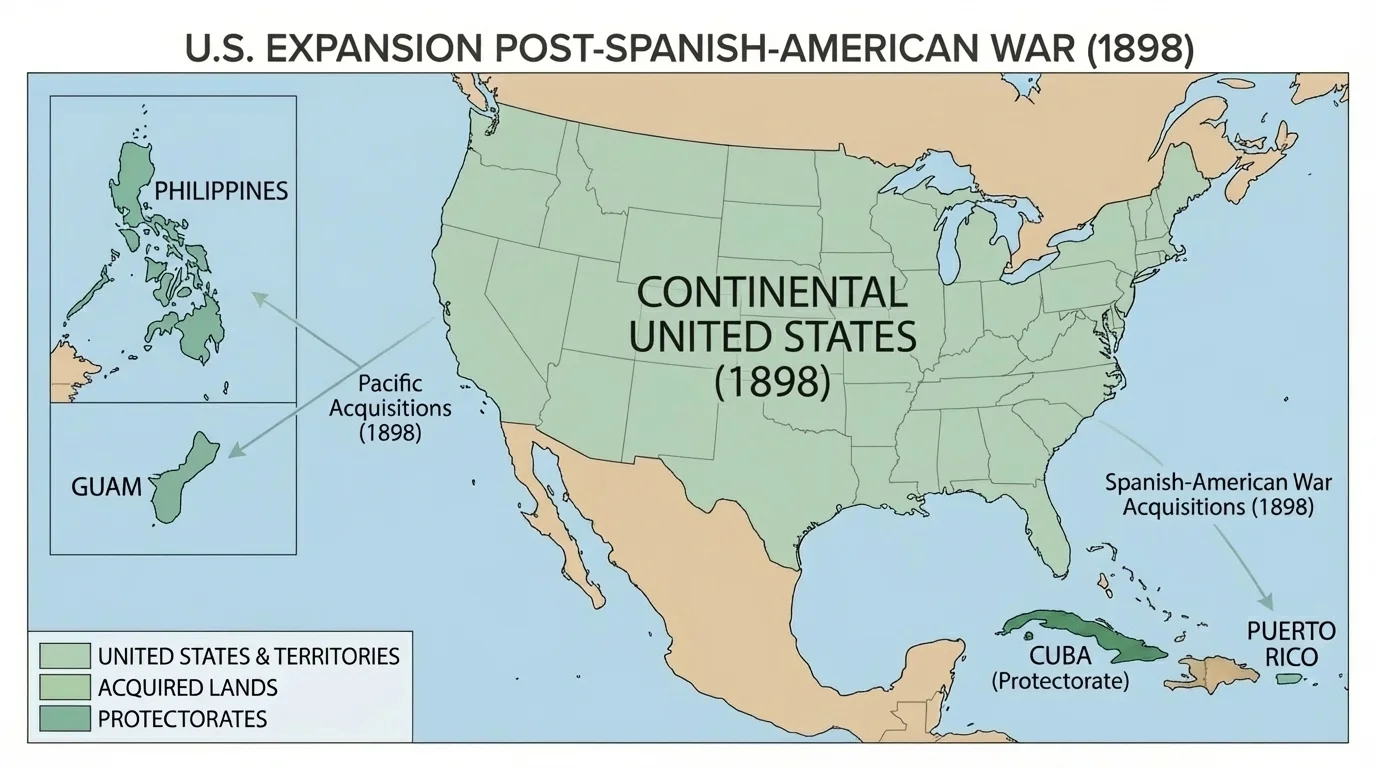
As [Figure 2] helps illustrate, the Spanish-American War of 1898 lasted only a few months, but its causes and effects were enormous. It grew out of several factors: U.S. sympathy for Cuban independence from Spain, American economic interests in the Caribbean, expansionist beliefs, sensationalist journalism, and the explosion of the battleship Maine in Havana Harbor. Although the exact cause of the explosion remained uncertain, many Americans blamed Spain. The war expanded U.S. power beyond the continent.
The effects of the war included U.S. control of Puerto Rico, Guam, and the Philippines, as well as strong influence over Cuba. For supporters, this marked the arrival of the United States as a world power. For critics such as Mark Twain and members of the Anti-Imperialist League, it betrayed American principles by denying self-government to others. In the Philippines, U.S. rule led to a brutal war against Filipino independence fighters. This shows that one event can be interpreted in sharply different ways depending on viewpoint.
Conflict within the United States also continued over Indigenous lands long after the Civil War. Federal policy aimed to seize land, weaken tribal sovereignty, and force assimilation. The Dawes Act of 1887 broke up communally held lands into individual allotments, with the so-called "surplus" sold to non-Indigenous settlers. Boarding schools attempted to erase Native languages and cultures. These policies were not accidents; they were deliberate efforts to reshape Indigenous societies to fit U.S. expansion.
The causes of this continued conflict included settler demand for land, railroad growth, mining, military policy, and racist beliefs about civilization. The effects included land loss, cultural destruction, family separation, and the weakening of tribal political power. At the same time, Indigenous communities resisted, adapted, preserved traditions, and fought for rights. That resilience is an essential part of the story. History is not only about what was done to people; it is also about how people responded.
The Tulsa Massacre of 1921 reveals how racial violence could destroy prosperity and shape memory. In the Greenwood district of Tulsa, often called Black Wall Street, Black entrepreneurs, professionals, and workers had built a thriving community despite segregation. After a false accusation against a Black teenager and rising tensions around a courthouse confrontation, white mobs attacked Greenwood. Homes, businesses, and churches were burned. Many residents were killed, though exact numbers remain debated.
The causes of the massacre included white supremacy, resentment of Black economic success, a climate of segregation, weak protection from authorities, and inflammatory rumors. The effects were devastating: lives lost, wealth erased, businesses destroyed, and trauma passed across generations. For decades, the event was silenced in textbooks and public memory. That silence itself had consequences. It shows how power can shape not only events but also what later generations remember or forget.
When historians return to these conflicts, they often compare them to broader national ideals. As we see again in [Figure 2], expansion and power often came with hard questions about democracy, race, and citizenship. The same nation that celebrated freedom also used force to control land and people.
"The past is never dead. It's not even past."
— William Faulkner
That idea fits these conflicts well. Their effects did not end when the fighting stopped. They shaped communities, institutions, and historical memory for generations.
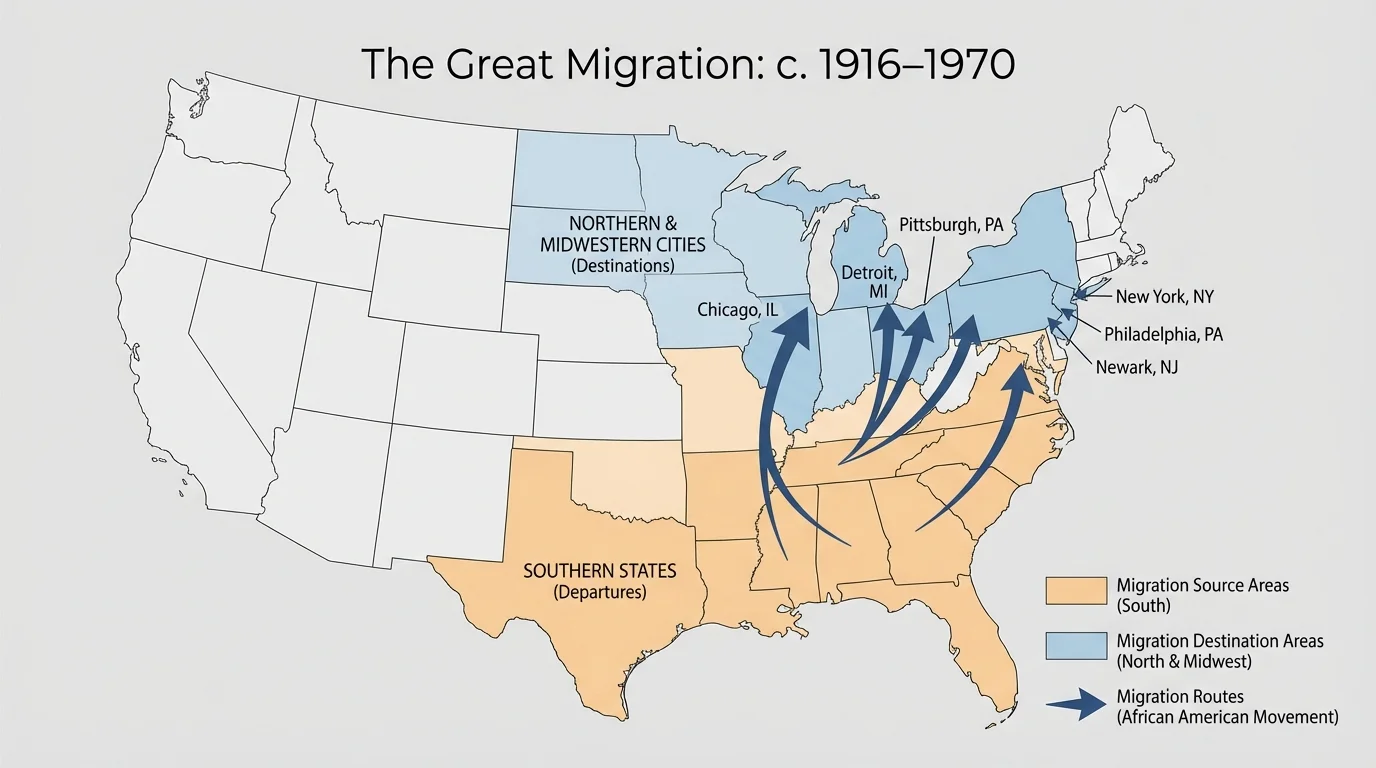
As [Figure 3] shows, the growth of cities transformed American life. Factories, railroads, and new industries pulled millions of people into urban areas. Immigrants from Europe and migrants from rural America sought jobs, but city life also brought overcrowding, pollution, dangerous working conditions, and political corruption. Urbanization created opportunity and hardship at the same time.
One of the most significant population movements in U.S. history was the Great Migration. Beginning in the early twentieth century and continuing in waves, millions of African Americans left the South. Push factors included Jim Crow segregation, racial terror, disenfranchisement, and limited economic opportunity. Pull factors included industrial jobs, especially during World War I and World War II, and the hope for greater freedom.
The effects of the Great Migration were major. Cities like Chicago, Detroit, New York, and Philadelphia changed demographically and culturally. Black newspapers expanded, labor activism grew, and artistic achievements flourished in places such as Harlem during the Harlem Renaissance. At the same time, migrants often faced housing discrimination, job discrimination, and race riots in Northern cities. Migration changed geography, politics, music, literature, and civil rights activism.
Urban growth in the twentieth century was later followed by another major pattern: suburbanization. After World War II, many white middle-class families moved from cities to suburbs. One famous example was Levittown, a mass-produced suburban community in New York. Developers used assembly-line methods to build homes quickly and cheaply. For many veterans and families, suburbia represented stability, privacy, and the American Dream.
But suburbanization was not simply a neutral lifestyle change. It was shaped by federal highway construction, mortgage policy, zoning, and racial exclusion. Many suburbs used discriminatory practices, including restrictive covenants and lending policies, to exclude Black families and other minorities. As a result, government-backed homeownership helped build wealth for some Americans while limiting access for others.
Case study: Levittown and unequal opportunity
Levittown helps explain why historians look beyond appearances. A row of nearly identical houses might seem to represent fairness, but access to those homes was not equal.
Step 1: Identify the visible change.
Large-scale suburban housing made homeownership possible for many families after World War II.
Step 2: Investigate the hidden causes.
Federal loans, road building, and favorable mortgage policies supported suburban growth.
Step 3: Examine unequal effects.
Because many Black Americans were excluded, suburban wealth accumulated unevenly across racial groups.
The result was both prosperity and inequality, built into the landscape itself.
Later debates over school funding, transportation, and neighborhood segregation grew partly from these patterns. As shown earlier in [Figure 3], where people move matters. Migration and settlement patterns can shape political power and economic opportunity for generations.
[Figure 4] Economic history is not just about numbers on a chart. It is about jobs, homes, food, savings, stress, and survival. The Great Depression and the Great Recession both show how downturns can begin in one part of the economy and spread widely through society.
The Great Depression began after the stock market crash of 1929, but the crash was not the only cause. Other causes included overproduction, weak consumer demand, bank failures, unequal wealth distribution, and problems in international trade. As banks collapsed and businesses failed, unemployment rose sharply. Families lost savings, farms were foreclosed, and many people became homeless.
The effects of the Great Depression were political as well as economic. President Franklin D. Roosevelt's New Deal expanded the role of the federal government. Programs created jobs, regulated banks, and established Social Security. Not all problems were solved, and benefits were often unequal across racial lines, but the crisis changed expectations about what government should do during an emergency.
The Great Recession of 2008 had different immediate causes. It grew from a housing bubble, risky lending practices, mortgage-backed securities, financial speculation, and weak regulation. When home prices fell and borrowers defaulted, the crisis spread through banks and global markets. Many people lost homes through foreclosure, retirement savings declined, and unemployment increased.
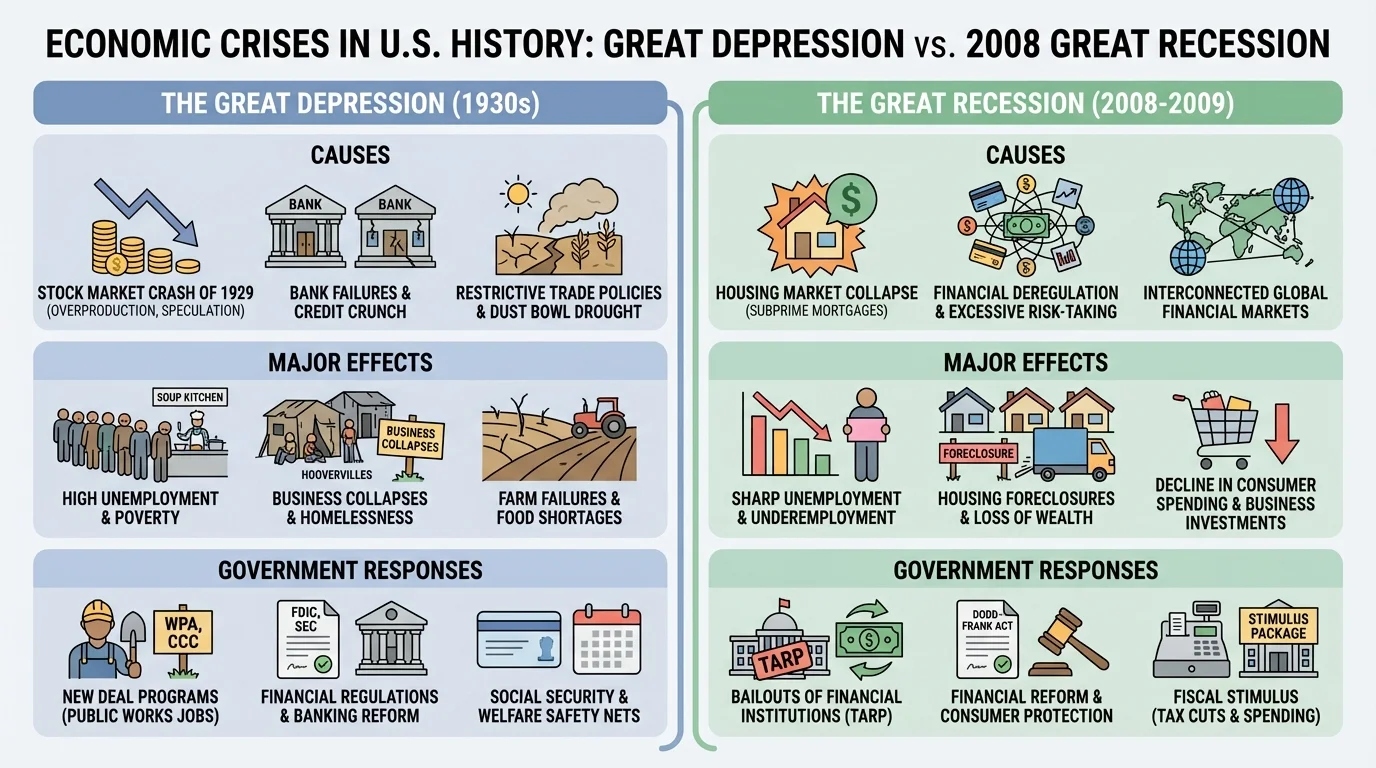
Comparing the two crises helps students see both continuity and change. In both cases, ordinary people suffered when financial systems failed. In both cases, government intervention became a major issue. Yet the sectors that triggered the crises differed, and the policy responses reflected different eras. The Depression produced long-lasting reforms in labor and social welfare, while the 2008 crisis sparked debate about debt, inequality, regulation, and recovery.
| Event | Major Causes | Immediate Effects | Long-Term Effects |
|---|---|---|---|
| Great Depression | Stock speculation, bank weakness, overproduction, unequal wealth, trade problems | Mass unemployment, bank failures, homelessness | New Deal reforms, expanded federal role, lasting political realignment |
| Great Recession | Housing bubble, risky mortgages, financial speculation, weak oversight | Foreclosures, job losses, credit crisis | Debates over inequality, regulation, household debt, and recovery policy |
Table 1. Comparison of major causes and effects of the Great Depression and the Great Recession.
Economic crises also reveal social inequality. Wealthier groups often have more protection through assets, insurance, or political influence. Poorer households are more vulnerable to layoffs, eviction, and debt. That pattern is one reason historians connect economic cycles to questions of class, race, and public policy.
The unemployment crisis of the Great Depression was so severe that many Americans sold apples on street corners, rode freight trains to seek work, or lived in makeshift communities nicknamed "Hoovervilles," named after President Herbert Hoover.
Looking back at the comparison, one major point becomes clear: economic systems are deeply connected to everyday life. A financial failure is never only financial.
Not all major historical events are wars or recessions. Ideas, music, media, protest, and daily behavior can reshape a society. Counterculture movements challenge dominant values, often exposing tensions that mainstream culture tries to ignore.
In the twentieth century, popular culture expanded through radio, movies, television, advertising, and later the internet. These forces helped create shared national experiences. A hit song, a televised speech, or a sports event could unite millions of people. Yet mass culture could also reinforce stereotypes and pressure people to conform.
Counterculture emerged in many forms. The civil rights movement challenged segregation and racist violence. The youth counterculture of the 1960s questioned consumerism, war, and traditional social rules. Feminist activists pushed for legal and workplace equality. LGBTQ+ activists demanded recognition and rights. Antiwar protesters challenged U.S. policy in Vietnam. Native American activists such as those in the American Indian Movement protested broken treaties and demanded sovereignty and justice.
The causes of these movements varied, but many grew from exclusion, censorship, inequality, militarism, or frustration with official promises. Their effects included legal reforms, changes in public attitudes, new forms of art and expression, and lasting political backlash. Counterculture does not always become mainstream, but it often forces society to confront contradictions.
Case study: popular culture versus protest culture in the 1960s
The 1960s are often remembered for music and style, but historians study deeper causes and effects.
Step 1: Identify the mainstream setting.
Postwar prosperity, television, advertising, and suburban life promoted conformity and consumption.
Step 2: Identify the challenge.
Young people, civil rights organizers, antiwar activists, and artists criticized racism, war, and social restrictions.
Step 3: Trace the effects.
These challenges influenced music, fashion, education, voting rights, and public debate, while also provoking resistance from those who saw protest as a threat to order.
Culture became a battleground over the meaning of freedom.
This pattern continues into the present. Debates over speech, protest, identity, and national symbols show that culture is not separate from politics. It is one of the places where political conflict becomes visible.
When we compare these events, several recurring patterns emerge. First, power matters. Governments, businesses, media outlets, and social majorities all shape events and public memory. Second, inequality matters. Race, class, gender, and citizenship repeatedly influence who gains opportunity and who faces exclusion. Third, resistance matters. People respond to oppression through migration, protest, institution-building, legal action, art, and memory work.
There is also clear change over time. The United States became more urban, then more suburban, and eventually more interconnected through digital networks. The federal government took on larger roles in economic regulation and civil rights protection than it had in the late nineteenth century. Social movements expanded the meaning of citizenship and rights, even when progress was incomplete.
At the same time, there is continuity. Land conflict, racial violence, economic instability, and arguments over who belongs in the nation all persist in different forms. This is why history should not be viewed as a simple march from bad to good. It is more accurate to see it as a struggle over competing visions of the country.
To study these events carefully, historians use both primary sources and secondary sources. A primary source comes from the time being studied, such as a newspaper article, speech, diary, government report, photograph, map, or oral testimony. A secondary source is created later by someone interpreting the evidence, such as a textbook, scholarly article, or documentary.
For example, a historian studying the Tulsa Massacre might examine newspaper accounts, survivor testimonies, insurance records, photographs, and city documents. A historian studying the Great Migration might use census records, letters, train routes, labor reports, and Black newspaper editorials. Different sources often tell different parts of the story, and some voices are harder to find because they were ignored or suppressed at the time.
Good historical analysis asks not only what happened but also who created the source, why it was created, what perspective it reflects, and what may be missing.
That is why historical interpretation can change. New evidence can emerge, and historians can ask new questions. For many years, textbooks gave little attention to Native resistance, racial massacres, housing discrimination, or LGBTQ+ activism. As scholarship expanded, the national story became more inclusive and more accurate.
Investigating causes and effects is therefore not just an academic skill. It helps students understand current debates about war, inequality, public memory, protest, housing, and economic policy. The past is not a distant collection of facts. It is a record of choices, conflicts, and consequences that still shape American life.
