The United States has often understood itself in terms of two powerful ideas at once: one nation and many peoples. That tension is not a side note in American history; it is one of the main stories. Since the end of the Civil War, Americans have argued over who belongs, who has power, what equality means, and what kind of loyalty the nation should expect from its people. From the promise of freedom after slavery to modern debates about immigration, policing, religion, and voting rights, the country's history shows that unity is never automatic. It is built, challenged, broken, and rebuilt.
In history, unity means the forces that hold a society together: shared laws, common ideals, national identity, and political institutions. Diversity means the variety of peoples, beliefs, cultures, languages, and experiences within that society. A nation can be diverse and still unified, but only if its institutions treat people fairly enough that they believe they have a stake in the whole.
In the United States, the central problem has often been that national ideals and social realities did not match. The Declaration of Independence speaks of equality, yet slavery existed. The Constitution created democratic government, yet voting and citizenship were limited for much of the population. After Reconstruction, legal freedom existed for formerly enslaved people, but full equality did not. Studying unity and diversity means asking not only what Americans believed, but also who was included in those beliefs and who was pushed out.
Systemic racism refers to patterns of discrimination built into institutions such as schools, courts, housing, employment, and government policy. Nativism is hostility toward immigrants or people seen as foreign, often based on the idea that some groups are more "truly American" than others. Patriotism is love of and commitment to one's country, but Americans have long debated whether patriotism means obedience, criticism, service, protest, or some combination of these.
These ideas matter because exclusion is rarely just a matter of individual prejudice. Laws, court decisions, policing practices, and economic systems can shape opportunity for millions of people at once. That is why historians look for both individual actions and broader structures.
After the Civil War, the nation faced an enormous question: what would freedom actually mean? The turning points of this period and the decades that followed, summarized in [Figure 1], reveal that freedom was not secured in a single moment but repeatedly contested. The abolition of slavery and the adoption of the Reconstruction Amendments transformed the Constitution. The 13th Amendment ended slavery, the 14th Amendment defined birthright citizenship and equal protection of the laws, and the 15th Amendment prohibited denying the vote on the basis of race.
For a brief period, these changes produced major advances. Black men voted, held office, helped write new state constitutions, and built schools, churches, and civic organizations. The federal government used military power and enforcement laws to suppress groups like the Ku Klux Klan. This was one of the most significant expansions of democracy in U.S. history.
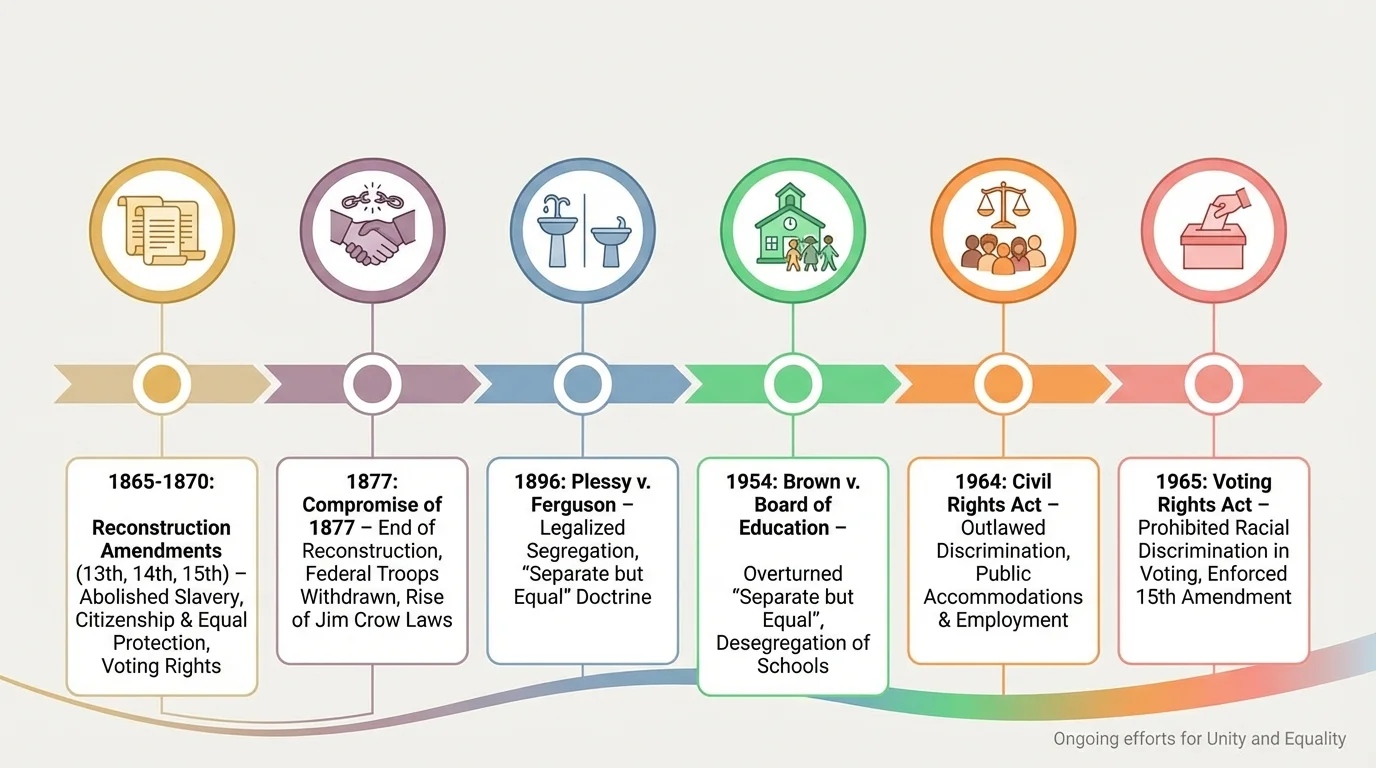
Reconstruction also demonstrates how progress can be reversed. Many white Southerners resisted Black political power through violence, intimidation, and local laws. The sharecropping system trapped many freedpeople in debt. In 1877, federal troops were withdrawn from the South, marking the effective end of Reconstruction. Without strong federal protection, white supremacist state governments regained control.
The effects were long-lasting. The amendments remained in the Constitution, but their promises were weakened in practice. This is an important example of continuity and change: the law changed dramatically after the Civil War, yet older racial hierarchies continued in new forms. Later civil rights movements returned again and again to the same constitutional principles first strengthened during Reconstruction, as the sequence in [Figure 1] makes clear.
"The slave went free; stood a brief moment in the sun; then moved back again toward slavery."
— W. E. B. Du Bois, describing the aftermath of Reconstruction
Du Bois's observation captures the tragedy of the era. Legal emancipation was real, but power, land, safety, and political protection remained deeply unequal.
By the late nineteenth century, exclusion took more organized forms. The legal and geographic dimensions of racial separation shaped where people could live, work, vote, and travel. In the South, states built the Jim Crow system, a network of laws and customs enforcing racial segregation in schools, transportation, housing, public spaces, and voting. Poll taxes, literacy tests, and grandfather clauses stripped many Black citizens of political power.
The Supreme Court helped legitimize this order in Plessy v. Ferguson in 1896, which approved the doctrine of "separate but equal." In reality, Black schools and services were almost never equal. Segregation was upheld by law but also by violence, including lynching. Ida B. Wells exposed this violence in journalism that remains a crucial primary source for understanding the period.
At the same time, nativism targeted immigrants. The Chinese Exclusion Act of 1882 sharply restricted Chinese immigration. In the early twentieth century, fears that immigrants from southern and eastern Europe were politically radical, racially inferior, or religiously suspect led to quota laws in the 1920s. These laws favored immigrants from northern and western Europe and reflected the belief that American identity should remain narrow and culturally uniform, a pattern connected to the regional movements shown in [Figure 2].
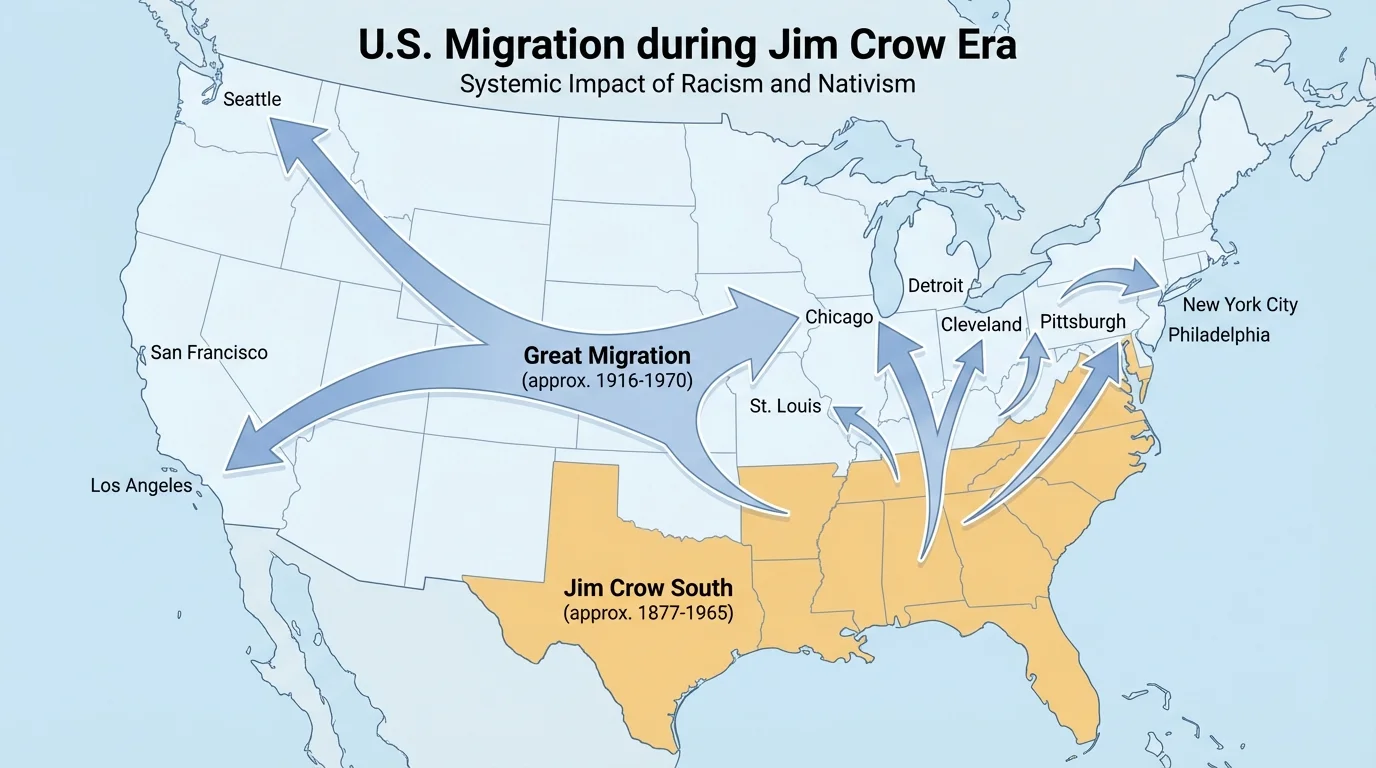
Nativism and racism often worked together. Both drew boundaries around belonging. Both claimed to protect the nation while limiting who could fully participate in it. And both influenced where people moved. During the Great Migration, millions of African Americans left the South for northern and western cities, seeking jobs and safety. Yet they often encountered segregation there too, especially through housing discrimination, restrictive covenants, and unequal schools.
This period reveals complexity. The North was not simply free of racism; it often expressed racism differently. Immigration brought cultural diversity and economic growth, but many Americans responded with fear instead of inclusion. The map in [Figure 2] makes it easier to see that unity and diversity were shaped by movement across regions as well as by law.
| Issue | How exclusion worked | Who was affected | Long-term impact |
|---|---|---|---|
| Jim Crow segregation | State laws, local customs, violence | African Americans, especially in the South | Political disenfranchisement and unequal education, housing, and justice |
| Immigration restriction | Federal laws and quotas | Chinese immigrants, later many southern and eastern Europeans, and others | Narrowed ideas of who counted as American |
| Housing discrimination | Redlining, restrictive covenants, lending bias | Black families and some immigrant groups | Wealth gaps and segregated neighborhoods |
Table 1. Major systems of exclusion and their effects on unity, diversity, and opportunity.
Many people assume patriotism always means agreement, but U.S. history suggests something more complicated. Some Americans define patriotism as military service, loyalty to symbols, and support for government policy. Others define it as defending constitutional ideals, even by criticizing the government when it violates them. Both views have existed side by side.
During World War I and World War II, patriotism became especially charged. German Americans faced suspicion during World War I. The Espionage Act and Sedition Act punished some antiwar speech. During World War II, Japanese Americans were forced into internment camps after Executive Order 9066, even though most had committed no crime. This was a major violation of civil liberties, driven by racism, wartime fear, and weak constitutional protection.
At the same time, military service became a way marginalized groups claimed belonging. African Americans served in segregated units and promoted the Double V campaign: victory against fascism abroad and victory against racism at home. Mexican American, Native American, and Asian American service members also challenged stereotypes through military service. Here again, patriotism could unite people, but it could also expose inequality. A country asking people to fight for democracy abroad was forced to confront undemocratic practices at home.
The Navajo Code Talkers used the Navajo language to transmit military messages during World War II. Their work demonstrates how cultural diversity, often treated as a problem in peacetime, became an important national strength in war.
Sports, popular culture, and public protest also shaped patriotic debates. When athletes salute the flag, stand silently, or kneel during the national anthem, people often disagree about what counts as respect. That argument has deep historical roots. Protest has often been one way Americans tried to make the nation live up to its stated ideals.
The mid-twentieth century marked a decisive challenge to legalized inequality. The modern civil rights movement combined court cases, direct action, journalism, local organizing, and national protest. In Brown v. Board of Education in 1954, the Supreme Court ruled that segregated public schools were inherently unequal. The Montgomery Bus Boycott, sit-ins, Freedom Rides, the Birmingham campaign, and the March on Washington increased pressure for federal action.
This movement led to major changes: the Civil Rights Act of 1964 banned discrimination in public accommodations and employment; the Voting Rights Act of 1965 targeted barriers to voting; and the Fair Housing Act of 1968 addressed discrimination in housing. These laws did not erase racism, but they significantly expanded rights and federal enforcement.
Religious pluralism played an important role in this transformation. Black churches were organizational centers for activism. Ministers such as Martin Luther King Jr. drew on Christian ideas of justice and human dignity. Jewish leaders, Catholic activists, and people from other faith traditions joined the struggle in many places. Religion here acted as a force for reform and solidarity across differences.
Expansion of rights is rarely linear. Rights can expand in one area while remaining limited in another. A law may grant equality on paper, but institutions may resist change in practice. That is why historians distinguish between formal rights, such as constitutional guarantees, and lived rights, meaning whether people can actually exercise those freedoms in everyday life.
The expansion of rights did not stop with race. Women's rights activists pushed for workplace equality, reproductive freedom, and legal protection against discrimination. The American Indian Movement challenged federal policies and demanded sovereignty and treaty rights. People with disabilities won major changes through activism that helped produce the Americans with Disabilities Act. LGBTQ+ activists fought police harassment, discrimination, and exclusion from marriage and military service. Each movement asked a version of the same question: if American ideals apply to everyone, what must change to make that true?
Yet every expansion also met resistance. That resistance came from political opposition, court rulings, cultural backlash, and disagreements over federal power. The history of rights is therefore both inspiring and contested.
One of the clearest examples of disagreement over equality is affirmative action. After centuries of discrimination, many policymakers argued that simply banning unequal treatment was not enough. Schools, employers, and governments sometimes adopted policies meant to increase opportunity for groups that had faced long-term exclusion, especially African Americans but also women and other minorities in some contexts.
Supporters of affirmative action argue that it addresses the lasting effects of historical injustice and unequal access to education, housing, and networks of opportunity. Critics argue that it can be unfair to individuals who are not responsible for past discrimination, and they often say institutions should be "color-blind" in admissions or hiring.
Important Supreme Court cases reveal this tension. Some decisions permitted limited consideration of race to create diverse educational environments, while others sharply restricted or ended certain practices. The debate shows that Americans do not all mean the same thing when they talk about equality. For some, equality means treating everyone identically in the present. For others, equality requires addressing unequal starting conditions created by the past.
Case study: Two meanings of fairness
A school district wants to increase college readiness for students across the district.
Step 1: One approach is formal equality.
The district gives every school the same amount of resources and the same rules.
Step 2: Another approach is remedial equity.
The district gives more support to schools that have been underfunded for decades because equal treatment now may not overcome unequal conditions from the past.
Step 3: Historians and policymakers debate which approach better fits democratic ideals.
This debate is similar to the national argument over affirmative action.
The disagreement is not only about policy. It is also about how Americans interpret justice, history, and responsibility.
That makes affirmative action a powerful example of cause and effect. Past discrimination causes unequal outcomes in the present, but people disagree about what effects government or institutions should try to correct.
To understand modern inequality, historians also examine how institutions interact. The chain of policies and consequences, outlined in [Figure 3], helps explain why many scholars describe mass incarceration as a systemic issue rather than only a matter of individual crime. Beginning in the late twentieth century, the prison population in the United States grew dramatically. Tough-on-crime politics, the War on Drugs, mandatory minimum sentences, and policing strategies in heavily surveilled neighborhoods all contributed to this increase.
Although crime policy affected many communities, its impact was not equal. Black Americans were disproportionately arrested, sentenced, and imprisoned in many places. Scholars point to racial profiling, sentencing disparities, unequal legal resources, neighborhood disinvestment, and historical segregation as part of the explanation. A person leaving prison may also face barriers to employment, housing, education, and voting, making inequality more likely to continue across generations.
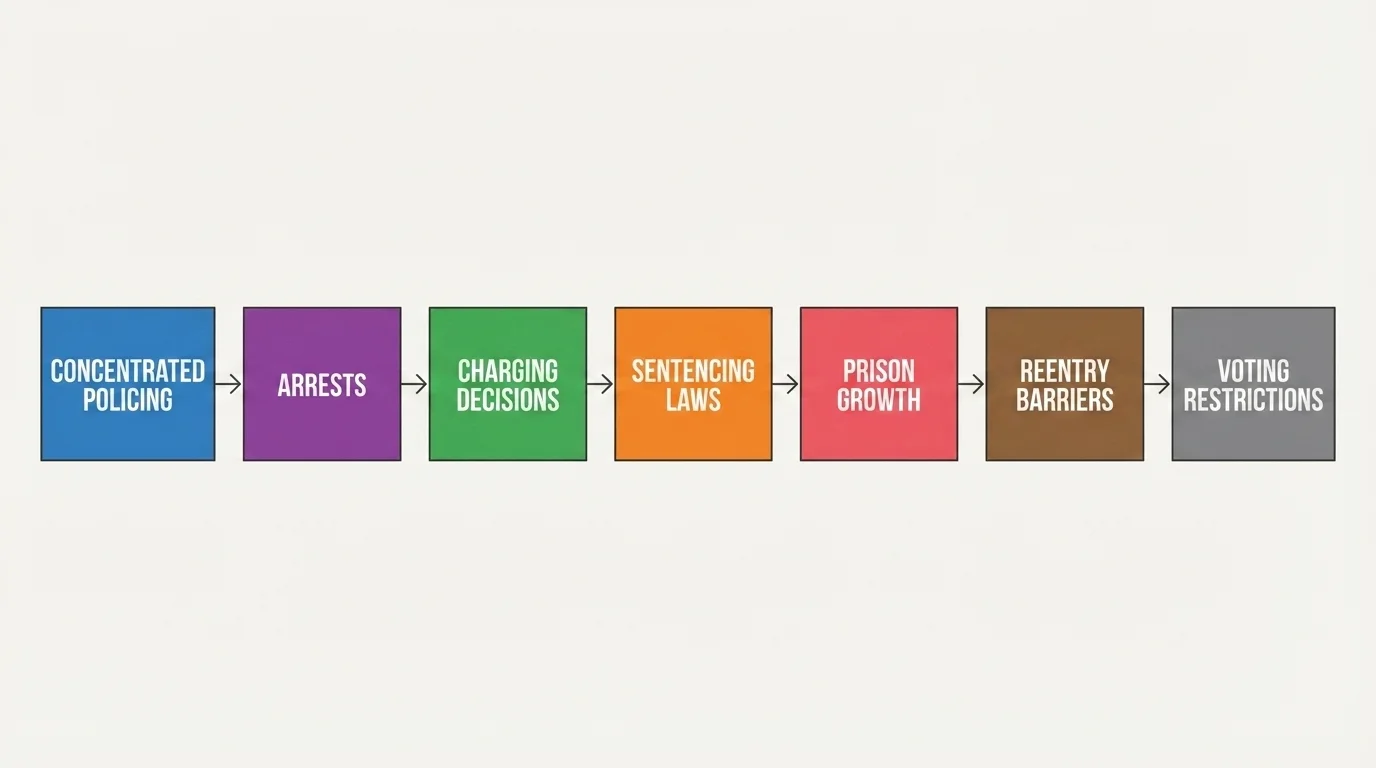
This is what makes the issue systemic. It involves the interaction of schools, housing patterns, labor markets, courts, and public policy. The flowchart in [Figure 3] highlights how one disadvantage can feed another. For example, segregated housing can shape school funding and job access; those conditions can influence policing patterns; criminal records can then worsen economic instability.
Writers such as Michelle Alexander have argued that mass incarceration functions as a modern system of racial control in some ways, while other historians urge careful attention to differences between eras. That debate matters. History requires comparison, but it also requires precision. Jim Crow and mass incarceration are not identical systems, yet both raise hard questions about citizenship, punishment, and equality before the law.
When historians say two eras are connected, they do not necessarily mean they are the same. They are tracing patterns of continuity and change: what persists, what shifts, and what takes a new form.
Recent reform efforts include challenges to cash bail, sentencing reform, body camera policies, community-based alternatives, voting rights restoration for formerly incarcerated people, and broader discussions about public safety. These efforts show that institutions can change, but change depends on public pressure, law, and political will.
Religion has been one of the most powerful forces in debates about unity and diversity. It can unite people through shared moral language, charity, and activism. It can also divide when some groups try to define the nation in exclusively religious terms. In U.S. history, religion has inspired abolitionism, civil rights activism, refugee support, and anti-poverty movements. It has also been used to defend segregation, oppose certain immigrant groups, or resist rights expansions for women and LGBTQ+ people.
The United States protects both the free exercise of religion and limits on government establishment of religion. That creates a persistent balance: individuals and groups may express faith publicly, but the government is not supposed to impose one religion on everyone. Conflicts arise over school prayer, public religious displays, business exemptions, reproductive rights, and same-sex marriage.
Religious diversity has also grown over time. Protestant dominance declined as Catholic, Jewish, Muslim, Hindu, Buddhist, Sikh, and nonreligious communities became more visible in public life. This has broadened the meaning of American identity. At the same time, some movements have argued that the United States is fundamentally a Christian nation, which raises questions about whose history and beliefs count as central.
The First Amendment protects both religious freedom and freedom from government-established religion. Those two ideas work together: the state cannot force belief, and citizens can practice a wide range of beliefs.
Religion therefore belongs in any serious study of unity and diversity. It is not only a private matter. It has shaped voting, reform movements, court cases, education, and ideas of national purpose.
In recent decades, the United States has become more visibly diverse in ethnicity, religion, language, and family background. Immigration from Latin America, Asia, Africa, and the Middle East has reshaped communities and schools. Interracial marriage has increased. Public discussions of gender identity, disability, and Indigenous sovereignty have become more prominent. These changes expand the country's diversity, but they also provoke backlash.
Modern debates over border policy, refugee admissions, voting access, police reform, school curriculum, and public monuments show that old questions remain unsettled. Who gets to define the nation? Is unity based on shared ancestry, shared ideals, shared laws, or something else? Can a democracy be strong when citizens deeply disagree about history itself?
Social movements such as Black Lives Matter, immigrant rights activism, anti-hate campaigns, and interfaith organizing show that many Americans continue to work for a broader, more inclusive version of unity. Critics of those movements sometimes argue that they divide the country; supporters argue that naming injustice is necessary to build a more honest union. This disagreement echoes earlier debates over abolition, women's suffrage, labor rights, and civil rights.
To evaluate issues of unity and diversity well, historians ask several kinds of questions. What changed? Slavery ended, legal segregation was challenged, and rights expanded to more groups. What continued? Racial inequality, exclusionary ideas about belonging, and unequal access to power persisted in different forms. What caused these patterns? Economic interests, political decisions, court rulings, social movements, war, migration, and cultural beliefs all played roles. Why is the story complex? Because the same institution or idea can promote unity in one moment and exclusion in another.
Patriotism is a good example of that complexity. It has inspired military service, community sacrifice, and civic pride. It has also been used to silence dissent or label certain groups as un-American. Religion is another example. It has supported justice movements and exclusionary movements. Rights expansion has brought real change, yet access to those rights has often remained unequal.
Primary sources help historians evaluate these issues directly. Constitutional amendments, Supreme Court decisions, speeches, protest signs, church sermons, wartime posters, photographs, census data, and oral histories all reveal how Americans understood belonging and difference. Secondary sources help place these materials in broader context and show historians' debates about interpretation.
The long arc from Reconstruction to the present does not tell a simple story of steady progress or constant failure. It shows a nation struggling to define itself. Unity has often depended on whether diversity is treated as a threat to control or as a reality that democracy must include. That struggle is not finished, and that is exactly why the history matters.
