The United States has often called itself a united nation at the very moments when people most fiercely disagreed about who counted, who belonged, and who deserved equal rights. That is one of the great paradoxes of American history: conflict has sometimes threatened national unity, but it has also pushed the country to redefine freedom in broader and more inclusive ways. From the end of the Civil War to the present, debates over race, gender, immigration, religion, sexuality, disability, and citizenship have not been side issues. They have been central to the story of the nation itself, not peripheral.
National unity does not mean that everyone thinks alike. In a democratic society, unity is often built through argument, protest, negotiation, and reform. At times, opposing perspectives have led to violence, exclusion, and injustice. At other times, compromise and cooperation have expanded democracy. The history of the United States since Reconstruction shows both patterns: the persistence of inequality and the repeated efforts of individuals, communities, organizations, and governments to move the country closer to its ideals.
One useful way to study this history is using the themes of continuity and change, cause and effect, complexity, and unity and diversity arguments over voting rights, fair treatment under the law, and access to education appear again and again. Yet the groups involved, the laws passed, and the strategies used have changed significantly.
Another key idea is that diversity is not the opposite of unity. The United States has always been made up of people with different languages, religions, traditions, identities, and experiences. The question has never been whether diversity exists. The real question has been whether the nation will treat diversity as a weakness to suppress or as a strength to protect.
National unity is the sense that people in a country share political membership and common civic principles, even when they have major differences.
Diversity refers to the presence of many different identities, cultures, backgrounds, and experiences within a society.
Compromise is an agreement in which different sides each give up something to reach a solution.
Cooperation is people or groups working together toward a shared goal, even if they do not agree on every issue.
These ideas matter because rights in the United States have rarely expanded automatically. Most changes have come when people challenged existing power and convinced others that the nation should live up to its promises more fully.
As [Figure 1] shows, after the Civil War, the United States faced a defining question: would freedom for formerly enslaved people lead to full equality, or would old systems of power return in new forms? The nation adopted the 13th Amendment, ending slavery; the 14th Amendment, establishing equal protection under the law; and the 15th Amendment, protecting voting rights for men regardless of race.
During Reconstruction, African Americans voted, held public office, founded schools and churches, reunited families, and built institutions of community life. This was a major expansion of American democracy. But white supremacist groups, discriminatory state laws, and uneven federal enforcement weakened these gains. By the late nineteenth century, Southern states had created Jim Crow systems that enforced segregation and denied many Black citizens the right to vote through poll taxes, literacy tests, intimidation, and violence.
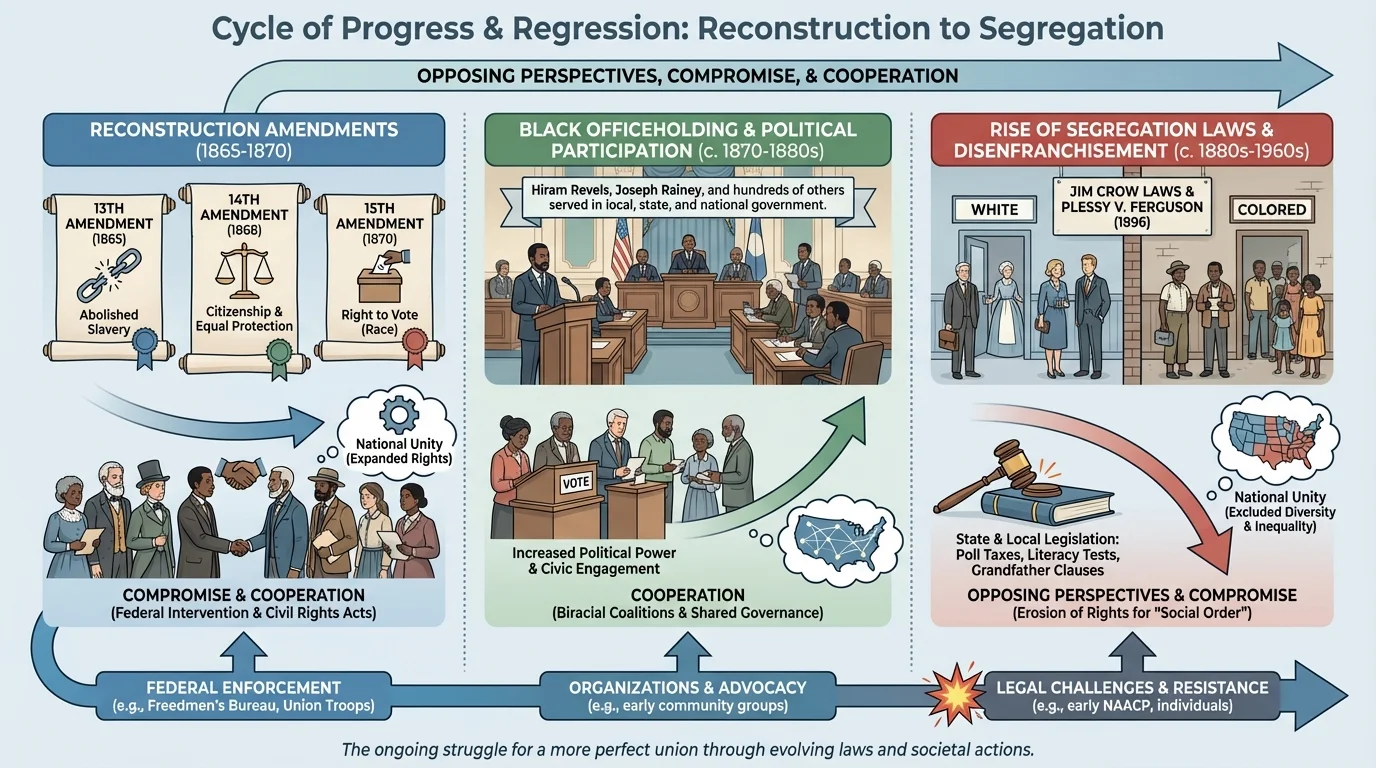
The post-Reconstruction period reveals a pattern that repeats in later history: progress can be real without being complete. Constitutional amendments changed the law, but laws alone did not eliminate racism. Federal action mattered, but local resistance mattered too. National unity remained fragile because the country had not resolved whether equality would be defended only in principle or also in practice.
This period also affected other groups. Indigenous Peoples continued to face military conquest, land seizure, and policies designed to destroy tribal cultures. Immigrants from Asia encountered growing exclusion. Women still lacked the right to vote nationally. In other words, the nation expanded freedom in one major way while still limiting it in many others.
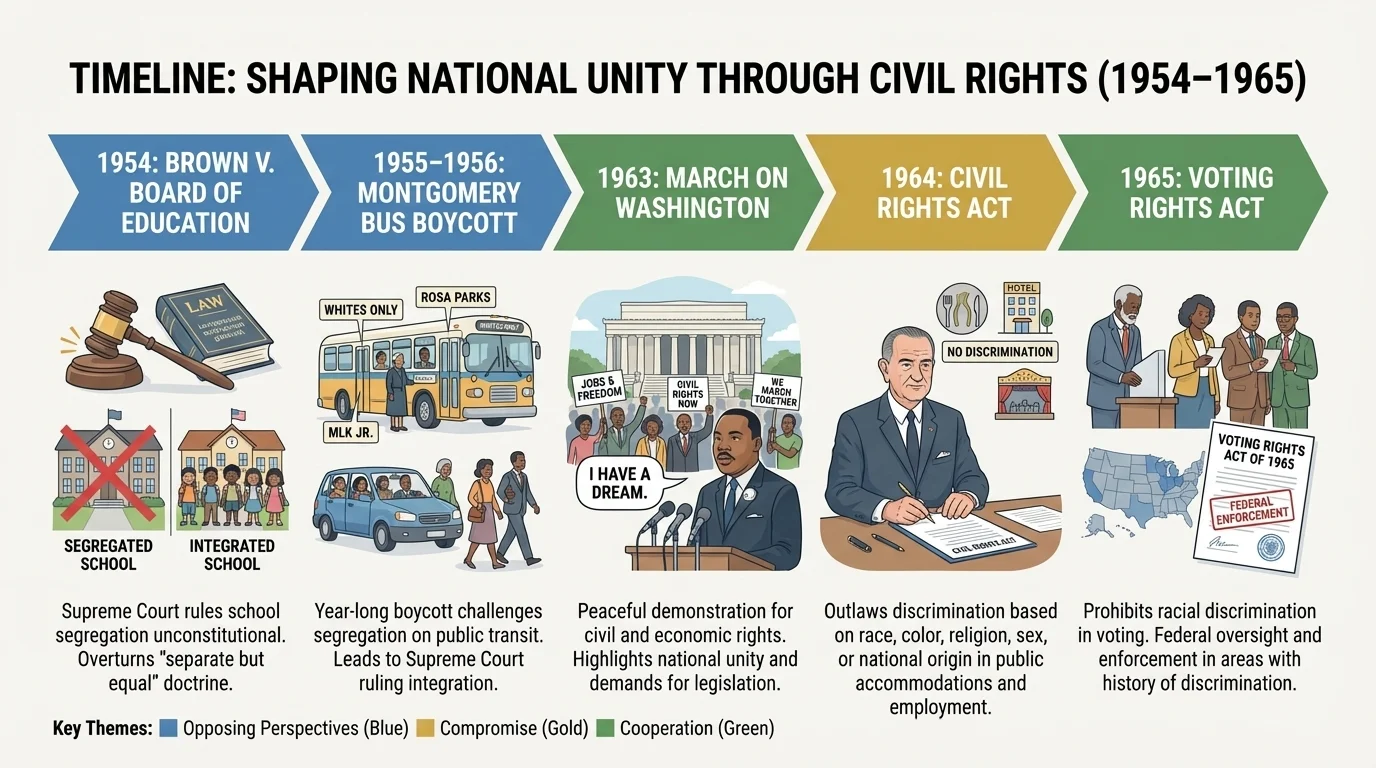
As [Figure 2] illustrates, in the twentieth century, African American activism became one of the most important forces reshaping the meaning of citizenship. Legal challenges, mass protest, local organizing, journalism, student activism, and religious leadership all worked together to confront segregation and disenfranchisement. This struggle did not begin in the 1950s; it grew out of decades of organizing by teachers, lawyers, veterans, clergy, and ordinary citizens.
The NAACP, founded in 1909, played a crucial role by challenging discrimination in the courts and in public opinion. Its lawyers helped win Brown v. Board of Education in 1954, in which the Supreme Court ruled that racial segregation in public schools was unconstitutional. This decision did not instantly desegregate schools, but it provided a powerful legal tool for change.
Mass movements then pushed the issue further. The Montgomery Bus Boycott, led in part by Rosa Parks and Martin Luther King Jr., showed the power of sustained nonviolent protest. Student sit-ins challenged segregated lunch counters. Freedom Riders confronted segregation in interstate travel. The March on Washington brought together labor leaders, clergy, students, and civil rights organizations. Cooperation among local activists and national organizations helped pressure the federal government to act.
These campaigns contributed to the Civil Rights Act of 1964, which outlawed discrimination in public accommodations and employment, and the Voting Rights Act of 1965, which targeted barriers to Black voting. President Lyndon B. Johnson, members of Congress, judges, and activists all played roles. Reform happened not because conflict disappeared, but because institutions responded to it.
At the same time, there were different perspectives within the movement. Some activists emphasized integration into existing institutions. Others emphasized Black power, community control, economic justice, or self-defense. Malcolm X, the Black Panther Party, and many local organizers argued that formal equality was not enough without deeper structural change. These disagreements reveal the complexity of freedom struggles. People could share the same goal of justice while disagreeing about strategy.
The long-term effect of the African American freedom struggle went beyond one community. It set legal precedents, protest models, and moral arguments that influenced many other movements. When later groups demanded equal protection, fair access, and dignity, they often drew from civil rights strategies first sharpened in Black activism. The power of coalition-building becomes a recurring feature of modern U.S. history.
"Injustice anywhere is a threat to justice everywhere."
— Martin Luther King Jr.
This statement captures an important historical truth: when one group expands rights, the meaning of citizenship often broadens for others as well.
As [Figure 3] makes clear, the history of Indigenous Peoples in the modern United States involves both forced control and organized resistance. Federal policy often aimed to break up tribal lands, weaken cultural traditions, and push Native people into assimilation. Boarding schools removed children from their families and tried to erase Indigenous languages and customs. Such policies were justified by some officials as national progress, but for Native communities they meant cultural destruction and political domination.
In 1924, Congress granted U.S. citizenship to all Indigenous people born in the United States, but citizenship did not end discrimination or guarantee full voting access in every state. Mid-twentieth-century policies of termination and relocation sought to end federal recognition of some tribes and move Native people to cities. These policies often disrupted communities and ignored tribal sovereignty.
In response, Native activists built movements demanding treaty rights, land rights, and self-determination. The Red Power movement and the American Indian Movement drew national attention through occupations, marches, and direct action, including the occupation of Alcatraz and protests at Wounded Knee. These actions were confrontational, but they also forced many Americans to reconsider the history they had been taught.
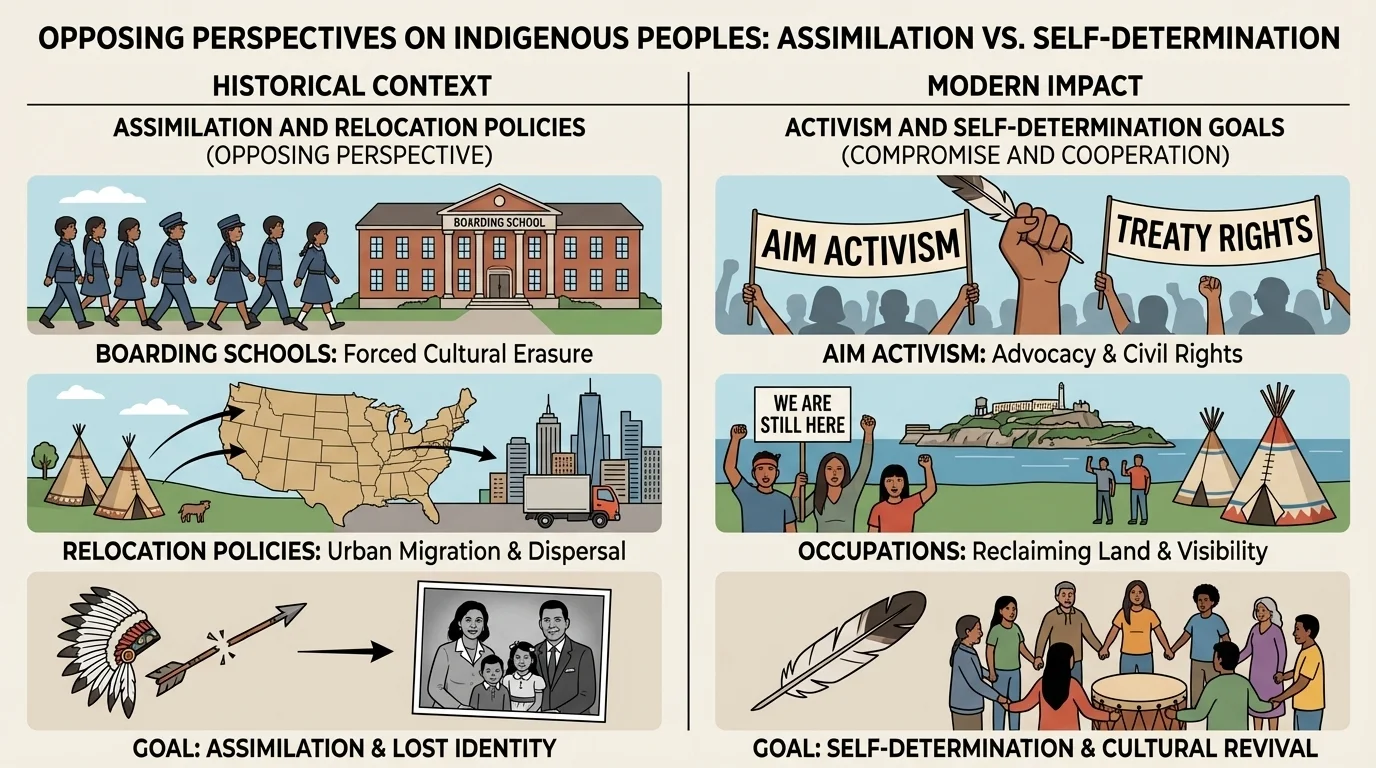
One major lesson from Indigenous activism is that national unity cannot be built fairly by erasing distinct peoples. Native nations sought not just inclusion in American society, but recognition of sovereignty, the right of tribes to govern themselves. That demand challenged a narrow version of unity and replaced it with a more complex one: a nation can remain politically united while recognizing that different peoples have distinct legal and cultural identities.
Later laws such as the Indian Self-Determination and Education Assistance Act reflected some of these changes. They did not solve every injustice, but they showed that government policy could shift when activism, public awareness, and political negotiation came together.
As [Figure 4] indicates, immigration has long been a source of American growth and cultural richness, but it has also triggered repeated arguments over labor, language, citizenship, and belonging. Those tensions connect national policy to everyday life in farms, factories, neighborhoods, and schools.
Asian Americans experienced both exclusion and contribution. The Chinese Exclusion Act of 1882 singled out one nationality for federal immigration restriction, showing how law could enforce racial hierarchy. During World War II, Japanese Americans were forced into internment camps, despite many being U.S. citizens. This was a profound violation of civil liberties fueled by wartime fear and racism. Yet Japanese American veterans served in the military with distinction, and later generations fought for redress, leading to a formal government apology and compensation in 1988.
Latino history in the United States includes migration, labor activism, military service, cultural influence, and political organizing. Mexican Americans, Puerto Ricans, Cuban Americans, and other Latino communities have had different histories, but many have faced unequal schools, job discrimination, and barriers to political power. The Chicano Movement pushed for educational reform, voting rights, and cultural pride.
The United Farm Workers, led by César Chávez, Dolores Huerta, and others, organized farm laborers to demand better wages and safer working conditions. Their movement used strikes, boycotts, and alliances with students, churches, and consumers. This is a powerful example of cooperation across group lines: many people who were not farmworkers joined the cause because they saw labor rights as human rights.
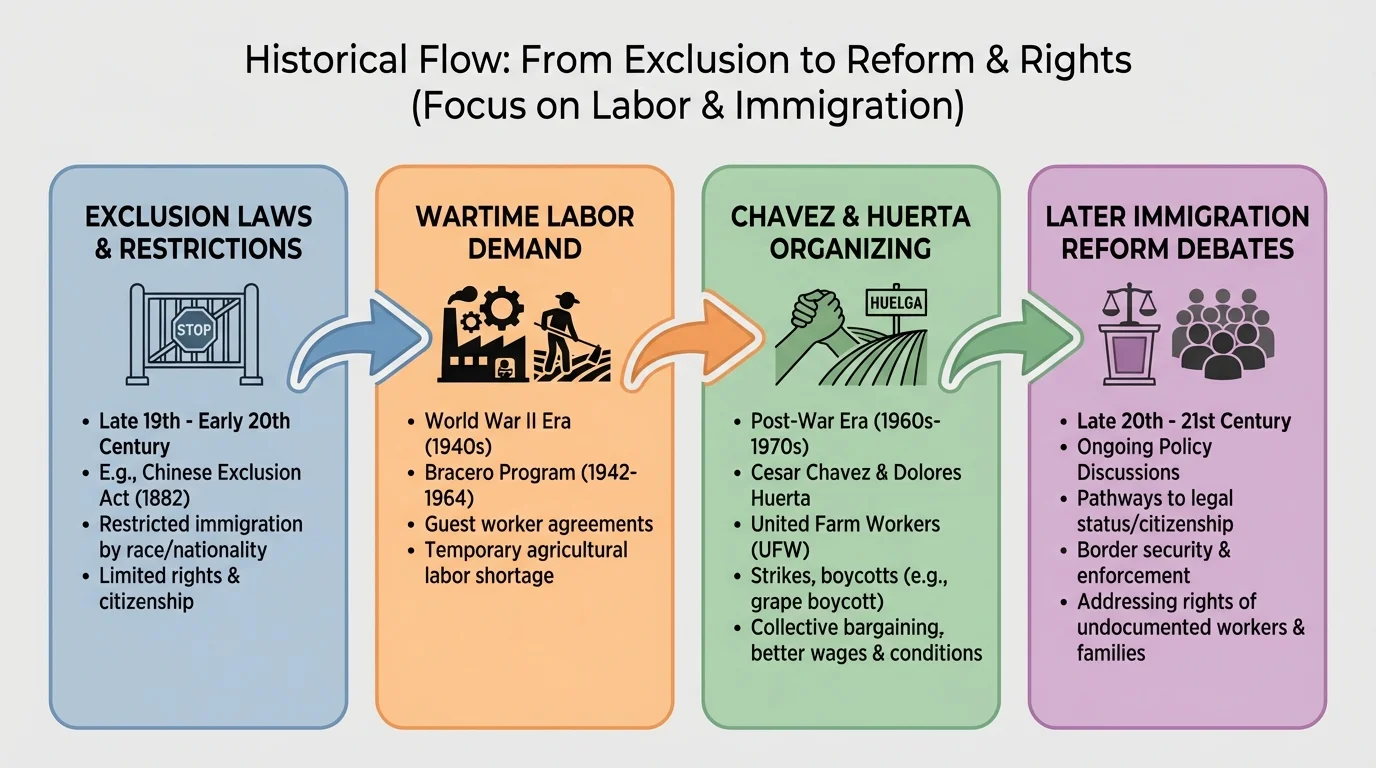
Debates over immigration policy have often involved opposing perspectives. Some Americans have argued for restriction based on security, economics, or cultural concern. Others have argued that immigrants strengthen the country through labor, entrepreneurship, military service, and creativity. Laws such as the Immigration and Nationality Act of 1965 changed the system by ending national-origins quotas that had favored some groups over others. Still, arguments over undocumented immigration, border policy, refugees, and language access continue today.
What remains consistent is that immigrants and their descendants have shaped the nation's economy, arts, science, politics, and military. Diversity is not something added to the American story later; it is part of the story from the beginning, even if the law has not always recognized that reality fairly.
Military service has often been one path by which marginalized groups claimed fuller citizenship. African Americans, Native Americans, Latinos, Asian Americans, women, and LGBTQ service members have all used service to challenge stereotypes and demand equal treatment.
That pattern reveals an important cause-and-effect relationship: when people contribute visibly to the nation, it often becomes harder for the nation to justify excluding them, though prejudice does not disappear automatically.
Women's rights struggles did not end with the achievement of national voting rights in 1920. In the decades that followed, women pushed for equal opportunity in education, employment, law, athletics, and political representation. During World War II, women entered industrial work in large numbers, challenging assumptions about gender roles. Later, feminist movements pressed for legal and social change, including equal pay, reproductive rights, and protection against discrimination.
Laws and court decisions played major roles. Title IX, passed in 1972, prohibited sex discrimination in federally funded education programs and activities. Its effects reached far beyond sports, although athletics became one of its most visible outcomes. It expanded access to educational opportunities and helped transform expectations about what girls and women could pursue.
LGBTQ individuals also fought for visibility, safety, and equality. For much of U.S. history, gay, lesbian, bisexual, transgender, and queer people faced criminalization, job loss, censorship, and medical stigmatization. The Stonewall uprising of 1969 became a major turning point because it sparked broader activism. Organizations and local communities demanded anti-discrimination protections, responses to the AIDS crisis, and recognition of same-sex relationships.
As with other rights movements, there were opposing views. Some Americans supported broader civil rights protections, while others argued that social traditions should remain unchanged. Over time, shifts in public opinion, court rulings, and activism contributed to major changes, including the legalization of same-sex marriage in Obergefell v. Hodges in 2015. Yet debates over transgender rights, public accommodations, schools, and health care show that the struggle over inclusion continues.
These histories demonstrate that compromise can sometimes open doors, but some compromises also leave injustice in place. For example, a policy may prohibit discrimination in one area while failing to protect people in another. That is why social change often unfolds through stages rather than a single moment of victory.
One of the most important but sometimes overlooked civil rights movements involves individuals with disabilities. For much of U.S. history, people with disabilities were excluded from schools, workplaces, transportation, and public spaces. Disability was often treated only as a medical issue rather than a matter of civil rights and public design.
Activists challenged that view by arguing that barriers were created not just by physical conditions, but by society itself. A staircase without a ramp, a bus without a lift, or a classroom without accommodation limits participation. In this sense, exclusion is not inevitable; it is built into systems that can be changed.
Access as a civil right means that freedom is not just the right to exist in theory, but the ability to participate in real life. Ramps, interpreters, captioning, accessible websites, and workplace accommodations are not special favors. They are ways of making citizenship meaningful for everyone.
The disability rights movement led to major legislation, including Section 504 of the Rehabilitation Act and the Americans with Disabilities Act of 1990. These laws prohibited discrimination and required many public spaces and employers to provide reasonable access. Cooperation among activists, lawyers, legislators, and families helped achieve these reforms, but direct protest was also important. Demonstrations, sit-ins, and public pressure made it harder for the government to ignore exclusion.
This movement broadened the country's idea of equality. It showed that rights are not only about formal legal status; they are also about whether the built environment and institutions allow people to participate fully.
Ethnic and religious minorities have also shaped American unity and diversity. Jewish Americans, Catholic immigrants, Muslims, Sikhs, and many other communities have contributed to civic life while facing prejudice, suspicion, or violence at different times. Anti-Catholic movements in the nineteenth and early twentieth centuries, antisemitism, Islamophobia after the attacks of September 11, 2001, and discrimination against Sikh Americans after being mistaken for Muslims all show how fear can undermine constitutional ideals.
At the same time, the First Amendment and later court decisions have provided important protections for religious freedom. Civil society organizations, interfaith coalitions, and local communities have often worked to defend pluralism. In schools, neighborhoods, and workplaces, cooperation across religious lines has helped reduce conflict and build civic trust.
Pluralism is not the absence of difference. It is the practice of living with difference under shared rules of liberty and equality. That requires both legal protection and civic habits such as listening, debate, and mutual respect.
As [Figure 5] shows, rights reform in the United States is rarely the product of one leader or one law. It is a layered process involving citizens, advocacy groups, courts, legislatures, executives, and public opinion. Sometimes the government protects rights; at other times it delays, limits, or violates them. Understanding this complexity is essential.
Organizations matter because they turn shared grievances into strategy. The NAACP used litigation and public education. The American Indian Movement used protest and media attention. The United Farm Workers organized labor campaigns and consumer boycotts. Women's groups, disability rights organizations, immigrant advocacy groups, and LGBTQ organizations all developed ways to connect local experiences to national change.
Government matters because laws, court rulings, executive orders, and enforcement power shape what rights mean in practice. Congress passed civil rights laws. Courts interpreted the Constitution. Presidents sometimes sent troops to enforce integration or used executive agencies to expand protection. State and local governments also played major roles, sometimes advancing rights and sometimes resisting them.
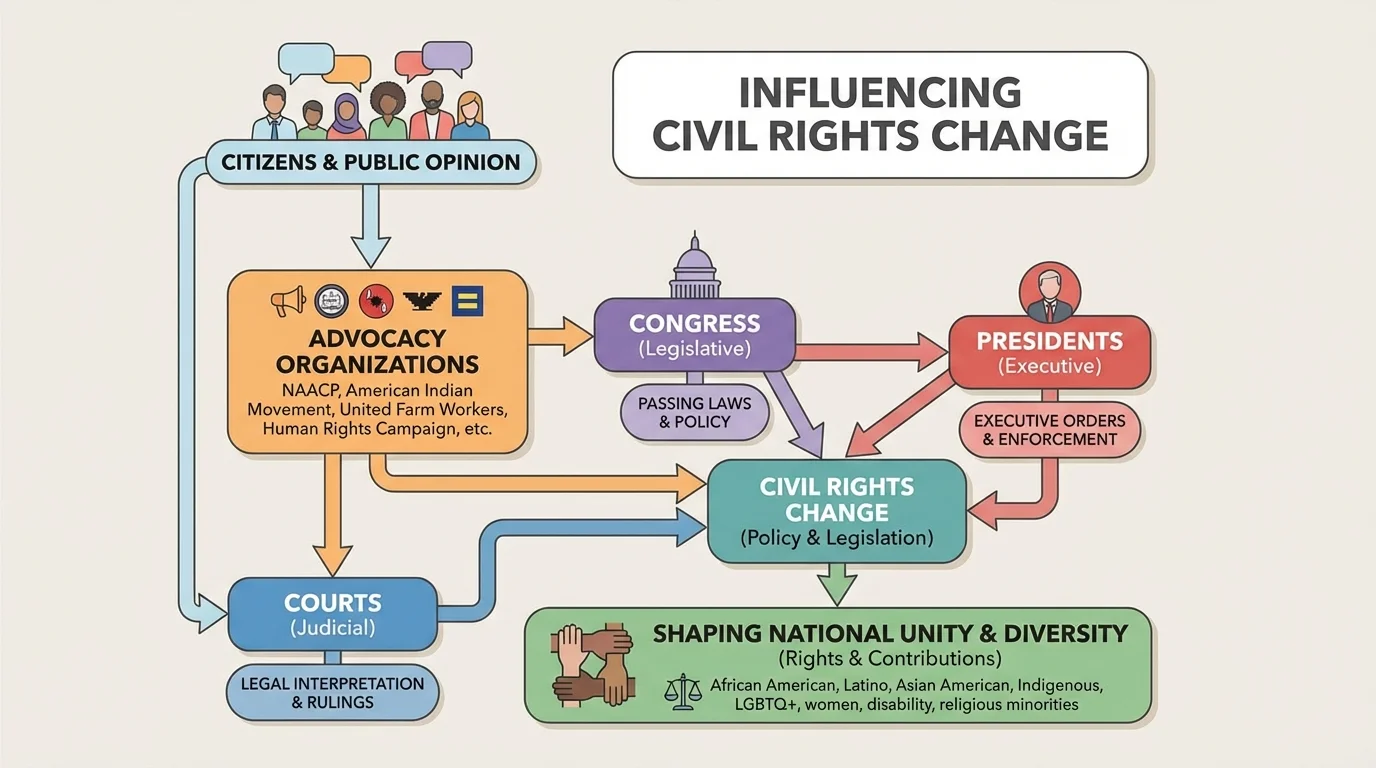
The interaction among these forces explains why progress can be uneven. A court decision may recognize a right, but local officials may resist enforcement. Congress may pass a law, but public opinion may lag behind. Grassroots activism may shift culture before policy catches up. This process helps explain why lasting change usually requires action at more than one level.
Primary sources help historians trace this process. Court opinions, protest speeches, letters, newspaper editorials, photographs, oral histories, and government records reveal both conflict and cooperation. Secondary sources then analyze those materials to explain broader patterns. For example, a historian might compare a speech by Dolores Huerta, a Supreme Court decision, and a newspaper response to understand how labor activism changed national debate.
It may seem strange to say that disagreement can strengthen a country. Yet in a democracy, peaceful conflict can expose injustice and force institutions to improve. The problem is not opposition itself. The problem is whether the nation responds through dialogue, law, intimidation, or violence.
Compromise has played mixed roles in this history. Some compromises have expanded participation by creating workable agreements among competing groups. Others have sacrificed the rights of vulnerable people in order to reduce conflict temporarily. Reconstruction's collapse, for example, showed how compromise can come at a terrible moral cost when equality is abandoned for political convenience.
Cooperation, by contrast, has often been most effective when different groups recognize shared interests. Black and white civil rights workers, farmworkers and urban consumers, disability activists and families, interfaith coalitions, and student groups across many causes demonstrate that change often accelerates when alliances broaden. National unity becomes stronger when more people believe they have a place in the nation.
Looking across the period from Reconstruction to the present, certain patterns stand out: rights expand, backlash follows, organizing continues, and institutions gradually shift. The nation changes not in a straight line, but through struggle.
| Period | Major Developments | Historical Significance |
|---|---|---|
| Reconstruction | 13th, 14th, and 15th Amendments; Black political participation | Expanded citizenship but left equality vulnerable to backlash |
| Late 1800s to early 1900s | Jim Crow, Native assimilation policies, Chinese exclusion, women's activism | Showed how rights could be restricted even in a growing nation |
| World War II era | Japanese American internment, women in wartime labor, military service by diverse groups | Revealed contradictions between democracy abroad and inequality at home |
| Civil Rights era | Brown v. Board, NAACP litigation, protest movements, Civil Rights Act, Voting Rights Act | Redefined federal responsibility for equal rights |
| 1960s to 1990s | AIM activism, Chicano Movement, UFW campaigns, feminism, disability rights, LGBTQ activism | Broadened the meaning of civil rights beyond race alone |
| 2000s to present | Debates over immigration, policing, gender identity, disability access, and religious freedom | Shows that unity and diversity remain active democratic challenges |
Table 1. Major patterns in the expansion and contestation of rights in the United States from Reconstruction to the present.
Seen together, these histories show that the United States has been shaped not by a single agreement about freedom, but by repeated debates over its meaning. Diverse groups have demanded that the nation include them not symbolically, but fully. Their contributions to labor, military service, culture, science, politics, religion, and community life have continually redefined what America is.
Earlier U.S. history already introduced tensions between ideals and reality: the Declaration of Independence proclaimed equality while slavery continued, and the Constitution created a national government while leaving many rights unresolved. The period since Reconstruction continues that story, but with new amendments, new movements, and broader definitions of citizenship.
The central lesson of this history is not that conflict disappears. It is that democracy depends on how a society handles conflict. When opposing perspectives lead to exclusion and violence, unity weakens. When disagreement leads to reform, recognition, and broader participation, unity becomes more durable because it rests on justice rather than silence.
