Have you ever helped clean up toys, listened to a classroom rule, or taken turns in a game? Those small actions are a big part of being a good citizen. A good citizen helps others, learns about the world around them, and joins in to make a group better.
A citizen is a person who belongs to a community. A community can be your family, your class, your school, your neighborhood, your city, or your country. Even young children are part of communities. That means you can practice being a good citizen every day.
When you care about the people around you, you are helping your community. You do not have to be a grown-up to do this. You can help by listening, following rules, speaking kindly, and working with others.
Citizen means a person who belongs to a community. An informed citizen learns and pays attention. An engaged citizen joins in and helps.
Good citizens understand that groups work best when people care for one another. In a classroom, that may mean sharing crayons. In a neighborhood, that may mean keeping the park clean. In every group, citizens matter.
An informed citizen learns about what is happening around them, as [Figure 1] shows through listening, learning, and noticing signs and helpers. For a young child, this can mean listening when a teacher explains a rule, noticing a crosswalk sign, or learning who helps in the community.
Being informed also means asking questions and paying attention. You might ask, "Why do we walk in a line?" or "Who helps if someone is hurt?" When you listen carefully and learn the answers, you understand your community better.
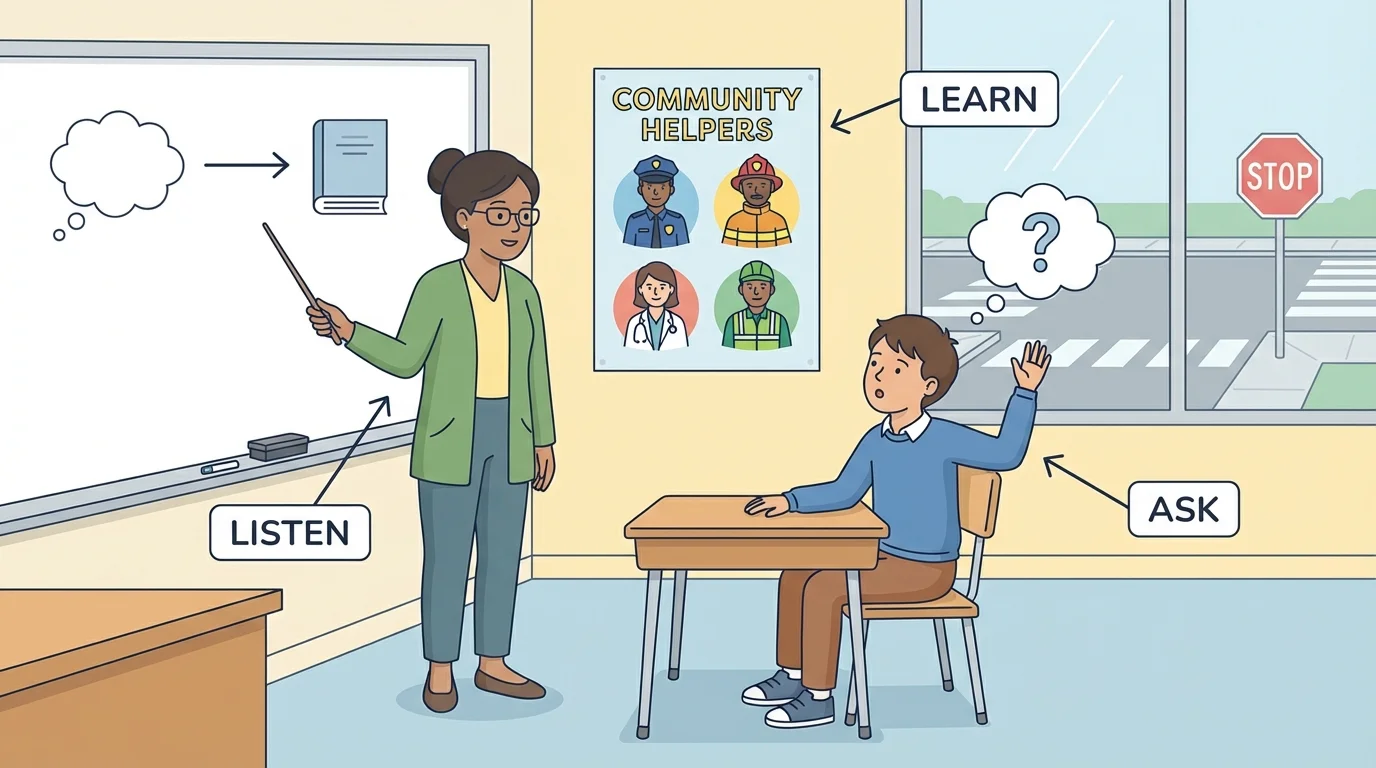
Informed citizens know that rules are there to help people stay safe and work together. If you know the rule to raise your hand before speaking, you help everyone get a turn. If you know to stop at a red light when walking with an adult, you help keep people safe.
Young children can begin citizenship by learning simple rules, recognizing helpers like teachers and firefighters, and noticing how their choices affect other people.
Learning can come from many places. You learn at home, at school, at the library, and in your neighborhood. The more you notice and learn, the more informed you become.
[Figure 2] An engaged citizen does not just know about the community. An engaged citizen joins in and helps. This can include taking part, helping clean up, and sharing ideas. Engagement means being part of the group.
You are engaged when you help clean up after snack, take turns in a game, raise your hand to share an idea, or help a friend who is sad. These actions show that you care about your group and want it to do well.
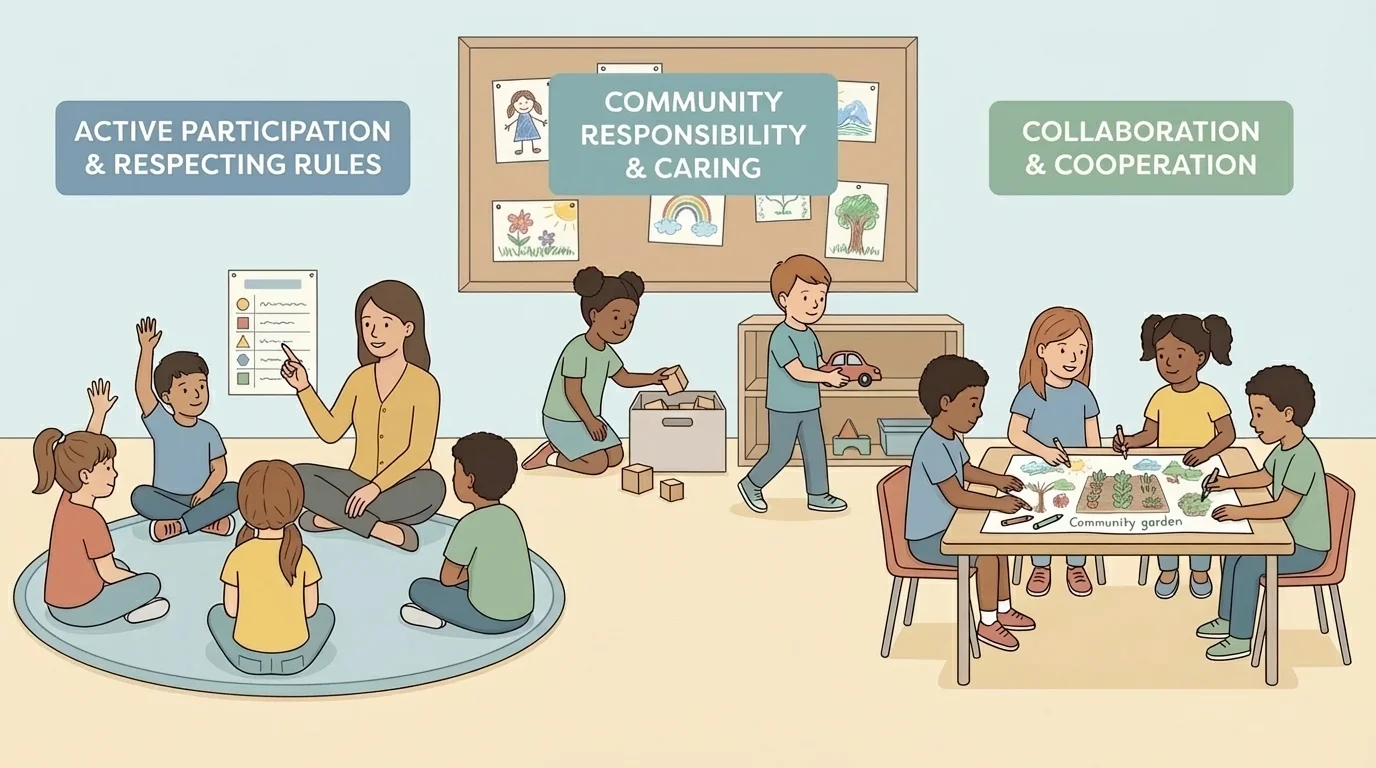
Sometimes engagement means making choices together. In class, children may vote by raising hands to choose a story or a song. Everyone may not get the same choice, but everyone gets to participate. That is part of working together fairly.
Engaged citizens also keep trying. If a job is hard, they do not give up right away. They help in ways they can, even if the help is small.
Knowing and doing work together
A good citizen does two things: learns and helps. Learning without helping leaves problems undone. Helping without learning can cause confusion. When a child understands the rules and joins in kindly, the whole group becomes stronger.
This is why informed and engaged citizens are both important. A child who knows the classroom rules and follows them helps the class run smoothly. A child who learns why we recycle and then sorts paper and plastic is helping the community too.
[Figure 3] Civic participation means helping and taking part in groups. It happens in many settings, including family, classroom, school, and neighborhood life. You can participate at home, in school, and in the community.
In a family, children can help put toys away, set the table, or care for a pet. In a classroom, children can listen, share, and help clean up. In a school, children can walk safely in line, be kind on the playground, and follow school rules. In a neighborhood, children can wave to neighbors, help pick up litter with an adult, or care for a community garden.
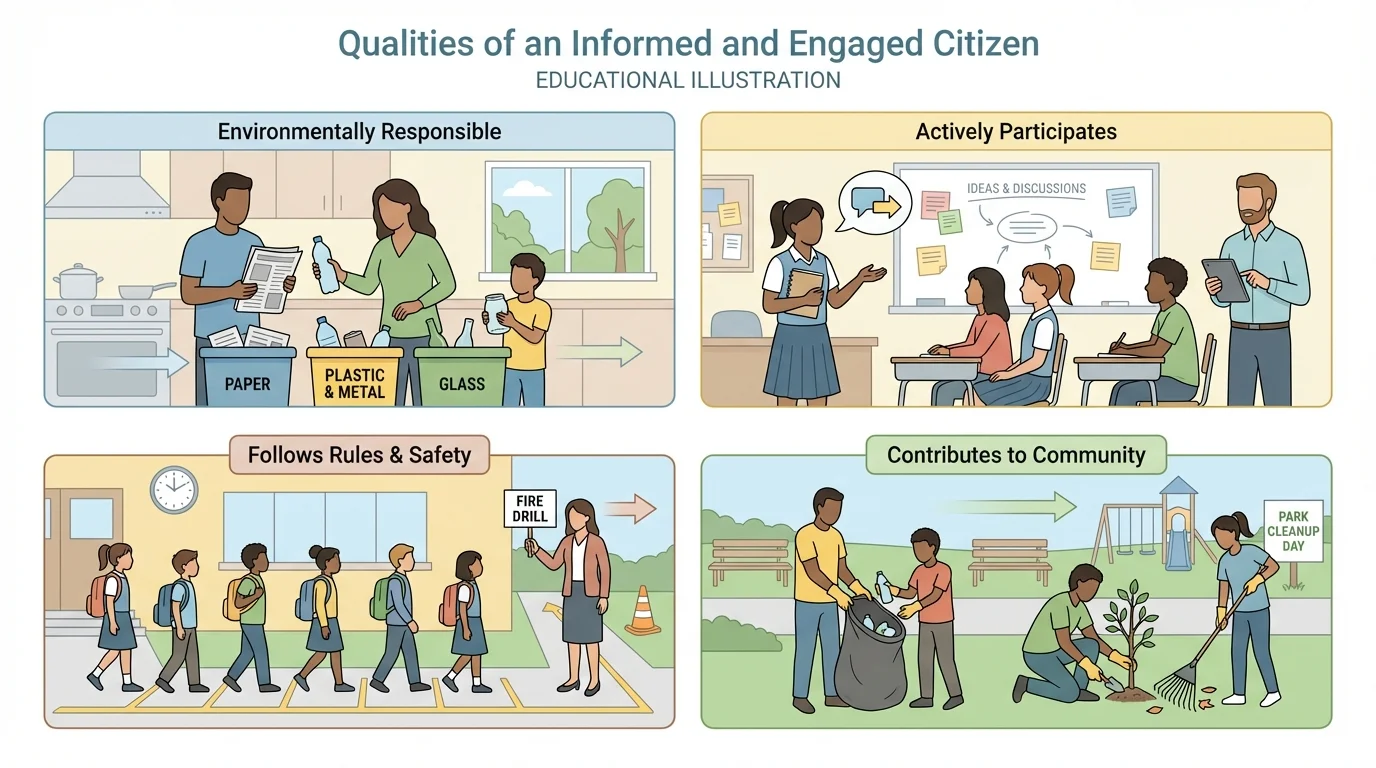
These groups may be different, but the idea is the same: people work together to help everyone. When citizens take part in many groups, communities become safer, kinder, and more organized.
| Group | How a child can participate |
|---|---|
| Family | Help clean up, listen, share |
| Classroom | Raise a hand, take turns, follow rules |
| School | Walk safely, be respectful, include others |
| Neighborhood | Help keep spaces clean, be kind, notice helpers |
Table 1. Examples of civic participation in different groups.
Later, when we think again about [Figure 3], we can see that citizenship is not only about one big place like a country. It also lives in the small groups children know every day.
A good citizen has important qualities, often called qualities. These are good ways of acting and treating others. Some important qualities are kindness, respect, responsibility, honesty, fairness, and courage.
Kindness means caring about others. Respect means treating people, places, and things well. Responsibility means doing what you should do. Honesty means telling the truth. Fairness means giving people a turn and following the same rules. Courage means doing the right thing even when it feels hard.
"We all do better when we help each other."
These qualities help groups solve problems peacefully. If two children want the same ball, fairness and patience can help. If someone drops papers, responsibility and kindness can help others pick them up. If a friend is left out, courage can help you invite that friend to join.
Being a good citizen does not mean being perfect. It means trying to make good choices, learning from mistakes, and caring about others.
Sometimes the best way to understand citizenship is to look at simple examples. These everyday moments show what informed and engaged citizens do.
Example 1: Listening to a safety rule
Step 1: The teacher says, "We walk in the hall."
Step 2: A child listens and remembers the rule.
Step 3: The child walks carefully with the class.
The child is informed because the child learned the rule, and engaged because the child followed it with the group.
Notice how this connects back to [Figure 1]. Learning from signs, teachers, and helpers gives children the information they need to make safe choices.
Example 2: Helping during cleanup
Step 1: It is cleanup time.
Step 2: A child sees blocks on the floor.
Step 3: The child puts the blocks away and helps a friend.
This child is engaged because the child joins in and helps the class.
That is the same idea we saw earlier in [Figure 2]: engaged citizens participate instead of standing aside.
Example 3: Taking turns in a group
Step 1: Two children want to speak.
Step 2: One child waits for a turn.
Step 3: Both children get to share ideas.
This shows fairness, respect, and responsibility.
Small moments like these help build strong habits. A child who practices fairness in class can also use fairness at home and in the neighborhood.
Every child can be a citizen who learns and helps. You can notice what is happening, listen to trusted adults, ask good questions, and care for others. You can also join in by sharing, helping, and following rules that protect the group.
Citizenship is not only something far away in government buildings. It happens when people live and work together. It happens when children help in the places they know best: at home, in class, at school, and in the neighborhood.
When people are informed and engaged, communities grow stronger. They become places where people feel safe, respected, included, and ready to help one another.
