What helps a classroom feel happy, calm, and ready to learn? It is not just toys, books, or songs. It is the way everyone works together. In a classroom, children and teachers share one space. When everyone knows what to do, the day goes more smoothly, and the group can learn, play, and feel safe.
A rule is something we follow to help keep people safe and kind. A rule tells us what we should do. For example, we use gentle hands, walking feet, and listening ears.
A routine is something we do the same way again and again. A routine helps us know what comes next. In class, a routine might be hanging up a backpack, sitting on the carpet, washing hands, or cleaning up after play.
An expectation is what others hope we will do. In the classroom, expectations help children know how to act during different parts of the day.
Rules help people stay safe and be fair. Routines are regular ways of doing things. Expectations show what behavior is needed in a certain place or time.
These ideas work together. Rules tell us what matters. Routines help us practice. Expectations remind us what to do right now.
Classroom rules and routines are important because many people are learning together. A class is made up of many children. The class is a group, and groups work best when everyone knows how to share space, time, and materials.
Rules help keep children safe. If everyone walks instead of runs indoors, people are less likely to fall. If everyone cleans up toys, the floor stays clear. If everyone listens when the teacher speaks, important directions are heard.
Rules also help people be fair and kind. Taking turns means everyone gets a chance. Waiting helps stop pushing. Using quiet voices helps others think and listen. These small actions help the whole class.
Why groups need rules
When many people are together, each person's choices affect others. Rules make the classroom more peaceful because they help children know what is safe, respectful, and helpful. This lets the group learn and play more effectively.
Following routines can also make children feel calm. Knowing what comes next can make the school day feel easier and more comfortable.
[Figure 1] Many preschool classrooms have routines that happen in the same order each day. Children learn these patterns over time, and the patterns help them move from one part of the day to the next.
One routine happens when children arrive. They may put away a backpack, hang up a coat, and join the class. Another routine happens at circle time, when children sit, look, and listen. Another routine happens at cleanup time, when toys go back where they belong.
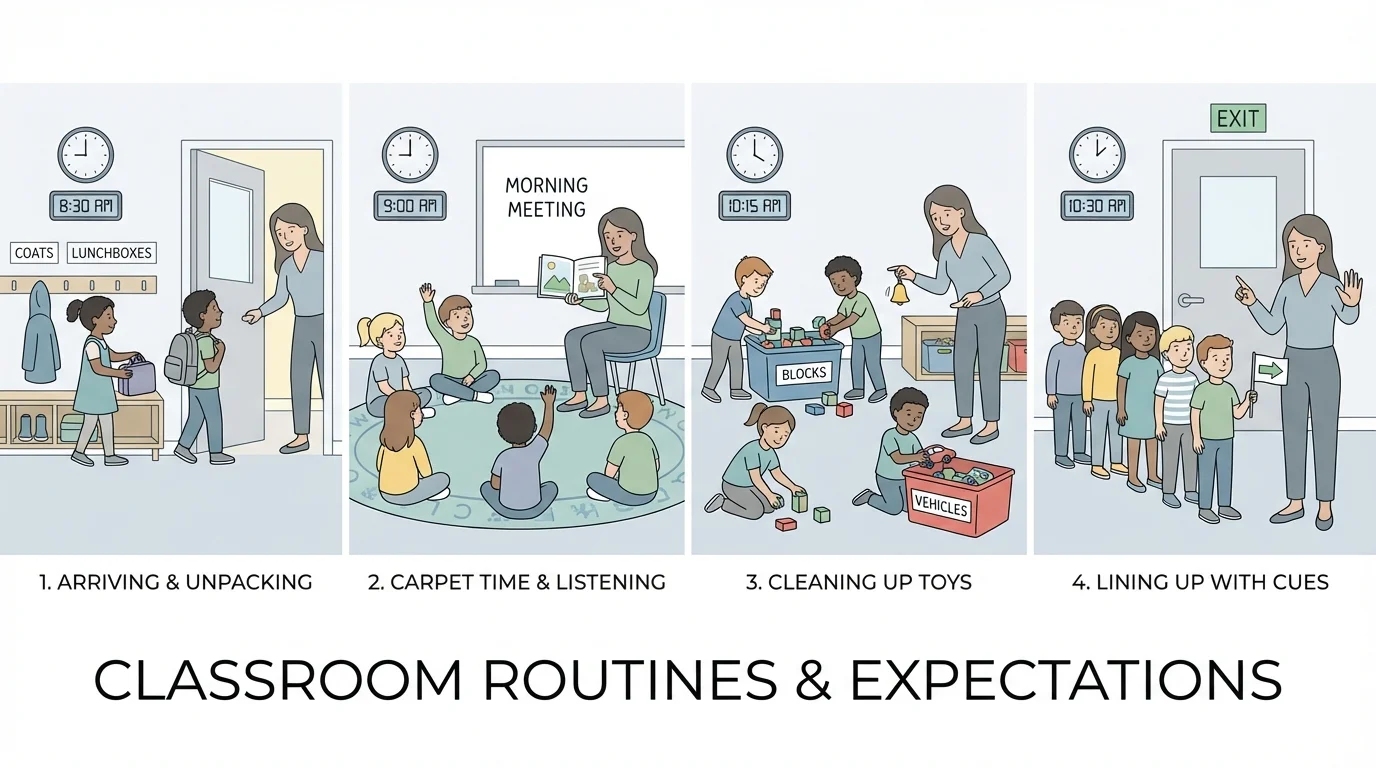
Routines also help during transitions. A transition is when the class moves from one activity to another, such as from playtime to snack time. Routines make transitions smoother because children know what to do.
For example, when it is time to line up, children may stand behind one another, keep hands to themselves, and wait for the teacher. When it is time to wash hands, children may take turns and wait patiently.
Example: Cleanup routine
Step 1: Hear the cleanup signal.
Step 2: Stop playing and look for where toys belong.
Step 3: Put toys away carefully.
Step 4: Join the next activity.
This routine helps the room stay neat and helps everyone get ready for what comes next.
Routines are not random. They are repeated steps that help the whole class move together.
Classroom rules guide how we use our bodies and voices at school. Rules are easier to follow when they are clear, simple, and practiced often.
[Figure 2] Some common rules are: use gentle hands, use kind words, walk inside, listen when someone is talking, raise a hand when needed, and take care of classroom materials.
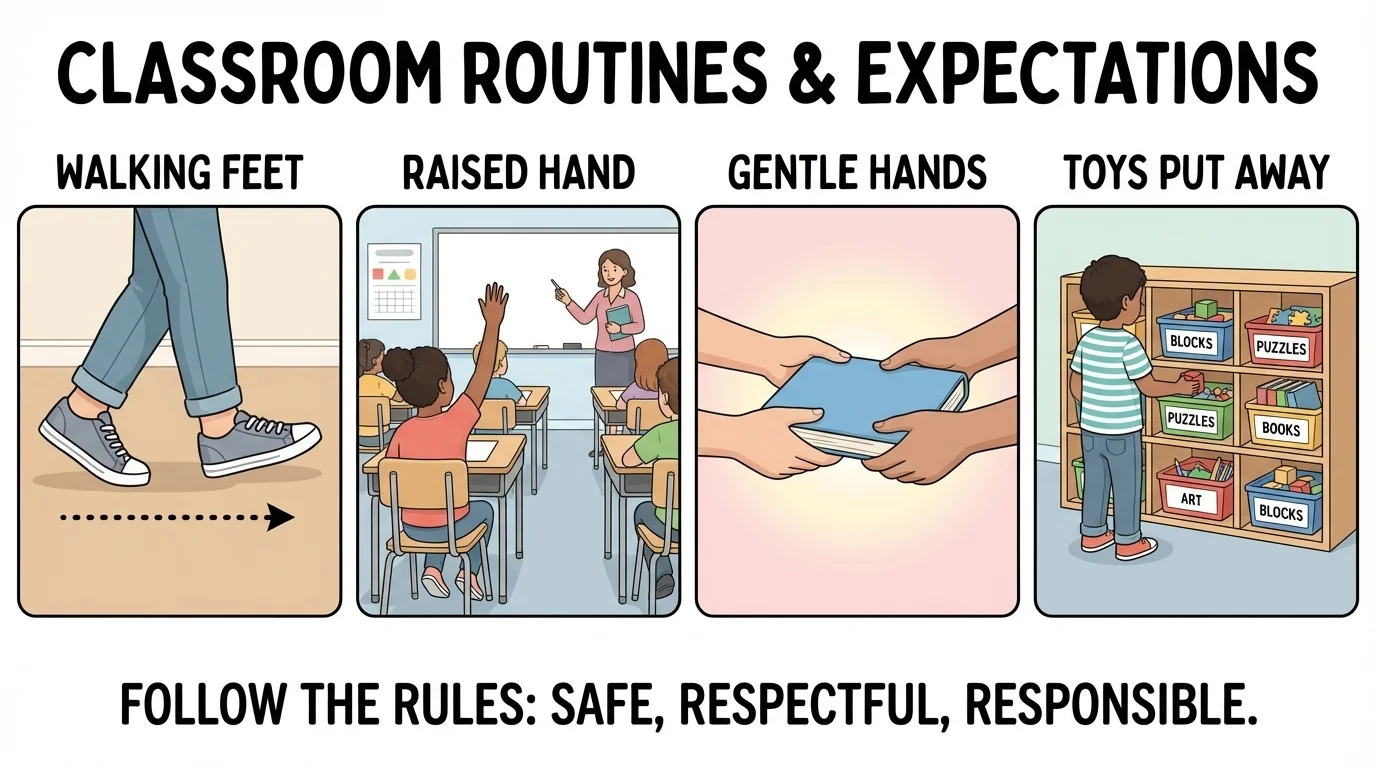
These rules help everyone. Gentle hands keep bodies safe. Kind words help protect people's feelings. Walking feet prevent accidents. Listening carefully helps children hear directions. Caring for crayons, books, and blocks means the class can use them again later.
Sometimes rules are about what not to do, but it is often easier for young children to learn what to do. Instead of only hearing "don't shout," a child can learn "use a quiet voice." Instead of only hearing "don't grab," a child can learn "take turns."
Young children learn routines best when they are practiced again and again in the same way. Repetition helps the brain remember what comes next.
Later in the day, the same ideas still matter. The safe, respectful actions shown in [Figure 2] can be used during play, snack, story time, and outdoor time.
[Figure 3] Expectations tell us what to do in a specific moment. A child may know the classroom rule "be safe," but expectations make that rule clearer in each activity.
At story time, expectations may include sitting in a spot, keeping eyes on the speaker, and listening quietly. At centers, expectations may include sharing materials and cleaning up when finished. At the sink, expectations may include waiting for a turn and washing hands carefully.
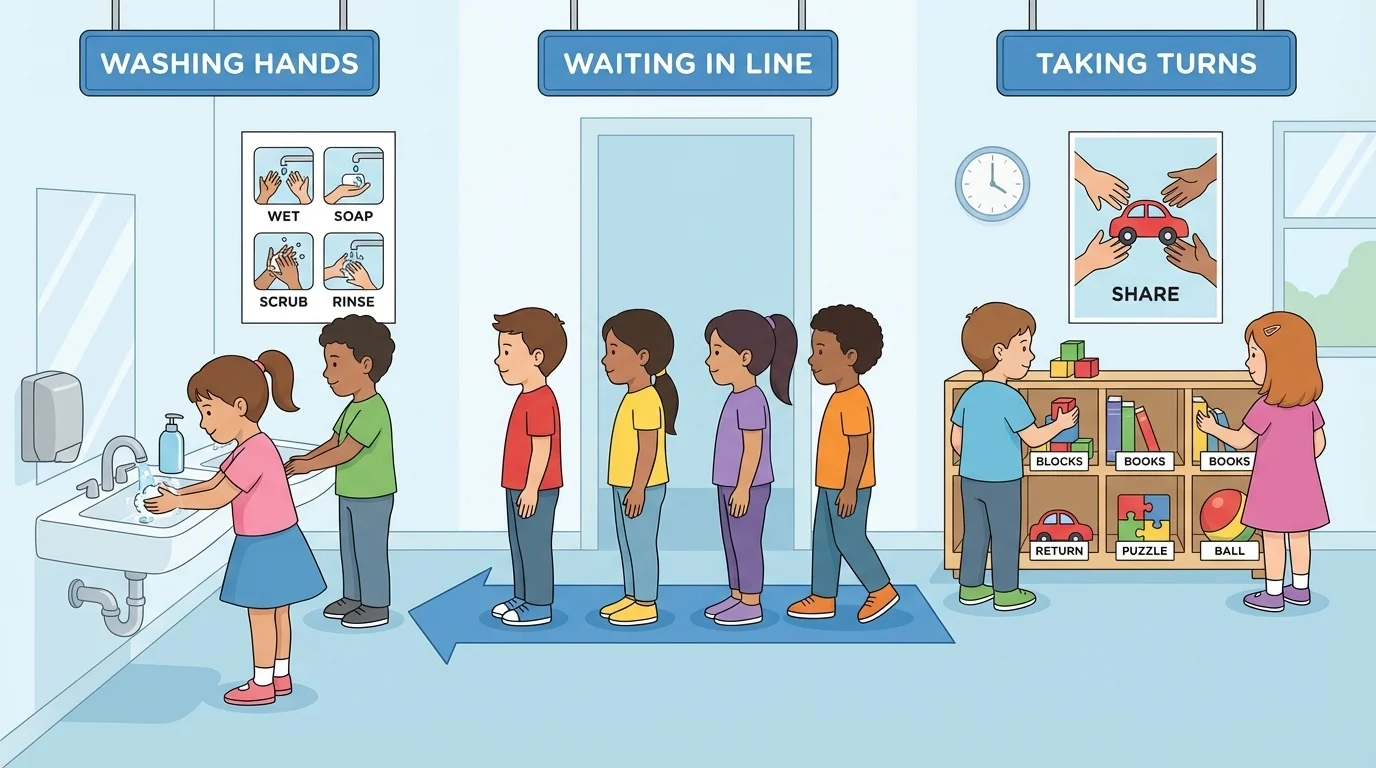
Expectations can change a little depending on the place and time. Outside, children may use bigger voices than inside. On the rug, bodies may stay still. At music time, bodies may move with the song. The important part is noticing what behavior fits the moment.
When children understand expectations, they can make good choices more independently. That means they need fewer reminders and can join the group more successfully.
Example: Waiting for a turn
There is one easel and two children want to paint.
Step 1: One child paints first.
Step 2: The other child waits nearby with calm hands.
Step 3: When the first child is done, the second child gets a turn.
This expectation helps the class share fairly.
We can notice in [Figure 3] that expectations are often about patience, order, and taking turns.
No one follows every rule perfectly all the time. Young children are still learning. Making a mistake does not mean a child cannot do well. It means the child needs a reminder, practice, and another chance.
If a child runs inside, the teacher may remind, "Use walking feet." If a child grabs a toy, the teacher may help with the words, "Ask for a turn." If a child forgets cleanup, the teacher may point to where the toy belongs.
Learning takes practice. Just like learning to zip a coat or hold a crayon, learning classroom behavior happens little by little.
Trying again is an important part of school. Children can stop, listen, and make a better choice. This helps build self-control and confidence.
A classroom is a community. When children follow routines, rules, and expectations, they help not only themselves but also everyone around them. The room becomes safer, calmer, and more ready for learning.
Children can show responsibility by putting things away, listening for directions, and waiting for turns. They can show respect by using kind words and careful hands. They can show cooperation by joining routines with the class.
These habits help groups work well. They make time for stories, art, play, songs, and discovery. When everyone does their part, the class can do more together.
"We take care of ourselves, we take care of others, and we take care of our classroom."
Following classroom routines, rules, and expectations is one way children learn how to be part of a group. It is a big step in learning how to live, work, and grow with other people.
