Have you ever used an umbrella that still let rain drip on your head? That means the umbrella did not do its job very well. Scientists and engineers check things carefully to see if they work the way they are supposed to work. They do not just guess. They test things, look closely, and use what they find out.
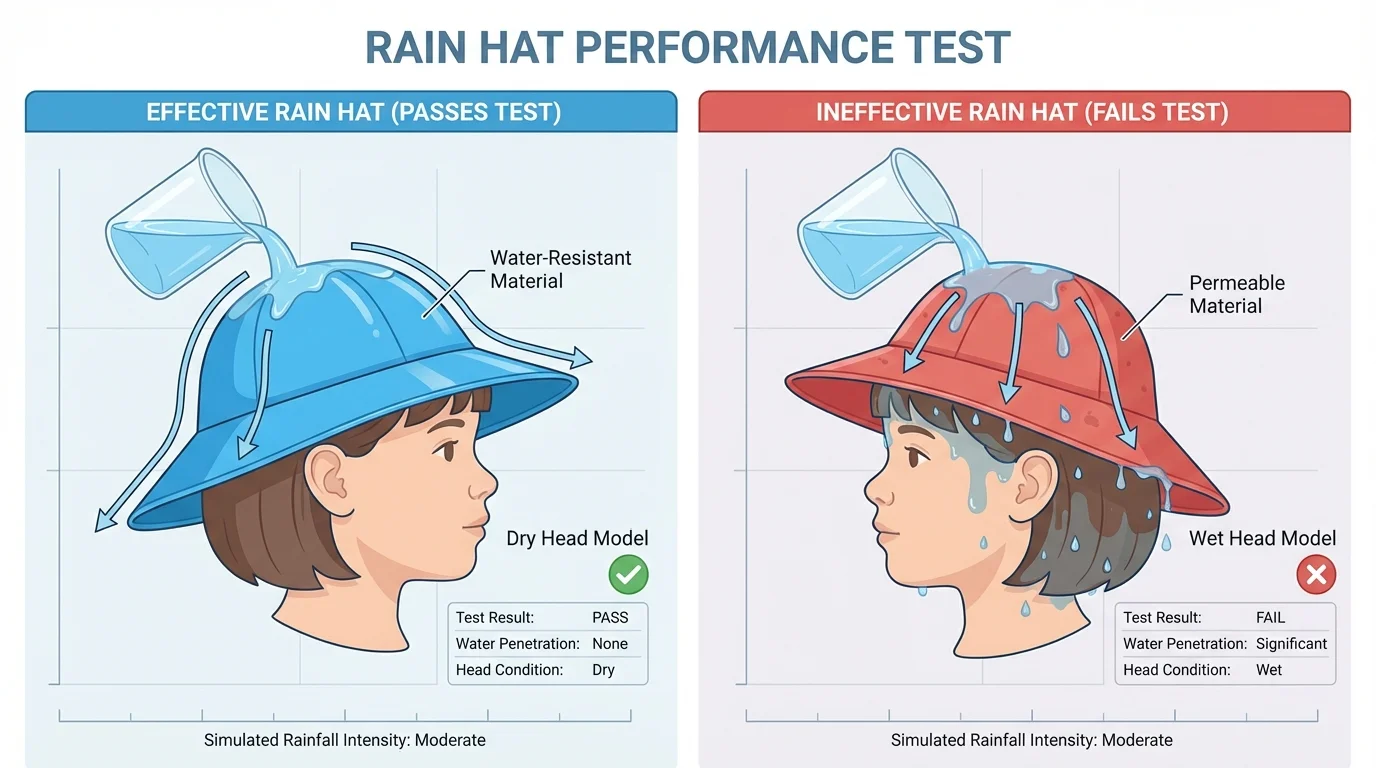
Every object or tool has a purpose. A cup should hold water. Boots should help keep feet dry. A toy car should roll when it is pushed. When we say something works as intended, we mean it does what it was designed to do. [Figure 1] shows an example of testing hats to see whether they keep water out.
If we pour a little water on two hats and one hat keeps the head dry while the other hat lets water through, we learn that one works better for rainy weather. The test gives us evidence. Evidence is information we gather by observing, counting, and measuring.
Intended purpose means the job something is supposed to do. Data means the information we collect during a test, such as what we see, count, or measure.
Sometimes more than one object can do the same job, but one does it better. A paper bag and a plastic bag can both carry things. But if they get wet, one may stay strong while the other may tear. Testing helps us choose the better one for a certain job.
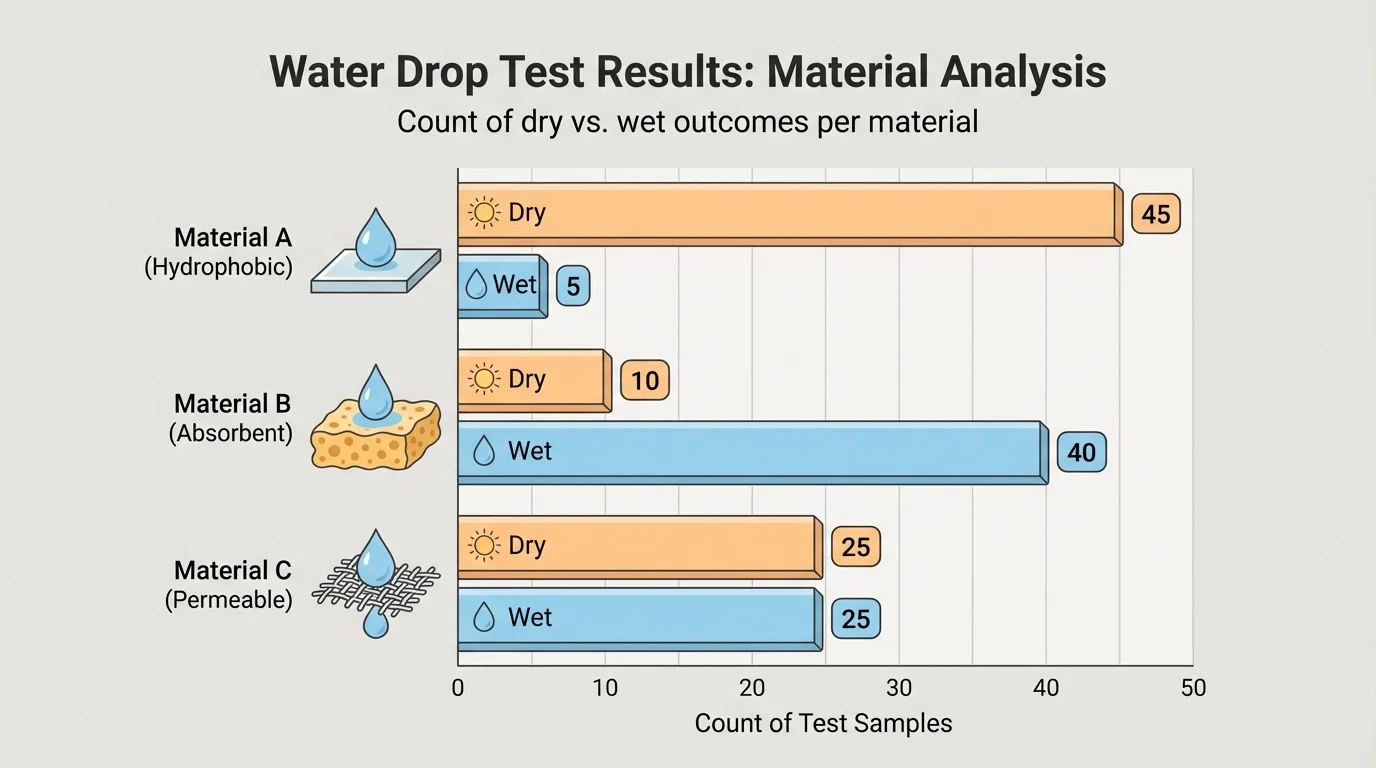
When we do a test, we collect data. Data can be words like "dry" and "wet." Data can also be numbers, tallies, or simple counts. [Figure 2] shows a class test in which water is placed on three kinds of fabric and the results are recorded.
If cloth A stayed dry in \(3\) out of \(3\) tests, cloth B stayed dry in \(2\) out of \(3\) tests, and cloth C stayed dry in \(0\) out of \(3\) tests, we can compare the results. Cloth A worked best for keeping water out.
| Material | Dry tests | Wet tests |
|---|---|---|
| Cloth A | \(3\) | \(0\) |
| Cloth B | \(2\) | \(1\) |
| Cloth C | \(0\) | \(3\) |
We can also compare with simple math. If a toy worked in \(4\) tests out of \(5\), then it worked most of the time. If another toy worked in only \(1\) test out of \(5\), the first toy worked better. The numbers help us make an informed choice.
Data is helpful because memory can trick us. We may think something worked well, but the written results give a more accurate picture. Later, when we think again about the wet hats in [Figure 1], we can use our observations instead of a guess.
Some materials can be soft and still be strong. Others may feel strong at first but fall apart when they get wet. That is why tests matter.
Scientists often test more than one time. One test is useful, but repeated tests are even better. If the same thing happens again and again, we can trust the results more.
Suppose we want to make a spoon for scooping sand at the playground. We try paper, plastic, and wood. The paper spoon bends, the plastic spoon scoops a little, and the wood spoon scoops well without bending. From the test data, wood has the best properties for this job.
Choosing a material for a scoop
Step 1: Name the job.
The scoop must pick up sand and not bend too much.
Step 2: Test each material the same way.
Try each spoon in the same sand with the same scooping motion.
Step 3: Record what happens.
Paper bends. Plastic works a little. Wood works best.
Step 4: Decide from the data.
Wood is the best choice because it keeps its shape and scoops sand well.
Sometimes the best material changes with the job. A metal spoon is strong, but a soft cloth is better for wiping a table. "Best" depends on the intended purpose.
Properties help materials do jobs
Properties are the features of a material, such as hard, soft, bendy, smooth, rough, waterproof, or absorbent. We test materials because different properties help with different jobs.
If we want a towel, we want a material that soaks up water. If we want a raincoat, we want a material that keeps water out. The test must match the job we care about.
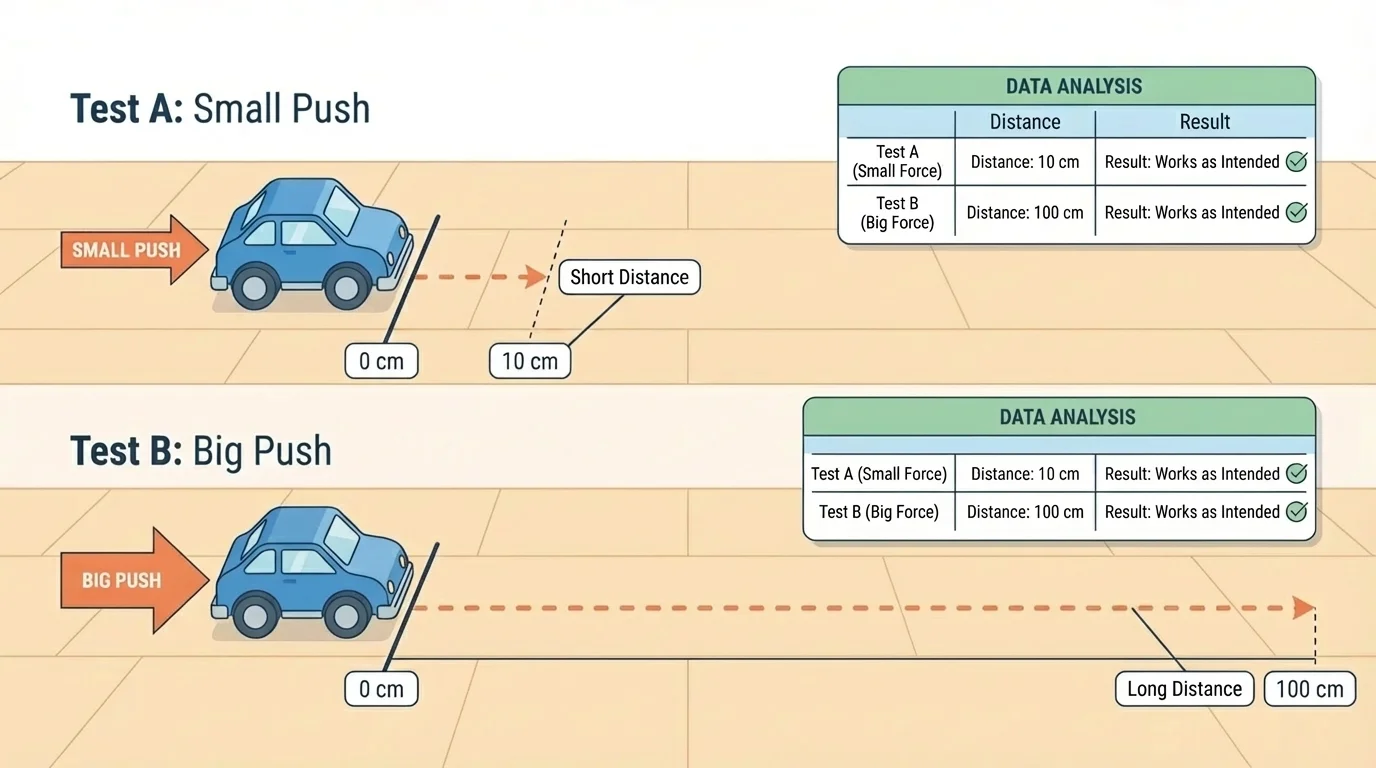
A tool or object can also be tested by seeing how it moves. When we give a toy car a push, we are using a force. [Figure 3] shows how a small push and a big push can make the car move in different ways.
If one push makes the car move a short distance and a stronger push makes it move farther, the data tell us that pushes can change motion. We can compare how far the car goes each time. For example, one test may go about \(2\) floor tiles, and another may go about \(5\) floor tiles. Since \(5\) is more than \(2\), the stronger push made a bigger change.
This kind of testing helps us understand motion. It also helps us design things. If a toy is supposed to roll easily, we can test it with the same push again and again. If it barely moves, maybe the wheels are not working well.
Later, when we compare distances from car tests in [Figure 3], we are using data to decide whether the toy works the way it should.
A fair test means we change just one thing at a time and keep other parts the same. If we are testing materials for a rain hat, we should pour the same amount of water on each one. If we use more water on one hat, the test is not fair.
Fair tests are important because they help us trust the data. If we test one toy car on a smooth floor and another on a bumpy rug, the results may not be about the cars at all. They may be about the floor.
You already know that people can observe with their eyes, ears, and hands. In science, careful observing helps us notice what changes and what stays the same.
We also need to record what happens. We can draw pictures, make check marks, or write short notes. If we tested \(3\) times and something worked all \(3\) times, that is stronger evidence than if it worked only \(1\) time.
People use testing every day. Builders test materials to see which are strong. Clothing makers test fabrics to see which stay dry. Toy designers test wheels, buttons, and parts to make sure toys work safely and well.
At home, adults may compare paper towels to see which one absorbs more spills. At school, students may test which bridge made of blocks or paper can hold more books. In each case, people look at the results and make decisions based on evidence.
"Good science means looking carefully and using evidence."
Testing helps us answer important questions: Does it work? Which one works better? What should we change? When we use observations and data, we can choose better tools and better materials.
