Have you ever argued with someone about which backpack is heavier, which drink bottle holds more, or whether the pool water feels colder than the air? People can guess, but guesses are not enough in science. Scientists need ways to measure things that everyone understands in the same way. That is why we use standard units. A standard unit is an agreed-upon unit of measurement, such as a gram, minute, degree Celsius, or liter. When people use the same units, they can compare results, make graphs, and explain the world clearly.
Suppose one person says a rock is "kind of heavy" and another person says it is "not very heavy." Those words are not exact. But if both people measure the rock and say it has a mass of \(450 \textrm{ g}\), everyone understands the same amount. Standard units make measurements fair, clear, and repeatable.
In science, measuring carefully helps us describe physical quantities. A physical quantity is something that can be measured, such as mass, time, temperature, or volume. These measurements help scientists study matter, weather, water, and many other aspects of Earth's systems.
Standard unit means an agreed-upon unit used by many people to measure the same kind of quantity.
Measure means to find the size, amount, or degree of something by using a tool and a unit.
Compare means to look at two or more measurements to see how they are alike or different.
Without standard units, it would be hard to trade food, follow a recipe, track a storm, give medicine, or describe how much freshwater is available on Earth. Standard measurements connect science to real life every day.
As [Figure 1] shows, people often use the word "heavy" in everyday speech, but in science we measure mass. In elementary science, mass is commonly measured in grams and kilograms. Small objects, like a paper clip or an eraser, are measured in grams. Larger objects, like a watermelon or a backpack, are often measured in kilograms.
A gram is a small unit of mass. A kilogram is a larger unit. The relationship between them is \(1{,}000 \textrm{ g} = 1 \textrm{ kg}\). That means an object with a mass of \(2 \textrm{ kg}\) has the same mass as \(2{,}000 \textrm{ g}\).
If a lunch apple has a mass of \(150 \textrm{ g}\) and a bag of rice has a mass of \(1 \textrm{ kg}\), the bag of rice has more mass. Standard units let us compare these fairly, even though the objects are different.
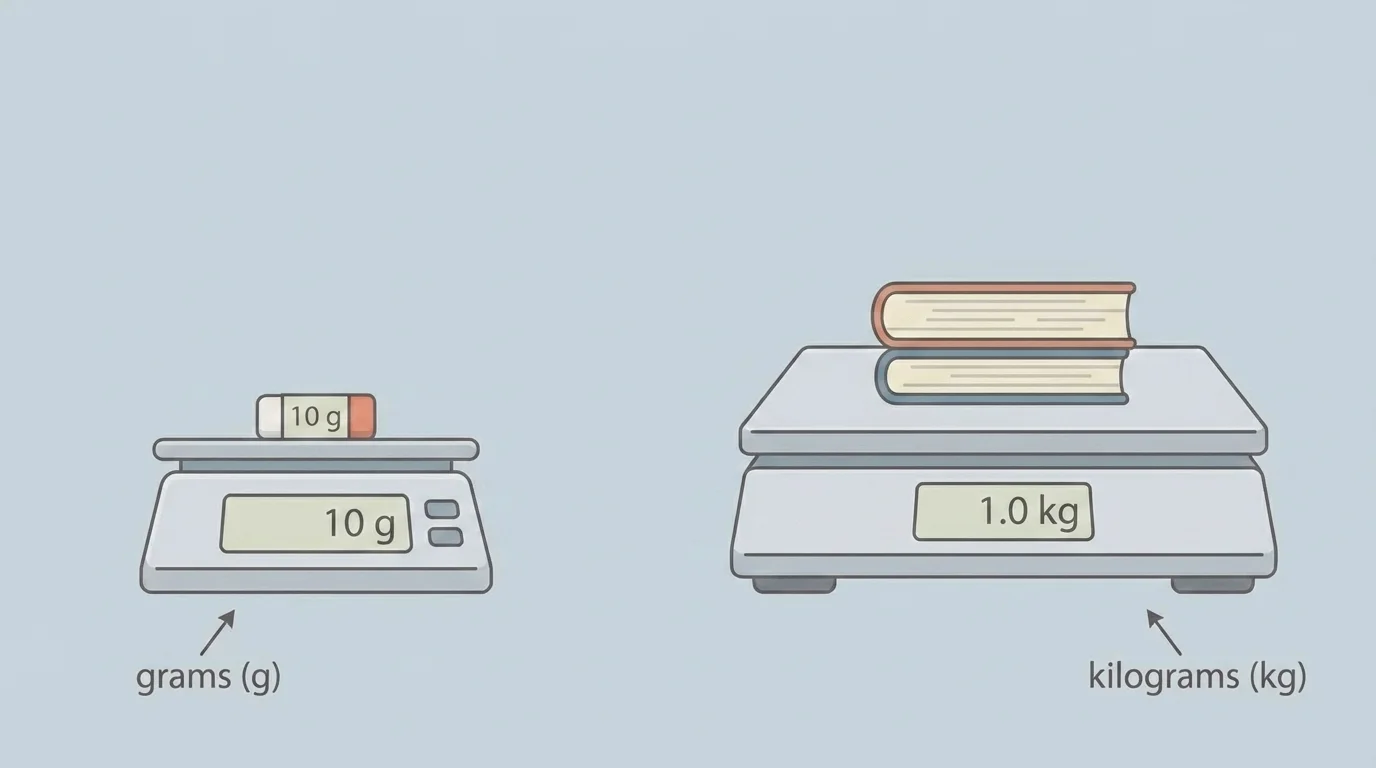
Mass measurements are useful in science when we describe matter. A cup of sand, a block of wood, and a bottle of water can all be measured and compared. If two containers look the same size, their masses may still be different because they contain different materials.
Comparing measured masses
Step 1: Look at the two measurements.
A science book has a mass of \(700 \textrm{ g}\). A laptop has a mass of \(2 \textrm{ kg}\).
Step 2: Write them in the same unit.
Since \(2 \textrm{ kg} = 2{,}000 \textrm{ g}\), the laptop has a mass of \(2{,}000 \textrm{ g}\).
Step 3: Compare.
Because \(2{,}000 \textrm{ g} > 700 \textrm{ g}\), the laptop has more mass.
Using standard units makes the comparison simple and accurate.
Later, when scientists collect samples of rocks, soil, or salt, they can compare masses from different places because everyone uses the same units.
Time tells how long something lasts or when something happens. Standard units of time include seconds, minutes, hours, and days. A blink may last about \(1 \textrm{ s}\). Recess may last \(20 \textrm{ min}\). A school day may last about \(6 \textrm{ h}\).
Clocks and timers help us measure time. Standard time is important because natural events happen over different lengths of time. Rain can fall for \(15 \textrm{ min}\), a plant may grow over many weeks, and a glacier forms over much longer periods.
We can also compare time using number relationships. For example, \(1 \textrm{ min} = 60 \textrm{ s}\), and \(1 \textrm{ h} = 60 \textrm{ min}\). So if a student reads for \(30 \textrm{ min}\), that is half of an hour because \(30 = \dfrac{60}{2}\).
Some scientific events happen so fast that they are measured in tiny parts of a second, while changes in Earth's surface can take thousands or millions of years.
Time measurements help scientists organize observations. If a puddle evaporates in \(3 \textrm{ h}\) on a sunny day and in \(7 \textrm{ h}\) on a cloudy day, the time data help explain how weather affects water.
As [Figure 2] illustrates, temperature tells how hot or cold something is. Scientists often use degrees Celsius, written as \(^\circ\textrm{C}\). A thermometer measures temperature. Different temperatures help us compare ice water, room air, and warm liquids.
Water freezes at about \(0^\circ\textrm{C}\) and boils at about \(100^\circ\textrm{C}\) under normal conditions. Room temperature is often around \(20^\circ\textrm{C}\) to \(25^\circ\textrm{C}\). If a day is \(10^\circ\textrm{C}\), it feels cooler than a day that is \(30^\circ\textrm{C}\).
Temperature is very important in Earth science. It affects snow, rain, evaporation, melting ice, and ocean conditions. If the air warms above \(0^\circ\textrm{C}\), snow and ice may begin to melt. That changes where freshwater is stored on Earth.
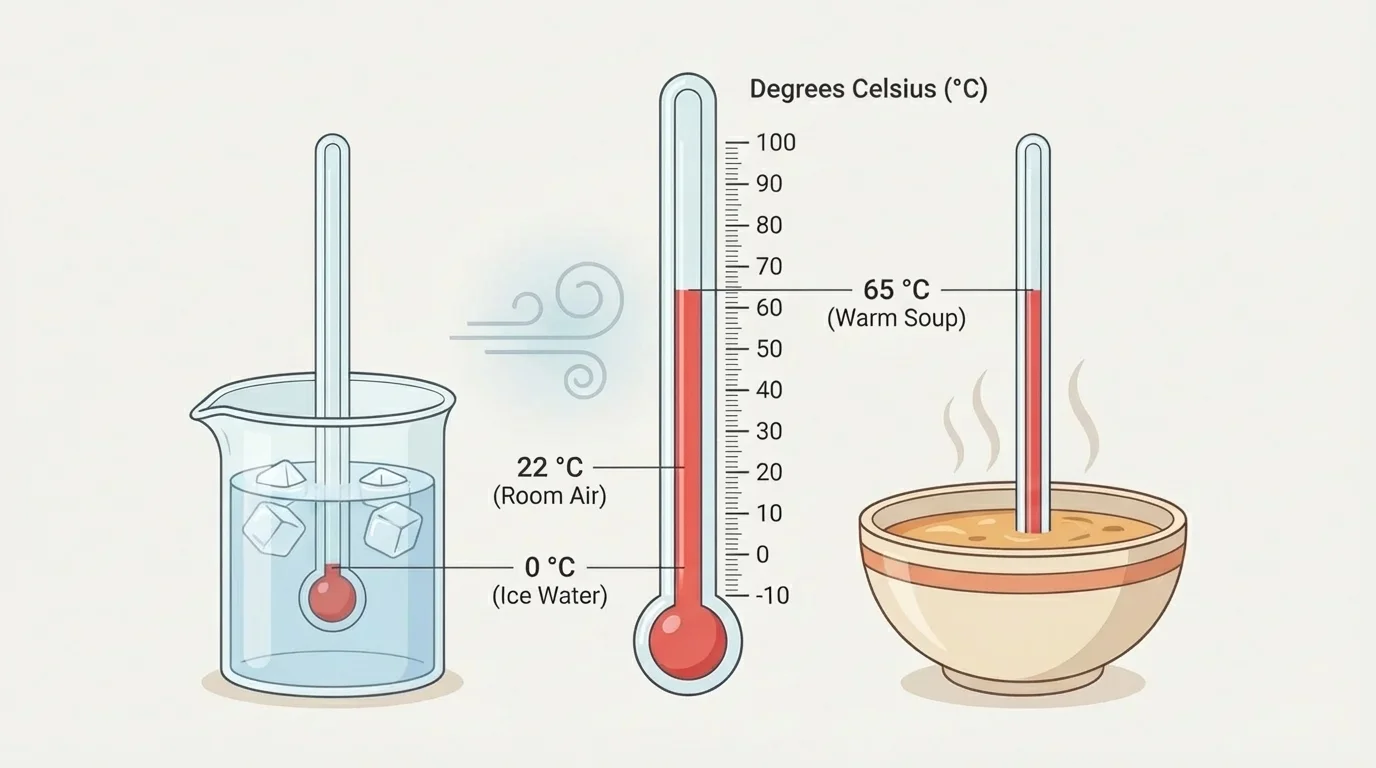
Temperature also helps us describe matter. Water can be solid ice, liquid water, or water vapor, depending on temperature. The chemical formula for water is \(\textrm{H}_2\textrm{O}\), and the same substance can change state when temperature changes.
Reading temperature values
Step 1: Compare two temperatures.
A lake surface is \(12^\circ\textrm{C}\). A swimming pool is \(24^\circ\textrm{C}\).
Step 2: Find the difference.
\(24 - 12 = 12\)
Step 3: State the result with the unit.
The pool is \(12^\circ\textrm{C}\) warmer than the lake surface.
This shows how standard units help us describe differences clearly.
Weather reports use the same unit every day so people can understand changes over time. That is another reason standard units matter.
Volume is the amount of space something takes up. For liquids, volume is often measured in liters and milliliters. A large bottle of juice might hold \(1 \textrm{ L}\). A small medicine cup might hold \(10 \textrm{ mL}\).
The relationship between these units is \(1 \textrm{ L} = 1{,}000 \textrm{ mL}\). That means \(500 \textrm{ mL}\) is half of a liter, since \(500 = \dfrac{1{,}000}{2}\).
Scientists measure liquid volume when they study rainfall, river water, or water samples. In class, a graduated cylinder helps measure liquid amounts more exactly than just guessing by looking at a container.
If one beaker holds \(250 \textrm{ mL}\) of water and another holds \(750 \textrm{ mL}\), together they hold \(250 \textrm{ mL} + 750 \textrm{ mL} = 1{,}000 \textrm{ mL}\), so the total is \(1 \textrm{ L}\).
Why volume matters for water on Earth
When scientists talk about reservoirs of water on Earth, they mean places where water is stored, such as oceans, glaciers, groundwater, lakes, rivers, and the atmosphere. To compare these reservoirs fairly, scientists use standard units of volume and also use percentages.
Volume measurements help us understand which reservoirs contain the most water and which contain only tiny amounts.
Earth has a huge amount of water, but it is not spread evenly. Most of Earth's water is saltwater in the oceans. Only a small part is freshwater. Then, even within freshwater, most is not easy to use right away. A large share of freshwater is stored in ice and underground, while only a very small amount is found in lakes and rivers.
As [Figure 3] shows, scientists often describe Earth's water using percentages. A simple model shows that about \(97\%\) of Earth's water is saltwater and about \(3\%\) is freshwater. These are rounded values, but they help us understand the pattern.
Inside that \(3\%\) freshwater, much is frozen in glaciers and ice caps, and much is underground as groundwater. Only a tiny amount is surface water in lakes, rivers, and streams. This means that even though Earth looks like a watery planet, the water people can easily use is a very small part of the total.
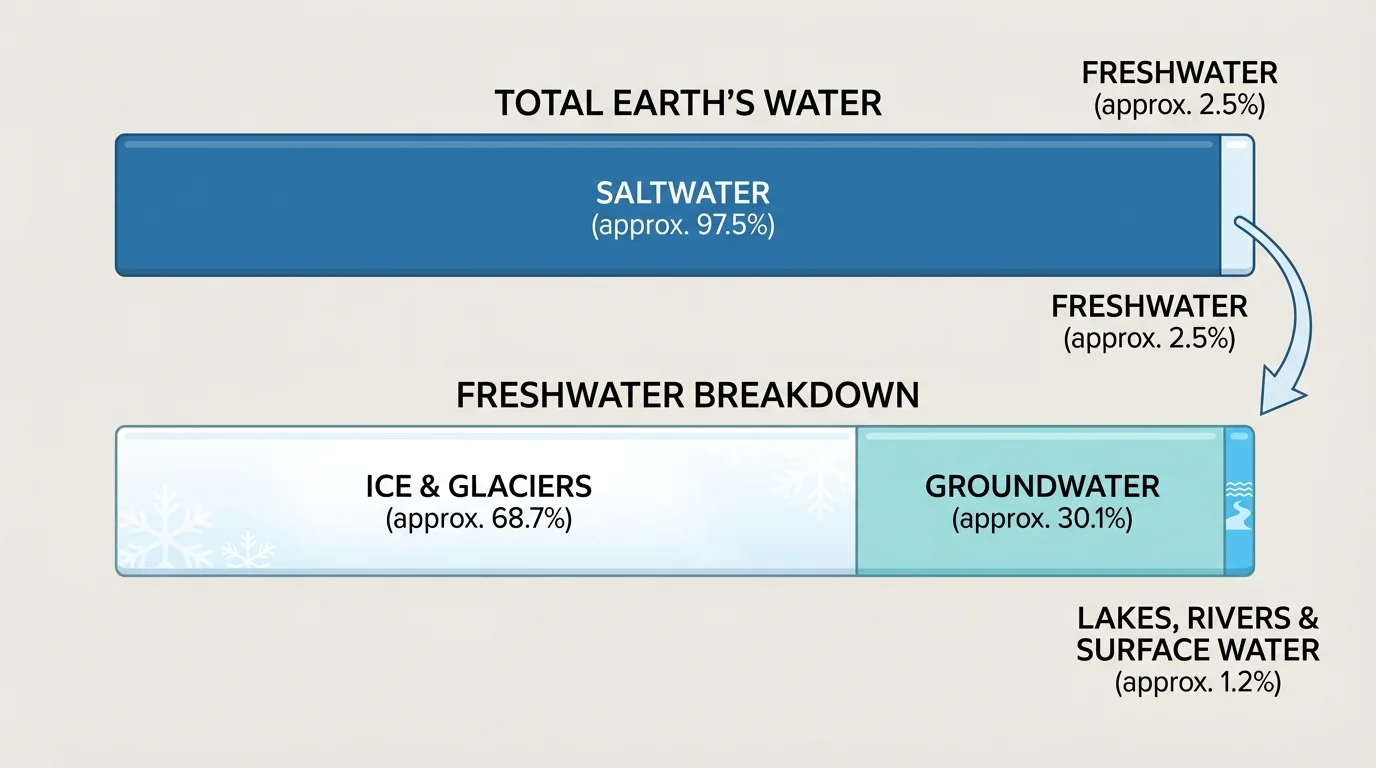
Scientists use standard measurements to compare these reservoirs. If one group used liters, another used gallons, and another used made-up units, their data would be hard to combine. Shared units let scientists describe the distribution of water on Earth in a way that others can understand.
Using percentages to describe Earth's water
Step 1: Start with a simple total.
Pretend Earth has \(100\) equal water parts.
Step 2: Separate saltwater and freshwater.
If \(97\) parts are saltwater, then \(3\) parts are freshwater.
Step 3: Explain what that means.
Out of every \(100\) parts of water on Earth, only \(3\) parts are freshwater.
This model helps students picture the uneven distribution of water.
The same idea helps explain why water conservation is important. The small freshwater share must support people, plants, animals, and ecosystems.
Once scientists measure something, they often organize the data in a table or graph. Graphs make patterns easier to see. For example, if we compare saltwater and freshwater, a bar graph can quickly show that the saltwater bar is much taller.
Here is a simple table using rounded percentages for Earth's water:
| Water reservoir | Approximate amount | Type of water |
|---|---|---|
| Oceans | \(97\%\) | Saltwater |
| Glaciers and ice caps | part of the \(3\%\) freshwater | Freshwater |
| Groundwater | part of the \(3\%\) freshwater | Freshwater |
| Lakes and rivers | very small part of the \(3\%\) freshwater | Freshwater |
Table 1. A simplified table showing how Earth's water is distributed among major reservoirs.
A graph is useful because our eyes notice differences in size quickly. If a bar graph uses one bar for \(97\%\) ocean water and another for \(3\%\) freshwater, the difference is easy to spot. Scientists use graphs to communicate evidence.
Standard units and standard ways of showing data work together. First, you measure carefully. Then, you organize the data. Finally, you describe what the data show.
You may already know that water moves through the water cycle by evaporation, condensation, precipitation, and collection. Measurements of time, temperature, and volume help scientists track these changes.
When a scientist says a reservoir has more water, they are not just guessing. They use measurements and evidence to support that statement.
Standard units are used far beyond science class. In cooking, people measure volume so recipes turn out the same way each time. In sports, time is measured to decide race results. In weather reports, temperature is measured so people know what to wear. In medicine, small liquid volumes must be measured carefully so the correct amount is given.
Environmental scientists use mass, temperature, time, and volume together. They may measure how much rain falls, how warm a stream becomes, how long a drought lasts, or how much salt is dissolved in a water sample. Salt is often present as sodium chloride, written as \(\textrm{NaCl}\). If ocean water has more dissolved salt than river water, the measurements help explain why ocean water is saltwater and river water is freshwater.
As we saw earlier in [Figure 1], shared units allow fair comparison. The same idea works for water studies: scientists can compare a river sample from one place to a lake sample from another if both are measured with the same tools and units.
"What gets measured can be described, compared, and understood more clearly."
Standard units help turn observations into evidence. Evidence is what allows scientists to explain patterns in matter and in Earth's systems. Whether measuring the mass of a rock, the time of a storm, the temperature of water, or the volume of freshwater in a lake, shared units make science trustworthy and useful.
