Have you ever noticed that your day is full of signals? A doorbell rings in a pattern, a traffic light changes in a pattern, a phone sends messages using patterns of electronic signals, and a package in a store may have a barcode or QR code label that a scanner reads. These are not random marks or sounds. They are organized on purpose. People design products with patterns so that information can be sent, received, and understood.
A pattern is something that repeats or follows a rule. It might be made of sounds, colors, shapes, flashes, or movements. A pattern can be very simple, like red-yellow-green on a traffic light. It can also be more complex, like the tiny black-and-white squares in a QR code or the invisible electronic signals used by a television remote.
A designed product is something people create to solve a problem or do a job. A flashlight, barcode label, walkie-talkie, smoke alarm, and remote control are all designed products. Engineers and inventors think carefully about what patterns these products should use. The pattern must be clear enough for people or machines to understand.
When we look for similarities and differences, we can sort and classify products. Sorting means putting things into groups. Classifying means grouping them by important features, such as shape, signal type, or purpose. Scientists and engineers often do this because it helps them compare designs and choose the best one for a job.
Pattern means something that repeats or follows a rule.
Sort means to put things into groups.
Classify means to group things by shared features.
Designed product means something made by people to solve a problem or do a task.
Patterns are useful because they make information easier to notice. If a signal changed in a messy, random way, it would be hard to understand. But if the signal follows a pattern, people can learn what it means. That is why warning sounds, signal lights, and printed codes are designed so carefully.
Some patterns are easy to see. A crosswalk has repeating stripes. A barcode has lines with different widths and spaces. A QR code has small black and white shapes arranged in a special way. Other patterns are easy to hear. A fire alarm may beep again and again. A school bell may ring in one pattern for class change and another for an emergency.
Patterns can also be hidden inside technology. A phone call travels as electronic signals. Those signals follow rules so that sound can move from one phone to another. A remote control sends information using light, often infrared light that our eyes cannot see. Even though we cannot see that light directly, it still carries a pattern.
To understand a pattern, we can ask questions such as: What repeats? What changes? How fast does it repeat? Is the pattern made of long and short sounds, or bright and dim lights, or large and small shapes? These questions help us notice the features we can use for sorting and classifying.
Patterns do more than look interesting. They can send a message. In technologies for communication, a signal is something that carries information from one place to another. Sound signals, light signals, and electronic signals can all work this way. [Figure 1] shows this basic idea using short and long flashes or beats that can stand for different messages.
Think about a flashlight. One short flash might mean "yes," while two short flashes might mean "no." A long flash might mean "help." The flashlight is the product, but the flashing pattern is what carries the information. If the pattern changes, the message changes too.
The same thing can happen with sound. A drumbeat pattern, a bell pattern, or a series of beeps can all send information. For example, a smoke alarm often uses a repeated loud beep pattern so people notice danger quickly. A microwave may use a different sound pattern to mean food is ready. The products are different, but both use sound patterns to communicate.
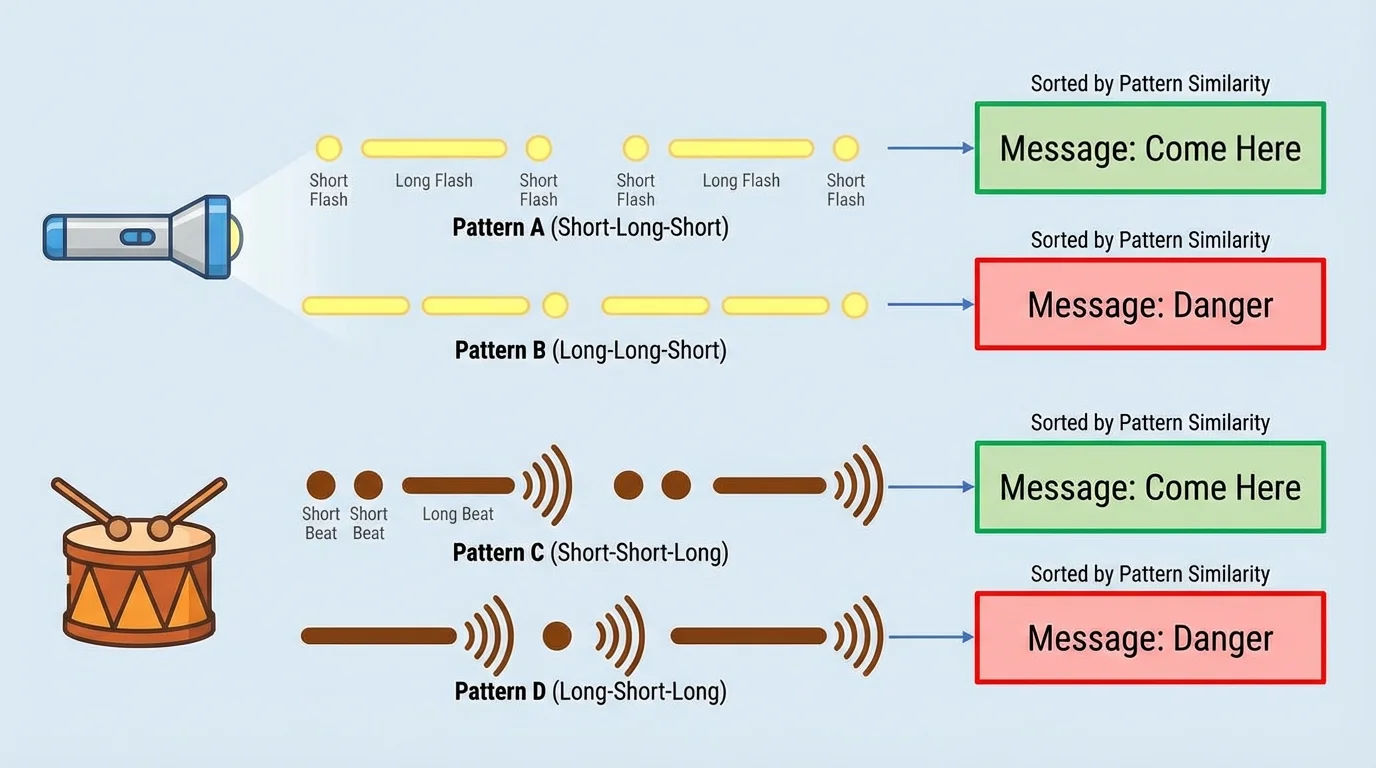
Light patterns are also common in safety products. Traffic lights use color sequences. Turn signals on a car blink on and off. Emergency vehicles often flash red and blue lights in repeating ways. These patterns help people understand what to do even from far away.
Machines can read patterns too. A scanner reads the lines of a barcode. A phone camera reads the arrangement of squares in a QR code. In both cases, the printed pattern stores information. A tiny change in the arrangement may mean a different item, website, or number. That is why printed information patterns must be exact.
How a pattern becomes a message
A message can be carried when a product uses a rule-based pattern that another person or machine knows how to read. The product does not need words. It can use flashes, beeps, lines, or color changes. If the sender and receiver both understand the rule, the pattern transfers information successfully.
This is why engineers test communication products carefully. They ask whether the pattern is easy to detect, easy to repeat, and hard to confuse with another pattern. If two signals are too similar, people may mix them up. Clear differences help messages stay accurate.
[Figure 2] When engineers compare products, they often begin by looking for similar features. Products can be grouped by the kind of pattern they use, such as repeating color sequences, printed line patterns, or square code patterns. Similarities help us notice that different products may solve similar problems.
For example, a barcode and a QR code look different, but both are printed patterns that store information for a machine to read. A traffic light and a pedestrian crossing signal also look different, but both use light patterns to guide people safely. A doorbell and a school bell both use sound patterns to communicate.
We can sort products by many kinds of similarities. We might group them by signal type: sound, light, or printed pattern. We might group them by purpose: warning, direction, identification, or entertainment. We might also group them by who reads them: people, machines, or both.
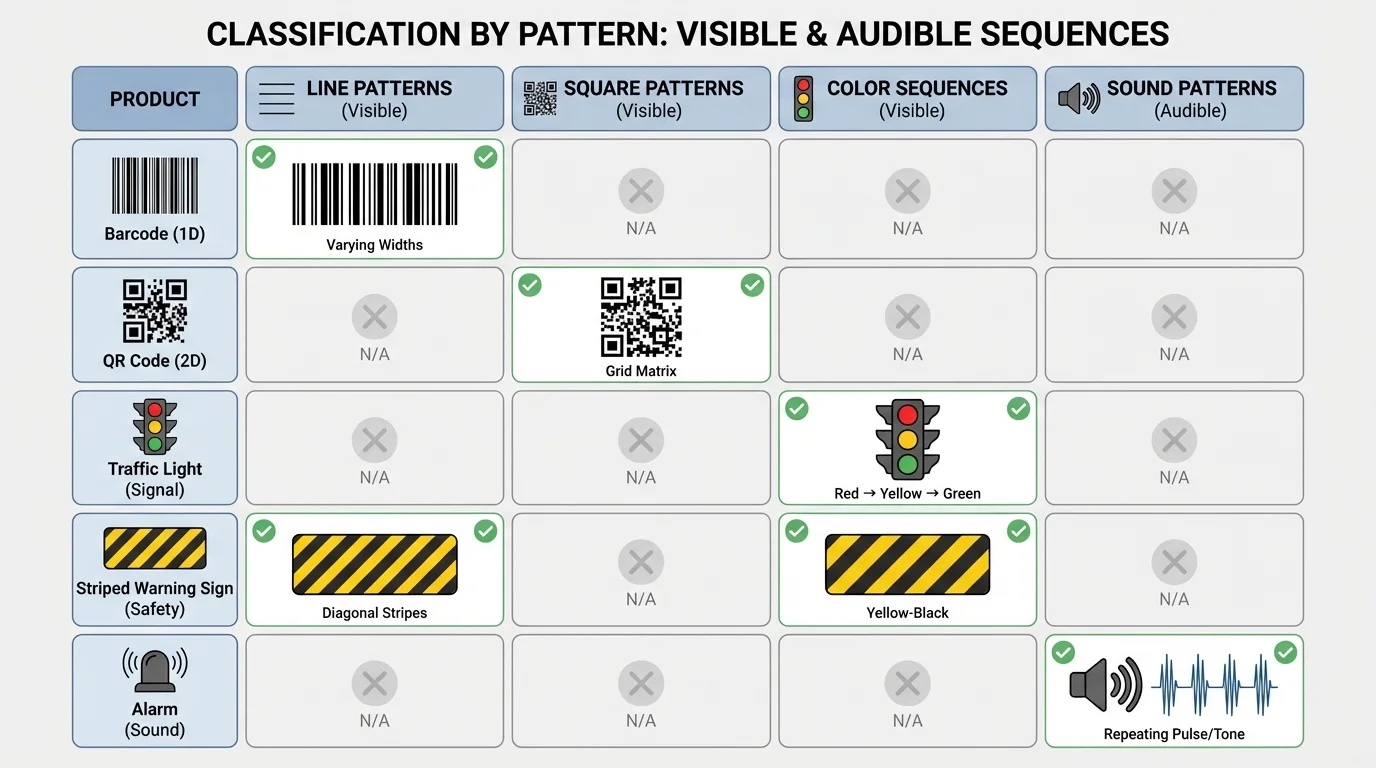
Here is one simple way to classify designed products:
| Product | Main Pattern Type | Who Reads It | Main Purpose |
|---|---|---|---|
| Barcode | Lines and spaces | Machine | Identify item |
| QR code | Black and white squares | Machine | Store digital information |
| Traffic light | Color sequence | People | Control movement |
| Smoke alarm | Repeated beeps | People | Warning |
| Remote control | Light pulses | Machine | Send command |
Table 1. Examples of designed products classified by the type of pattern they use, who reads the pattern, and the product's purpose.
Notice that products in the same group may not look exactly alike. Classification does not mean everything in a group is identical. It means they share important pattern features. That is useful because it helps us make sense of many products quickly.
Differences matter just as much as similarities. If all alarms sounded exactly the same, it would be hard to know what kind of warning you were hearing. If every code looked the same, scanners could not tell one item from another. Small differences can change meaning.
A difference might be in color, timing, size, spacing, or order. For example, a barcode with one set of line widths stands for one product, while a different arrangement stands for another. A pattern of three short beeps may mean one thing, while a long beep followed by a short beep may mean something else.
This is also true with light signals. A flashing yellow light and a solid red light are both signals, but they give different instructions. A car's left turn signal and right turn signal blink in similar ways, yet their positions help people tell them apart. The design must make the difference clear enough for quick understanding.
Engineers study differences so they can avoid confusion. They ask questions such as: Are two signals too much alike? Can people recognize them in bright sunlight, darkness, or noisy places? Can a machine read the pattern correctly every time? Good design makes important differences easy to notice.
Some remote controls send information using very fast light pulses that people cannot see, but a phone camera may sometimes detect them. Hidden patterns are still patterns if they follow a rule and carry information.
The same idea still applies here: when the pattern changes, the message can change. That is why clear differences in signals are a big part of safe and useful product design.
[Figure 3] The same message can often be sent by different products using different patterns. This helps engineers compare multiple solutions and think about which one works best in a certain situation.
Suppose the message is "stop." One solution is a red light. Another is a handheld sign. Another is a beeping device with a warning pattern. All three are designed products that send information, but they use different types of patterns. The red light uses color. The sign uses shape, color, and printed symbols. The beeping device uses sound timing.
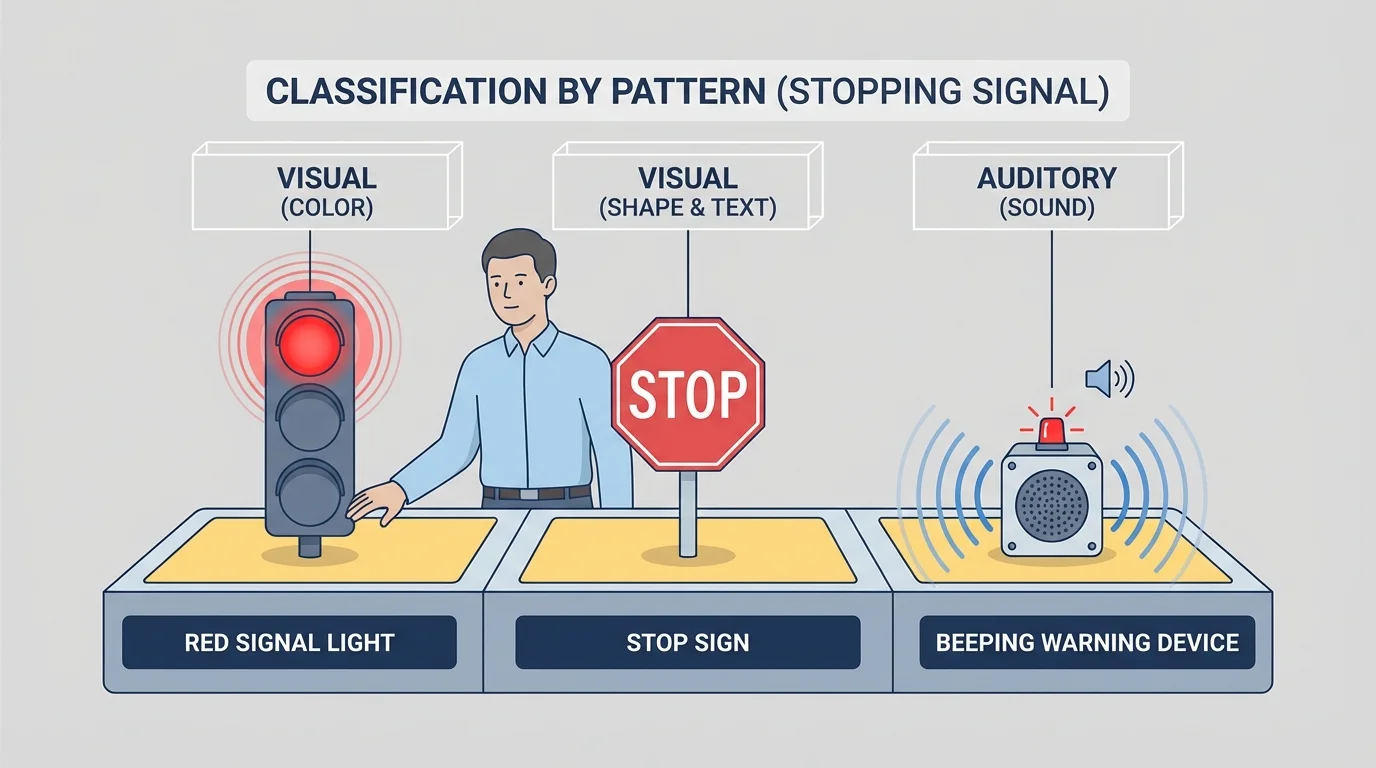
Now think about the strengths and weaknesses of each solution. A red light is easy to see at night and from a distance. A sign can be useful in daylight and can include extra details. A sound signal can help when people are not looking in the right direction. Engineers compare products like this to decide which design fits the job.
Sometimes the best solution uses more than one pattern. A railroad crossing may have flashing lights, a gate arm, and a bell. These work together so the warning is more noticeable. If one pattern is missed, another may still be noticed.
Case study: Choosing a signal for a bike path crossing
A town wants to warn both walkers and cyclists when a path crosses a busy road.
Step 1: List possible products.
The town considers a flashing light, a striped sign, and a beeping signal.
Step 2: Compare the patterns.
The flashing light uses a repeating light pattern. The striped sign uses a visible line pattern. The beeping signal uses a repeated sound pattern.
Step 3: Match the solution to the need.
Because some people may be looking ahead while others may not, a light plus a sign may work better than only one signal.
This comparison shows that products can be sorted by pattern type and then judged by how well the pattern communicates information.
Later, when engineers improve a product, they may return to the same comparison chart from earlier ideas, like the grouping in [Figure 2], to see whether the new design belongs in the same class or solves the problem in a different way.
Stores classify products with barcodes and package designs. Roads use lane markings, signs, and signals that can be sorted by their visible patterns. Schools use bells and alarm sounds that can be grouped by sound pattern and purpose. Hospitals use monitors that beep in different ways to tell workers about different conditions.
Digital technology depends heavily on patterns. A phone screen shows icons arranged in useful ways. A computer keyboard uses repeated key layouts. Wi-Fi and radio communication use wave patterns that devices can send and receive. Even though students may not see those waves directly, the patterns are still carrying information through space.
People also classify products for safety. Warning labels often use special colors such as red, yellow, or orange. Hazard tape uses stripes. Exit signs use clear symbols and color contrast. These similarities help people recognize an important message quickly.
Differences keep those messages from blending together. For example, a fire alarm should not sound just like a timer. An emergency light should not look just like a decoration. Good classification helps designers see whether a product fits the group it belongs to, while useful differences help the product stand out when needed.
Sorting and classifying are not just ways to organize objects on a shelf. They help us understand how products work. When we group products by their patterns, we can compare them more fairly. We can ask whether two products solve the same problem, whether one is easier to understand, or whether one works better in bright light, darkness, quiet places, or noisy places.
Classification also helps engineers invent new products. If they know that several successful warning products use bright color contrast or repeated beeps, they may use similar ideas in a new design. If they know that confusion happens when patterns are too similar, they can make stronger differences.
This kind of thinking is useful for students too. When you notice how products use patterns, you begin to think like a scientist and an engineer. You are paying attention to evidence, features, and purpose instead of just saying that one object looks "nice" or "cool."
Earlier science learning about waves helps here. Sound and light can travel as waves, and those waves can be changed into patterns that carry information. Designed products use those patterns in practical ways.
Understanding patterns also helps people make smart choices. If you can classify which products are for warning, which are for identifying objects, and which are for controlling machines, you can better understand the world around you.
Sometimes comparison includes very simple counting. You might count how many times a light flashes in one pattern or how many shapes repeat in a design. For example, if Signal A flashes twice and Signal B flashes four times in the same amount of time, then Signal B repeats more often. We can write that comparison as follows:
\(4 > 2\)
If a warning strip has a repeating pattern of two colors, red and white, and another strip has three colors, black, yellow, and white, we can compare the patterns by number of repeating parts. We do not need hard math to notice that different numbers and arrangements can help classify products.
Engineers may also compare lengths of patterns. A beep-beep-pause pattern has a different timing from a long-beep-pause pattern. A code with more squares may store more information than a simpler code. Careful observation and simple comparisons help people decide what class a product belongs to.
Why exact patterns matter in technology
For products that send information, even a small pattern change can matter. A scanner may read the wrong item if printed lines are damaged. A person may misunderstand a signal if the timing is unclear. Exact patterns make communication more reliable.
That is one reason products are tested many times. Designers want to know whether the same pattern works every time and whether the receiver, either a person or a machine, understands it correctly.
To study designed products, it helps to observe in an organized way. Look at the pattern type. Ask whether it is made of light, sound, color, shape, movement, or printed marks. Then ask what information it sends, who reads it, and what other products use a similar pattern.
You can also ask what makes the product different from others in its group. Maybe the signal is louder, brighter, faster, larger, or arranged in a different order. These differences may be the key to what message the product sends.
Products all around us use patterns to solve problems. Some patterns help people move safely. Some help machines identify objects. Some help families use technology at home. When we notice similarities and differences in those patterns, we can sort and classify products in meaningful ways. That helps us understand design, communication, and the smart choices engineers make.
