Your body is doing thousands of jobs right now without asking your permission. Your lungs are moving air, your heart is pushing blood, your stomach is breaking down food, your brain is sending signals, and billions of cells are carrying out tiny chemical tasks. None of these parts works alone. A human body is a powerful example of a big system made of smaller systems, and each smaller system is made of even smaller parts.
Scientists often study living things by asking two connected questions: What are the parts? and How do the parts interact? That approach helps us understand not just bodies, but forests, coral reefs, cities, and even smartphones. A system may interact with other systems; it may have sub-systems and be part of a larger complex system. In life science, this idea is especially important because every organism depends on many levels of organization working together.
A system is a group of parts that work together to do a job. The parts of a system affect one another, and the system often has inputs and outputs. For example, a bicycle is a system: the pedals, chain, gears, wheels, and brakes all interact. If one part breaks, the whole bicycle may not work properly.
Living systems are more complex because their parts are alive or are made by living cells. A body takes in food, water, and oxygen. It releases wastes such as carbon dioxide, urine, sweat, and heat. It also responds to changes inside and outside the body. This makes the body more than just a collection of organs. It is an organized network of interacting parts.
System means a set of interacting parts that work together. A subsystem is a smaller system inside a larger one. In living things, the body is a system, organ systems are subsystems, and each organ system is made of organs, tissues, and cells.
Scientists break systems into smaller pieces so they can study them, but they also have to put the pieces back together mentally. Studying the heart alone tells us something useful. But the heart makes the most sense when we connect it to the blood, the lungs, the muscles, the brain, and the cells that need oxygen and nutrients.
To understand the body, scientists follow a pattern of organization: cells form tissues, tissues form organs, organs form organ systems, and organ systems together make an organism. This hierarchy helps us see how very small structures contribute to the work of the whole body.
A cell is the basic unit of life. Some cells are specialized for movement, some for carrying oxygen, some for sending signals, and some for protection. Groups of similar cells that work together form a tissue. For example, muscle tissue contains cells that can contract, and nervous tissue contains cells that send electrical signals.
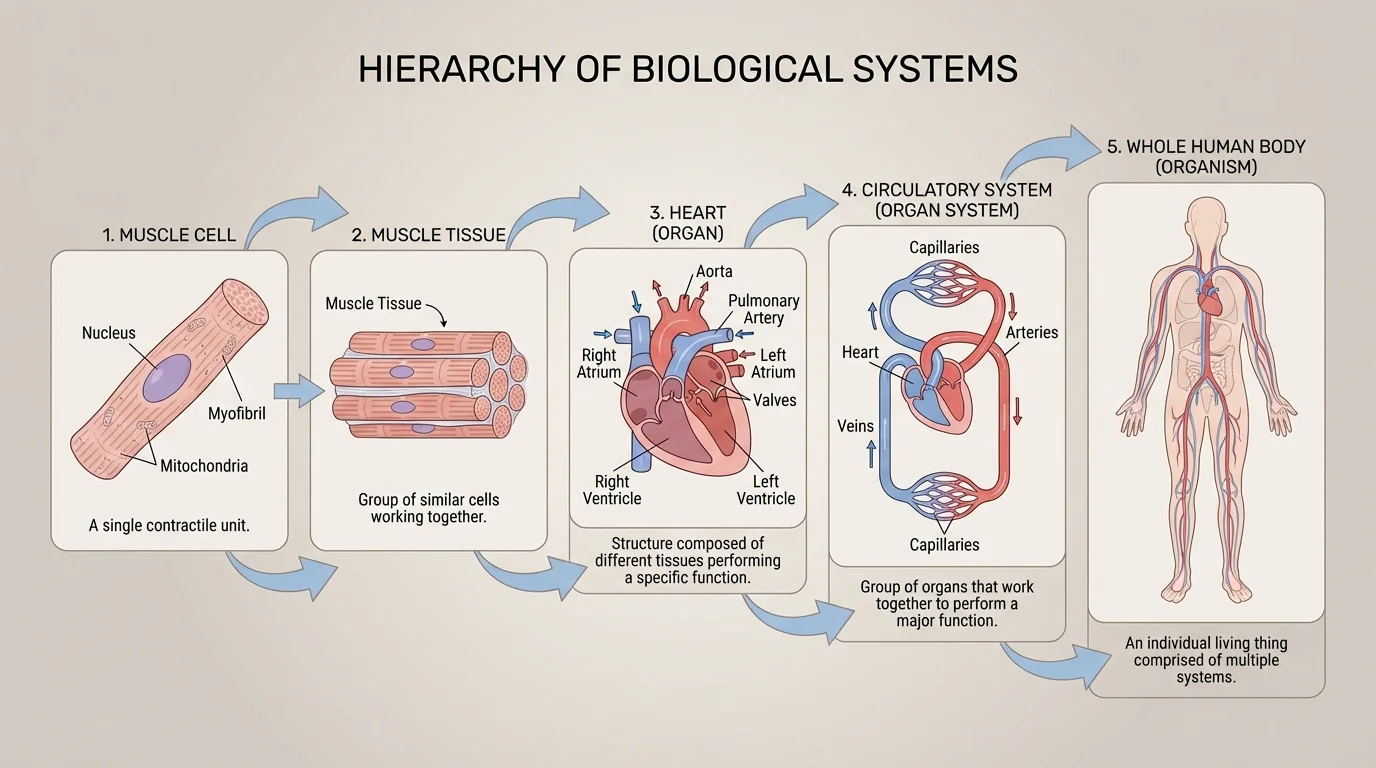
An organ is a structure made of different tissues working together. The stomach, lungs, skin, and heart are organs. The heart contains muscle tissue, nervous tissue, blood vessels, and connective tissue. Because these tissues interact, the heart can contract, respond to signals, and move blood.
A group of organs that work together forms an organ system. For example, the circulatory system includes the heart, blood, and blood vessels. The digestive system includes the mouth, esophagus, stomach, intestines, liver, and pancreas. Each organ system has a main job, but it cannot do that job in isolation.
The hierarchy in [Figure 1] matters because it shows that a whole organism is built from smaller levels. If cells are damaged, tissues may fail. If tissues fail, organs may not function correctly. If organs fail, an entire organ system can be affected.
Your body contains trillions of cells, and many of them are replaced over time. Some skin cells live only a short time, while many nerve cells can last for years.
This cell-to-organism pattern is not limited to humans. Plants also have cells, tissues, and organs. A leaf is an organ made of tissues that capture light, move gases, and transport water. The plant's root and shoot systems are subsystems inside the larger plant system.
The body is not a set of separate machines. It is a web of connected subsystems. The digestive system gets nutrients from food, the respiratory system brings in oxygen, the circulatory system transports materials, and the urinary system removes certain wastes. Each system depends on the others.
Think about what happens after lunch. The digestive system breaks food into smaller molecules such as glucose from carbohydrates, amino acids from proteins, and fatty acids from fats. These molecules enter the blood. The respiratory system brings oxygen into the lungs, and oxygen enters the blood there. Then the circulatory system carries both nutrients and oxygen to body cells, where the materials are used for energy, growth, and repair.
If cells use glucose and oxygen for cellular respiration, they release energy and also produce wastes such as \(\textrm{CO}_2\) and water. The carbon dioxide is carried by the blood back to the lungs and breathed out. This means the digestive, respiratory, and circulatory systems are interacting all the time.
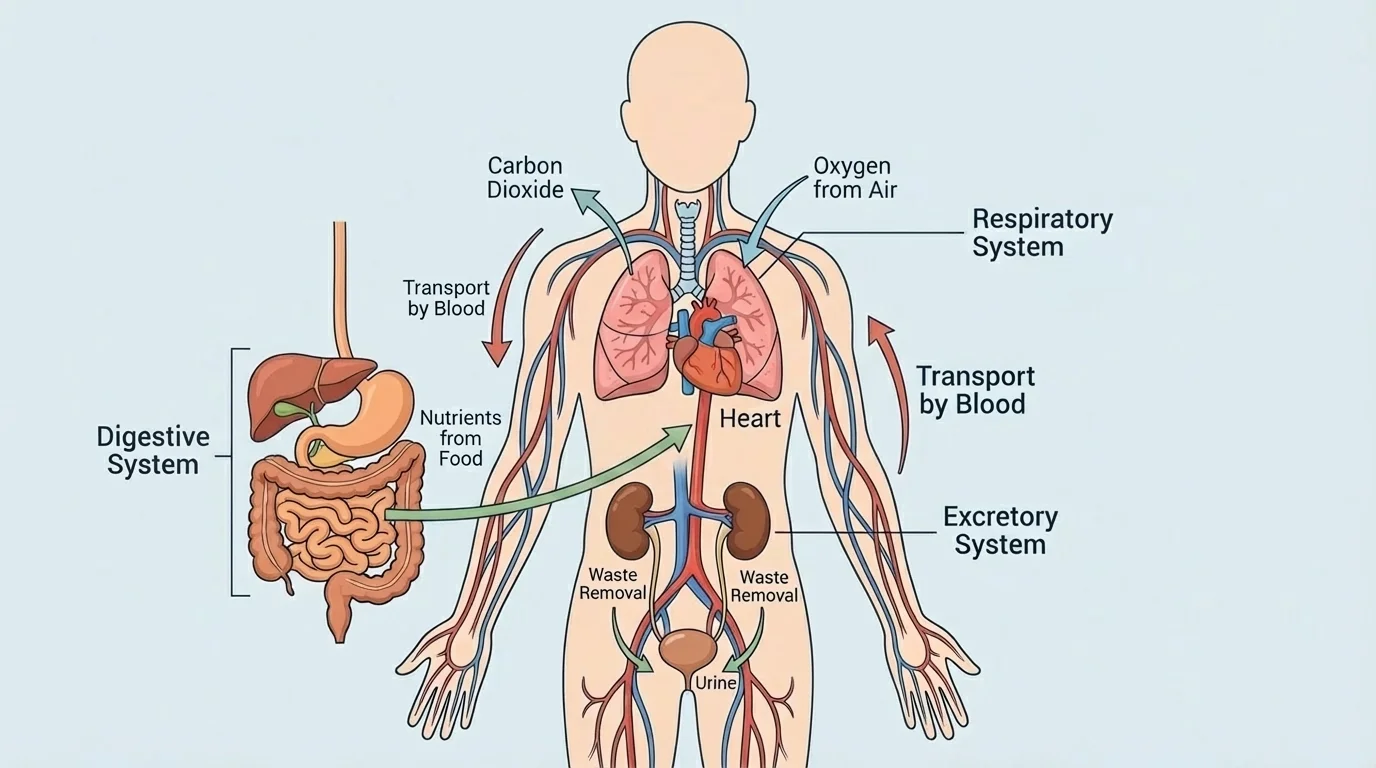
The circulatory system is especially important because it connects many other systems. Blood carries oxygen from the lungs, nutrients from the small intestine, hormones from glands, heat through the body, and wastes toward organs that remove them. In a sense, blood is part transport network and part communication network.
The nervous system also links body subsystems. It detects information, processes it, and sends signals. If you touch a hot pan, your nervous system quickly causes muscles to pull your hand away. At the same time, your brain interprets pain, and your circulatory system may change blood flow to the area as healing begins.
The musculoskeletal system is another interacting subsystem. Muscles need oxygen and nutrients from the blood, instructions from nerves, and support from bones and joints. Bones are not just hard supports; they also protect organs and contain marrow, where many blood cells are made.
When we revisit the pathway in [Figure 2], it becomes clear that no body system works alone for long. Even a simple action like climbing stairs requires breathing, circulation, muscle contraction, bone movement, nerve control, and energy release inside cells.
Why interaction matters
An organ system can be described by its main function, but its actual performance depends on connections. The digestive system may absorb nutrients well, but cells still cannot use those nutrients unless the circulatory system delivers them. The respiratory system may bring in oxygen, but oxygen still must travel through the blood to reach muscles, organs, and brain cells.
Real-world medicine depends on this idea. Doctors do not only ask, "Which organ is affected?" They also ask, "Which other systems might be affected next?" A heart problem can change kidney function. A lung problem can reduce oxygen to the brain. A digestive problem can leave muscles without enough fuel.
Systems interact by exchanging matter and energy. Matter includes substances such as oxygen, water, nutrients, salts, and wastes. Energy in food is stored in chemical bonds, such as those in glucose, \(\textrm{C}_6\textrm{H}_{12}\textrm{O}_6\). Cells can release some of that energy through cellular respiration.
A simplified chemical equation for cellular respiration is:
\[\textrm{C}_6\textrm{H}_{12}\textrm{O}_6 + 6\textrm{O}_2 \rightarrow 6\textrm{CO}_2 + 6\textrm{H}_2\textrm{O} + \textrm{energy}\]
This equation shows that glucose and oxygen are inputs, while carbon dioxide, water, and released energy are outputs. For a numeric example, one molecule of glucose reacts with \(6\) molecules of oxygen to form \(6\) molecules of carbon dioxide and \(6\) molecules of water. Students do not need to memorize every detail of this equation yet, but it helps show that body systems are linked by matter moving from place to place and changing form.
Your digestive system supplies glucose. Your respiratory system supplies oxygen. Your circulatory system delivers both to cells. Then the circulatory and respiratory systems help remove \(\textrm{CO}_2\). This is a clear example of interacting subsystems composed of groups of cells.
Real-world example: sprinting across a field
A student runs hard for \(20\) seconds during a soccer game.
Step 1: The musculoskeletal system increases activity.
Muscle cells need more energy because they are contracting faster and more often.
Step 2: The respiratory and circulatory systems respond.
Breathing rate rises, heart rate increases, and more oxygen-rich blood travels to the leg muscles.
Step 3: The nervous system helps coordinate the response.
The brain and nerves adjust breathing, heartbeat, balance, and movement.
This event makes sense only when several systems are considered together.
Water is another important example. Water helps transport substances in blood, regulates temperature through sweat, and supports chemical reactions inside cells. Too little water in the body affects many systems at once.
Living systems must stay within safe ranges. The body uses homeostasis, which means keeping internal conditions relatively stable even when the environment changes. Body temperature, blood sugar, and water balance are examples.
Many control processes work through feedback. In a feedback loop, a change is detected, information is processed, and a response helps correct the change. If body temperature rises, the brain detects the change and signals sweat glands to produce sweat. Blood vessels near the skin may widen, helping heat leave the body.
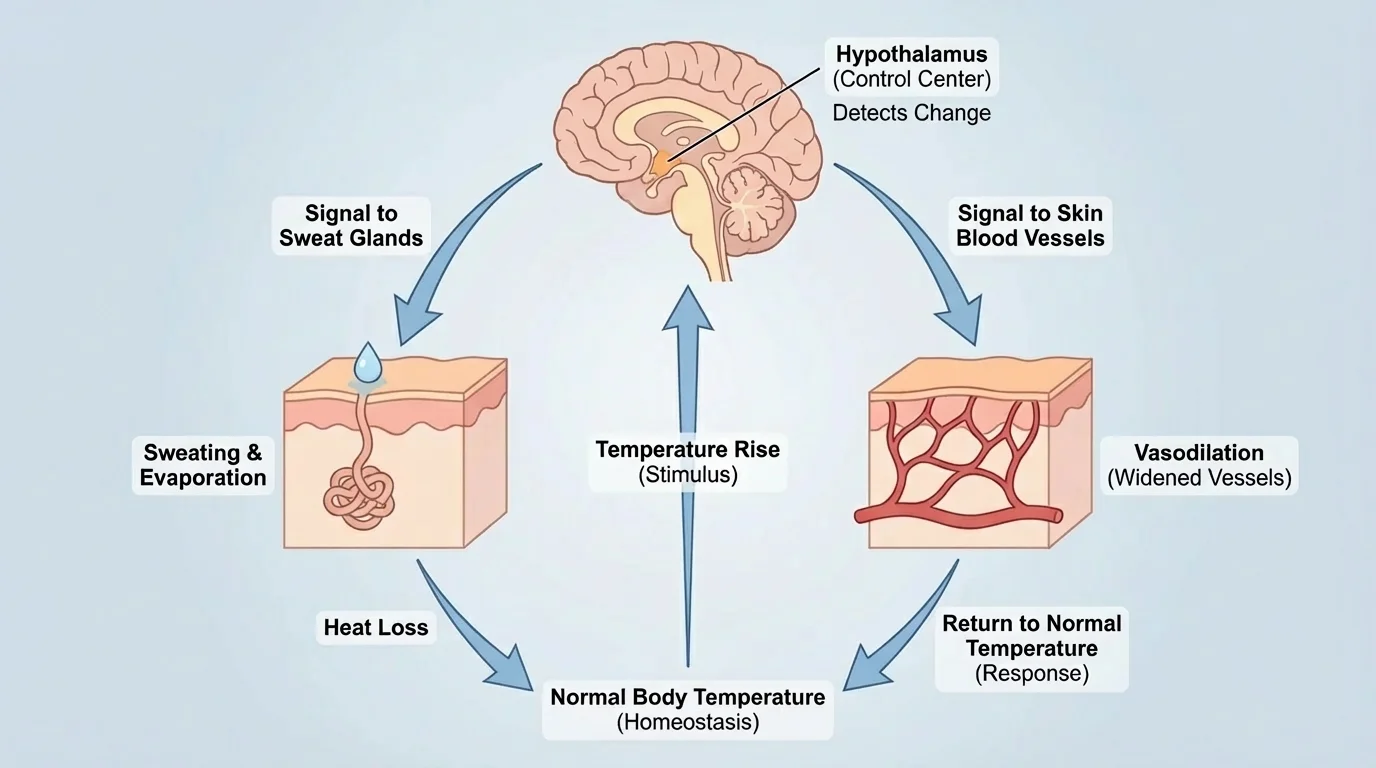
If body temperature drops, different responses happen. Muscles may shiver, which releases heat, and blood vessels near the skin may narrow to reduce heat loss. Notice that this involves the nervous system, muscular system, circulatory system, and skin working together.
Hormones also help regulate the body. The endocrine system releases chemical messengers into the blood. For example, insulin helps control the amount of glucose in the blood. This is another case where one subsystem communicates with others to keep the larger system stable.
Cells need certain conditions to survive, including enough water, a proper temperature range, and a supply of nutrients and oxygen. Organ systems help keep those conditions stable for the body's cells.
The temperature loop in [Figure 3] is useful because it shows that body control is not just about one organ giving an order. It is about signals, responses, and corrections moving among several interacting parts.
One of the strongest pieces of evidence that the body is made of interacting subsystems is that a problem in one area often spreads. If the respiratory system cannot bring in enough oxygen, muscles become weaker and the brain may have trouble concentrating. If the circulatory system fails to move blood well, organs throughout the body are affected.
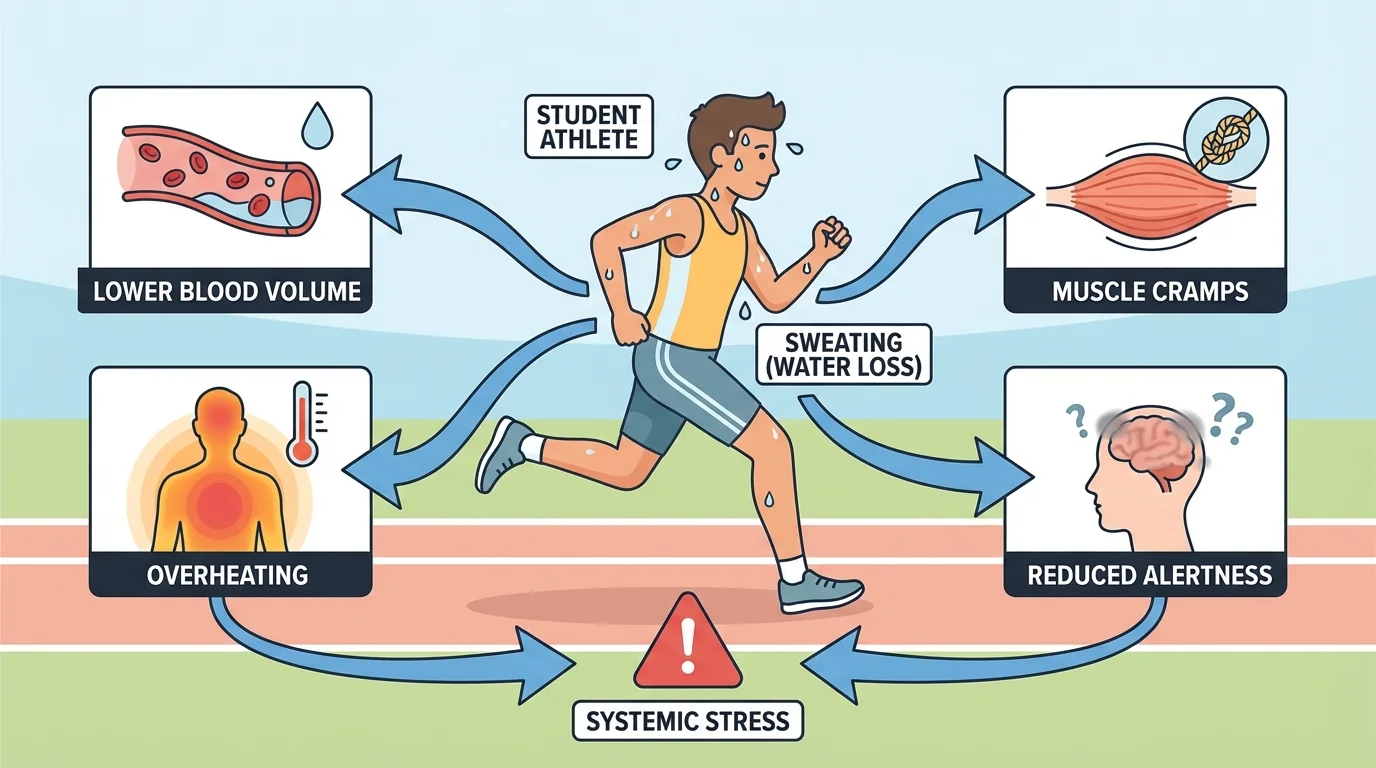
Dehydration during exercise is a clear example. When too much water is lost in sweat and not replaced, blood volume can drop. The heart has to work harder to move blood. Less cooling may occur through sweating, so body temperature can rise. Muscles may cramp, and the brain may receive signals that make a person feel dizzy or tired.
Infection is another example. If bacteria or viruses affect one organ, the immune system responds. Fever may develop, appetite may change, energy use may rise, and many body systems may shift their activity. What starts locally can become system-wide.
Broken bones also show system interaction. A fracture is an injury to the skeletal system, but nerves detect pain, blood vessels may be damaged, muscles may spasm, and the immune system helps begin the repair process. Healing requires cells, tissues, and organ systems to cooperate.
The athlete example in [Figure 4] also helps explain why coaches emphasize water, rest, and breathing. Good performance depends on many subsystems staying coordinated, not just on having strong muscles.
| Subsystem | Main role | How it interacts with others |
|---|---|---|
| Digestive | Breaks down food and absorbs nutrients | Provides materials carried by blood to cells |
| Respiratory | Takes in oxygen and removes \(\textrm{CO}_2\) | Works with blood to exchange gases |
| Circulatory | Transports substances | Links nearly all body systems |
| Nervous | Detects, processes, and sends signals | Coordinates responses across systems |
| Musculoskeletal | Supports movement and protection | Needs oxygen, nutrients, and nerve signals |
| Urinary | Removes liquid wastes and helps balance water | Helps maintain stable internal conditions |
The body is itself a system, but it is also part of larger systems. A person depends on family, community, food systems, water systems, health care systems, and ecosystems. For example, the respiratory system depends on clean air from the environment. The digestive system depends on agriculture and food distribution. Human health is connected to the larger world.
Medical technology is another example of systems interacting with systems. A pulse oximeter measures oxygen in the blood, connecting engineering with body function. A pacemaker interacts with the heart's electrical system. An inhaler helps open airways in the respiratory system. These tools are designed by understanding how the body's subsystems work together.
Artificial organs and prosthetic limbs are built by engineers who study both biology and mechanics. To design them well, they have to understand how body systems interact with motion, signals, and materials.
Ecosystems also contain systems within systems. A forest has organisms, populations, food webs, water cycles, and nutrient cycles. Each organism in that forest, including an animal or plant, is also made of subsystems. Nature is full of nested levels of organization.
In science, it is not enough to say, "The body is a system." You should support the claim with evidence. A strong argument might say: the body is made of groups of cells that form tissues, tissues form organs, and organs form interacting organ systems. Evidence includes the movement of oxygen from lungs to blood to cells, the movement of nutrients from the digestive system to the circulatory system, and the regulation of temperature by feedback among the brain, skin, blood vessels, and sweat glands.
You can also use evidence from failures. If one subsystem changes, others are affected. Asthma can reduce oxygen intake, making exercise harder for muscles. Kidney problems can change water and salt balance, affecting blood pressure and heart function. These examples show interdependence, which is a key feature of systems.
Another useful way to argue scientifically is to explain levels. Cells are not random building blocks. Specialized cells perform particular jobs. Similar cells form tissues, tissues build organs, and organs join organ systems. This is evidence that the body is organized, not accidental.
When scientists understand these relationships, they can predict outcomes. If exercise increases muscle energy use, then breathing and heart rate should increase. If water is lost, cooling and circulation may be affected. Prediction is another sign that a system model is useful.
"To understand the whole, we must study both the parts and the connections among them."
Seeing the body as a system of interacting subsystems helps explain health, disease, growth, sports performance, medicine, and survival itself. In the same way that a city depends on roads, power, communication, and water systems, the body depends on many biological systems working together at the same time.
