A skateboard rolls smoothly, a bridge stands for years, and a car stops in seconds at a red light. These events may seem completely different, but they are connected by one powerful idea: systems can stay stable or change, and we can explain what happens by studying forces, motion, and what is happening over time. Sometimes the important changes are easy to see. Sometimes they happen inside the material itself, all the way down to tiny particles and atoms.
A system is a set of parts that work together. A bicycle is a system. A river is a system. Even a moving soccer ball can be treated as a system when we study the forces acting on it. When a system stays mostly the same, we call that stability. When it becomes different, we call that change.
Scientists and engineers often ask two related questions: What keeps this system stable? and What causes it to change? To answer those questions, they look for patterns over time. They also examine processes at different sizes, or scales. A mountain may look stable over a single day, but over millions of years it changes because of erosion. A metal spoon may look solid and unchanging, but at a very small scale its atoms vibrate and move.
Stability means a system stays nearly the same over time or resists change.
Change means a system becomes different over time.
Scale means the size level at which we study something, such as a whole object, a microscopic structure, or the atomic level.
When we study motion, stability does not always mean that an object is standing still. A satellite can be stable while moving in orbit. A car can move at a steady speed in a straight line and still be in a stable motion pattern. What matters is whether the motion is staying the same or changing.
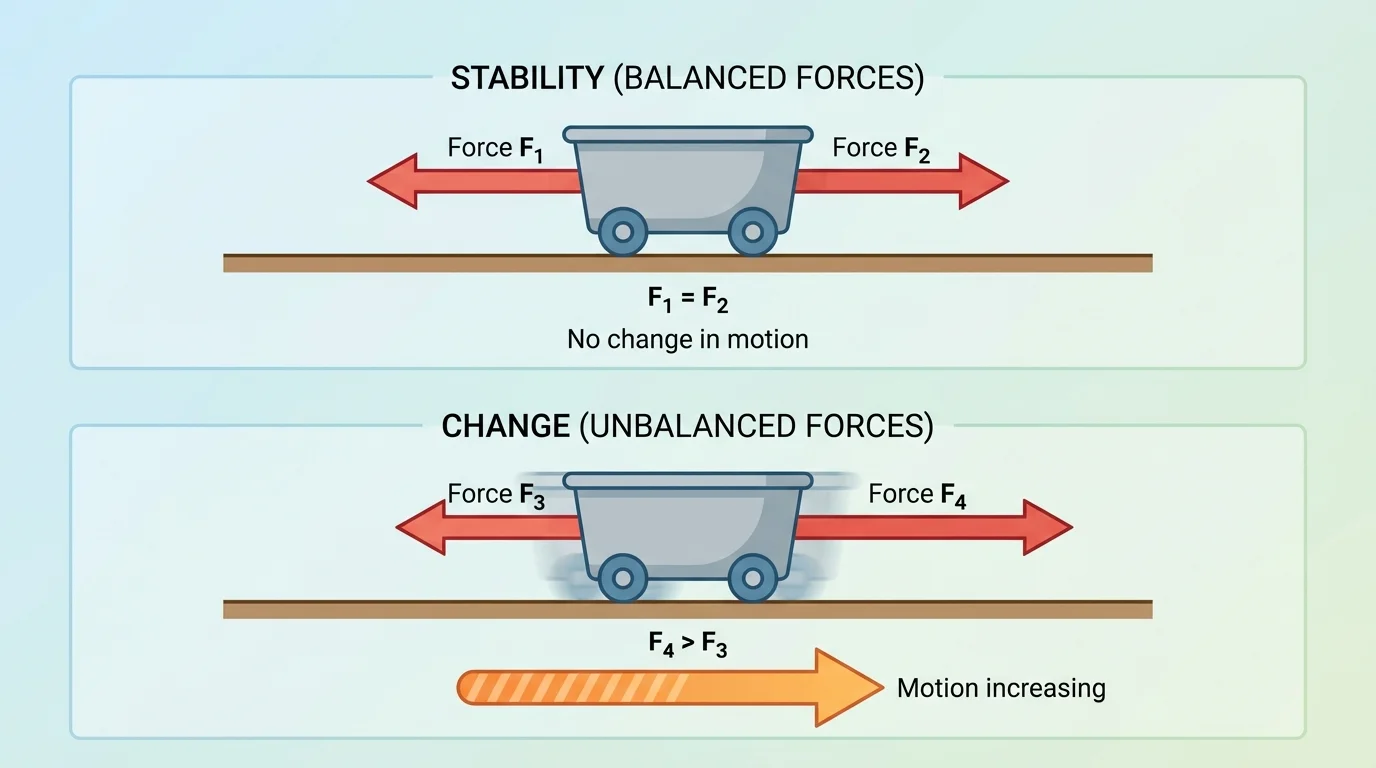
A key idea in physical science is that an object's motion changes when the forces on it do not balance. The net force is the overall force after all the pushes and pulls are combined. When the net force is zero, the forces are balanced. When the net force is not zero, the forces are unbalanced, and motion can change, as [Figure 1] shows with equal and unequal pushes on carts.
If a book rests on a table, gravity pulls it downward, but the table pushes upward with an equal force. The book stays still because the forces balance. If you push the book sideways and your push is greater than opposing friction, the book starts to move. That is change caused by an unbalanced force.
[Figure 1] The amount of motion change also depends on mass. Mass is the amount of matter in an object, and it also measures how hard it is to change that object's motion. A light soccer ball speeds up easily when kicked. A heavy medicine ball needs a much bigger push to speed up by the same amount.
Scientists often describe this relationship with Newton's second law:
\[F_{\textrm{net}} = ma\]
This means the net force equals mass times acceleration. Acceleration is any change in motion, including speeding up, slowing down, or changing direction.
For example, suppose a cart has a mass of \(2 \textrm{ kg}\) and the net force on it is \(6 \textrm{ N}\). Then its acceleration is \(a = \dfrac{F_{\textrm{net}}}{m} = \dfrac{6}{2} = 3 \textrm{ m/s}^2\). If the same \(6 \textrm{ N}\) net force acts on a cart with mass \(3 \textrm{ kg}\), then \(a = \dfrac{6}{3} = 2 \textrm{ m/s}^2\). The heavier cart changes motion less.
This is why force and mass must both be considered when explaining stability and change in motion. A strong net force can produce a large change, but a large mass resists that change. Engineers use this idea whenever they design vehicles, sports equipment, roller coasters, and safety systems.
An astronaut in space may seem weightless, but mass does not disappear. A massive object in space is still hard to start, stop, or turn because mass still resists changes in motion.
Motion can also stay stable even while an object is moving. A hockey puck sliding across smooth ice at nearly constant speed is an example. Its motion remains almost unchanged because the forces are close to balanced. Once friction or another force becomes important, the motion changes.
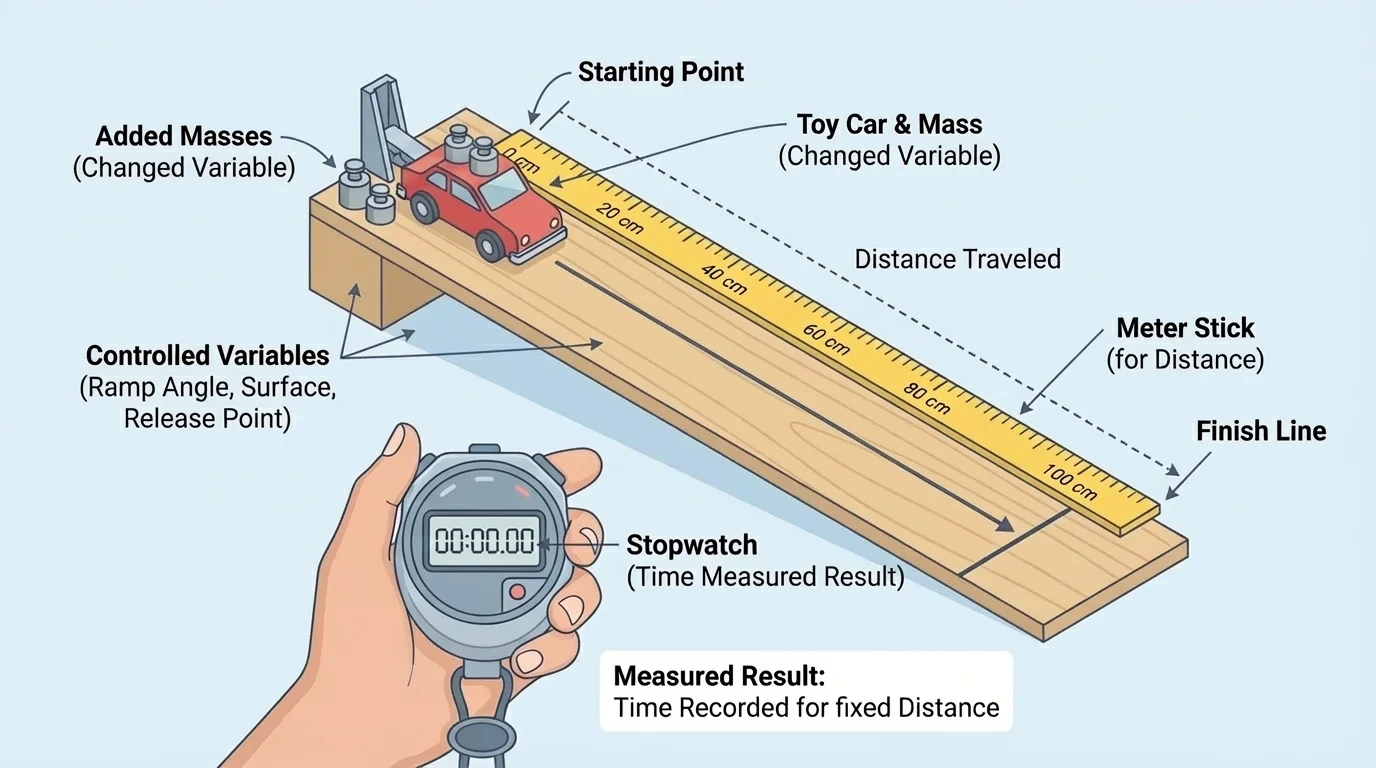
Scientists do not just state ideas about force and motion. They gather evidence. To understand how motion changes, students can plan an investigation, as [Figure 2] illustrates, using a toy car, ramp, measured distances, and different masses. A good investigation isolates one factor at a time so that the results are meaningful.
Suppose you want to test how mass affects motion. You might use the same ramp and the same starting height each time, but add different amounts of mass to the toy car. Then you measure how the motion changes, perhaps by timing how long the car takes to travel a fixed distance after rolling down the ramp. Because the ramp height stays the same, the starting conditions are more controlled.
Another investigation could test how net force affects motion. You could pull the same cart with one rubber band and then with two identical rubber bands. If the two rubber bands create a larger total force, the cart should speed up more quickly. The key idea is to keep the cart's mass the same while changing only the pulling force.
Example: Using a formula to compare motion changes
A student pulls a \(4 \textrm{ kg}\) cart with a net force of \(8 \textrm{ N}\). Later, the same student pulls the same cart with a net force of \(12 \textrm{ N}\).
Step 1: Use the relationship between force, mass, and acceleration.
\[a = \frac{F_{\textrm{net}}}{m}\]
Step 2: Calculate the first acceleration.
For \(F_{\textrm{net}} = 8 \textrm{ N}\) and \(m = 4 \textrm{ kg}\), \(a = \dfrac{8}{4} = 2 \textrm{ m/s}^2\).
Step 3: Calculate the second acceleration.
For \(F_{\textrm{net}} = 12 \textrm{ N}\) and \(m = 4 \textrm{ kg}\), \(a = \dfrac{12}{4} = 3 \textrm{ m/s}^2\).
The larger net force causes a greater change in motion because the mass stays the same.
When planning an investigation, it helps to identify variables. The independent variable is what you change. The dependent variable is what you measure. Controlled variables are things you keep the same for a fair test. In force-and-motion investigations, fair testing is essential because many factors can affect motion at the same time.
Evidence from such investigations can be shown in a table.
| Trial | Mass of Cart | Net Force | Observed Motion Change |
|---|---|---|---|
| \(1\) | \(2 \textrm{ kg}\) | \(4 \textrm{ N}\) | Medium acceleration |
| \(2\) | \(2 \textrm{ kg}\) | \(8 \textrm{ N}\) | Larger acceleration |
| \(3\) | \(4 \textrm{ kg}\) | \(8 \textrm{ N}\) | Medium acceleration |
Table 1. Sample investigation data showing that motion change depends on both net force and mass.
Notice the pattern: increasing force tends to increase acceleration, while increasing mass tends to decrease acceleration if the force stays the same. This is the kind of evidence scientists use to support explanations.
Explanations of stability and change become stronger when we study systems over different time periods. Some changes happen quickly, like a baseball changing direction when hit by a bat. Other changes happen slowly, like a cliff wearing down from wind and rain.
Time matters because the same system can appear stable in one time frame and changing in another. A parked bicycle may look stable over an hour. Over months, its tires may slowly lose air. Over years, metal parts may rust. Over even longer periods, the materials may weaken enough that the bicycle no longer works safely.
Why time scale matters
A system can look unchanging when viewed briefly, but clear patterns may appear over longer periods. Scientists often compare short-term observations with long-term evidence to decide whether a system is truly stable or only changing slowly.
This is true in natural systems too. A river can seem steady from day to day, yet over decades it can carve a wider channel. A hillside can appear fixed until one storm triggers a landslide. Studying changes over time helps us understand what forces and processes have been acting.
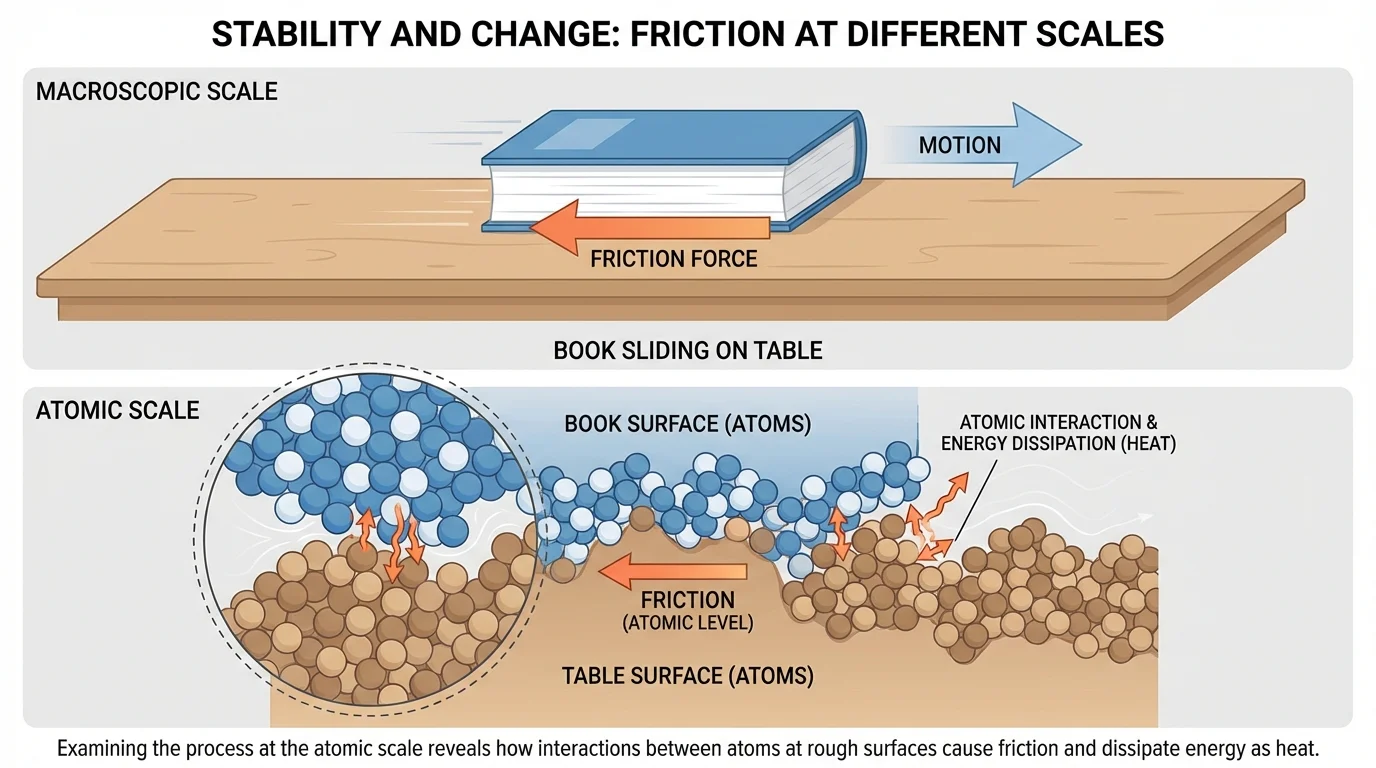
[Figure 3] Scale changes how we explain what we observe. A book sliding across a table can be described at the object level and at the microscopic scale. At the object level, we say the book slows down because friction acts opposite its motion. At a much smaller scale, we explain friction by looking at tiny surface bumps and interactions among atoms in the materials.
No surface is perfectly smooth. Even objects that feel smooth have microscopic roughness. When two surfaces touch, these tiny high points press against each other. At the atomic scale, atoms in one surface interact with atoms in the other. These interactions make it harder for the surfaces to slide freely, so the moving object loses speed.
As the book slows, some of its motion-related energy is transferred into thermal energy. That is why rubbing your hands together makes them warmer. The change you feel at the large scale is connected to interactions happening at a much smaller scale.
Atomic-scale explanations also matter when materials bend, stretch, crack, or melt. A metal paper clip bends because layers of atoms can shift position under force. Ice melts because water molecules move more freely as thermal energy increases. A wooden stick snaps when the forces inside the material exceed what the arrangement of its particles can hold together.
You may already know that matter is made of particles too small to see directly. Those particles are always moving, and the way they are arranged and interact helps explain the properties and behavior of materials.
Looking across scales helps scientists build fuller explanations. If we only describe what happens at the large scale, we know what changed. If we also study the microscopic or atomic scale, we start to understand why it changed.
Natural systems show both balance and change all the time. Consider a tree branch in the wind. Most of the time the branch bends and returns to its original shape. That is a kind of stability. But if the wind force becomes too strong, the branch may break. The same system changes when the forces exceed what the material can handle.
Animal movement is another example. A bird flying at constant speed in a straight path is in a fairly stable motion pattern. If it flaps harder, turns suddenly, or meets a gust of wind, the forces change and its motion changes too. Scientists can explain that motion by examining the net force on the bird and the bird's mass.
Earth systems also involve change over time. Rocks weather, rivers erode land, glaciers move, and earthquakes suddenly shift the ground. Some of these changes are gradual and some are sudden, but all involve forces and processes acting over time. Stable-looking landscapes may actually be changing very slowly.
Real-world example: A falling rock
A rock falls from a cliff because gravity creates a net downward force. At first, the rock speeds up quickly. As it moves through air, air resistance pushes upward.
Step 1: Early in the fall, gravity is stronger than air resistance.
The net force points downward, so the rock accelerates downward.
Step 2: As speed increases, air resistance increases.
The upward force becomes larger, reducing the net force.
Step 3: If the upward air resistance becomes equal to the downward weight, the net force becomes \(0\).
Then the rock continues at a constant speed instead of speeding up more.
This example shows how a system can change at one stage and become more stable at another.
Ecosystems also show stability and change, though the forces are not always pushes and pulls in the usual sense. Population sizes may remain fairly stable for a time, then change because of drought, disease, or human activity. Scientists examine these changes over months, years, or decades to understand the processes involved.
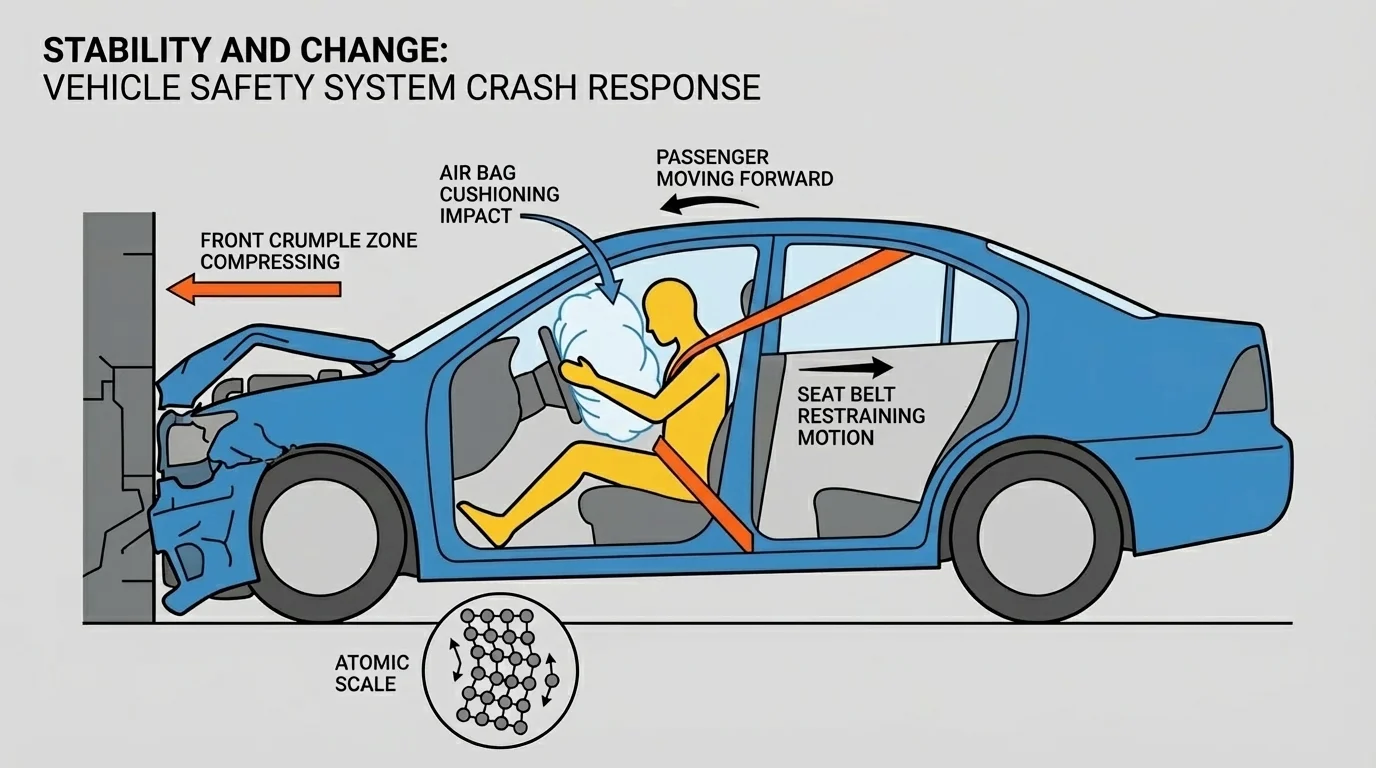
[Figure 4] Engineers build designed systems to control motion and improve stability. A car is a good example, and the figure shows how seat belts, air bags, and crumple zones help manage sudden changes in motion during a crash. The goal is not to remove forces completely, which is impossible, but to reduce harmful effects by changing how those forces act over time and across the vehicle.
When a moving car stops suddenly, the passengers inside keep moving forward unless another force acts on them. A seat belt provides that force and helps bring the person to a stop more safely. An air bag spreads the force over a larger area and increases the stopping time slightly. This reduces the severity of the motion change on the body.
Bridges are also designed for stability. Engineers must consider the mass of the bridge, the forces from vehicles, the force of wind, and the long-term effects of heating, cooling, and weathering. A bridge may seem stable day to day, but its materials slowly expand, contract, and weaken over years.
Bicycles, helmets, playground equipment, and building supports all depend on understanding how forces affect motion and how materials behave over time. The same principles that explain a toy cart in a classroom also help engineers design safer roads, stronger towers, and better sports gear.
Later, when engineers check whether a design is still safe, they often look for evidence of change: tiny cracks, bent parts, loose joints, or worn surfaces. Those visible signs can point to invisible changes in the arrangement of particles inside the material, linking the large scale back to the atomic scale we saw earlier in [Figure 3].
Many changes in systems make more sense when we consider atoms and molecules. For example, when iron rusts, the object changes over time because iron atoms react with oxygen in the air and water in the environment. A new substance forms. At the large scale, we see reddish-brown rust. At the atomic scale, the particles are rearranging.
Chemical change is one kind of process that can affect stability. If metal rusts for a long time, a structure may weaken. If battery chemicals react, electrical energy can be produced. These changes matter in designed systems such as vehicles, tools, and electronics.
A simple example of a chemical equation is:
\[4Fe + 3O_2 \rightarrow 2Fe_2O_3\]
This equation represents iron reacting with oxygen to form iron oxide, which is rust. Even though students may not need to memorize the equation yet, it shows that matter changes by rearranging atoms, not by disappearing.
Graphite in pencil lead and diamond in jewelry are both made of carbon atoms. They behave very differently because the atoms are arranged in different patterns.
Atomic-scale motion also explains heating and cooling. When particles move faster, temperature rises. When particles move more slowly, temperature falls. So when friction warms bicycle brakes or your hands, the visible effect connects directly to changes in particle motion.
Good scientific explanations connect observations, evidence, and models. If you observe that a heavier cart speeds up less than a lighter cart when both are pulled with the same net force, you can explain that using the relationship among net force, mass, and acceleration. If you observe that a material wears out over time, you can explain that by examining repeated forces, friction, and tiny changes in the material's structure.
This is one reason science often moves across scales. A complete explanation of stability and change may include visible motion, measurements over time, and atomic-scale interactions. For example, a skateboard wheel slows because of friction. Over months of use, the wheel surface wears down. At the microscopic and atomic scales, repeated contact and force cause tiny pieces of material to change or break away.
Scientists also compare systems. A natural system like a river and a designed system like a water pipe both carry moving water. Both can remain stable for a time, and both can change due to force, pressure, erosion, or material failure. Comparing systems helps reveal common patterns.
By studying time, forces, mass, and scale together, we can explain why systems stay stable, why they change, and how those changes can be predicted or controlled. That idea connects classroom investigations to real science and engineering all around us, from sports and transportation to geology and materials science.
