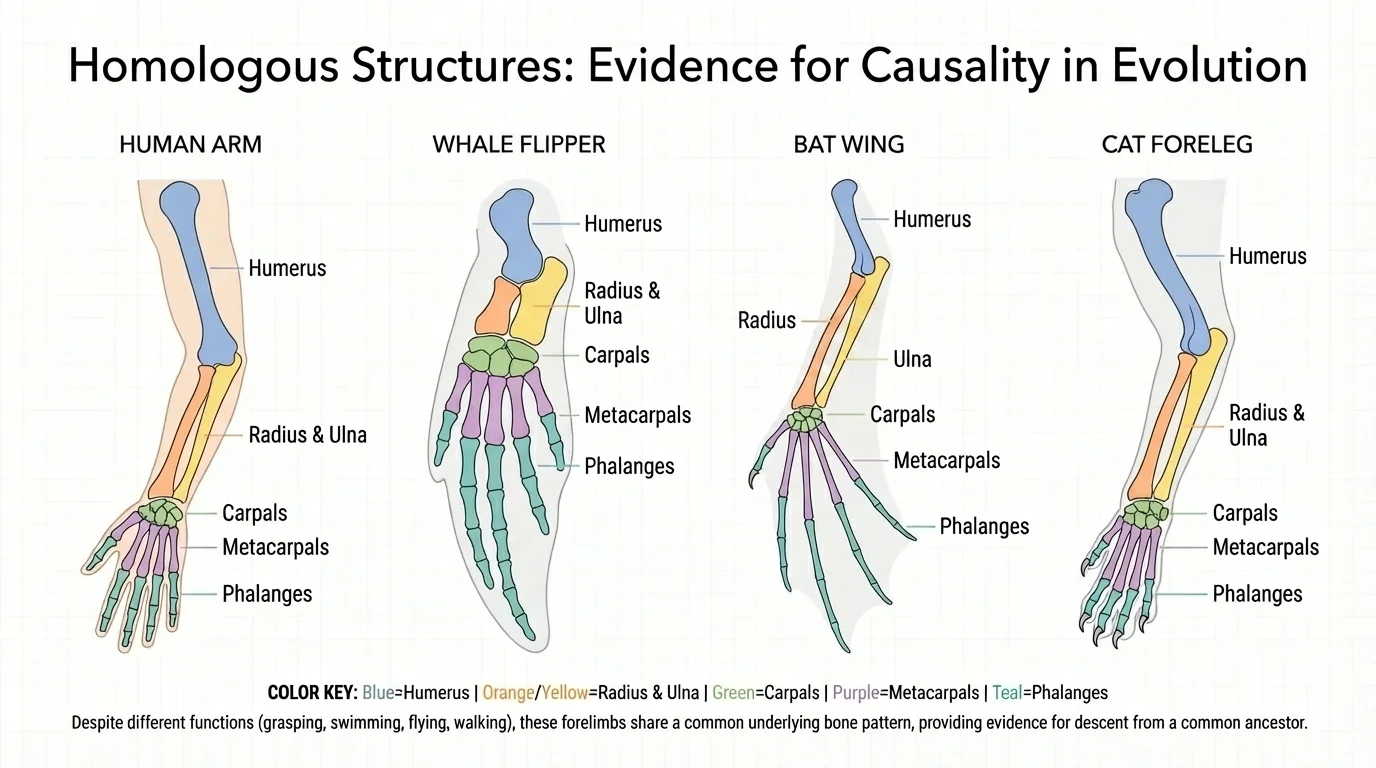
A human arm, a bat wing, a whale flipper, and a cat leg do not look alike at first glance. One lifts, one flies, one swims, and one runs. But inside, they share the same basic bone arrangement. That is one of the most powerful ideas in science: when you study a system at different scales, you notice different patterns, and those patterns can reveal causes that are not obvious on the surface. In evolution, this is especially important because life can look wildly diverse at one scale while showing deep unity at another.
Biologists study life across many scales: molecules such as DNA, cells, tissues, whole organisms, populations, ecosystems, and the fossil record across millions of years. At each scale, scientists ask two related questions: What pattern do we observe? What process could have caused it?
A system is a set of parts that interact. A biological system might be a gene network, an organism, a population, or an ecosystem. The features you notice depend on the scale at which you study that system. If you zoom in to the molecular level, you may notice sequences of bases in DNA or similarities in proteins. If you zoom out to the organism level, you may notice similar body plans. If you zoom out even further to the scale of populations and continents, you may see patterns in where species live or how lineages change over time.
Pattern is a repeated or organized feature in data or observations. Causality means a cause-and-effect relationship, where one process helps produce a particular outcome. In biology, patterns do not prove causation by themselves, but they provide evidence that supports a causal explanation when combined with other observations and tested ideas.
This is why evolution is not supported by only one kind of evidence. A single fossil might be questioned. A single anatomical similarity might be a coincidence. But when molecular data, anatomy, embryology, geography, and fossils all point in the same direction, the most reasonable explanation is common ancestry: different species descended from shared ancestors and changed over time.
Patterns can be simple or subtle. A simple pattern is that closely related species often live near one another geographically. A subtle pattern is that species that appear different on the outside may share unusual gene sequences that are unlikely to have arisen independently. Scientists then ask whether a process such as inheritance, mutation, natural selection, migration, or isolation can explain the pattern.
A causal explanation in evolution usually works across generations, not just within a single lifetime. For example, bacteria becoming resistant to an antibiotic is not just a pattern of survival. The causal explanation is that genetic variation already exists or arises through mutation, the antibiotic creates a selective pressure, resistant bacteria survive at higher rates, and their descendants become more common. The pattern we observe over time is caused by differential survival and reproduction.
To follow this topic, remember three ideas from earlier biology: traits can be inherited, mutations create new genetic variation, and populations can change over generations even though individual organisms do not evolve during their lifetimes.
This distinction matters because students often confuse change with cause of change. Scientists do not stop at saying, "These organisms are similar." They ask, "Why are they similar in this specific way, and which explanation best fits all available evidence?"
[Figure 1] At the molecular level, organisms reveal relationships that may be invisible at larger scales. Related species share more DNA sequence similarities, more similar proteins, and more matching genetic instructions. These molecular patterns are powerful because DNA is inherited. If two species share many unusual sequences, the most likely cause is that they inherited them from a common ancestor.
One striking pattern is the near universality of the genetic code. Almost all organisms use the same basic code to translate DNA information into proteins. This does not mean every species is identical. It means life shares a deep biochemical foundation. Another pattern is that species judged to be closely related by anatomy are also usually close at the molecular level. That agreement across scales strongly supports evolutionary explanations.
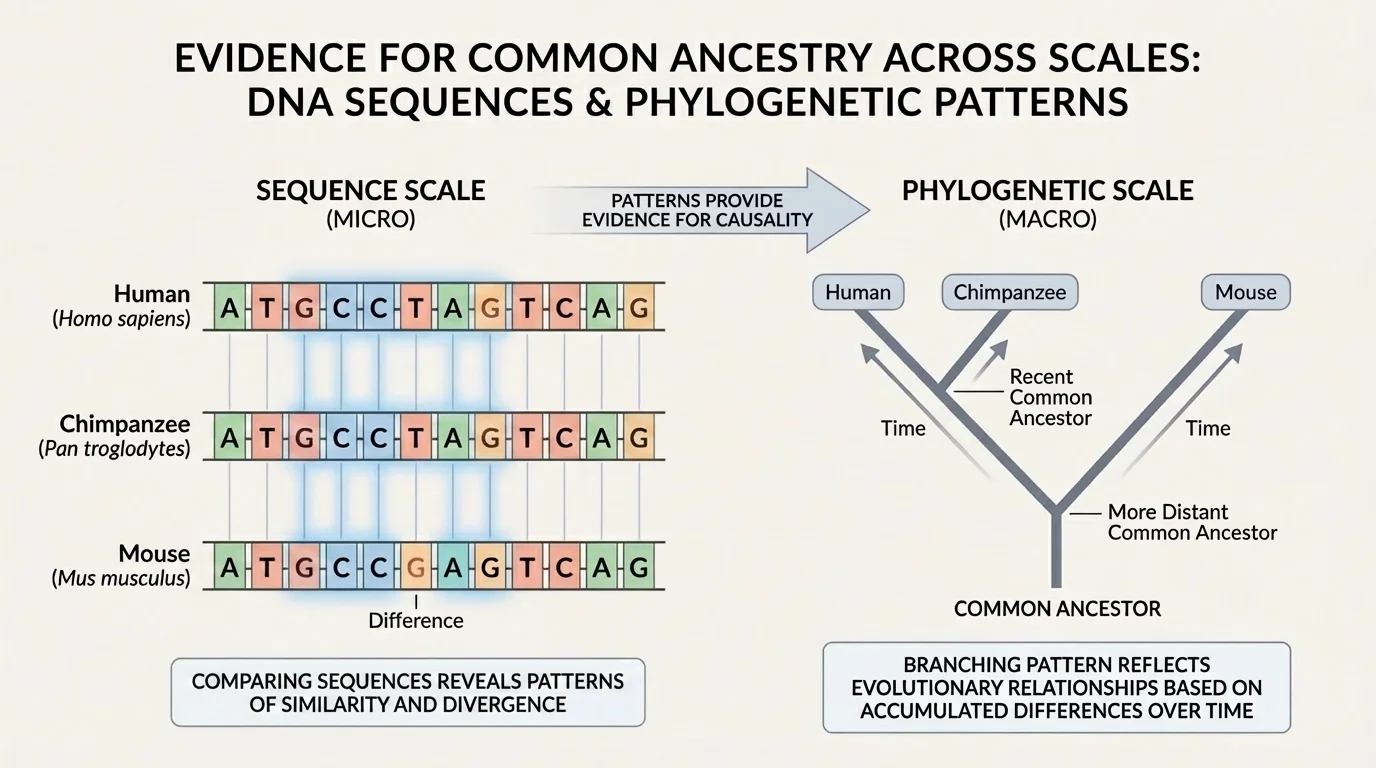
Scientists also compare specific genes and proteins. For example, humans and chimpanzees have highly similar DNA sequences in many genes, much more similar than either species has to mice. The exact percentage depends on which sequences are being compared, but the overall pattern is clear: more closely related species show greater molecular similarity. This nested pattern of similarity is what scientists expect if lineages branch from common ancestors.
Molecular homology and inherited information
Homology means similarity due to shared ancestry. At the molecular scale, homologous genes and proteins are not just "look-alikes." They are inherited versions of ancestral molecules that have been modified over time. Because mutation changes DNA gradually, comparing sequences allows scientists to reconstruct evolutionary relationships.
Molecular evidence is especially important when outward appearance is misleading. Sharks and dolphins both have streamlined bodies, but sharks are fish and dolphins are mammals. Their body shapes reflect similar environments, not close ancestry. DNA patterns help distinguish similarity caused by shared ancestry from similarity caused by similar lifestyles. That is why molecular evidence often strengthens causal explanations that anatomy alone cannot fully resolve.
Scientists sometimes use mutation rates to estimate divergence times. If a DNA region changes at an average rate of about \(2\) substitutions per \(1{,}000\) bases per million years in a certain lineage, and two species differ by about \(10\) substitutions in that \(1{,}000\)-base region, one rough estimate is \(\dfrac{10}{2} = 5\) million years since divergence. This is a simplified example, but it shows how quantitative patterns can support historical explanations.
[Figure 2] At the scale of whole organisms, scientists compare structures, development, and function. One of the clearest patterns is that very different animals can share the same structural blueprint, as shown by vertebrate forelimbs. Humans, bats, whales, and cats use their limbs for different tasks, but the bones line up in a similar order: one upper bone, two lower bones, wrist bones, and digits.
These are homologous structures. Their similarity is not mainly about what they do now. It is about how they are built and where they came from evolutionarily. The most convincing causal explanation is descent from a common ancestor whose limb structure was modified in different descendant lineages.
Another pattern comes from embryology, the study of development. Early embryos of different vertebrates often share features that become quite different later. These similarities suggest inherited developmental pathways. They do not mean embryos of one species "turn into" another species. Instead, they show that different organisms start from related developmental instructions and then diverge.
Vestigial structures are reduced structures inherited from ancestors in which they had a larger function. Whale pelvis bones, the human tailbone, and tiny leg bones in some snakes are examples. Vestigial structures make sense as evolutionary leftovers. They are harder to explain if each species were designed independently with no historical connection.
Case study: whale pelvis bones
Modern whales do not walk on land, yet some species retain small pelvic bones.
Step 1: Observe the pattern
Whales are fully aquatic, but they still possess tiny bones related to the pelvis.
Step 2: Compare across species
Those bones correspond to larger, functional pelvis structures in land mammals.
Step 3: Infer the causal explanation
The most consistent explanation is that whales descended from land-dwelling ancestors and inherited modified versions of those structures.
This anatomical pattern becomes even stronger when combined with fossils and DNA evidence.
Later, when fossils of early whales are considered, the anatomical story becomes even clearer, and the connection we first noticed in [Figure 2] becomes part of a much larger historical explanation.
At the population level, evolution becomes measurable. A population is a group of individuals of the same species living in the same area and capable of interbreeding. Populations contain variation. Some individuals have traits that affect survival or reproduction. If those traits are heritable, their frequencies can change over generations.
This is where causality becomes very direct. The pattern is a change in trait frequency. The cause may be natural selection, genetic drift, migration, or mutation. For example, in a population of insects, suppose a gene for pesticide resistance is rare at first: \(5\) out of \(100\) insects carry it. The initial frequency is \(\dfrac{5}{100} = 0.05\). After pesticide use, suppose \(40\) out of \(100\) survivors carry it. The new frequency is \(\dfrac{40}{100} = 0.40\). The large shift in frequency is a pattern that strongly suggests selection caused resistant insects to leave more descendants.
Over many generations, this process can produce adaptations. An adaptation is not a conscious choice by an organism. It is a heritable trait that becomes common because it improves success in a specific environment. Camouflage in insects, drought tolerance in plants, and antibiotic resistance in bacteria are all examples.
Some bacteria can evolve noticeable resistance in a short time because their generations are so brief. In a hospital, evolutionary change is not an ancient event locked in fossils; it can happen in real time.
At this scale, scientists often use long-term observations or experiments. Peter and Rosemary Grant's studies of finches in the Galápagos showed that beak sizes in populations shifted after droughts changed which seeds were available. The pattern was measurable from one generation to the next, and the causal explanation involved environmental pressure acting on inherited variation.
[Figure 3] When biologists map where species live, geographic patterns reveal evolutionary history. Species on islands often resemble nearby mainland species, but with important differences. This pattern suggests colonization followed by isolation and divergence. If species were unrelated and separately created for each place, this repeated geographic pattern would be much harder to explain.
This field is called biogeography. It examines the distribution of life across space and time. Marsupials are concentrated in Australia, many island species are found nowhere else, and lineages often match the history of continental drift and isolation. These are not random placements. They are patterns expected from descent, migration, and geographic separation.
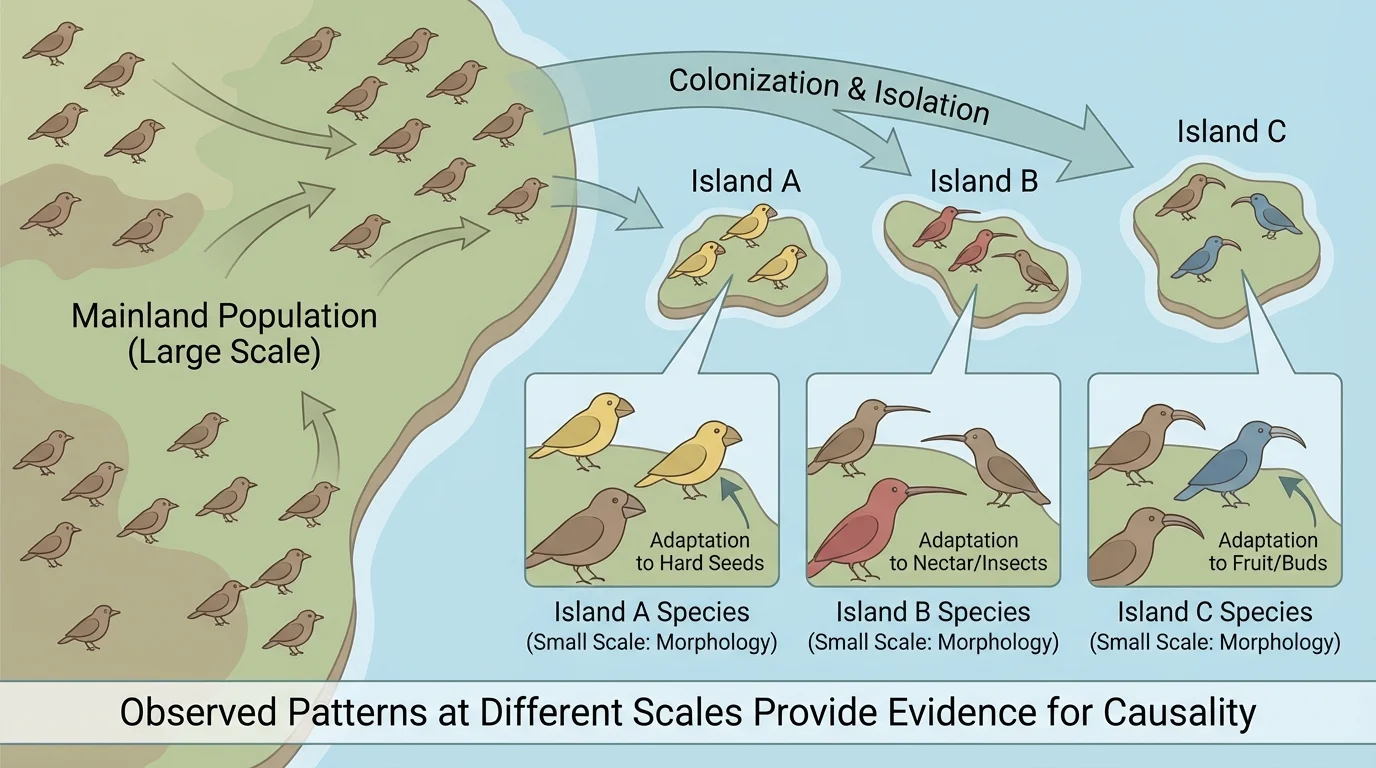
The Galápagos finches are a famous example. Different islands contain finch species with different beak shapes suited to different foods, yet they are clearly related. The causal explanation is that ancestral birds reached the islands, populations became isolated, and natural selection shaped different traits in different environments. Geographic separation did not merely accompany the change; it helped cause it by limiting gene flow.
Biogeography also helps explain why similar environments can contain very different lineages. Deserts in Africa, Australia, and North America all select for water-saving traits, but the species living there are not closely related in every case. This reminds us that some patterns reflect shared environmental pressures, while others reflect shared ancestry. Scientists must distinguish between these causes carefully.
[Figure 4] The fossil record adds the dimension of time. Fossils show ordered changes in rock layers, and those ordered patterns can reveal historical cause-and-effect relationships, including whale evolution. Simpler forms appear earlier than their modified descendants, and transitional fossils often show mixtures of ancestral and derived traits.
A transitional fossil does not mean "halfway" in a simplistic sense. It means a fossil with features that connect major groups or stages in a lineage. Fossils of early whales, for example, show a progression from land-dwelling mammals with walking limbs to increasingly aquatic forms with modified skulls, reduced hind limbs, and tail-powered swimming.
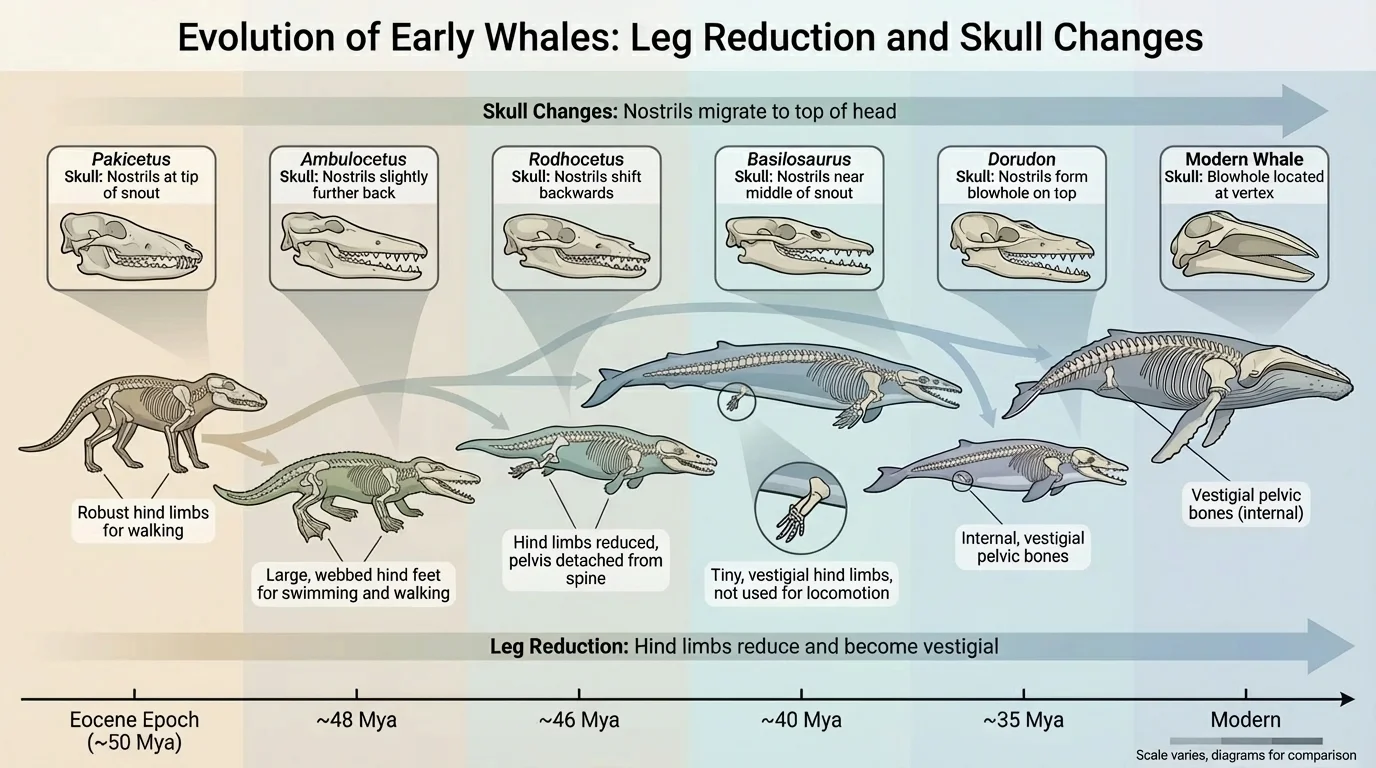
The fossil record is incomplete, but it still contains strong large-scale patterns. Species appear, persist, change, and go extinct. Major transitions are documented by many discoveries, not by single dramatic specimens alone. The causal explanation is evolution over long time spans through mechanisms such as mutation, selection, isolation, and extinction.
Scientists also use radiometric dating to estimate ages of rocks and fossils. If a radioactive isotope has a half-life of \(5{,}730\) years, as in carbon-14 dating for relatively recent materials, and a sample has \(\dfrac{1}{4}\) of its original carbon-14 remaining, then two half-lives have passed. The estimated age is \(2 \times 5{,}730 = 11{,}460\) years. For much older rocks, other isotopes are used. These measurements allow scientists to place fossils in chronological order rather than guessing.
Why deep time matters
Many evolutionary changes are too slow to observe directly in large organisms over a single human lifetime. Fossils, rock layers, and radiometric dating extend our view into deep time, letting scientists connect present-day species to ancestral forms through evidence rather than imagination.
The whale sequence is especially persuasive because it links several scales at once. Fossils show changing anatomy through time, modern whales still retain vestigial pelvis bones, and molecular evidence places whales within mammals close to hoofed relatives. The same historical explanation fits all of those patterns.
Science becomes most convincing when different scales tell the same story. Molecular similarities suggest relationships. Anatomical homologies show inherited body plans. Biogeography reveals the effects of movement and isolation. Fossils show change through time. Each line of evidence is important, but together they form a network of support.
This is called converging evidence. Suppose you only knew that bats and birds both fly. You might guess they are close relatives. But anatomy, fossils, and DNA show that bat wings and bird wings evolved independently as flight adaptations, while the deeper homology lies in the vertebrate forelimb pattern. Looking at multiple scales prevents misleading conclusions.
| Scale of study | Pattern observed | Causal explanation supported |
|---|---|---|
| Molecular | Similar DNA and protein sequences | Inheritance from common ancestors |
| Organism | Homologous and vestigial structures | Modification of ancestral body plans |
| Population | Trait frequencies change over generations | Selection, drift, mutation, migration |
| Geographic | Related species clustered by location | Dispersal, isolation, divergence |
| Fossil/deep time | Ordered appearance and transitional forms | Long-term descent with modification |
Table 1. Patterns observed at different biological scales and the causal explanations they support.
Notice that the same explanation can appear differently depending on scale. At the population scale, selection looks like changing frequencies. At the anatomical scale, it looks like modified limbs. At the fossil scale, it looks like a sequence of forms through time. The process is connected, even though the pattern changes with perspective.
These ideas matter far beyond textbooks. In medicine, evolutionary reasoning helps scientists track how viruses change and why antibiotic resistance spreads. When doctors and public health researchers compare genetic sequences of pathogens, they can identify lineages, estimate how strains are related, and infer how transmission occurred. That is molecular-scale pattern analysis with direct human consequences.
In agriculture, farmers and researchers use evolutionary principles to manage pesticide resistance. If the same pesticide is used repeatedly, the environment strongly favors resistant individuals. The result is a predictable evolutionary pattern. Strategies such as rotating pesticides or preserving refuge areas aim to reduce the selection pressure and slow resistance.
Real-world example: tracing a viral outbreak
Scientists collect virus samples from different patients and compare their genomes.
Step 1: Identify sequence similarities
Closely matching sequences suggest close transmission links.
Step 2: Build a branching relationship
Researchers infer which samples share more recent ancestors.
Step 3: Combine with time and place data
If a group of similar sequences appears in one region before spreading, the pattern supports a causal explanation about the outbreak's path.
This process helps public health teams respond more effectively.
In conservation biology, understanding patterns across scales helps protect biodiversity. A population may look stable in numbers, but molecular data might reveal dangerously low genetic diversity. Geographic data may show that habitat fragmentation is isolating groups. Fossil and historical data may show what the species' range used to be. Effective conservation depends on recognizing the right pattern at the right scale.
Patterns are powerful, but scientists must still be careful. Not every similarity has the same cause. Wings in bats and birds are similar in function, but they evolved independently. Fish and dolphins have similar body shapes because moving through water favors streamlining. This is called convergent evolution, and it reminds us that similar environments can produce similar traits without close ancestry.
Scientists also avoid claiming causation from a single observation. One fossil, one gene, or one structural resemblance is rarely enough. Strong causal explanations are built from repeated, testable patterns that fit together logically. That is why the evolutionary case is so strong: it is not based on one famous fossil or one DNA comparison, but on a vast set of matching observations across scales.
"Nothing in biology makes sense except in the light of evolution."
— Theodosius Dobzhansky
The deeper lesson is not only about evolution. It is about how science works. When we study a system at different scales, we discover different patterns. Those patterns are clues. When the clues align, they help us explain causes that no single viewpoint could reveal on its own.
