A modern car traveling at highway speed can go from that speed to rest in a fraction of a second, yet the difference between a survivable crash and a deadly one often comes down to design. That is one of the most powerful ideas in science and engineering: systems are not just collections of parts. They can be deliberately arranged so that interactions inside the system produce a desired effect. In collision safety, that desired effect is not to "remove" force completely, because forces cannot simply disappear. Instead, engineers design systems that change how forces act, spreading them out over time, redirecting them, or absorbing energy so that people and objects are less likely to be damaged.
When two objects collide, the result may look sudden, but it is shaped by many hidden choices: material, shape, structure, speed, mass distribution, and even the order in which parts begin to deform. A bicycle helmet, for example, does not protect you because it is merely "hard." It protects you because its shell and foam are designed to work together. The same is true for a phone case, a football helmet, a spacecraft landing system, and the crash structure of a car.
This means safety is a systems problem. If one part works well but another part fails, the whole outcome changes. A seat belt without an airbag is less effective in some collisions. An airbag without a seat belt can also fail to protect properly because the person may be out of position. Engineers therefore think in terms of interactions, not isolated parts.
System means a set of interacting parts that together produce behavior or effects. Force is a push or pull that can change an object's motion. A collision is an interaction in which objects exert forces on one another over a short time. A desired effect is the intended outcome a designer wants the system to produce.
In science, the idea of cause and effect is essential here: if a design changes the structure of a system, then the interactions in the system change, and the outcome changes too. A softer landing pad causes a longer stopping time. A well-designed helmet shell helps spread forces over a larger area. A guardrail causes a vehicle to redirect instead of stopping instantly against a rigid obstacle.
To understand engineered safety, it helps to define the system carefully. In a car crash, the "system" might include the car body, crumple zones, seat belts, airbags, seats, passengers, and the road barrier. If we choose a different system boundary, we might also include the road surface, friction, and nearby vehicles. The system we choose affects which causes and effects we focus on.
Engineers ask questions such as: What do we want to happen? What do we want to avoid? Which parts interact directly? Which variables can we change? In a collision-safety device, the desired effects often include reducing peak force, increasing stopping time, lowering acceleration, absorbing energy, preventing penetration, and keeping the person or object in a safer position.
That last point matters. Good design is often about controlling motion. A seat belt does not only "hold you in place." It makes sure your body slows down with the car instead of continuing forward until you strike the dashboard or windshield. The system is designed to change the path from dangerous motion to controlled deceleration.
From earlier study of motion, remember that unbalanced forces change velocity. If velocity changes, then acceleration occurs. During collisions, the acceleration can be extremely large because the change in velocity happens in a very short time.
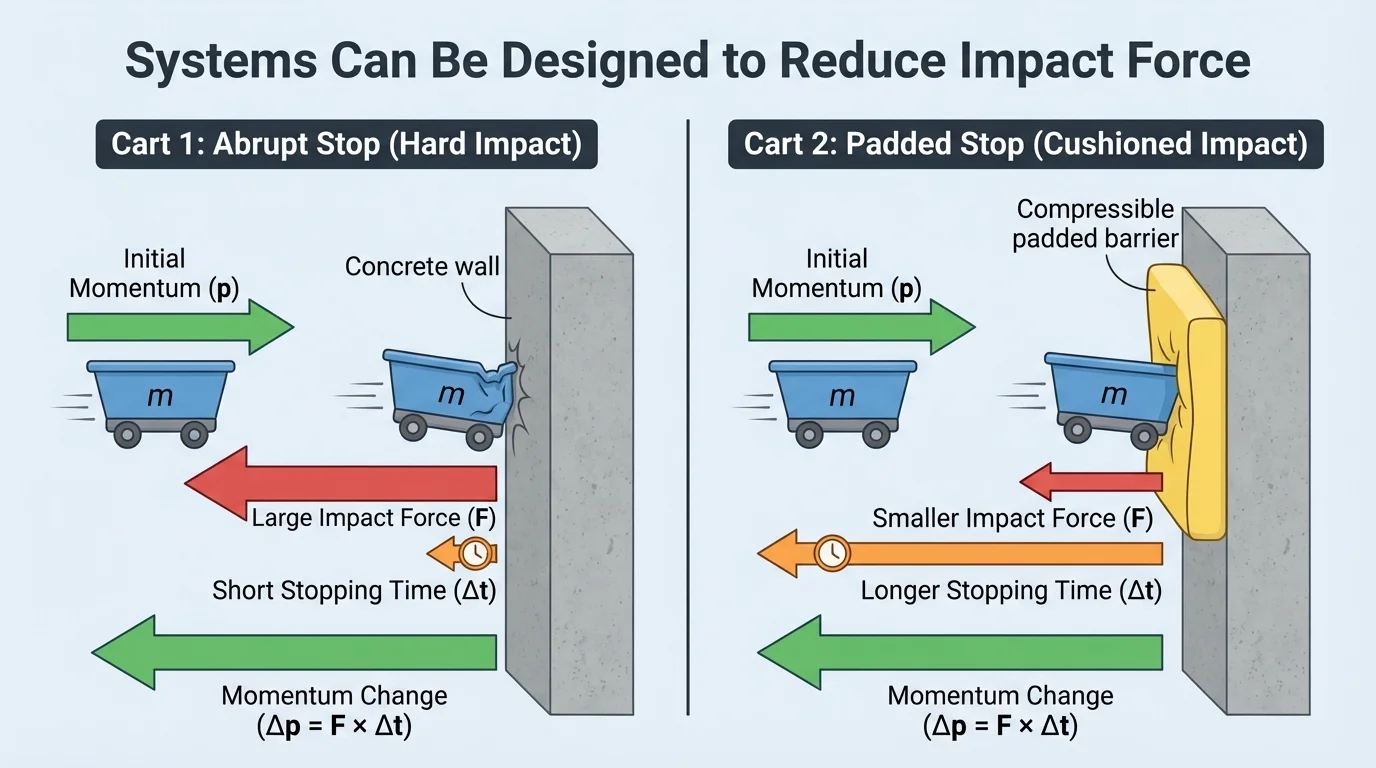
Cause-and-effect reasoning helps explain why this works. If the same moving object must be brought to rest, then increasing the time over which it stops decreases the average force needed. That relationship is one reason so many safety devices are built to compress, bend, stretch, or deform during impact rather than remain perfectly rigid.
As shown in [Figure 1], during a collision, objects exert forces on each other for a limited time. One of the most useful ideas for understanding this is impulse because it connects force and time. The basic relationship is
\[J = F\Delta t\]
where \(J\) is impulse, \(F\) is average force, and \(\Delta t\) is the interaction time. Impulse is also equal to change in momentum:
\[J = \Delta p\]
If the change in momentum is fixed, then making \(\Delta t\) larger makes \(F\) smaller. Suppose a passenger's momentum must change by \(240 \textrm{ kg}\cdot\textrm{m/s}\). If the stopping time is \(0.02 \textrm{ s}\), the average force is \(F = \dfrac{240}{0.02} = 12{,}000 \textrm{ N}\). If a safety system increases the stopping time to \(0.20 \textrm{ s}\), the average force becomes \(F = \dfrac{240}{0.20} = 1{,}200 \textrm{ N}\). That is ten times smaller.
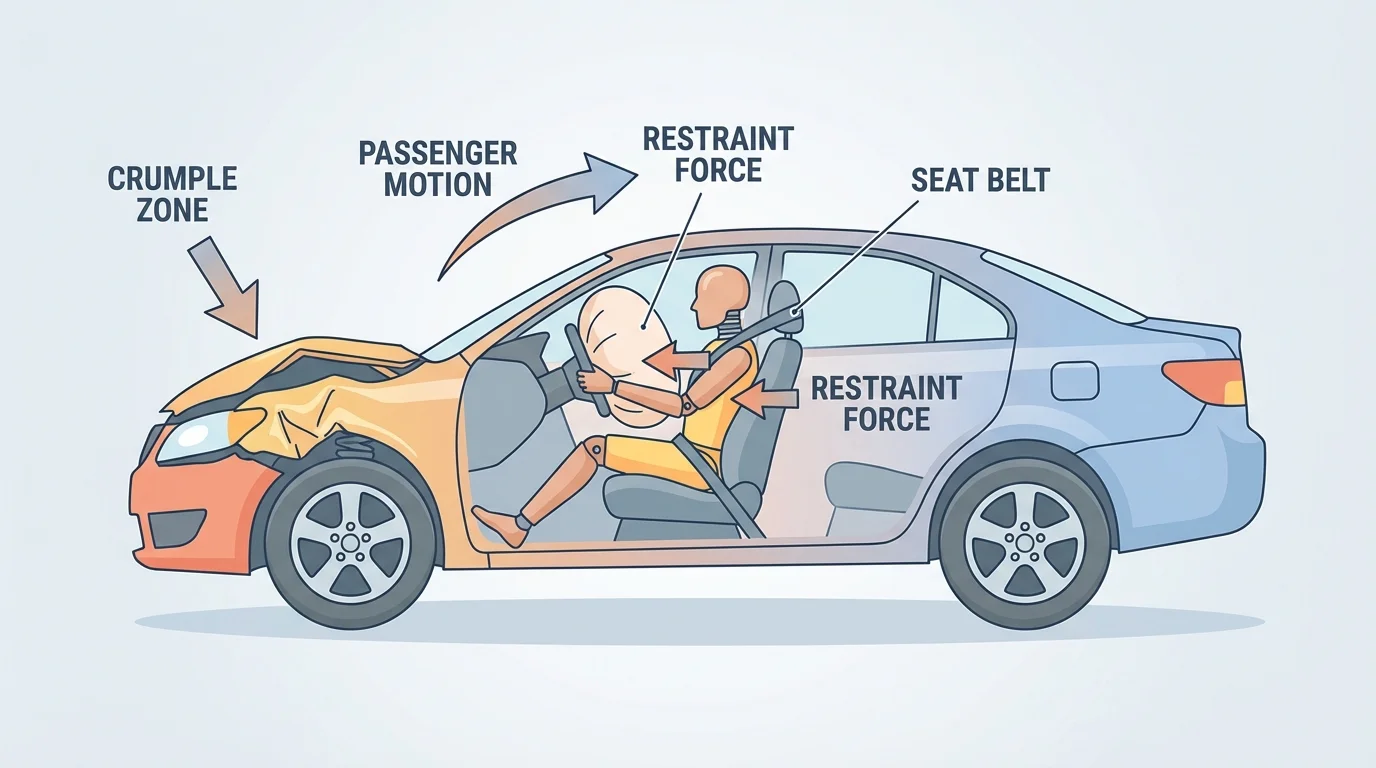
Collisions also involve deformation. Materials may bend, crush, stretch, crack, or compress. This is not always a failure. In many safety systems, controlled deformation is exactly what the engineer wants. A crumple zone is designed to deform in a predictable way so energy is transferred into bending and crushing metal instead of being delivered directly to passengers.
Another important idea is kinetic energy. A moving object has kinetic energy given by
\[KE = \frac{1}{2}mv^2\]
If a \(1{,}000 \textrm{ kg}\) car moves at \(20 \textrm{ m/s}\), then \(KE = \dfrac{1}{2}(1{,}000)(20^2) = 200{,}000 \textrm{ J}\). In a crash, that energy does not vanish. It is transformed into sound, heat, deformation, motion of other objects, and sometimes damage to human tissue. Engineering design aims to control where that energy goes.
This is why rigid is not always safer. A completely rigid vehicle would reduce its own deformation, but the people inside could experience a much larger force because their stopping time would be shorter. As we saw in [Figure 1], extending the time of impact can greatly reduce average force while still producing the same overall change in momentum.
Why "absorbing energy" helps
When a material crushes or compresses during impact, work is done to deform it. That means some of the moving object's kinetic energy is transferred into changing the shape of the material. Foam liners, airbags, and crumple zones are valuable because they manage this transfer in a controlled way rather than allowing the energy to be concentrated in a person or fragile object.
Of course, no device can eliminate all risk. Extremely high speeds, poor fit, weak materials, or unusual impact angles can overwhelm even a good design. Engineering is often about reducing harm as much as possible, not achieving perfection.
As shown in [Figure 2], a crumple zone is one of the clearest examples of a system designed for a desired effect. In a frontal crash, the front of the car is intended to deform first, increasing the time over which the car slows and reducing the force transmitted to the passenger compartment. The passenger area is then built more rigidly so it remains intact while the front structure sacrifices itself.
Now add a seat belt. The belt spreads force across stronger parts of the body such as the pelvis and rib cage and prevents the person from continuing forward uncontrolled. Add an airbag, and the stopping time for the head and chest becomes longer still, while the contact area increases. Instead of one rigid surface producing a concentrated force, the body meets a cushion that slows it more gradually. These parts form one system, not three separate inventions.
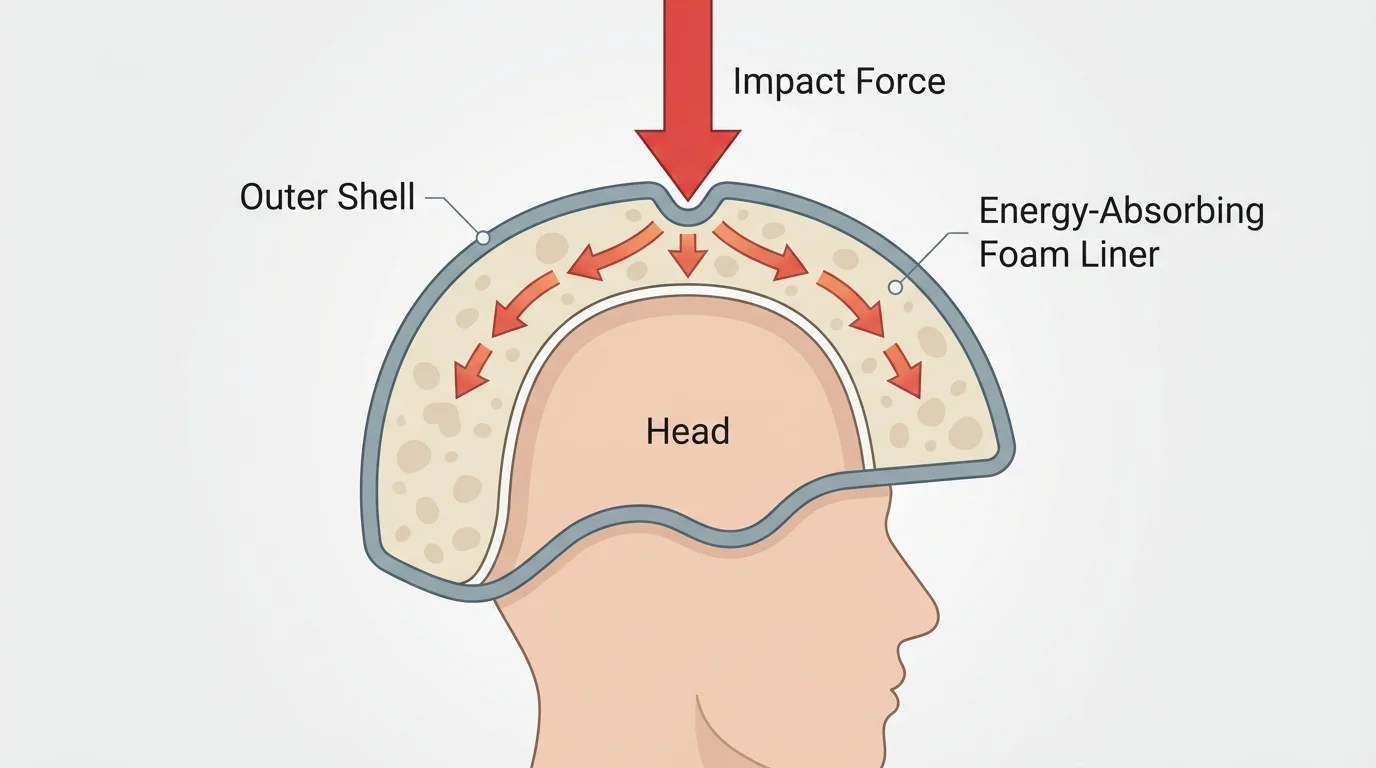
Helmets use a similar strategy on a smaller scale. The outer shell helps distribute impact and resist penetration. The foam liner compresses and crushes, increasing stopping time and reducing acceleration of the head. Good helmet design also depends on fit, strap position, and intended type of impact. A bike helmet is not identical to a climbing helmet because the desired effects and typical collision conditions differ.
Packaging materials provide another everyday example. Bubble wrap, molded foam, corrugated cardboard, and inflatable inserts all work by increasing the distance and time over which a product slows during impact. A glass object wrapped in soft material can survive a drop that would shatter it if dropped unprotected onto a hard floor.
Even road barriers are engineered systems. A concrete barrier may redirect a car, while a guardrail may bend and guide the vehicle along the road edge. In both cases, the desired effect is not simply "stop the car," but reduce the chance of more dangerous outcomes such as rollover, crossing into oncoming traffic, or impact with a rigid object.
Formula One race cars are designed so that certain parts break or crush in a crash. That sounds destructive, but it is actually protective because the car is engineered to absorb energy in sacrificial structures while preserving the driver's survival cell.
The broader lesson is that materials and geometry matter. Thin metal can fold. Foam can compress. Fabrics can stretch. Curved shapes can redirect force. Honeycomb structures can crush in controlled layers. Engineers choose among these possibilities based on the effect they want the system to produce.
No real device is designed under perfect conditions. Engineers work with constraints such as mass, cost, environmental conditions, manufacturing limits, and user comfort. A thicker helmet liner may reduce force better, but if it becomes too heavy or uncomfortable, fewer people may wear it correctly. A safer car structure may increase cost or fuel use. A package that protects extremely well may use too much material.
This is why design always involves trade-offs. Improving one feature may worsen another. A stiffer structure can better prevent intrusion but may transmit more force. A softer barrier can reduce force but may allow too much motion. Good engineering tries to balance these competing needs while keeping the desired effect clear.
Scientists and engineers also think about variability. Real collisions differ in angle, speed, temperature, body size, and surface type. A design must work not only in ideal lab conditions but across a range of realistic situations. That is one reason standards and repeated testing are so important.
| Design feature | Desired effect | Possible trade-off |
|---|---|---|
| Crumple zone | Increase stopping time and absorb energy | Repair cost after crash |
| Airbag | Cushion impact and spread force | Needs sensors and correct timing |
| Helmet foam | Reduce head acceleration | May be single-use after major impact |
| Guardrail | Redirect vehicle and reduce severe impact | May still cause damage to vehicle |
| Protective packaging | Prevent breakage during drops | Added material and shipping volume |
Table 1. Examples of collision-safety design features, the effects they are intended to produce, and common trade-offs.
Engineering is not just inventing a first idea. It involves testing, analyzing evidence, and refining the design. To evaluate a collision-safety device, engineers define criteria and constraints. Criteria describe what success looks like, such as lowering peak force, preventing breakage, or keeping acceleration below a target limit. Constraints include available materials, size limits, or maximum cost.
Testing must be fair and controlled. If engineers compare two phone cases, they should keep the phone model, drop height, surface, and angle as constant as possible. Then they can decide whether one design actually performs better. Sensors, high-speed cameras, crash-test dummies, and computer simulations help measure outcomes that happen too fast for the eye to see clearly.
Evaluating a padded barrier
A cart of mass \(2 \textrm{ kg}\) rolls toward a wall at \(3 \textrm{ m/s}\) and stops. Two barriers are tested. Barrier A stops the cart in \(0.03 \textrm{ s}\). Barrier B stops it in \(0.12 \textrm{ s}\). Which barrier produces the smaller average force?
Step 1: Find the change in momentum.
The initial momentum is \(p_i = mv = 2 \cdot 3 = 6 \textrm{ kg}\cdot\textrm{m/s}\). The final momentum is \(0\), so \(\Delta p = 6 \textrm{ kg}\cdot\textrm{m/s}\).
Step 2: Use \(F = \dfrac{\Delta p}{\Delta t}\).
For Barrier A, \(F_A = \dfrac{6}{0.03} = 200 \textrm{ N}\). For Barrier B, \(F_B = \dfrac{6}{0.12} = 50 \textrm{ N}\).
Step 3: Compare the results.
Barrier B gives the smaller average force because it increases the stopping time.
The better design, for this criterion, is Barrier B.
Refinement means using evidence to improve the design. If a helmet liner compresses too easily, engineers may change the foam density. If a seat belt causes too much force on one region of the chest, they may redesign the belt path or pretensioner. Each new version is compared against the old one.
In modern engineering, simulation plays a major role. Computer models can test many designs quickly, but physical testing still matters because real materials behave in complex ways. The best designs usually emerge from a cycle of modeling, prototyping, testing, and revision.
As shown in [Figure 3], a bicycle helmet is a layered system, not just a hard covering. The shell helps keep the helmet intact and distribute impact forces, while the foam liner compresses to reduce the head's acceleration. The desired effect is not merely to stop the head, but to slow it over slightly more time and distance so brain injury becomes less likely.
Child car seats are another strong example of system design. They position the child correctly, distribute force differently from an adult seat belt, and often include side-impact protection. The design depends on age and size because the body itself is part of the system. What works for a fully grown adult may not work for a toddler.
Sports equipment shows that "more padding" is not always the whole answer. Protective gear must match the kind of impact expected. A catcher's helmet, a hockey helmet, and a cycling helmet may all reduce injury, but they are optimized for different directions of force, speeds, and contact surfaces. This is why using the wrong gear for the wrong activity can be dangerous even if the gear looks protective.
Space exploration offers an impressive large-scale example. When a spacecraft lands, the system may include heat shields, parachutes, retrorockets, crushable landing legs, or inflatable airbags. Each part causes a different desired effect at a different stage: reduce speed, stabilize orientation, absorb impact, or prevent tipping. The mission succeeds only if the parts work together as a coordinated system.
We can return to the bicycle helmet in [Figure 3] to see an important engineering principle: a single device often uses multiple materials because no one material does everything well. Hardness can help distribute force, while softness can increase stopping time. Good system design combines properties rather than depending on one feature alone.
Numerical example: kinetic energy and speed
A \(0.15 \textrm{ kg}\) baseball travels at \(40 \textrm{ m/s}\). Its kinetic energy is
\(KE = \dfrac{1}{2}mv^2 = \dfrac{1}{2}(0.15)(40^2) = 120 \textrm{ J}\).
If the speed doubles to \(80 \textrm{ m/s}\), then
\(KE = \dfrac{1}{2}(0.15)(80^2) = 480 \textrm{ J}\).
The speed only doubled, but the kinetic energy became four times larger because energy depends on \(v^2\). This is one reason collision severity rises so quickly as speed increases.
Even small objects reveal the same ideas. A phone case may include a rigid frame, soft corners, and raised edges around the screen. Those parts are not random. They are designed to redirect impacts, absorb energy, and protect the most fragile components.
Suppose engineers want to protect a fragile sensor dropped from a fixed height. They might compare several designs: thick foam, air pockets, folded cardboard structures, or spring mounts. The desired effect is to reduce the force on the sensor during impact while keeping cost and size reasonable.
To judge performance, they could measure whether the sensor survives, how much the housing deforms, and how long the stopping time lasts. A successful design may not look the strongest. In fact, it may intentionally crumple or compress. That apparent weakness is often a sign of smart engineering because it means the system is managing energy rather than passing it directly into the fragile part.
Comparing two packaging designs
A fragile object experiences a momentum change of \(15 \textrm{ kg}\cdot\textrm{m/s}\) in a drop test. Package X increases stopping time to \(0.05 \textrm{ s}\), while Package Y increases it to \(0.15 \textrm{ s}\).
Step 1: Compute the average force for Package X.
\(F_X = \dfrac{15}{0.05} = 300 \textrm{ N}\).
Step 2: Compute the average force for Package Y.
\(F_Y = \dfrac{15}{0.15} = 100 \textrm{ N}\).
Step 3: Interpret the result.
Package Y produces a smaller average force, so it is more effective at minimizing collision effects for this object.
This comparison shows how a design choice causes a measurable change in outcome.
Engineers would then refine the best design. Perhaps the foam works well but costs too much. Perhaps folded cardboard works almost as well and is easier to recycle. Real design decisions usually combine physics, economics, environmental concerns, and user needs.
Collision protection is a powerful example, but the main principle reaches much further. Systems can be designed to cause heating, cooling, sound amplification, chemical mixing, electrical control, or biological regulation. In every case, the core idea is the same: changing the arrangement and properties of parts changes the interactions, and changing the interactions changes the effect.
That is why system thinking matters in science. It pushes us to ask not just "What is this made of?" but "How do the parts work together?" In engineering, that question leads directly to design choices that save lives, protect technology, and make the world more reliable.
"The details are not the details. They make the design."
— Charles Eames
When engineers design a device that reduces the force on a person or object during a collision, they are applying deep physical ideas in a practical way. A better design produces a better effect because the system itself has been shaped to guide what happens.
