A century ago, no one could track heat moving through the deep ocean from space, estimate ancient air composition from polar ice, or simulate Earth's climate with supercomputers. Today, scientists do all three. That is the striking reality of modern climate change: humans are altering the planet more strongly than ever before, yet humans also have more scientific power than ever to understand what is happening and to respond wisely.
Global climate change is not just about warmer air. It is about shifts in the entire Earth system: the atmosphere, the oceans, the land surface, ice sheets, and living things. Because these parts are connected, a change in one can trigger changes in others. Climate science therefore studies both causes and interactions, asking not only what is changing but also how one change influences the next.
This topic belongs to the study of Earth and Human Activities because climate change is a powerful example of how human societies affect planetary systems and how those systems then affect human life in return. Agriculture, water supply, cities, transportation, public health, and ecosystems are all influenced by climate patterns.
Climate change is a long-term shift in average weather patterns, including temperature, precipitation, wind, and extreme events.
Global warming refers specifically to the long-term increase in Earth's average surface temperature.
Greenhouse gases are gases in the atmosphere that absorb and re-radiate heat, helping warm the lower atmosphere.
Weather and climate are not the same. Weather is what happens today or this week: a thunderstorm, a cold front, a heat wave. Climate is the longer pattern over decades. A single cold day does not disprove global warming, just as one hot day does not prove it. Scientists look at long records, global measurements, and many kinds of evidence together.
Climate change matters now because its effects are already visible. Average global temperature has risen, glaciers are retreating, sea level is increasing, and heat waves are becoming more common in many regions. Some storms are producing heavier rainfall because warmer air can hold more water vapor. In dry regions, rising temperatures can intensify drought by increasing evaporation from soil and water bodies.
The changes are not identical everywhere. Some places warm faster than others. Some regions become wetter, while others become drier. This unevenness is one reason climate science is complex: local outcomes depend on geography, ocean currents, elevation, land cover, and atmospheric circulation.
Students often hear climate change described as a future problem, but that is outdated. It is a present process with future consequences. Heat stress in cities, coastal flooding during storm surges, coral bleaching, and shifting growing seasons are all examples already being observed.
The Arctic is warming much faster than the global average. This happens partly because when bright ice melts, darker ocean water absorbs more solar energy, which leads to even more warming.
One major reason climate change is such a serious issue is that natural systems and human systems are built around fairly stable climate patterns. Crops are planted according to seasonal expectations. Buildings and roads are designed for expected temperature ranges. Water systems depend on rainfall and snowmelt patterns. When these patterns shift, many systems become less reliable.
Earth's climate operates through connected subsystems: energy, water, and carbon are constantly moving among air, water, land, ice, and living things. A warmer ocean can change atmospheric moisture. Melting ice can alter ocean salinity and reflectivity. Changes in forests can affect how much carbon is stored on land.
[Figure 1] The atmosphere controls the movement of heat and moisture around the planet. The ocean stores enormous amounts of heat and dissolves gases such as carbon dioxide, written as \(\textrm{CO}_2\). The biosphere includes all living things, from plankton to forests, and influences both carbon and water cycles. The cryosphere includes ice sheets, glaciers, sea ice, and permafrost. These systems are linked, not separate.
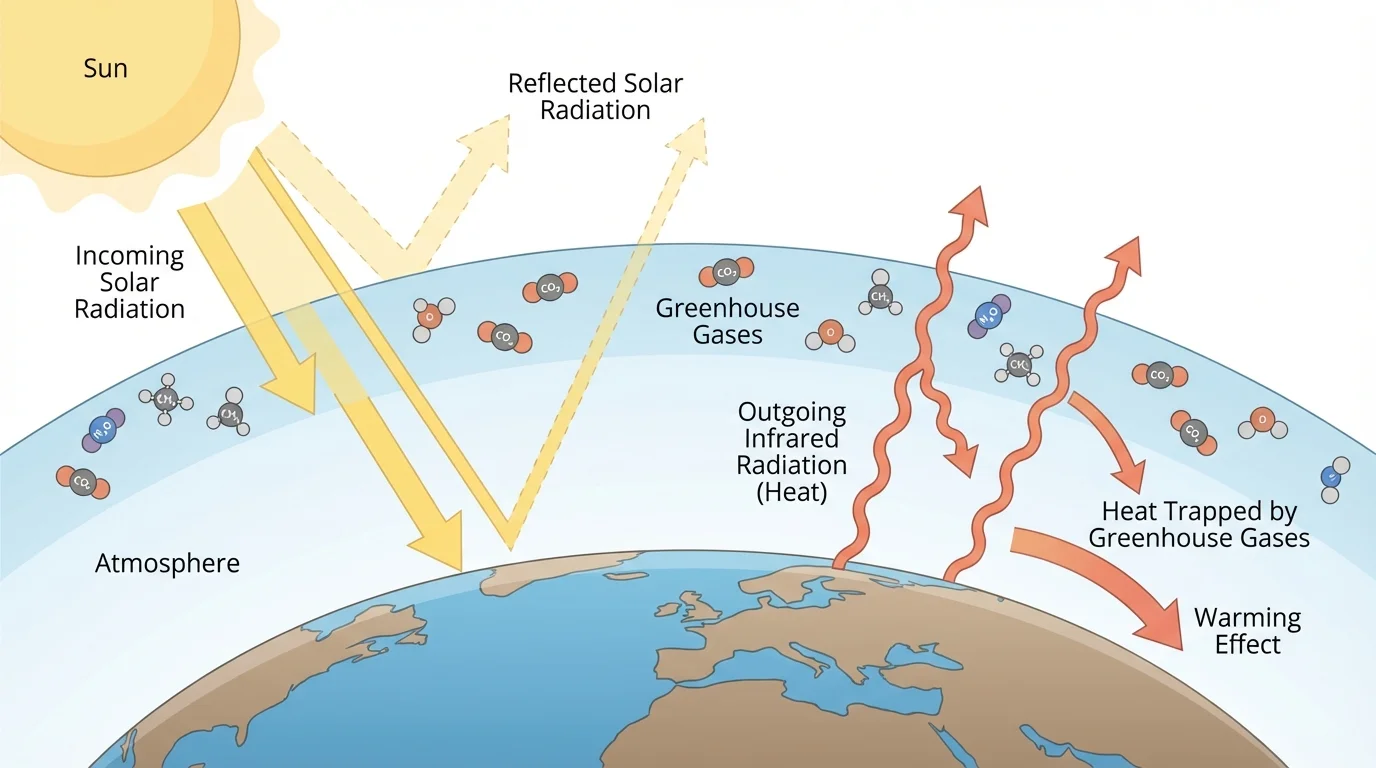
Energy from the Sun drives much of this system. Some solar energy is reflected back to space, while some is absorbed by land, water, and atmosphere. Earth then emits energy outward as infrared radiation. The balance between incoming and outgoing energy helps determine global temperature.
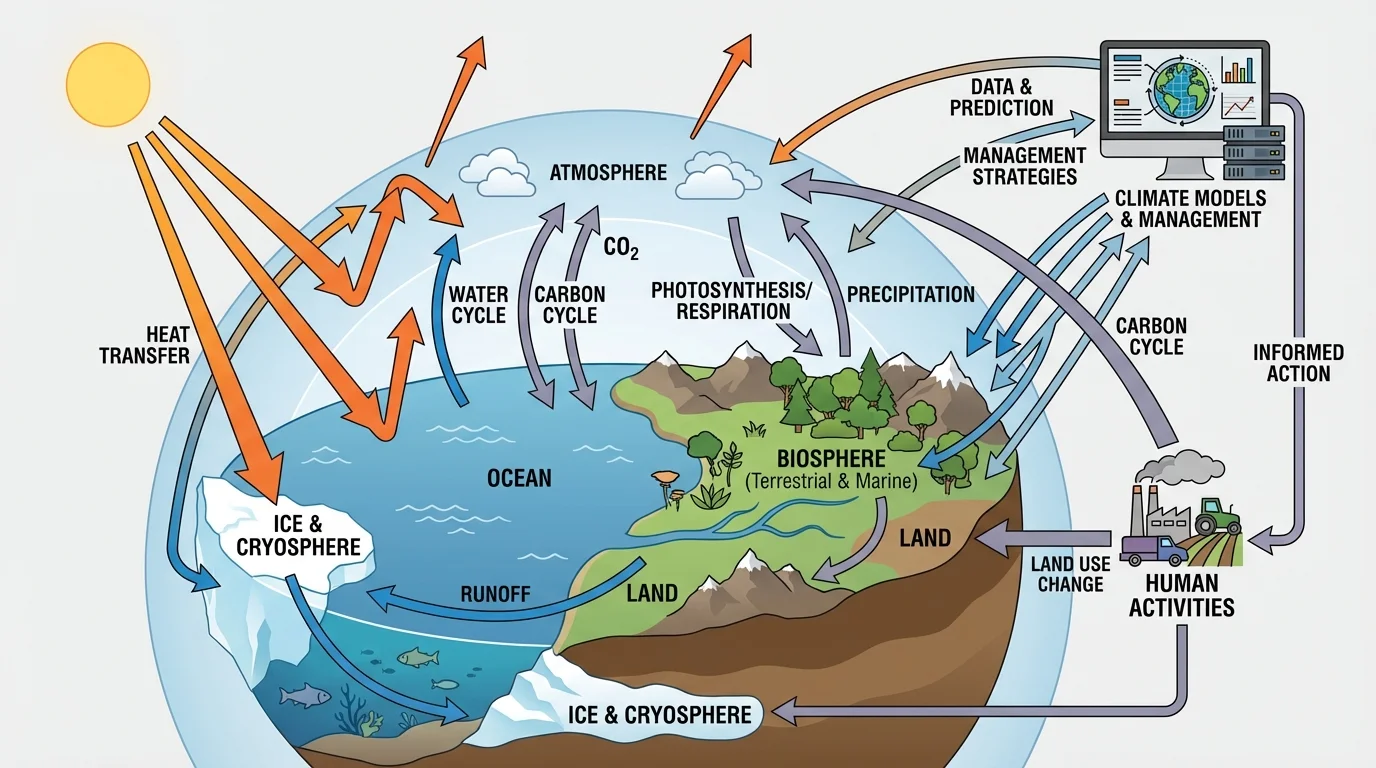
Water is another major connector. Ocean water evaporates, enters the atmosphere, forms clouds, and returns as precipitation. Plants release water vapor through transpiration. Snow and ice store freshwater and release it seasonally. If warming changes any part of this cycle, the effects can spread through rivers, soils, ecosystems, and weather patterns.
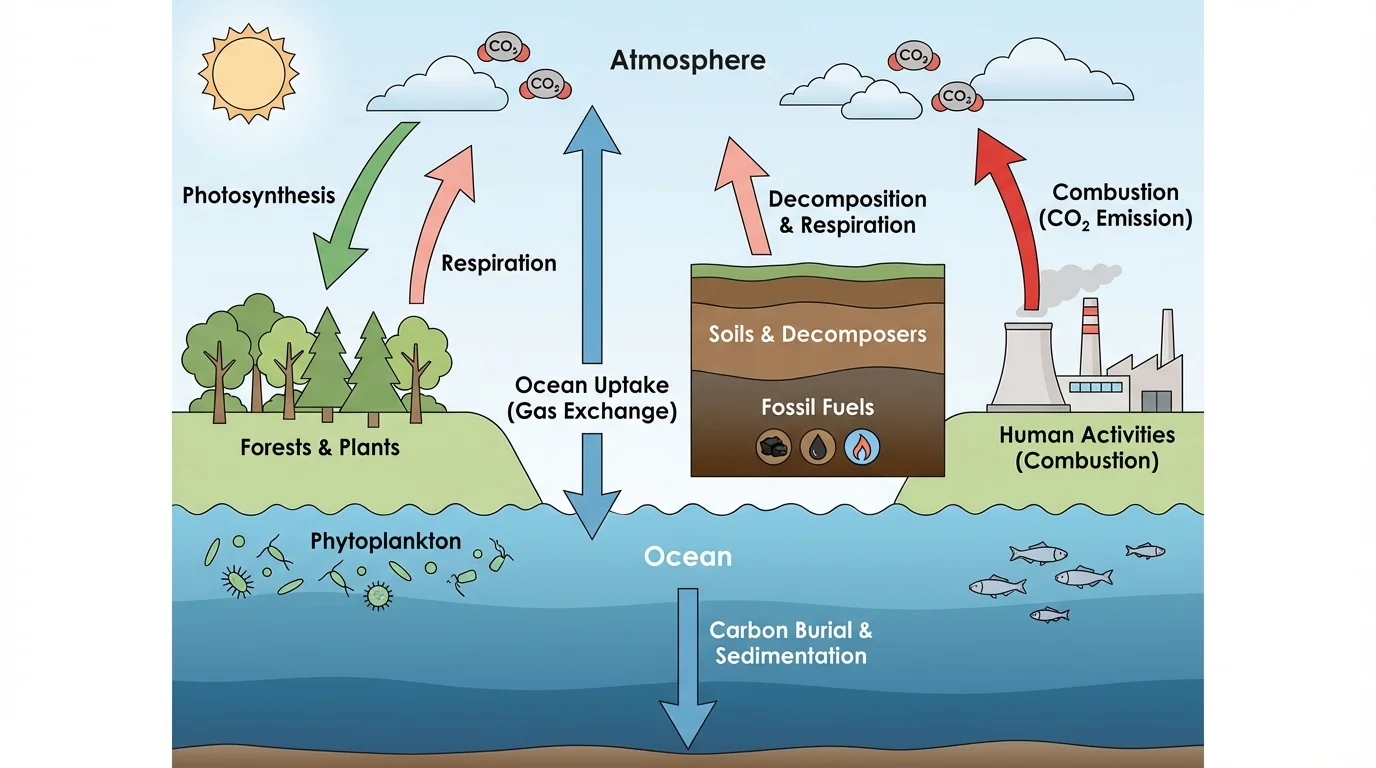
Carbon also moves among systems. Plants take in \(\textrm{CO}_2\) during photosynthesis, while organisms release \(\textrm{CO}_2\) during respiration. Oceans absorb some atmospheric \(\textrm{CO}_2\), and soils can store large amounts of carbon. Burning fossil fuels shifts carbon that was once locked underground into the atmosphere on a much faster timescale than many natural processes can balance.
The natural greenhouse effect, illustrated in [Figure 2], is essential for life. Without it, Earth would be far colder. Certain gases, including \(\textrm{CO}_2\), methane \(\textrm{CH}_4\), nitrous oxide \(\textrm{N}_2\textrm{O}\), and water vapor, absorb some outgoing infrared radiation and re-radiate energy in all directions, warming the lower atmosphere.
The problem is not the existence of the greenhouse effect but its strengthening. Human activities have increased the concentration of greenhouse gases, especially since the Industrial Revolution. The largest source is the burning of fossil fuels such as coal, oil, and natural gas for electricity, heating, transportation, and industry.
Deforestation adds to the problem in two ways. First, cutting or burning forests can release stored carbon. Second, fewer trees remain to remove \(\textrm{CO}_2\) from the atmosphere through photosynthesis. Agriculture also contributes through methane released by livestock and rice farming, as well as nitrous oxide from fertilizers.
A simple way to think about radiative forcing is that adding greenhouse gases changes Earth's energy balance. If incoming energy exceeds outgoing energy by even a small amount over many years, the climate system gains heat. For example, if a region receives an extra average energy imbalance of \(1 \textrm{ W/m}^2\) over \(10 \textrm{ m}^2\), the added power is \(1 \times 10 = 10 \textrm{ W}\). Spread over Earth's vast surface and long time periods, small imbalances matter greatly.
Scientists know greenhouse gas concentrations have risen because they directly measure air samples today and analyze air bubbles trapped in old ice. They know humans are a major cause because the timing matches industrial emissions and because carbon from fossil fuels carries distinctive chemical signatures.
Why \(\textrm{CO}_2\) matters so much
Although \(\textrm{CO}_2\) is not the most powerful greenhouse gas molecule-for-molecule, it matters enormously because humans emit it in very large amounts and it can remain in the climate system for a long time. That makes it a major driver of long-term warming.
Other human-caused changes also affect climate. Soot can darken snow and ice, causing them to absorb more sunlight. Some aerosols reflect sunlight and temporarily cool certain regions, which is one reason climate systems can respond in complicated ways. Land-use change, including urbanization, can alter surface temperature and water flow at local and regional scales.
Climate change is not always a simple chain of cause and effect. Often, a change triggers a feedback loop. In a positive feedback, the initial change becomes stronger. In a negative feedback, it becomes weaker.
An important positive feedback involves ice and snow. Bright surfaces reflect a large fraction of sunlight. When warming melts sea ice or snow cover, darker land or ocean is exposed. These darker surfaces absorb more solar energy, causing further warming and more melting. This is one reason polar regions change so quickly.
Water vapor creates another major feedback. Warmer air can hold more water vapor, and water vapor itself is a greenhouse gas. So warming can increase atmospheric water vapor, which can increase warming further. This does not mean water vapor is the initial driver in modern climate change; instead, it amplifies warming started mainly by human-added greenhouse gases.
Some systems may approach tipping points, where a relatively small additional change pushes the system into a new state. Scientists study this possibility in systems such as ice sheets, permafrost, rainforests, and ocean circulation. Predicting exact thresholds is difficult, which is one reason researchers work intensely on improved models and observations.
Permafrost offers a useful example. Frozen soils in high latitudes store organic carbon. If those soils thaw, microbes can break down the organic matter and release \(\textrm{CO}_2\) and \(\textrm{CH}_4\). That creates another possible positive feedback between warming and greenhouse gas release.
Real-world example: Why regional climate change differs
Two places at the same latitude may not warm at the same rate.
Step 1: Consider nearby ocean influence.
Coastal areas often warm more slowly than inland areas because water heats and cools more slowly than land.
Step 2: Consider land cover.
Forests, cities, deserts, and farmland absorb and release energy differently, which affects local temperature and moisture.
Step 3: Consider atmospheric circulation.
Prevailing winds and storm tracks transport heat and moisture unevenly, so one region may become wetter while another becomes drier.
This is why climate projections are both global and regional: the planet warms overall, but local outcomes vary.
The unevenness of climate change does not make it less real. Instead, it shows that Earth is a complex system with many interacting parts. Understanding those interactions is one of the most important goals of modern Earth science.
Climate change becomes easier to understand when we follow how carbon and heat move through connected reservoirs, as [Figure 3] illustrates. The atmosphere gains greenhouse gases from human activities, the ocean absorbs both heat and some \(\textrm{CO}_2\), and the biosphere responds through changes in growth, migration, and ecosystem stability.
The ocean is especially important because it stores far more heat than the atmosphere. This means much of global warming is not just warming air but warming water. Ocean heat can influence storms, sea level, and marine ecosystems. Warmer seawater also expands, contributing to sea-level rise even before additional water from melting land ice is added.
The relationship between temperature change and thermal expansion can be described by \(\Delta V = \beta V_0 \Delta T\), where \(\Delta V\) is the change in volume, \(\beta\) is the expansion coefficient, \(V_0\) is the original volume, and \(\Delta T\) is the temperature change. For example, if a body of seawater has \(V_0 = 1{,}000 \textrm{ m}^3\), \(\beta = 0.0002\, /^\circ\textrm{C}\), and \(\Delta T = 2^\circ\textrm{C}\), then \(\Delta V = 0.0002 \times 1{,}000 \times 2 = 0.4 \textrm{ m}^3\). That small fractional expansion becomes significant across the global ocean.
When the ocean absorbs \(\textrm{CO}_2\), some of it reacts with water to form carbonic acid. This process contributes to ocean acidification, which can make it harder for organisms such as corals and some shell-forming species to build calcium carbonate structures. The ocean therefore helps slow atmospheric warming by absorbing carbon, but that service comes with ecological costs.
The biosphere responds in many ways. Plants may grow faster in some places if there is more \(\textrm{CO}_2\) and enough water and nutrients, but heat stress, drought, pests, and wildfire can offset or reverse those gains. Animals may shift their ranges toward cooler areas or higher elevations. Seasonal timing can change too: flowers bloom earlier, migrations shift, and food webs can become mismatched.
Marine ecosystems are also changing. Coral bleaching occurs when corals under heat stress expel the symbiotic algae that help feed them. Without these partners, corals turn pale and may die if stressful conditions persist. This is not only an ecological problem but also a human one, because coral reefs support fisheries, tourism, and coastal protection.
Forests play a double role. They remove \(\textrm{CO}_2\) from the atmosphere, but under severe warming and drying they can become sources of carbon through fire, decay, and tree mortality. As seen earlier in [Figure 3], the direction of carbon flow can change depending on environmental conditions and human actions.
Scientists do not rely on a single thermometer or one year of data. They build climate knowledge from many observations and physical laws, and [Figure 4] shows how those pieces connect in modern climate modeling. Data come from weather stations, satellites, ocean buoys, ice cores, tree rings, aircraft, and field studies.
Climate models are computer simulations that represent processes such as radiation, cloud formation, ocean circulation, wind patterns, sea ice behavior, and carbon cycling. These models divide Earth into three-dimensional grid cells and calculate how energy and matter move between them over time.
At the core of modeling is the idea of conservation. Energy cannot simply disappear. Matter moves and changes form but must be accounted for. Models therefore use physics, chemistry, and biology together. They are tested by seeing whether they can reproduce past climate patterns when given known conditions such as volcanic eruptions, solar changes, and greenhouse gas concentrations.
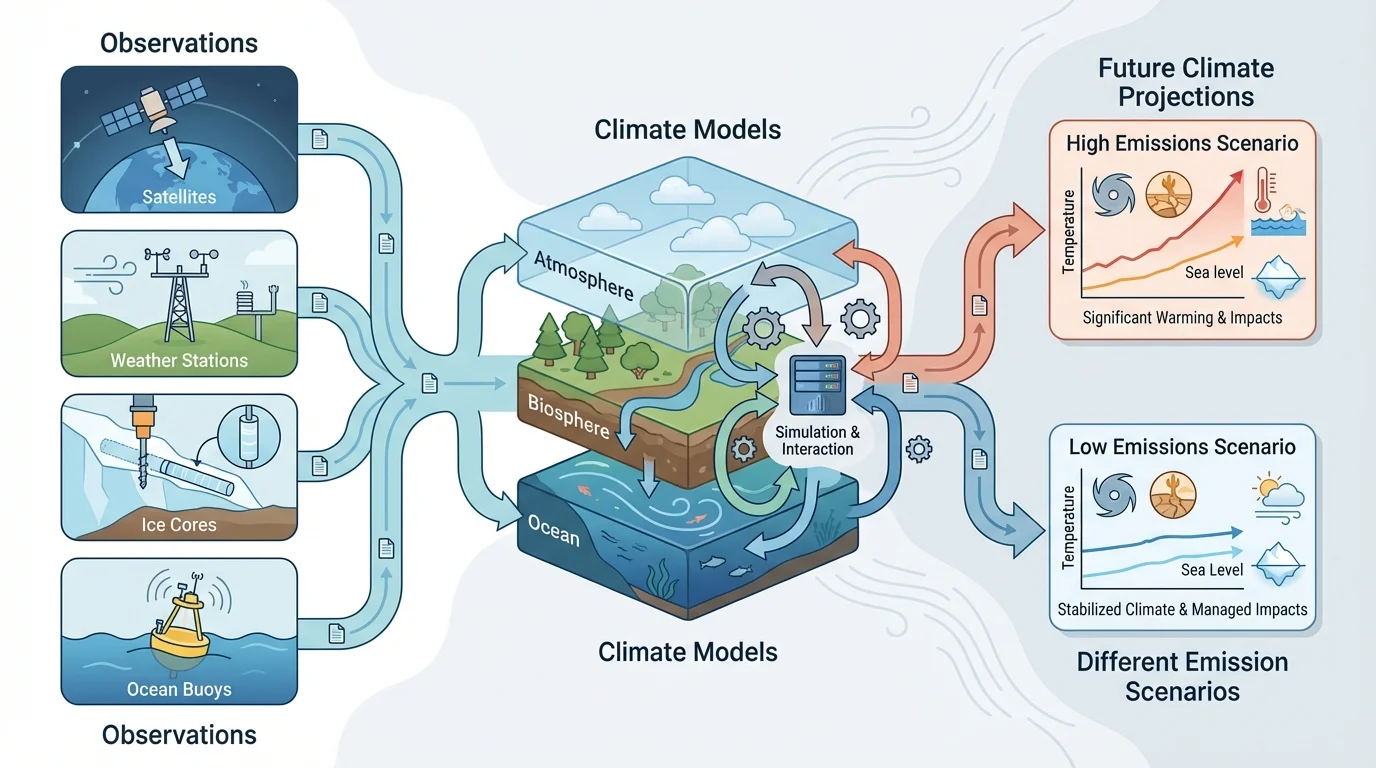
No model is perfect, and uncertainty is normal in science. But uncertainty does not mean ignorance. It means scientists describe a range of likely outcomes based on evidence and assumptions. For example, one major uncertainty is how much greenhouse gas humanity will emit in the future. That is why scientists use multiple scenarios rather than a single prediction.
Models improve over time as computing power grows and observations become more precise. Scientists compare many models, look for agreements and disagreements, and study why differences occur. This process strengthens understanding. If several independent models show warming under rising greenhouse gas concentrations, confidence increases.
Researchers also use attribution studies to ask whether a particular event was made more likely or more intense by climate change. For instance, a heat wave can be analyzed in two modeled worlds: one with modern greenhouse gas levels and one without the added human influence. If the event is much more likely in the modern world, scientists can say climate change increased its probability.
Scientific models are not guesses. They are evidence-based tools built from tested principles. A model can be useful even if it is not perfect, just as a weather forecast can be useful even though it cannot predict every raindrop.
Students sometimes ask why climate models deserve trust if weather forecasts can be wrong after a week. The answer is that weather and climate are different kinds of prediction. Weather asks exactly what the atmosphere will do on a certain day. Climate asks about long-term averages and trends. It is easier to project that summers will generally become hotter than to know the exact temperature at \(3 \textrm{ p.m.}\) six months from now.
The evidence for climate change comes from many independent lines. Thermometer records show long-term warming. Satellites measure shrinking sea ice and changing energy flows. Glaciers retreat on multiple continents. Sea level rises through a combination of thermal expansion and melting land ice. Spring events often occur earlier in many ecosystems.
Coral bleaching events provide one striking example. When marine heat waves raise ocean temperatures beyond what corals can tolerate, bleaching becomes widespread. Scientists have documented such events in places including the Great Barrier Reef. This is a visible case of atmosphere-ocean-biosphere interaction: greenhouse-gas-driven warming affects seawater temperature, which affects living organisms and human economies.
Another example comes from wildfire conditions. Climate change does not ignite every fire, because ignition often depends on lightning or human actions, but hotter and drier conditions can increase the likelihood that fires spread rapidly. This distinction matters: climate change often acts by loading the dice, making certain extremes more probable or more severe.
Arctic sea ice decline is another major signal. As reflective ice disappears, more dark ocean absorbs energy, reinforcing regional warming. This pattern links directly back to the ice-albedo feedback discussed earlier and helps explain why the Arctic changes faster than many other places.
"The climate system is an angry beast, and we are poking it with sticks."
— Wallace Broecker
Heat waves in cities also reveal how climate interacts with built environments. Concrete and asphalt absorb and release heat differently from vegetation, producing urban heat island effects. When background global warming is added to local heat trapping, the result can be dangerous for human health, especially for elderly people, outdoor workers, and communities without access to cooling.
Although the scale of climate change is large, humans are not powerless. In fact, one of the most important scientific ideas in this topic is that our capacity to model, predict, and manage impacts has never been greater. Better monitoring, better models, and better technology mean better decisions are possible.
There are two broad response categories: mitigation and adaptation. Mitigation means reducing the causes of climate change, mainly by lowering greenhouse gas emissions or increasing carbon storage. Adaptation means adjusting human or natural systems to cope with climate impacts that are already happening or are likely to happen.
Mitigation includes shifting electricity production toward low-carbon energy sources, improving energy efficiency, electrifying transportation, protecting forests, restoring wetlands, and reducing methane leaks. Some strategies focus on carbon capture and storage, though these are still developing and vary in cost and practicality.
Adaptation includes building flood defenses, redesigning drainage systems for heavier rainfall, planting heat-tolerant crops, changing irrigation practices, improving wildfire planning, expanding urban tree cover, and creating heat emergency plans. Coastal communities may elevate infrastructure or change zoning rules in flood-prone areas.
| Approach | Main Goal | Examples |
|---|---|---|
| Mitigation | Reduce future climate change | Renewable energy, energy efficiency, forest protection, methane reduction |
| Adaptation | Reduce harm from climate impacts | Sea walls, drought planning, cooling centers, resilient crops |
Table 1. Comparison of mitigation and adaptation strategies in climate response.
Natural systems can also be part of climate solutions. Wetlands store carbon and reduce flooding. Mangroves protect coasts from erosion and storm surges. Healthy soils can store more carbon and support agriculture. In other words, managing the biosphere wisely can help both climate stability and human well-being.
Case study: City heat planning
A city expects more frequent extreme heat days in coming decades.
Step 1: Scientists analyze local temperature records and climate projections.
They identify neighborhoods with higher nighttime temperatures and lower tree cover.
Step 2: Officials map risk.
They compare heat exposure with age, income, health conditions, and access to air conditioning.
Step 3: The city responds.
It plants street trees, creates cooling centers, changes building codes, and develops warning systems.
This is climate science in action: observation, prediction, and management working together.
Not every solution works equally well everywhere. A strategy useful in a wet tropical region may not fit a dry inland region. That is why local data and local knowledge matter. Climate management is most effective when global science is combined with regional planning and community needs.
One of the most important discoveries of climate science is that future warming is not fixed at a single value. Different emission pathways lead to different outcomes. That means policy decisions, technological innovation, economic choices, and everyday infrastructure decisions all matter.
This is where climate science becomes both scientifically challenging and socially important. Human behavior affects emissions. Emissions affect atmospheric composition. Atmospheric composition affects oceans, weather patterns, ecosystems, and risks to people. Then human societies respond again. Climate change is therefore both a natural science issue and a human decision-making issue.
Some students find climate change overwhelming because the system is so large. But scale does not remove responsibility. It clarifies it. The same species that has altered Earth systems also has the tools to measure atmospheric \(\textrm{CO}_2\), simulate future scenarios, engineer cleaner energy systems, restore ecosystems, and design more resilient communities.
Modern climate science is still discovering new details about clouds, ice dynamics, ecosystem responses, ocean circulation, and regional extremes. That ongoing research is not a sign of weakness. It is a sign of active, improving knowledge. Science becomes more useful as it becomes more detailed, and that growing knowledge helps societies make better choices.
