Have you ever seen the sky become bright, then dark, then bright again? Nature is full of things that happen again and again. When we notice these repeating things, we are doing an important part of science.
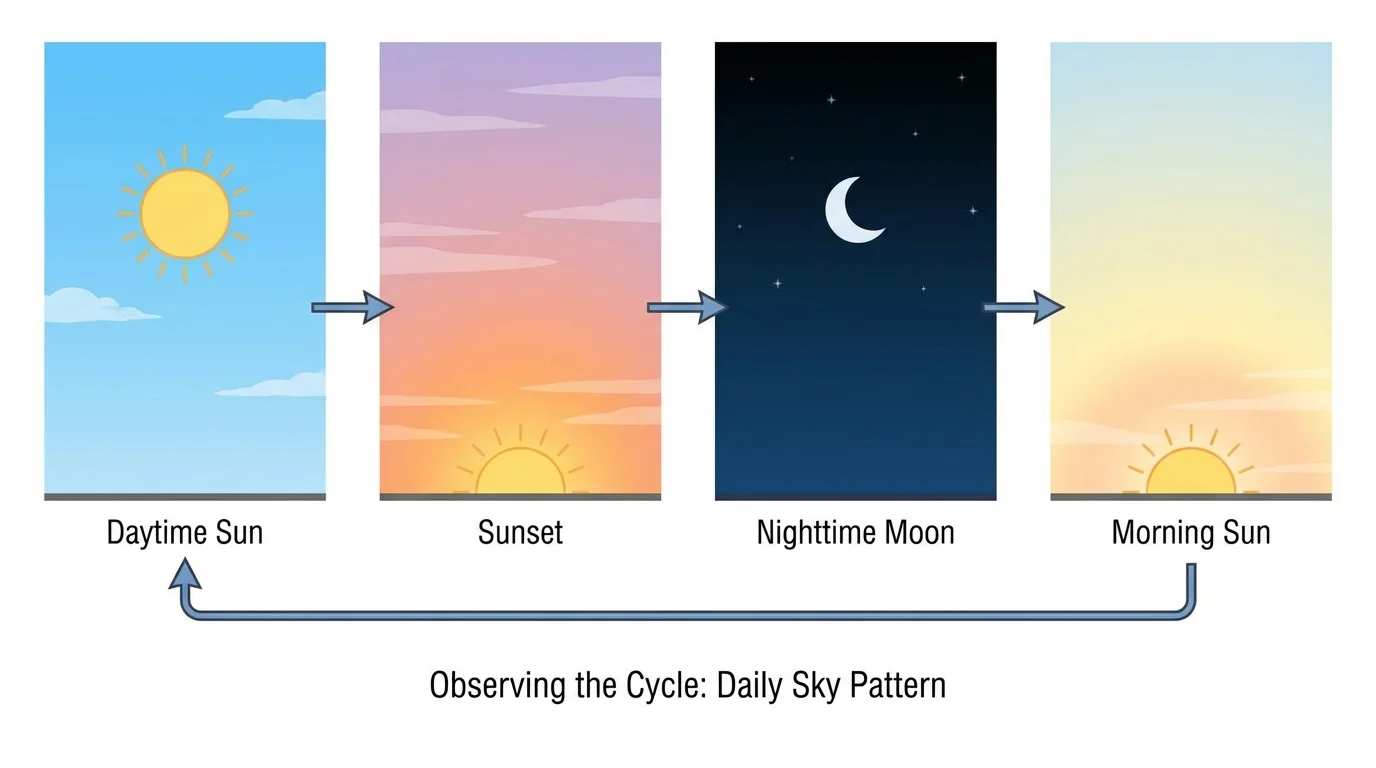
A pattern is something that happens again and again in a way we can notice. In nature, some things repeat every day, every night, every season, or every time we look carefully. Day comes, then night comes, then day comes again, as [Figure 1] shows. That is a pattern in the natural world.
We can see patterns in many places. Leaves may fall in some seasons. Birds may come to the same feeder each morning. Puddles may get smaller after sunshine. When we say what we notice, we are describing patterns.
Observation means using your senses to notice something. Pattern means something we can notice happening again and again. A scientific question is a question about the world that we can try to answer by looking, listening, touching, or measuring.
Some patterns are about time. Some are about shape, color, sound, or movement. A spider web has a shape pattern. Waves on a beach have a movement pattern. Animal footprints can make a pattern on the ground.
Scientists use observations to learn about the world. Sometimes they make firsthand observations. That means they look at something themselves. A child watching ants carry food is making a firsthand observation.
Sometimes scientists learn from media. Media can include photos, videos, diagrams, or sound recordings. If you watch a video of baby ducks following their mother, you are still using observations to learn. You did not stand by the pond, but you can still notice what happens.
Both kinds of observations can help us answer questions. We can ask, "Do flowers open in sunlight?" We can watch flowers outside, or we can look at pictures taken at different times. Then we tell what we notice.
Some scientists study animals they cannot always see in person. They use cameras, videos, and sound recordings to notice patterns in animal behavior.
Good observers try to notice details. They look for color, size, shape, sound, number, and movement. They also look more than one time, because one look may not tell the whole story.
When we collect observations, we have data. Data are the things we noticed. To understand data, we can sort them into groups, compare them, and talk about what is the same or different.
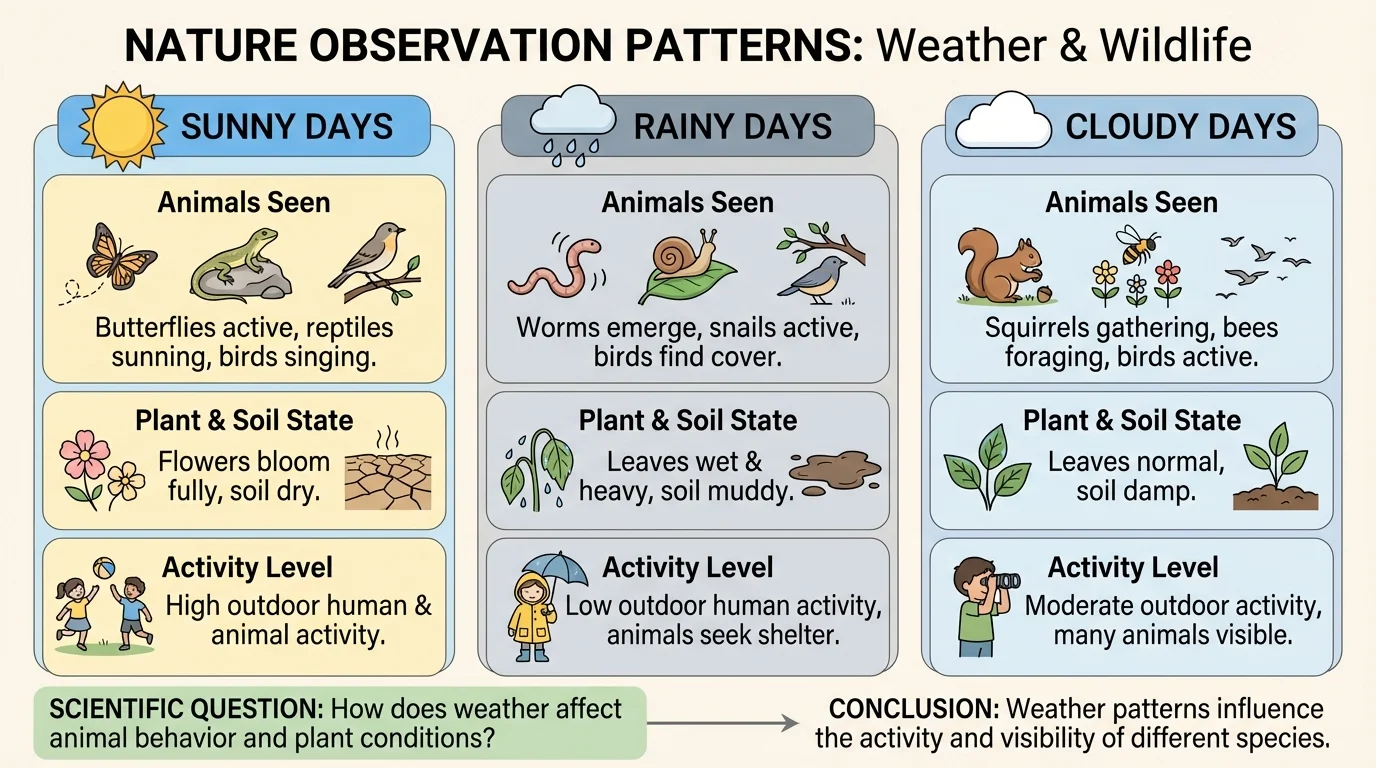
As [Figure 2] shows, we do not need advanced math to begin analyzing data. We can say, "I saw more birds in the morning than at noon." We can say, "The ground looked wetter after rain." We can say, "The plant was short first and taller later." These are simple ways to analyze and interpret what we observed.
We can also use words like more, less, same, different, first, and next. If we look at weather pictures for several days, we might sort them into sunny, cloudy, and rainy groups. Then we can describe which kind happened more often.
Looking at data carefully helps us find a pattern. Maybe worms come out after rain. Maybe shadows are longer when the Sun is low in the sky. Maybe a pet becomes active at the same time each day. The pattern gives us a clue.
How analyzing helps
Analyzing means looking closely at observations. Interpreting means telling what those observations might mean. If we see dark clouds and then rain many times, we can say there is a pattern: dark clouds often come before rain.
Scientists are careful not to guess without observations. They look for what really happened, not just what they think happened. That makes science strong and trustworthy.
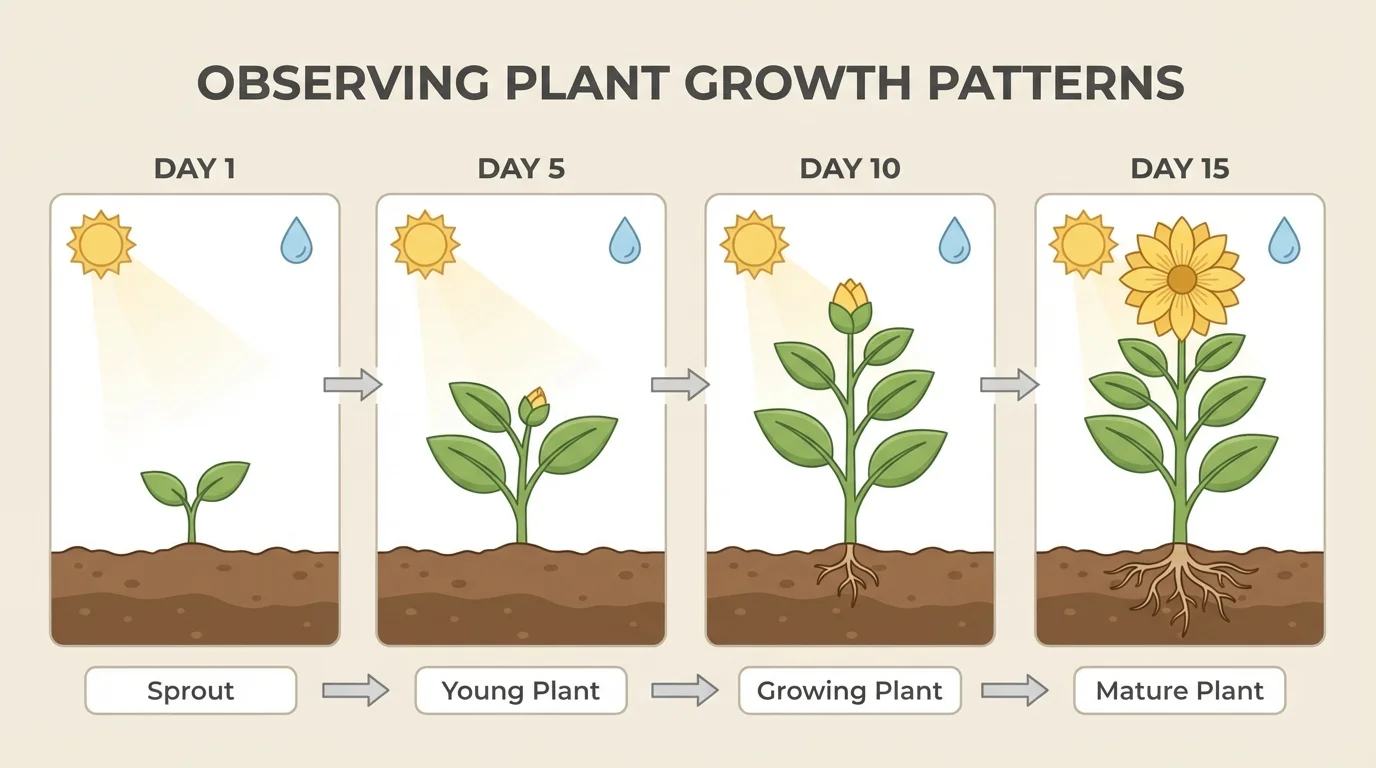
As [Figure 3] shows, a scientific question can often be answered by looking for a pattern. We might ask, "When do bees visit flowers?" If we watch at different times, we may notice bees come more when flowers are open. We might ask, "Is the plant growing?" Repeated observations over days help us answer that.
If we see the same thing many times, we feel more sure. One rainy day does not tell us everything about weather. But many days of observations can show a pattern. Then we can answer a question in a science way.
A child might wonder, "Do puddles stay the same size?" The child looks in the morning and later in the day. If the puddle is smaller after sunshine many times, that pattern helps answer the question: puddles often shrink after warm, sunny weather.
Example: Watching birds at a feeder
Step 1: Ask a question
"When do birds come to the feeder?"
Step 2: Observe
Look in the morning, at noon, and in the afternoon on several days.
Step 3: Analyze
Sort the observations by time of day and compare them.
Step 4: Interpret
If birds come most often in the morning, the pattern helps answer the question.
The answer comes from observations, not from guessing.
Patterns do not answer every question perfectly, but they help us make good science ideas. Later, scientists can keep observing to learn even more.
People observe patterns every day. Weather scientists watch clouds, wind, and rain. Farmers look for patterns in plant growth. Doctors may look for patterns in symptoms and signs of health. Scientists who study animals watch when animals sleep, eat, or move.
Young students can notice patterns too. The Moon seems to change shape over time. Trees may have many green leaves, then fewer leaves later. A shadow may look short at one time and long at another. These natural patterns help us understand our world.
When we think back to the sorting in [Figure 2], we can see how simple groups help us talk about weather clearly. When we think back to the growing plant in [Figure 3], we can understand why scientists observe over and over, not just once.
You already know how to look, listen, and describe. Science uses those same skills in a careful way to learn from nature.
Sometimes patterns come from things we can hear. Frogs may croak more at certain times. Rain may sound loud on a roof and then stop. Sometimes patterns come from touch, such as soil feeling dry and later wet after rain.
Careful observers tell what they really notice. They do not change the story. They look again if they are unsure. They may compare today with yesterday. They may use pictures or notes to help remember.
It is also important to know that not every pattern is exact every time. A bird may not come every morning. A flower may not open at the same minute each day. But if something happens often in a similar way, that can still be a useful pattern.
Science begins with wonder, but it grows with careful observation. When we notice what repeats, sort what we saw, and describe it clearly, we can answer questions about the natural world.
