Your phone might be designed in one country, use minerals from another, be assembled in a third, shipped across oceans, and supported by customer-service workers in a fourth. That is not economic chaos. It is a pattern. International trade often works because different places are relatively better at producing different things, and one of the most powerful ideas for explaining that pattern is comparative advantage.
Comparative advantage helps explain why countries trade even when one country seems stronger, richer, or more productive overall. It shows that trade is not only about who can produce more. It is also about who gives up less to produce a certain good or service. This idea helps economists understand why globalization can increase total output and why countries often specialize in certain industries.
To understand modern trade, we need to look at how countries make choices about land, labor, capital, technology, and entrepreneurship. These resources are limited, so producing more of one thing usually means producing less of another. Comparative advantage is really a way of deciding how to use scarce resources most efficiently.
Countries trade because they do not all have the same resources, climate, skills, technology, or costs. Brazil can grow coffee efficiently because of its land and climate. Japan has limited natural resources but highly advanced manufacturing and engineering. India has become a major exporter of information technology services because of its large, educated workforce. Switzerland is known for specialized finance and high-value manufacturing.
Trade allows countries to consume beyond what they could produce alone. If each country tries to make everything by itself, resources may be wasted. If countries specialize and trade, total production can rise. That means more goods and services are available worldwide, often at lower cost.
Specialization does not mean a country produces only one thing. Instead, it means focusing more heavily on the products or services it can provide at a lower opportunity cost. This is where comparative advantage becomes more useful than a simple comparison of total output.
Absolute advantage means a producer can make more of a good or service with the same resources.
Comparative advantage means a producer can make a good or service at a lower opportunity cost than another producer.
Opportunity cost is the value of the next best alternative that is given up when a choice is made.
These terms are related, but they are not the same. A country can have an absolute advantage in many products and still gain from trade if another country has a comparative advantage in at least one product.
A common misunderstanding is that trade only benefits weak countries that need help from stronger countries. In fact, as [Figure 1] illustrates, even a highly productive country can benefit from trade with a less productive one if their opportunity costs differ. That is the surprising power of comparative advantage.
Suppose Country A can produce more wheat and more cars than Country B using the same amount of labor. Country A has an absolute advantage in both products. At first, it may seem that Country B has nothing useful to offer. But if Country B gives up fewer cars when it produces wheat, then Country B has a comparative advantage in wheat. If Country A gives up less wheat when producing cars, then Country A has a comparative advantage in cars.
The key question is not "Who is best at everything?" The key question is "What is each country giving up to make one more unit?" Trade becomes beneficial when countries specialize according to comparative advantage and then exchange output.
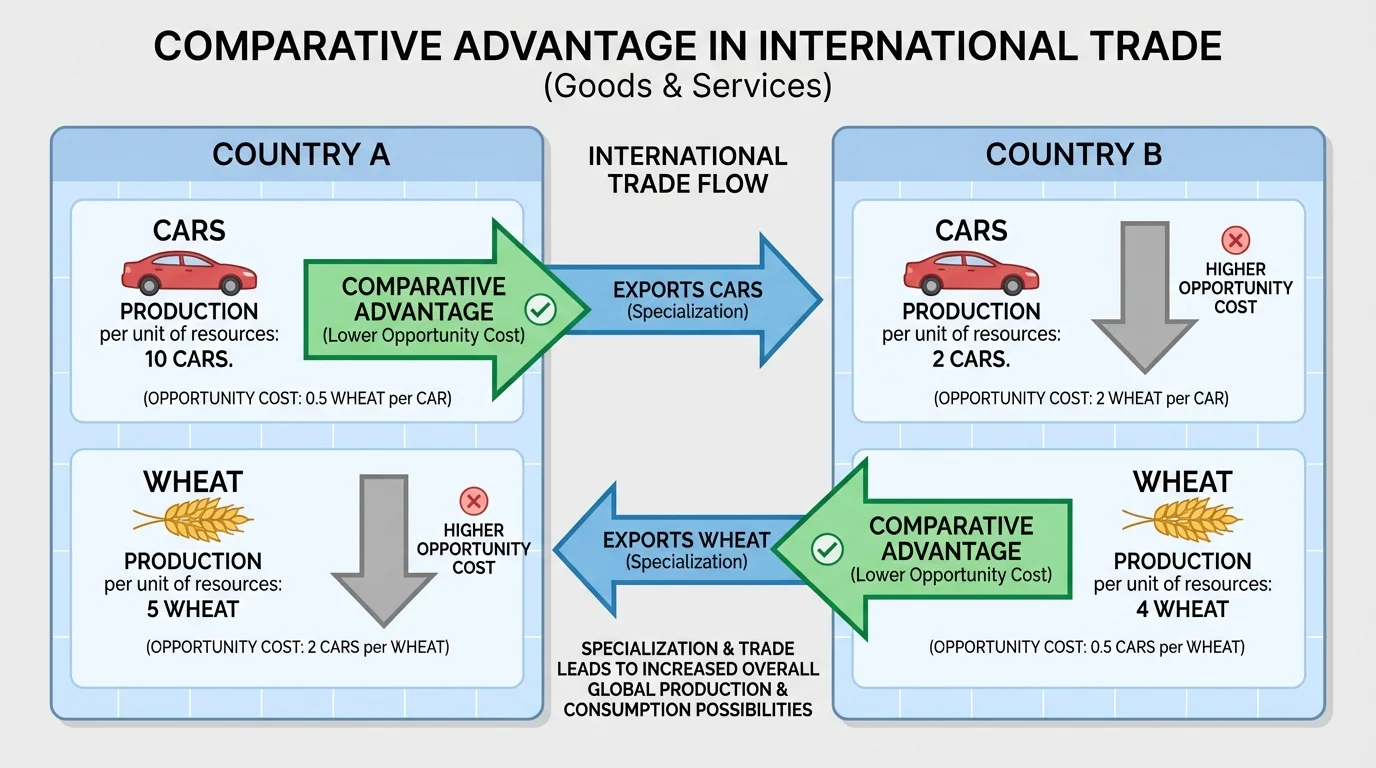
This principle is one of the foundations of international economics. It helps explain why highly developed economies still import products they could produce themselves. The issue is often not whether they can produce them, but whether doing so would pull resources away from areas where they are relatively more efficient.
Comparative advantage depends on opportunity cost. If a country has to give up a large amount of one product to make more of another, then producing that second product is relatively costly. If another country gives up less, then it has the comparative advantage.
Consider a simple example. If one worker in Country X can produce either 10 shirts or 5 pairs of shoes in a day, then producing 1 pair of shoes costs 2 shirts. If one worker in Country Y can produce either 6 shirts or 4 pairs of shoes, then the cost of 1 pair of shoes is \(\dfrac{6}{4} = 1.5\) shirts. Country Y gives up fewer shirts to make shoes, so it has the comparative advantage in shoes, even though Country X can produce more of both goods.
Likewise, we can compare the cost of producing shirts. In Country X, 1 shirt costs \(\dfrac{5}{10} = 0.5\) pairs of shoes. In Country Y, 1 shirt costs \(\dfrac{4}{6} = \dfrac{2}{3}\) pairs of shoes. Country X gives up fewer shoes to make shirts, so Country X has the comparative advantage in shirts.
The central logic is simple: if each country specializes in the product with the lower opportunity cost, and then they trade, both sides can end up with more total output or lower-cost access to goods and services than they would have had without trade.
This does not mean every individual person gains equally, and it does not mean adjustment is painless. But at the level of total production, comparative advantage predicts efficiency gains from specialization and exchange.
The pattern becomes easier to see visually, and [Figure 2] displays the shift from mixed production to specialization and trade. Consider two countries: Coastland and Hillland. Each has the same amount of labor available.
In one month, Coastland can produce either \(100\) tons of coffee or \(50\) bolts of cloth. Hillland can produce either \(60\) tons of coffee or \(60\) bolts of cloth.
Now calculate opportunity costs. In Coastland, producing \(1\) bolt of cloth costs \(\dfrac{100}{50} = 2\) tons of coffee. In Hillland, producing \(1\) bolt of cloth costs \(\dfrac{60}{60} = 1\) ton of coffee. Hillland has the comparative advantage in cloth because it gives up less coffee for each bolt of cloth.
For coffee, Coastland gives up \(\dfrac{50}{100} = 0.5\) bolts of cloth for each ton of coffee, while Hillland gives up \(\dfrac{60}{60} = 1\) bolt of cloth for each ton of coffee. Coastland has the comparative advantage in coffee.
Worked trade example
Suppose that before trade, each country splits its labor equally between coffee and cloth.
Step 1: Find production before specialization.
Coastland produces \(50\) tons of coffee and \(25\) bolts of cloth.
Hillland produces \(30\) tons of coffee and \(30\) bolts of cloth.
Total world output is \(80\) tons of coffee and \(55\) bolts of cloth.
Step 2: Specialize according to comparative advantage.
Coastland produces only coffee: \(100\) tons.
Hillland produces only cloth: \(60\) bolts.
Total world output becomes \(100\) tons of coffee and \(60\) bolts of cloth.
Step 3: Compare totals.
Coffee rises from \(80\) to \(100\), an increase of \(20\).
Cloth rises from \(55\) to \(60\), an increase of \(5\).
Because total output rises, there is more available to trade and consume.
After specialization, the countries can trade coffee for cloth at a rate between their opportunity costs. For example, if they trade \(1\) bolt of cloth for \(1.5\) tons of coffee, both can gain. Coastland gets cloth more cheaply than producing it at home, because making cloth itself costs it \(2\) tons of coffee per bolt. Hillland gets coffee more cheaply than producing it at home, because making coffee itself costs it \(1\) bolt of cloth per ton.
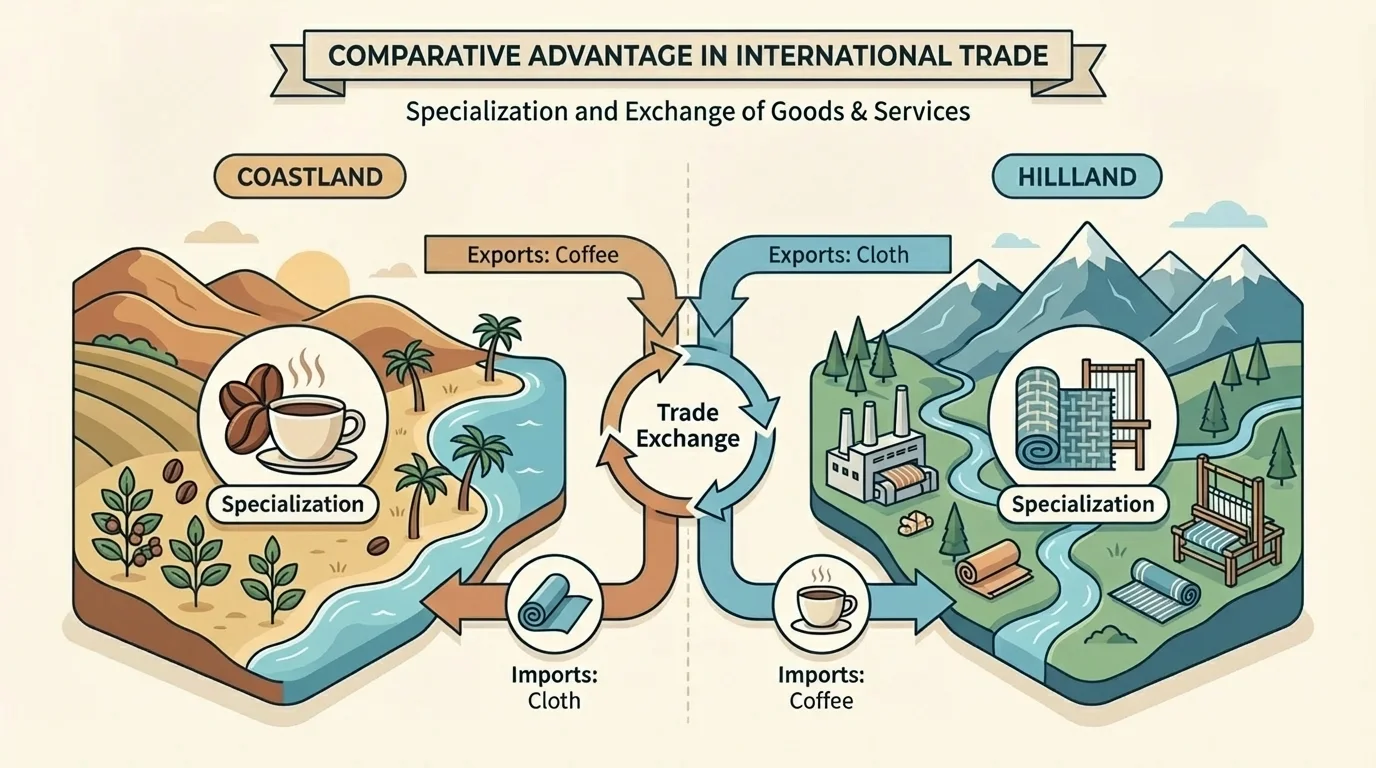
This example is simplified, but it shows the main idea. Trade allows countries to move beyond their own production possibilities by exchanging with others. Comparative advantage helps determine what they tend to specialize in.
Many students first learn trade through physical goods such as wheat, oil, or cars. But comparative advantage also applies to services trade. Services include banking, software development, engineering design, online tutoring, tourism, transportation, legal consulting, health-related support, and entertainment.
For example, one country may have a comparative advantage in software coding because it has a large number of trained programmers and lower labor costs in that industry. Another country may have a comparative advantage in medical research because it has advanced laboratories, universities, and highly specialized scientists. A third may have a comparative advantage in tourism because of natural attractions, cultural heritage, and hospitality infrastructure.
Services can now be traded more easily because of the internet, fiber-optic networks, cloud computing, and digital platforms. A business in Canada can hire a design team in South Korea, accounting support in India, and data-security experts in Israel. Global trade is no longer just about ships carrying containers. It is also about information crossing borders almost instantly.
Some of the fastest-growing parts of global trade are not physical products at all. Digital services such as app development, streaming support, and cloud-based business services can be exported without a crate, a truck, or a port.
This matters because students often picture trade as factories alone. In reality, a growing share of international exchange involves knowledge, communication, finance, design, and digital work.
Modern globalization connects countries through trade, investment, migration, and information flows. As [Figure 3] shows, a single product or service may involve a chain of activities spread across many countries. Comparative advantage influences where each stage happens.
A company may locate research and development where scientific talent is concentrated, manufacturing where production costs are relatively low, customer support where language skills and labor supply fit the task, and shipping through ports with strong transportation networks. This is an example of how trade affects the allocation of resources.
Resources move toward their most valued uses in a global market. Labor shifts into industries where a country is relatively more efficient. Capital flows into profitable sectors. Land is used for crops or industries where returns are highest. Technology spreads as firms compete internationally.
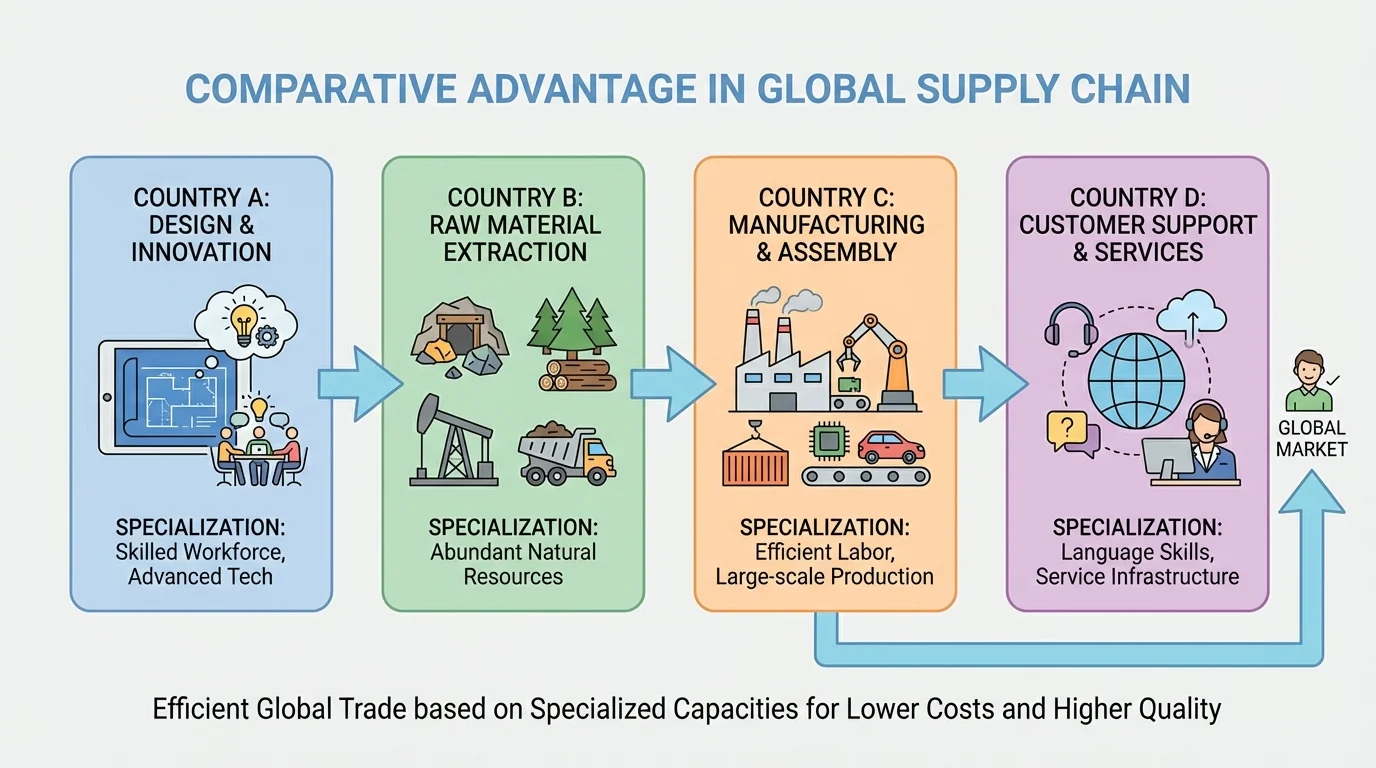
Think about a smartphone. Rare earth minerals may come from one region, chip design from another, assembly from another, shipping through international ports, and software updates from teams located worldwide. Or think about a streaming platform: coding, data storage, billing systems, content licensing, and multilingual customer service may all happen in different places. Comparative advantage helps explain why these tasks are distributed rather than kept in one location.
When this system works well, total output expands and prices can fall. But it also means economies become interconnected. A drought, war, pandemic, strike, or shipping disruption in one part of the world can affect production elsewhere. The same global specialization that creates efficiency can also create vulnerability.
When countries specialize according to comparative advantage, several benefits can follow. First, efficiency increases because resources are used where they produce the most value. Second, consumers often gain access to lower prices and greater variety. Third, firms can reach larger markets, making large-scale production more practical. Fourth, innovation can speed up because international competition pushes businesses to improve.
These gains can affect everyday life directly. Students may wear shoes designed in Europe, made in Vietnam, and sold by an American company. Families may buy fruit in winter because imports arrive from warmer climates. Schools may use software tools coded by teams on multiple continents. Hospitals may depend on medical devices and digital systems built through global supply chains.
The comparative advantage idea in [Figure 1] remains important here: gains from trade do not require one side to be "better" at everything. What matters is relative cost. That is why countries with very different income levels still trade with each other.
| Possible effect of trade | How comparative advantage helps explain it | Example |
|---|---|---|
| Lower prices | Production shifts to relatively lower-cost producers | Imported clothing or electronics |
| More variety | Countries specialize and exchange different outputs | Coffee, cars, software, tourism services |
| Higher productivity | Resources move toward more efficient uses | Workers and capital concentrate in stronger industries |
| Innovation | Global competition rewards better methods | New manufacturing technology or digital services |
Table 1. Common effects of trade and the role comparative advantage plays in producing them.
Comparative advantage is a powerful model, but real economies are more complicated than textbook examples. Trade does not automatically make every person better off, even when total output rises. Some workers may lose jobs if production moves abroad or if imports outcompete local industries. New jobs may appear in other sectors, but the transition can be difficult and slow.
Tariffs, quotas, transportation costs, political conflict, and exchange-rate changes can all alter trade patterns. If moving goods is expensive, then specialization may not save much. If a government taxes imports, consumers may face higher prices, but domestic firms may get temporary protection from competition.
Why theory and reality can differ Economics models often assume smooth adjustment, full information, and low barriers. In the real world, workers may need retraining, businesses may fail before new industries grow, and countries may care about national security, strategic industries, or food independence as well as efficiency.
Environmental effects also matter. Shipping goods worldwide uses energy and creates emissions. Some countries may specialize in pollution-intensive industries, raising questions about who bears the environmental cost. Labor standards and working conditions are also important. A product made more cheaply is not automatically better if the low price depends on unsafe workplaces or exploitation.
Another complication is that comparative advantage can change over time. A country may develop better education, infrastructure, or technology and create new strengths. South Korea, for example, shifted over decades from lower-cost manufacturing toward advanced electronics, cars, shipbuilding, and technology. Comparative advantage is not fixed by nature alone; it can be shaped by investment and policy.
Case study: a tariff on imported steel
Suppose a government places a tariff on steel imports to protect domestic steel producers.
Step 1: Imported steel becomes more expensive.
Domestic steel companies may sell more because foreign steel now costs more in the home market.
Step 2: Steel-using industries face higher costs.
Car makers, appliance companies, and construction firms may pay more for steel.
Step 3: Consumers and workers are affected differently.
Some steel jobs may be protected, but prices of cars or appliances may rise, and jobs in steel-using industries may come under pressure.
This example shows that trade policy often creates winners and losers at the same time.
These complications do not erase the usefulness of comparative advantage. Instead, they remind us that economic efficiency is only one goal among many. Societies also care about fairness, stability, security, and sustainability.
Governments influence trade through trade agreements, tariffs, subsidies, safety standards, labor laws, and investments in education and infrastructure. Policymakers may support free trade when they want lower prices and larger markets, or they may use protectionist policies when they want to shield domestic industries.
A trade agreement can reduce barriers between countries and make trade easier. That can increase competition and lower prices, but it can also intensify pressure on local producers. Education and job-training programs are often important because they help workers adjust when the economy shifts toward industries where the country has stronger comparative advantages.
Comparative advantage also helps explain why debates about trade are often intense. Consumers may benefit from cheaper imports, while workers in import-competing industries may face hardship. Export industries may grow, while others shrink. The gains from trade are real, but they are not always distributed evenly.
As we saw in [Figure 3], globalization connects many stages of production across borders. That means policy choices in one country can affect jobs, prices, and supply chains elsewhere. A decision about semiconductors, shipping rules, data privacy, or tourism policy can ripple across the global economy.
Understanding comparative advantage gives students a tool for analyzing these debates more carefully. Instead of asking only whether trade is "good" or "bad," we can ask better questions: Which industries have lower opportunity costs? Who gains? Who loses? How large are the gains? What policies help people adapt? How should societies balance efficiency with other values?
"Trade can make the economic pie larger, but societies still have to decide how that pie is divided."
That is why comparative advantage is not just an abstract theory. It is part of daily life, from the food in stores to the apps on phones, from tourism jobs to manufacturing plants, from shipping routes to remote digital work.
