Have you ever felt stuck, scared, or confused and not known what to do next? That happens to everyone. Asking for help is not a sign that you are weak. It is a smart way to keep yourself safe, calm, and ready to learn.
Sometimes you can do things on your own, and sometimes you need support. A trusted adult is a grown-up who listens, cares, and helps keep you safe. This could be a parent, grandparent, caregiver, online teacher, school counselor, coach, doctor, or another safe adult in your life.
Help means getting support when something is too hard, unsafe, confusing, or upsetting to handle alone.
Support is the kind of help you get. Support can be comfort, directions, protection, care for your body, or help solving a problem.
When you ask for help early, small problems can stay small. If you wait too long, a small problem can become bigger. For example, if your learning video will not load and you say nothing, you may miss your lesson. If you tell an adult right away, the problem can be fixed faster.
Asking for help helps you in many ways. It can keep you safe if something feels wrong. It can help your body if you are hurt or sick. It can help your mind if you feel confused. It can help your emotions if you feel sad, worried, or lonely.
It is also a way to learn about yourself. You notice, "I need help right now," and then you take a good next step. That is called self-awareness. It means knowing what is happening inside you.
Strong people ask for help. Firefighters, doctors, and pilots all work with other people when they need support.
If you ask for help, you are taking care of yourself. That is a brave choice.
Your body, feelings, and situation can give you clues, as shown in [Figure 1]. You may need help if you feel confused, stuck, hurt, scared, very upset, or unsure what to do next.
Sometimes your body gives clues. You may be crying, shaking, feeling pain, coughing a lot, or feeling too tired to do what you need to do. Those are important signs to tell a trusted adult.
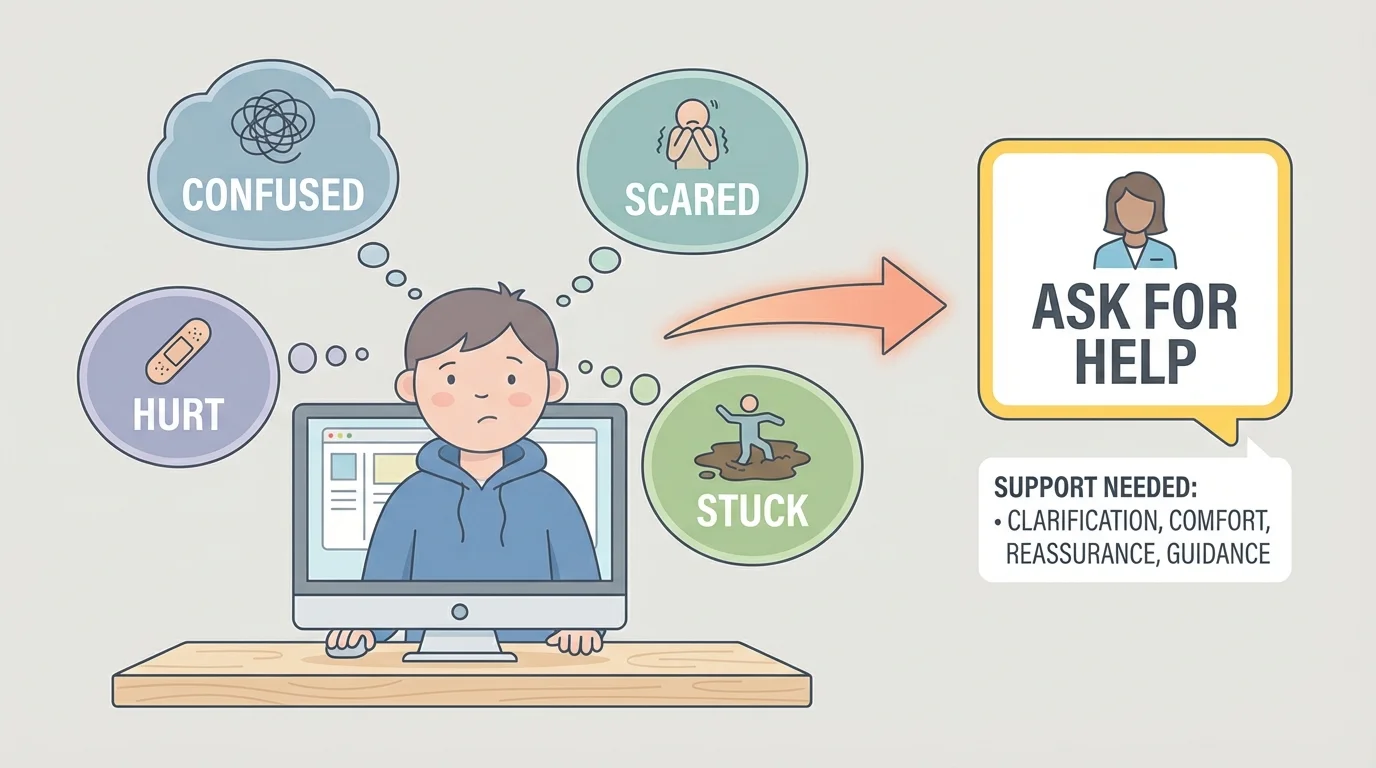
Sometimes your feelings give clues. You may feel worried before an online class call, sad after a mean message, or angry because something is not working. Big feelings are a good time to slow down and ask for support.
Sometimes the situation gives clues. Maybe you cannot log in, you do not understand directions, a stranger messages you online, or you cannot find your grown-up at the park. These are all times to get help.
Notice the clue, then act. First, stop and notice what is happening. Next, think, "Can I solve this safely by myself?" If the answer is no, ask for help right away. If a problem is about safety, do not wait.
A good rule is this: if you are not safe, not sure, or not able to do the next step alone, ask for help. The clues in [Figure 1] remind you that help can be needed for feelings, body problems, and tricky situations.
Different people help in different ways. A parent or caregiver may help when you feel sick, scared, or need comfort. An online teacher may help when directions are confusing. A doctor or nurse may help when your body hurts. A counselor may help with big feelings. A tech support person may help with a broken device or internet problem.
Friends can help with small things, like reminding you where to click in a game or saying kind words when you feel sad. But for safety problems, hurt feelings that are very big, body problems, or online stranger problems, tell an adult.
| Problem | Good Person to Ask |
|---|---|
| You feel sick or hurt | Parent, caregiver, doctor, nurse |
| You do not understand school directions | Online teacher, caregiver |
| A device will not work | Caregiver, tech support, teacher |
| You feel sad, scared, or worried | Parent, caregiver, counselor, trusted adult |
| A stranger contacts you online | Trusted adult right away |
Table 1. Examples of who to ask for help in common situations.
You can even make a small help list at home with names of safe adults. Keep it where you can find it quickly.
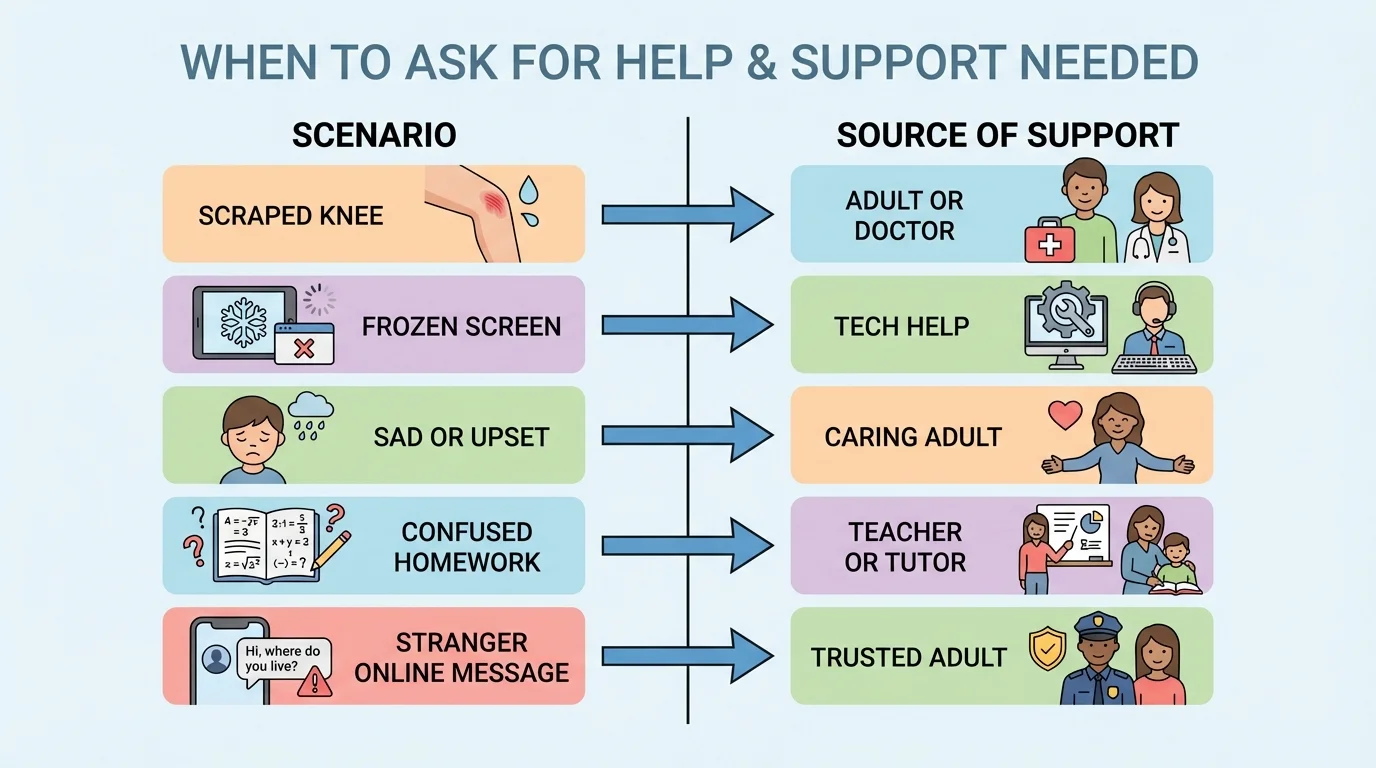
Different problems need different kinds of support, as [Figure 2] shows. When you know what kind of help you need, it is easier to ask clearly.
You might need support like comfort, information, protection, health care, or help fixing something. If you scraped your knee, you need body care. If you feel scared after a bad dream, you may need comfort. If your screen freezes during class, you need technology help.
Try asking yourself, "What do I need right now?" Here are some helpful choices:
Comfort: "I need a hug." "Please stay with me."
Directions: "Can you explain this?" "Can you show me the next step?"
Safety help: "I do not feel safe." "Please help me now."
Health help: "My throat hurts." "I fell and my arm hurts."
Technology help: "The sound is not working." "I cannot log in."
When you match the problem to the right kind of support, the helper can act faster. The chart in [Figure 2] makes this easier to see.
You do not need fancy words. A simple plan works well, and [Figure 3] lays out the steps clearly. You can speak, call, video chat, or send a message if that is the safest way.
Step 1: Get the attention of a trusted person.
Step 2: Say what is wrong.
Step 3: Say what you need, if you know.
Step 4: Listen to the next steps.
Simple ways to ask for help
Step 1: Start with the person's name.
"Mom, I need help." or "Teacher, I am confused."
Step 2: Say the problem.
"My computer screen is frozen." "My stomach hurts." "I got a message from someone I do not know."
Step 3: Say what you need.
"Please come here." "Can you explain it again?" "Please help me block this person."
Clear words help other people understand you faster.
If you feel shy, you can still use a short sentence. "I need help." That is enough to start.
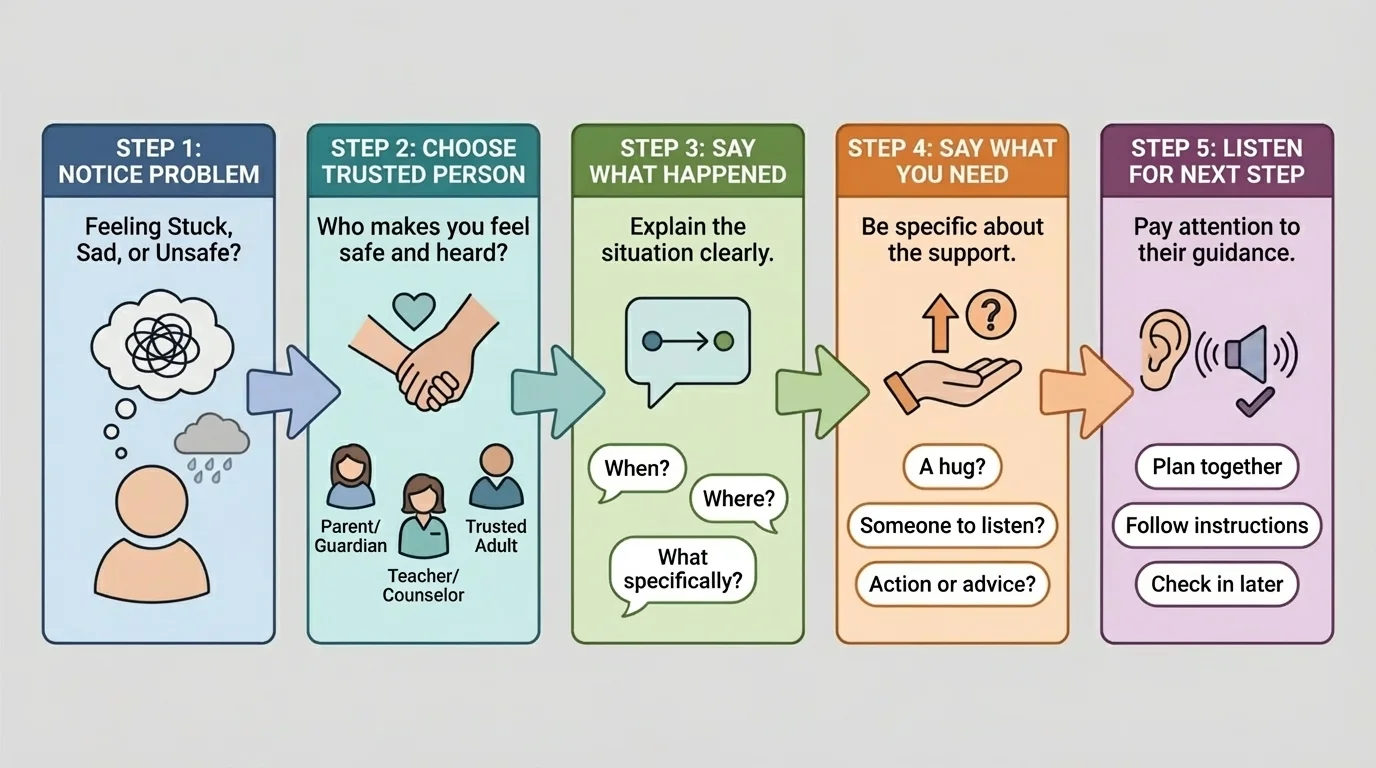
If you are in danger, use strong, clear words: "Help now." "I am hurt." "I do not feel safe." The steps in [Figure 3] help you remember what to say, even when you feel nervous.
Sometimes the first person is busy, does not answer right away, or is not the right helper for that problem. That does not mean you should stop. Ask another trusted adult.
This is extra important for safety problems. If someone online is being mean, if a stranger contacts you, if your body is hurt, or if something feels dangerous, keep telling trusted adults until someone helps you.
"When something feels wrong, keep asking until you get help."
You never have to keep a secret that makes you feel unsafe. Safe adults want you to tell them.
Make a short help plan for yourself. Think of three trusted adults you can ask. Practice one sentence you can say, such as "I need help, please." Put your plan somewhere easy to remember.
You can also notice your own clues today. If you feel stuck during a task, stop and ask, "Do I need directions, comfort, or help fixing something?" That question can guide you to the right support.
Learning when to ask for help is part of growing up. You are learning how to know yourself, speak up, and stay safe.
