Have you ever been doing schoolwork at home and suddenly wanted to groan, stomp, or give up? That happens to lots of kids. Your brain is learning something new, and new things can feel tricky. The good news is this: you can learn ways to help yourself feel calmer and ready to keep going.
Frustration is the upset feeling you might have when something is hard, confusing, or not working yet. Maybe a word is hard to read. Maybe the video lesson moves too fast. Maybe you click the wrong button and feel mad. Frustration is a real feeling, but it does not have to take over.
When frustration grows too big, it can make learning harder. You may stop listening, rush, cry, yell, or say, "I can't do it." But when you calm your body and mind, you give yourself a better chance to learn. That is what self-management means: helping yourself make a good choice, even when feelings are strong.
Self-management means taking care of your feelings, body, and actions so you can do what you need to do. Calm means your body and mind feel more settled and ready.
You do not need to be upset for a long time. You can use words, breathing, or movement to help yourself.
Your body often gives clues before frustration gets very big, as [Figure 1] shows. You might squish your eyebrows, squeeze your hands, wiggle roughly in your chair, feel hot, or want to shout. You might also think, "This is too hard," or "I am bad at this."
When you notice those clues early, you can help yourself sooner. That is a smart skill. It is easier to calm a small feeling than a giant feeling.
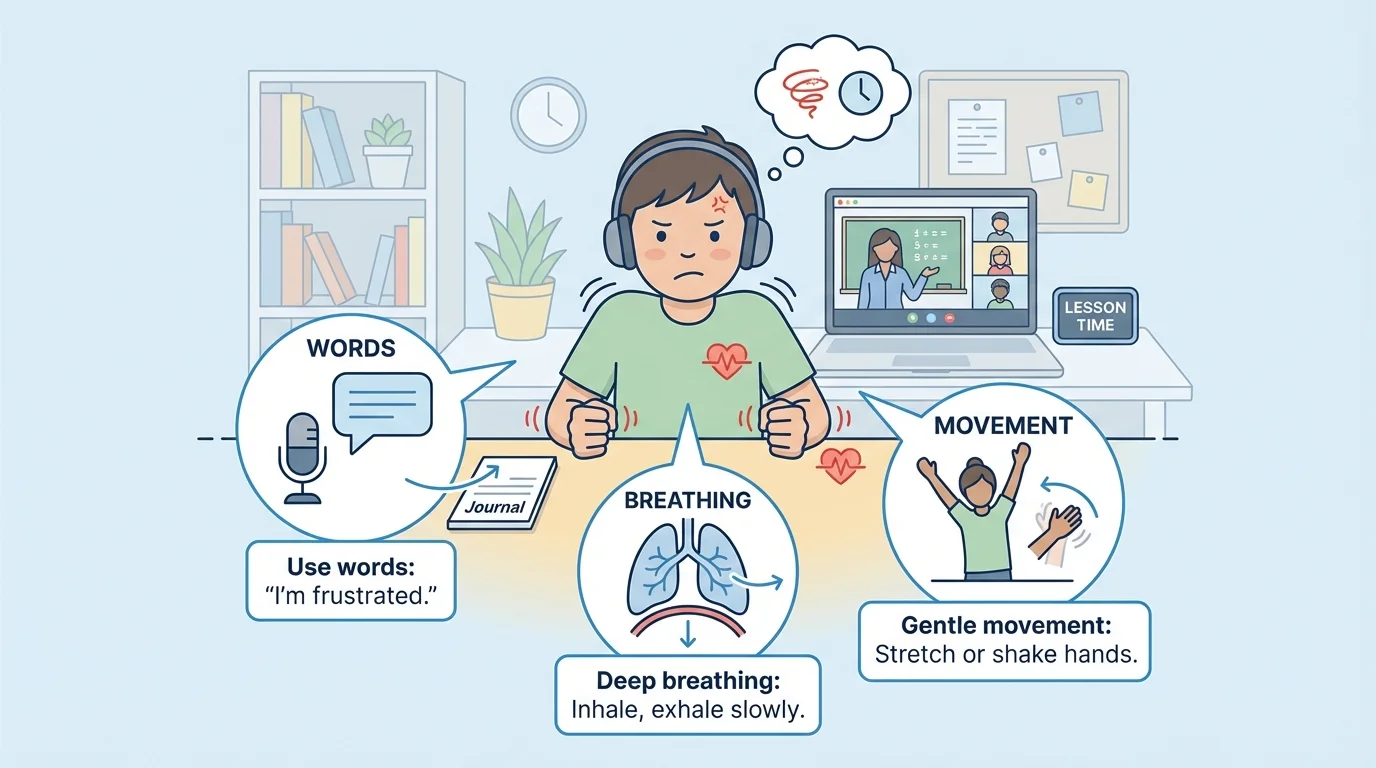
Try naming the feeling in a simple way. You can say, "I feel frustrated." You can also say, "This is hard right now." Saying the feeling does not make it bigger. It helps you understand what is happening.
Your brain grows when you practice hard things. A tricky job can help your brain get stronger, even if it feels frustrating at first.
Sometimes the clue is in your actions. Maybe you click too fast, erase hard, or want to leave your seat. Those are signs that you may need a quick reset before you continue.
Self-talk means the words you say to yourself in your head or out loud. Helpful self-talk can calm you down. Unhelpful self-talk can make frustration bigger.
Instead of saying, "I can't," try saying, "I can try one more time." Instead of saying, "This is the worst," try saying, "This is hard, but I can slow down." Instead of saying, "I will never get it," try saying, "I do not get it yet."
Helpful words you can use
Step 1: Name the feeling.
Say, "I feel frustrated."
Step 2: Say one calming sentence.
Say, "I can slow down," or "I can ask for help."
Step 3: Say what you will do next.
Say, "I will read the directions again," or "I will send a message to my teacher or grown-up."
You can also use words with other people. If you are in an online class or working near a grown-up, you can say, "I need a minute," "Can you help me with the first part?" or "Can you read the directions with me?" Asking for help is not giving up. It is a strong choice.
Later, when you notice your own clues again, you can remember the body signals from [Figure 1] and use helpful words before the frustration gets bigger.
Breathing reset is a short way to breathe slowly so your body can relax, as [Figure 2] shows. When you are upset, your breathing can get fast. Slow breathing tells your body, "We are safe. We can calm down."
One easy way is balloon breathing. Put your hands on your belly. Breathe in through your nose and feel your belly get bigger like a balloon. Hold for a tiny moment. Then breathe out slowly through your mouth and feel the balloon get smaller.
You can do it like this: breathe in for a count of 1, hold for 1, and breathe out for a count of 3. You do not need to count perfectly. Slow and gentle is what matters.
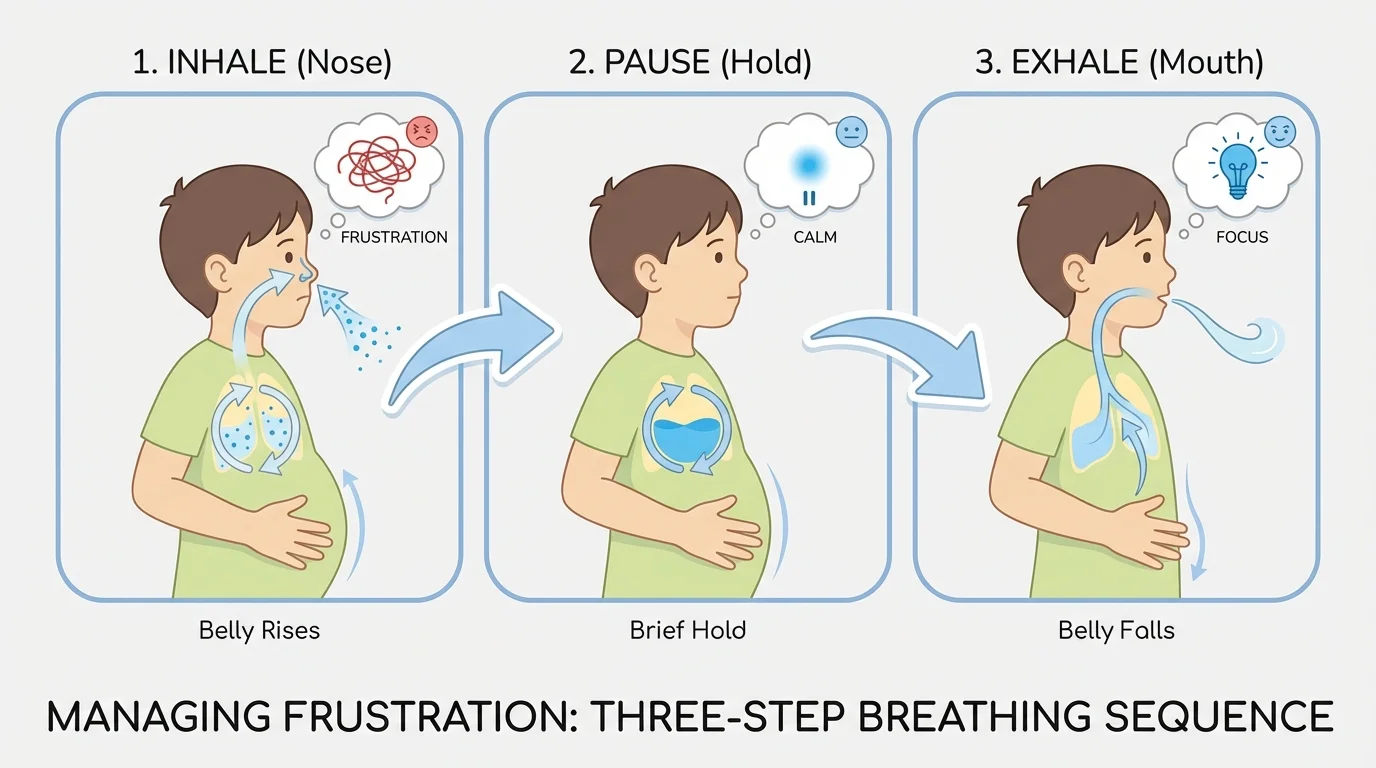
If you want, breathe slowly three times before you go back to your work. You can do this before reading, before a quiz, or after making a mistake on the screen.
Why breathing helps
When your body is tight and fast, your brain has a harder time focusing. Slow breathing helps your body settle down, and then your thinking can get clearer.
Breathing is quiet, simple, and easy to do almost anywhere at home. It can help when the internet freezes, when a math page feels confusing, or when you feel upset after getting something wrong.
Sometimes your body needs to move. A small reset with movement can help your mind feel fresh again, as [Figure 3] illustrates. Movement is not about running away from the work. It is about helping your body get ready to try again.
You can roll your shoulders, stretch your arms up high, press your feet into the floor, stand up and sit down slowly, or shake your hands gently. These are safe, simple moves you can do near your learning space.
If you need a bigger break, ask a grown-up first. You might walk to get a drink of water, do five wall pushes, or march in place for a short time. Then come back.
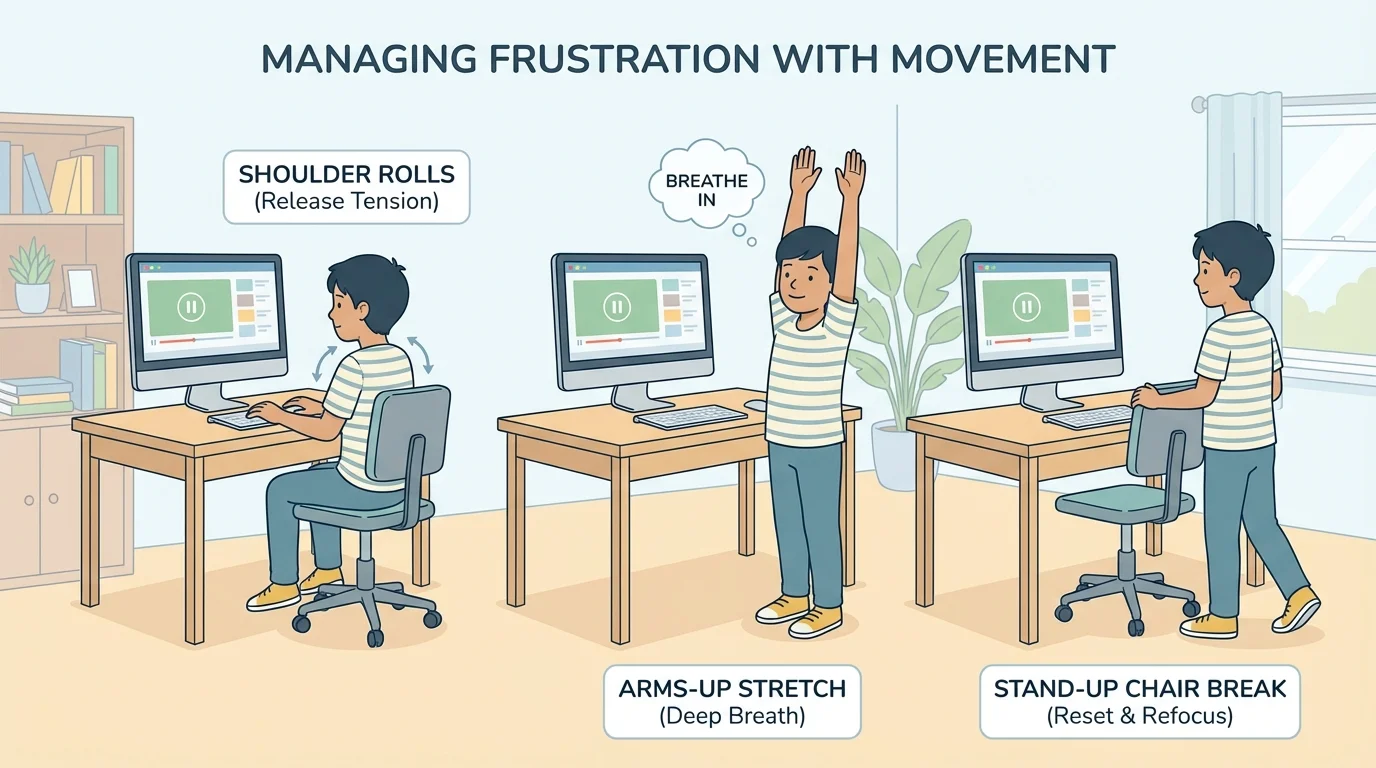
Movement works well when your body feels stuck, wiggly, tight, or restless. If your legs want to kick or your hands want to slam the desk, that is a clue that a movement reset may help.
"Hard is not bad. Hard means you are learning."
After a quick stretch, think about the calm steps from [Figure 2] too. You can even mix tools: first breathe, then stretch, then return to your task.
You do not have to use the same tool every time. Different problems may need different choices. A good plan is simple: notice, choose, reset, return.
Here are some examples from home learning:
Real-life calm-down plans
Situation 1: You cannot log in and feel mad.
Say, "I feel frustrated." Take three slow breaths. Then ask a grown-up for help.
Situation 2: A reading page has too many hard words.
Say, "I can do one line at a time." Stretch your shoulders. Then read the first line only.
Situation 3: You get an answer wrong in a live class.
Say, "Mistakes help me learn." Put your feet on the floor and take a slow breath. Then listen for the next step.
You can even make your own little plan and keep it near your computer: "When I feel frustrated, I will say helpful words, take three breaths, or do one stretch."
Resilience means you keep going after something feels hard. It does not mean you never feel upset. It means you know how to bounce back.
After you calm down, come back to the work in a small way. Read one direction. Answer one question. Watch one part of the lesson again. Small steps count.
If something is still too hard, it is okay to ask for support. You might send a kind message to your teacher, ask a grown-up to sit nearby, or use a break timer. Strong learners do not do everything alone. They use tools.
The more you practice words, breathing, and movement, the easier it becomes to choose them. Over time, your brain and body learn, "I know what to do when I feel frustrated." That is a powerful life skill for school, home, hobbies, and friendships.
