Have you ever wanted two things at the same time, but you could only choose one? That happens with money, too. Money helps you buy things you need and things you want, but you cannot buy everything at once. Learning how to make small money choices now helps you later when you shop, save, and plan.
When you make a money choice, you decide what to do with the money you have. You might use it to buy something now, or you might keep it for later. A good choice can help you get what matters most. A rushed choice can leave you without enough for something important.
At home, you may see adults choose between different groceries, games, or supplies. You can practice the same kind of thinking in pretend shopping. That means you pretend to shop and use play money, drawings, or real price labels to decide what to buy.
Price is how much something costs. Spend means to use money to buy something. Save means to keep money for later instead of using it right away.
These words help you talk about money choices clearly. If a toy costs $4, then $4 is the price. If you give $4 to get the toy, you spend $4. If you keep your $4 for another day, you save it.
Money comes in different forms, as [Figure 1] shows with coins, a bill, and simple price tags. In pretend shopping, you can use pictures of money, play money, or real coins with an adult watching. A coin is a small round piece of money. A bill is paper money.
You also need to know price and cost. These words are very close in meaning. If a book has a price of $3, then the book costs $3. If you have only $2, you do not have enough yet.
Sometimes you compare two prices. If one sticker is $1 and one coloring book is $3, the sticker costs less. The coloring book costs more. Comparing helps you choose what fits your money.
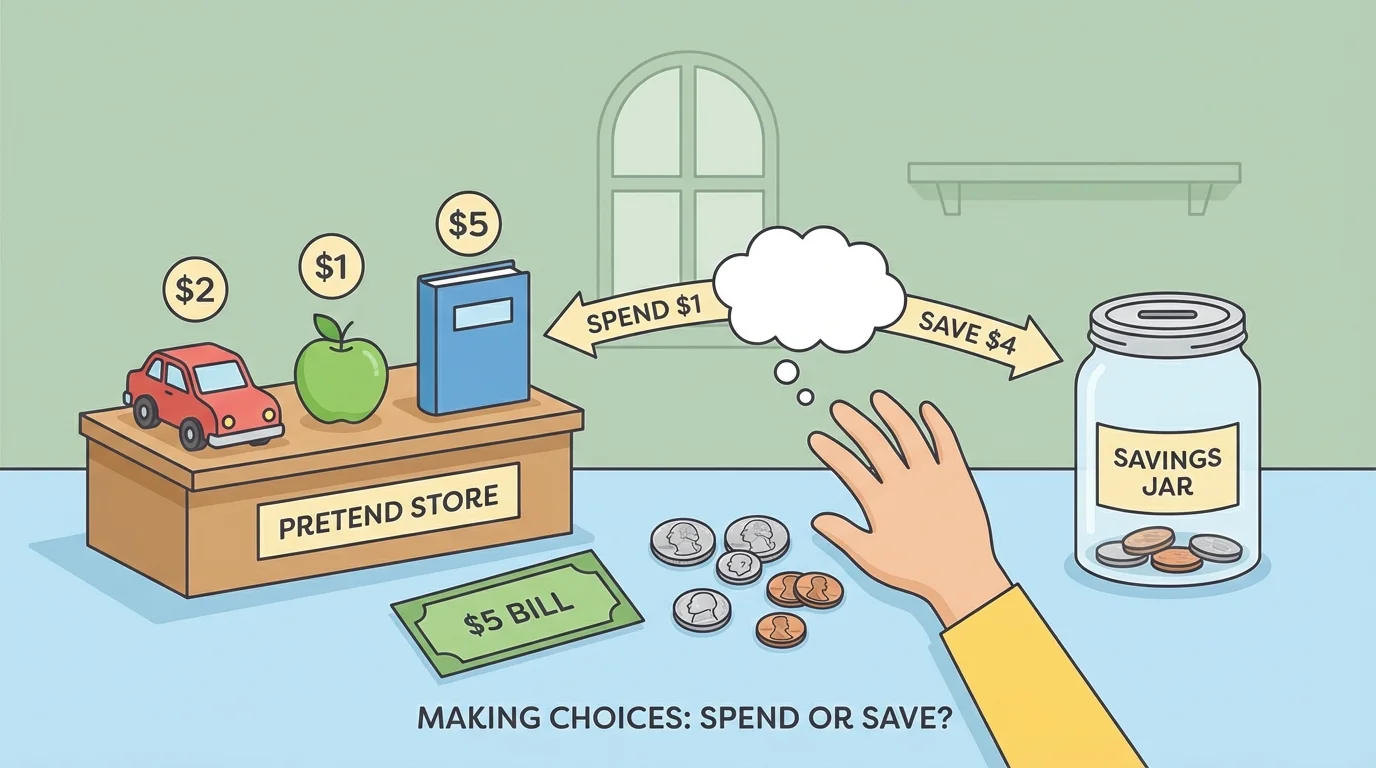
You can also count your money to see what you can buy. For example, if you have $2 and want a puzzle that costs $2, then you have exactly enough. If you have $5 and a game costs $3, then you still have some left after you buy it.
Even adults make money decisions all day long. Choosing what to buy now and what to wait for is a real-life skill everyone uses.
Knowing these money words makes pretend shopping feel more real. It also helps you tell an adult what you are thinking, like "I want to save this" or "I have enough to spend on that."
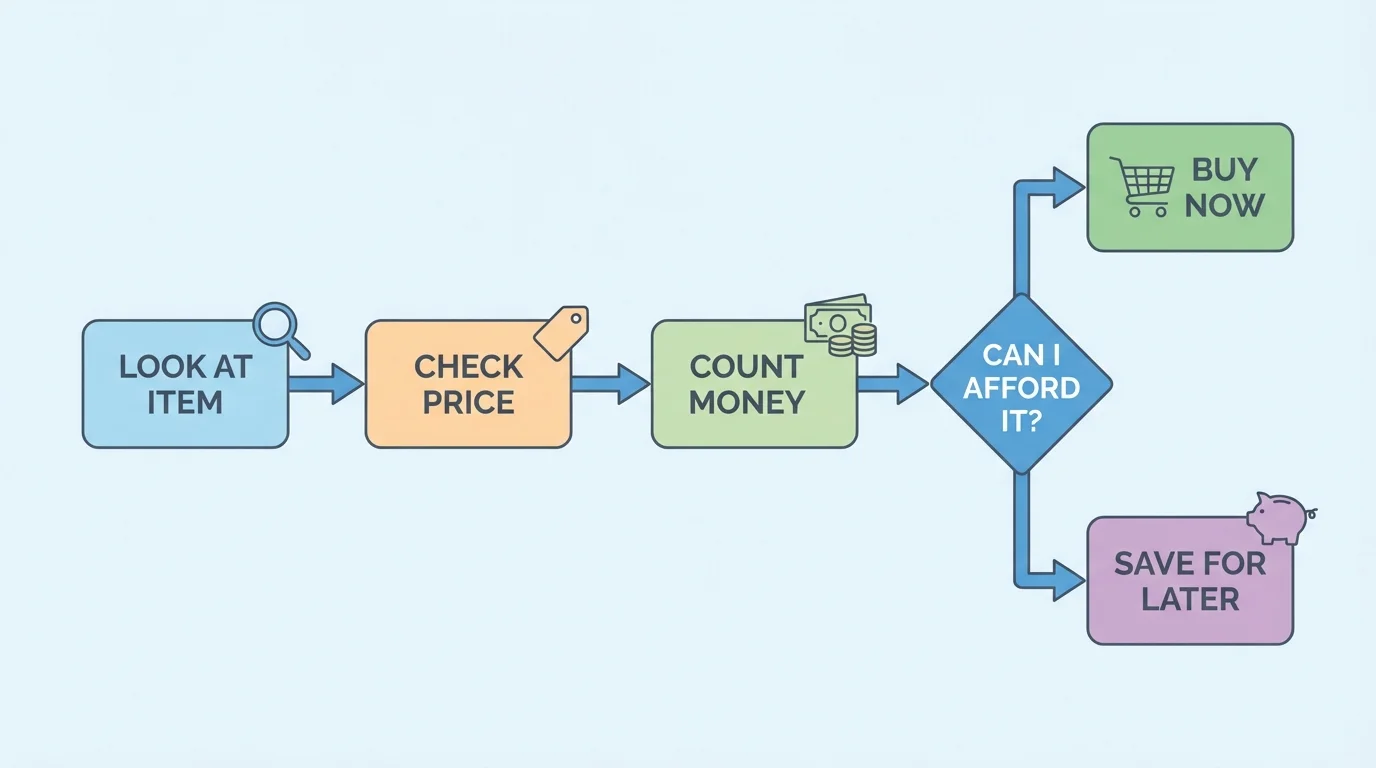
There is a simple way to make a shopping choice, and [Figure 2] lays out the steps in order. First, look at the item. Next, check the price. Then, count your money. Last, decide: buy it now or wait.
Step 1: Look at the item. Ask, "Do I want this?" and "Do I need this for my activity?" In pretend shopping, maybe you are choosing art paper, a snack, or a small toy.
Step 2: Check the price. Find the number on the label. If the label says $2, that tells you how much money you need.
Step 3: Count your money. If you have $1 and another $1, then your total is \(1 + 1 = 2\). That means you have $2.
Step 4: Decide. If you have enough and still feel good about the choice, you can buy it in the pretend activity. If not, you can wait and save.
This kind of step-by-step thinking helps you stay calm. Instead of grabbing the first thing you see, you pause and check. That is a smart habit for real shopping later on.
Pretend shopping example
You have $4 in play money. A ball costs $3.
Step 1: Check the price
The ball costs $3.
Step 2: Count your money
You have $4.
Step 3: Compare
Since \(4 > 3\), you have enough money.
Step 4: Find what is left
After buying the ball, \(4 - 3 = 1\). You have $1 left.
You can choose to buy the ball and keep $1, or you can save all $4 for something else.
When you use the same steps again and again, shopping choices become easier. Later, as we saw in [Figure 2], you can quickly decide whether something fits your money or whether it is better to wait.
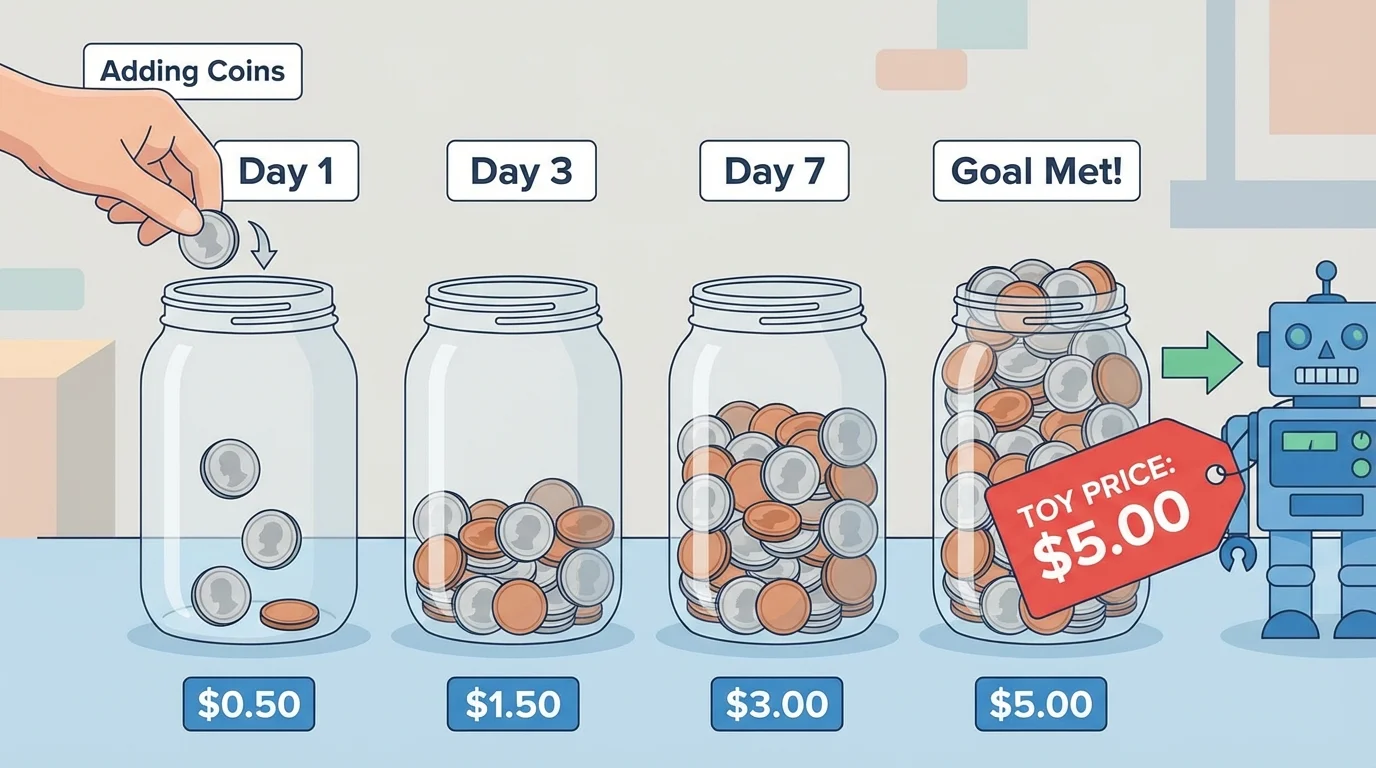
Sometimes the best choice is not buying right away. [Figure 3] shows how a savings jar grows when you add a little money over time. Save means you keep money now so you can use it later.
Suppose you have $1 today, but a toy costs $3. You cannot buy it yet. That does not mean "never." It means "not yet." If you save another $1 tomorrow and another $1 later, then \(1 + 1 + 1 = 3\). Now you have enough.
Saving helps you be patient. It also helps you work toward a goal. A goal is something you want to reach, like buying a coloring set, a puzzle, or a gift for someone.
One easy way to practice saving is with jars or envelopes. You might have one jar for "spend" and one jar for "save." When you get some play money or pretend allowance in an activity, you can choose where it goes.
Saving means planning ahead. When you save, you tell your money, "You have a job later." That helps you remember that not every choice has to happen right now.
A small saved amount can grow. If you save $1 four times, then \(1 + 1 + 1 + 1 = 4\). Little steps matter.
Let's look at a few everyday choices. These are the kinds of decisions you can practice at home with play money, paper price tags, or items from around the house.
Example 1: You have $2. A snack costs $1. A juice costs $2. If you buy the snack, you have \(2 - 1 = 1\) left. If you buy the juice, you have \(2 - 2 = 0\) left. If you want to keep some money, the snack is the better choice.
Example 2: You have $5. A toy car costs $4. A sticker sheet costs $1. If you buy both, then \(4 + 1 = 5\). You use all your money. That is okay if you planned for it.
Example 3: You have $3. A book costs $5. Since \(3 < 5\), you do not have enough yet. You can wait and save $2 more.
| Money You Have | Item | Price | Can You Buy It? |
|---|---|---|---|
| $2 | Snack | $1 | Yes |
| $2 | Juice | $2 | Yes |
| $3 | Book | $5 | No, save more |
| $4 | Ball | $3 | Yes |
Table 1. Simple pretend shopping choices showing money you have, item prices, and whether you can buy each item.
These examples are not just about numbers. They are about choices. You are learning to ask, "What can I buy?" "What should I wait for?" and "How much will I have left?"
Good money habits start small. Put money in the same safe place each time. Count carefully. Tell the truth about how much you have and what you spent. If you are using real money, have an adult help you.
You can also practice asking helpful questions: "How much does it cost?" "Do I have enough?" "Should I save this?" Those questions make you thoughtful, not slow. Careful choices are strong choices.
You already know how to count small numbers and compare which number is greater or less. Those same skills help you make money decisions.
It also helps to make a simple plan before you start. You might say, "I will spend $1 and save $2," or "I will wait until I have enough for the bigger item." That plan gives your money a purpose.
If you buy the first thing you see every time, you may run out of money fast. Then later, you may not have enough for something you wanted more. That can feel frustrating.
But if you stop, check the price, and think, you stay in control. This is the same idea we saw earlier in [Figure 3], where saving a little at a time helps you reach a bigger goal. Good money choices help you feel ready instead of stuck.
Here is a simple real-world example. You have $3 in pretend money for a family game activity. You can buy one pretend toy for $3, or you can buy a pretend pencil for $1 and save $2. Neither choice is always right. The smart part is thinking about what matters most to you before you decide.
"Use your money on purpose."
— A smart money rule
When you practice with pretend shopping and saving, you build a skill you will use for years. Small choices today help you become a careful shopper and saver tomorrow.
