Have you ever tried to carry something big all by yourself? It can start to feel hard very quickly. But when two or more people help, the job often gets easier. That is one reason teamwork is so powerful. Teamwork helps people share jobs, help each other, and finish tasks together.
Teamwork means working with other people to do one job. In teamwork, everyone has a part, as shown in [Figure 1]. One person might start, another person might help, and another person might check that the job is done.
You use teamwork in many places. You might clean up toys with your family, make a snack with an adult, or draw something with a friend on a video call. You are not doing everything alone. You are helping each other.
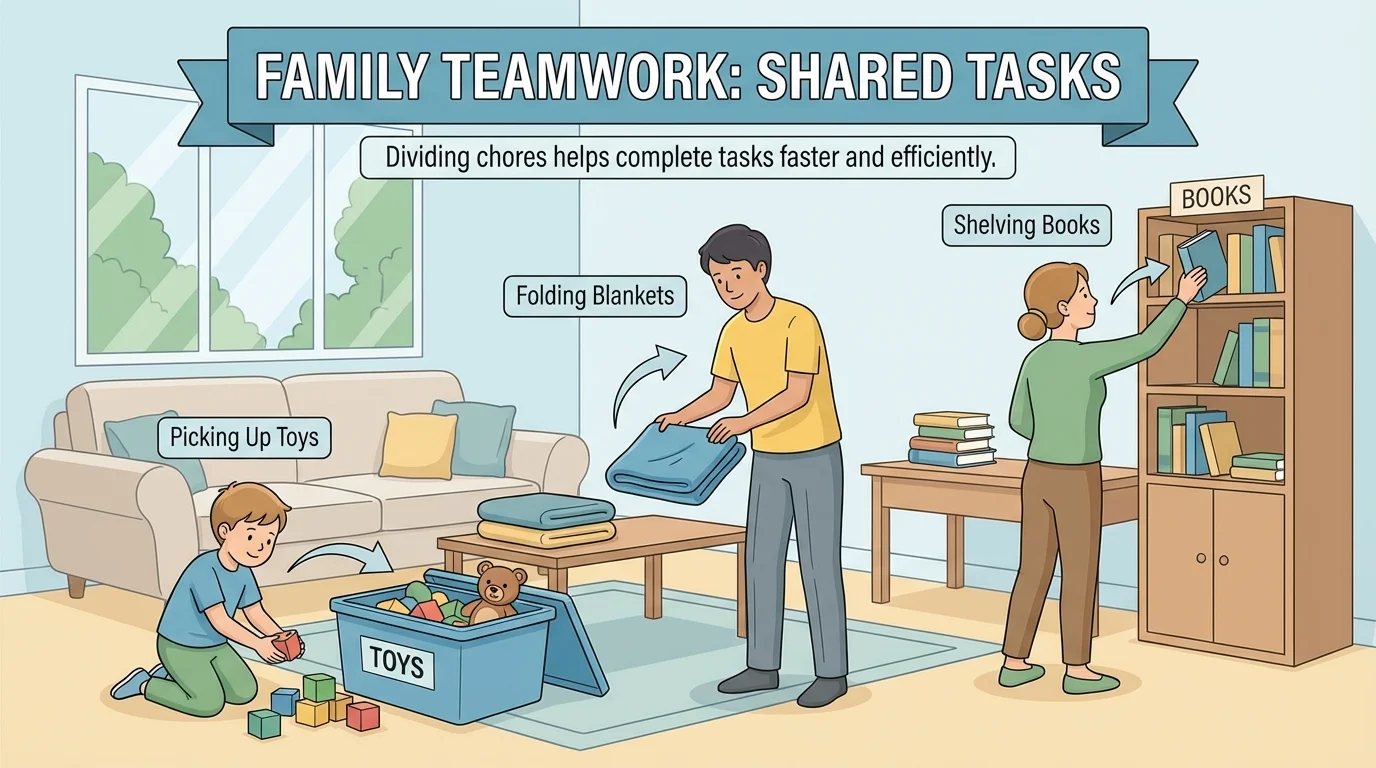
Team means a group of people working together.
Responsibility means doing the job you said you would do.
Leader means a person who helps the group get started, stay kind, and keep going.
When people work as a team, each person matters. Even a small job can help the whole group. Putting away books, holding a bowl while someone stirs, or reminding everyone of the next step can all be important.
Teamwork helps people solve problems because one person may see something another person missed. If a puzzle piece is hard to find, one teammate may look under the couch while another checks the box. Working together gives the team more ideas.
Teamwork also helps people complete tasks faster. If your family is getting ready for a picnic, one person can pack snacks, one can bring water, and one can check the blanket. The jobs are shared, so the task does not feel so big.
Why shared work matters
Big jobs often feel easier when they are broken into smaller parts. A team can split the work, help when someone gets stuck, and cheer each other on. This makes the work smoother and can help everyone feel proud at the end.
Teamwork can make people feel less worried too. If you are trying something new, it feels good to know someone can help you. When people are kind teammates, they make the group stronger.
Later, when you think about shared jobs again, [Figure 1] reminds you that each person doing one part helps the whole task get done.
A good teammate listens. Listening means paying attention when another person talks. Good teammates do not grab, yell, or always try to be first. They take turns and use calm words.
A good teammate also shows responsibility. If you say, "I will put the napkins on the table," then you do that job. When everyone does their part, the team can trust each other.
Good teammates are kind. They say things like, "I can help," "Good idea," or "Let's try together." Kind words help people keep trying, even when something is tricky.
Real-life example: making fruit salad together
Step 1: One person washes the fruit.
Step 2: One person puts pieces into the bowl.
Step 3: One person brings spoons or napkins.
Step 4: Everyone checks that the table is ready.
Each person has a job, so the snack gets ready smoothly.
You do not have to be the loudest person to be a strong teammate. Sometimes helping quietly, noticing what is needed, and finishing your job are the best ways to help.
Good teamwork follows simple steps, and [Figure 2] shows an easy order to follow. These steps can help you at home, in a club, or while working with someone online.
Step 1: Talk about the job. Make sure everyone knows what you are trying to do. Maybe the job is cleaning up art supplies or preparing to feed a pet.
Step 2: Choose jobs. Each person picks a part. Try to make the jobs fair and clear.
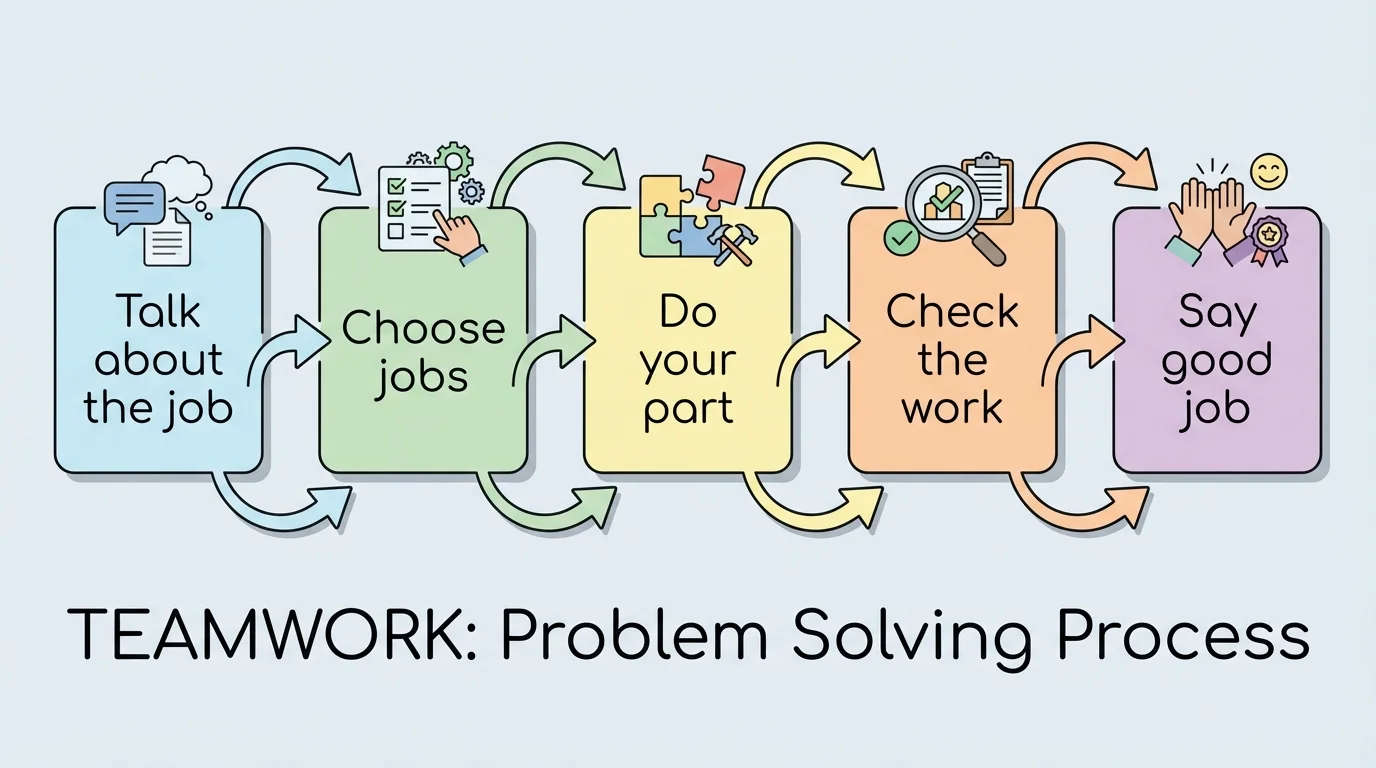
Step 3: Do your part. Stay with your job until it is finished or until you ask for help.
Step 4: Check the work. Ask, "Are we done?" or "Did we forget anything?"
Step 5: Celebrate together. You can smile, say "We did it," or thank each other.
These steps help because they stop confusion. When everyone knows what to do, there is less arguing and more helping. The order in [Figure 2] also helps you remember that checking the work matters, not just starting it.
You can use teamwork during chores at home. For example, one person matches socks, one folds towels, and one puts clothes away. The laundry gets done faster, and no one has to do every part alone.
You can use teamwork in games too. In a backyard game or sports practice, teammates pass, wait for turns, and help each other. If one player falls behind, others can encourage them.
You can even use teamwork online. Maybe you and a cousin are making a drawing on a video call. One person chooses colors, one person draws shapes, and both people share ideas. Teamwork is not only for being in the same room.
Many important jobs in the world are done by teams. Doctors, firefighters, builders, and game designers work with other people because big jobs often need many helpful hands and minds.
Teamwork also builds community. Community means people who help and care for one another. When you work well with others, you help make your home, team, or group a better place.
Sometimes teamwork is not easy. Someone may interrupt, forget a job, or want to do everything alone. Small problems happen, and [Figure 3] shows that calm words and taking turns can help fix them.
If people start to argue, stop and take a breath. Then use simple words: "You talk first," "Now it is my turn," or "Let's try your idea, then mine." Calm voices help the team think better.
If someone forgets their job, remind them kindly. You can say, "Can you do your part now?" or "Do you want help getting started?" Being helpful is better than being mean.
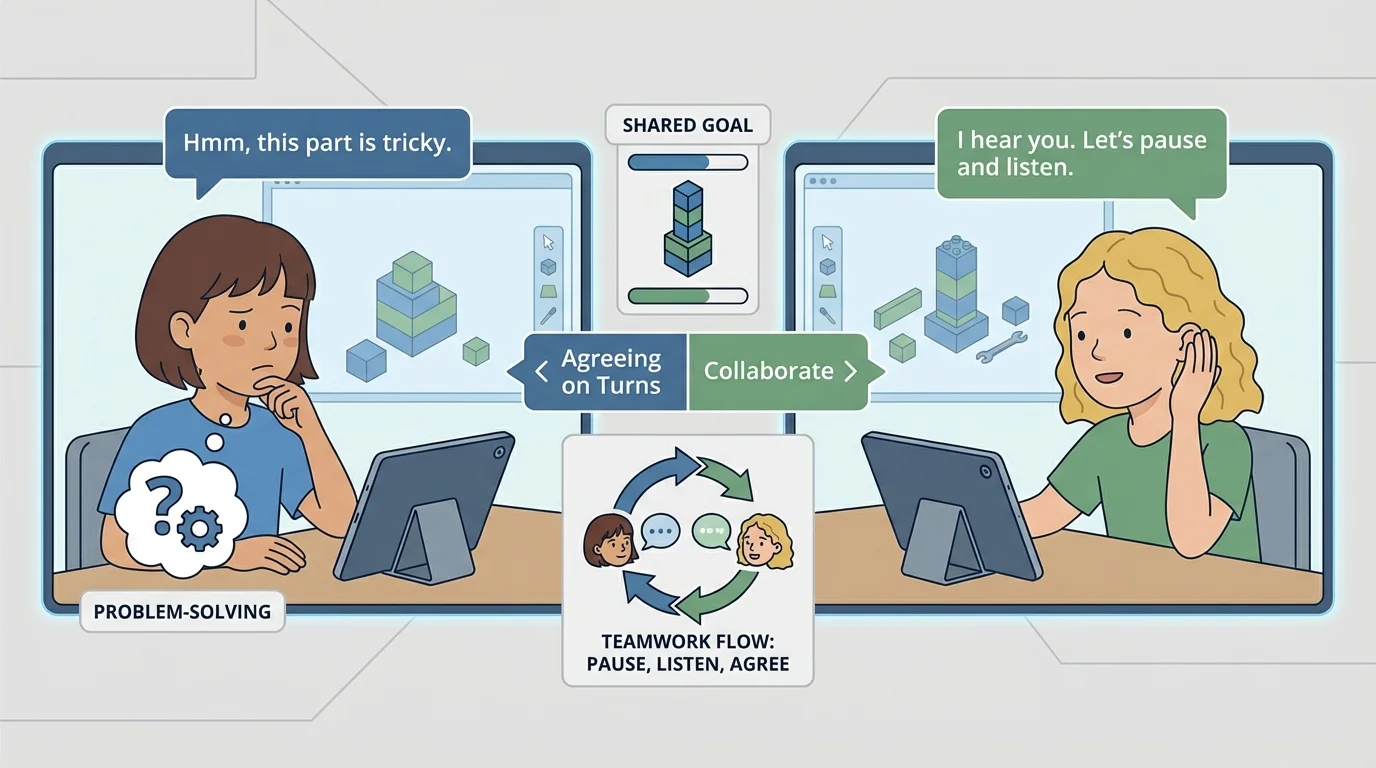
Fixing a teamwork problem
Step 1: Stop and stay calm.
Step 2: Say the problem in simple words.
Step 3: Listen to the other person.
Step 4: Pick one fair plan together.
This helps the team get back to the task.
If a task is too hard, ask for help. Strong teammates are not the ones who pretend everything is easy. Strong teammates speak up so the whole team can do well.
When you remember the calm problem-solving in [Figure 3], it becomes easier to see that teamwork problems can be fixed with listening and kindness.
You can show initiative by helping before someone asks. Maybe you notice the crayons need to be put away, or you see that a family member needs help carrying light items. Offering help is a small way to lead.
A leader in teamwork does not boss people around. A good leader helps the team begin, keeps people included, and uses kind words. A leader might say, "You can do this part," or "Let's work together."
"Many hands make light work."
When you practice teamwork now, you are learning skills for the future. You are learning how to help, how to solve problems, how to finish tasks, and how to care about other people. These are important life skills wherever you go.
