People notice accountability quickly. They notice when someone says, "I'll do it," and actually does it. They also notice when someone disappears, makes excuses, or blames everyone else. Whether you are helping at home, joining a community group, working a part-time job, managing online responsibilities, or making decisions on your own, accountability affects how much people trust you. Trust is one of the most useful things you can build, and it is built through repeated actions, not promises alone.
Accountability is not about being perfect. It is about being honest, dependable, and willing to take responsibility for your choices. If you forget something, accountability means admitting it, fixing what you can, and learning from it. If you make a commitment, accountability means treating that commitment as real. This matters now, not just in adulthood. The habits you build as a teenager often shape your reputation, opportunities, and self-respect for years.
At its core, accountability means being answerable for your actions, decisions, and responsibilities. It means you recognize that what you do affects other people, your future, and your own character. Accountable people do not wait to be watched. They act responsibly even when nobody is checking.
Accountability means owning your actions and their results. Responsibility means the duties or tasks you are expected to handle. Integrity means doing what is right consistently, even when it is inconvenient or private.
There is an important difference between accountability and shame. Shame says, "I made a mistake, so I am a failure." Accountability says, "I made a mistake, so I need to deal with it honestly." That difference matters. If you connect every mistake to your worth, you may hide problems. If you connect mistakes to growth and repair, you become stronger and more trustworthy.
Accountability also differs from obedience. Obedience is doing what you are told. Accountability is deeper. It includes thinking for yourself, making choices carefully, and accepting the outcome. A person can follow instructions without understanding why. An accountable person understands that choices have consequences and acts with intention.
"Character is what you do when no one is watching."
— Common ethical principle
This idea matters in online life too. If you say you will join a video meeting, send a file, help with a project, or respond by a certain time, people begin forming opinions based on whether you follow through. Your digital behavior is still real behavior.
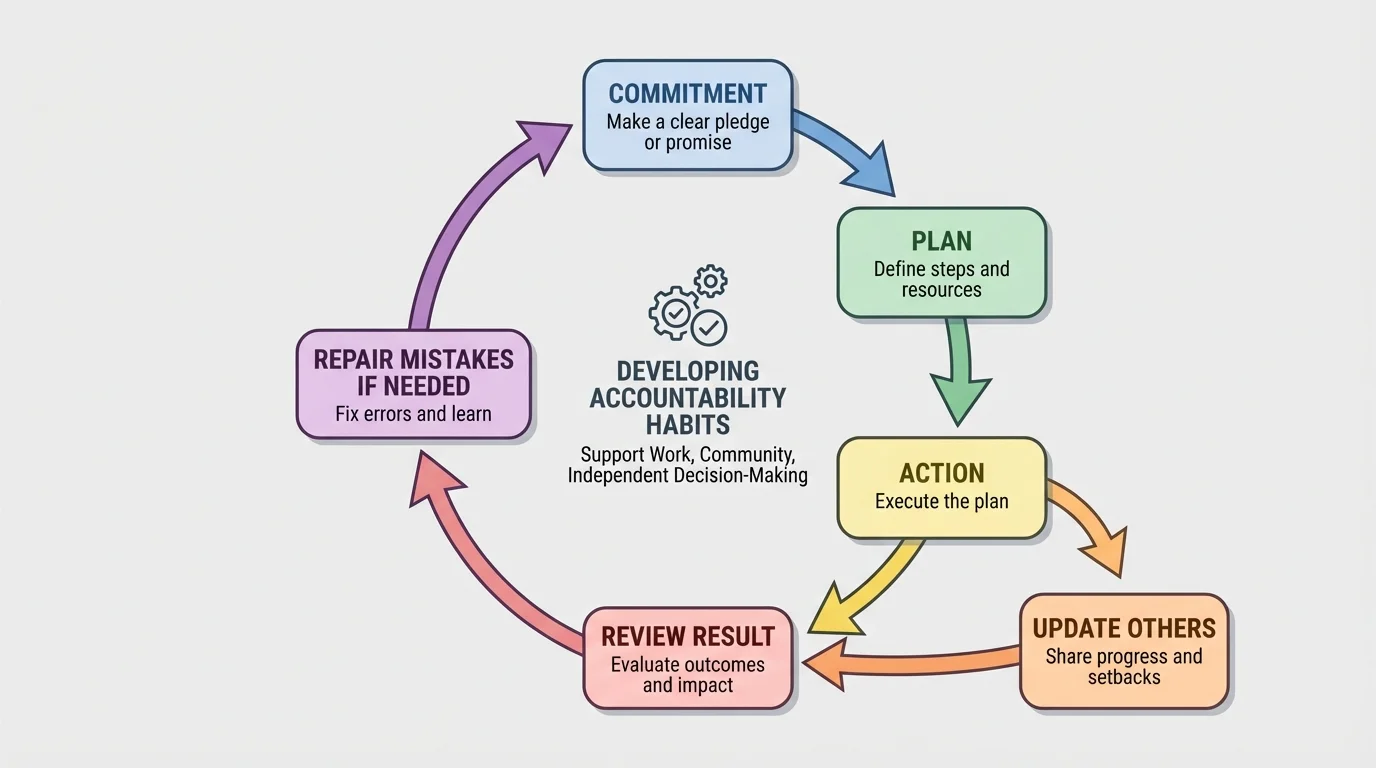
Accountability becomes easier when it turns into routine behavior. The basic pattern, shown in [Figure 1], is simple: make a commitment, plan for it, act on it, communicate if something changes, and review the result. That sounds basic, but many problems happen when one of those steps gets skipped.
The first habit is follow-through. This means finishing what you said you would do. A lot of people are good at intentions. Far fewer are good at completion. If you say you will email someone, submit an application, watch your younger sibling for an hour, or clean up after cooking, follow-through means the task actually gets done.
The second habit is being reliable. Reliability means people can reasonably predict that you will do your part. It includes showing up on time, meeting deadlines, bringing what you need, and responding when someone is depending on you. Reliable people make life easier for the people around them.
The third habit is honest communication. If something prevents you from doing what you promised, accountability does not mean pretending everything is fine until the last minute. It means communicating early. For example, if your internet goes down before a volunteer check-in call, sending a quick message right away is far more responsible than staying silent and explaining later. Silence often creates more problems than the original mistake.
The fourth habit is owning mistakes without drama. This is where many people struggle. They want to protect themselves, so they say things like, "It wasn't really my fault," or "I forgot because everyone kept texting me." Sometimes outside factors matter, but accountable people start with their own part. A stronger response sounds like this: "I missed the deadline. I should have planned better. Here is what I can do now."
The fifth habit is keeping track of commitments. Memory is not enough. If you have three family tasks, one online appointment, two assignment deadlines, and a work shift, you need a system. That system can be a notes app, calendar, planner, or reminder alarms. Being organized is not separate from accountability; it supports it.
Why small habits matter
Accountability usually does not fail because of one giant moment. It fails through small repeated choices: not writing things down, delaying communication, assuming you will remember, avoiding discomfort, or hoping a problem goes away. Small improvements in these areas create a big difference over time.
You can also hear accountability in the language people use. Compare these two statements: "I had to do it" and "I chose to do it." The second statement recognizes agency. Even when choices are limited, you usually still make decisions about effort, honesty, timing, and response.
Later, when you think about decisions under pressure, the same pattern from [Figure 1] still applies: plan, act, communicate, and repair instead of avoiding responsibility.
Work does not only mean a full-time career. For you, it can include a part-time job, babysitting, freelancing, yard work, volunteering, helping with a family business, or managing long-term responsibilities at home. In all of these settings, accountability makes you stand out quickly.
At work, accountable behavior includes being on time, reading instructions carefully, asking questions before a mistake becomes expensive, and completing tasks to the expected standard. If your manager says your shift starts at 4:00, being ready at 4:00 matters more than arriving at 4:07 and saying traffic was bad. Time is part of the commitment.
Accountability also means understanding the cost of unreliability. If you are late opening an online customer support chat, someone else has to cover. If you forget to send an update, your team may make decisions with missing information. If you promise a neighbor you will pet-sit and then fail to show up, a real animal may go without care. Responsible habits protect real people from preventable problems.
Work scenario: missing a deadline responsibly
You promised to create a simple social media graphic for a community fundraiser by Thursday evening, but on Wednesday you realize you underestimated the time it would take.
Step 1: Admit the problem early.
Do not wait until Thursday night. Send a message on Wednesday saying you may not meet the deadline as planned.
Step 2: State your part clearly.
Say, "I planned poorly and I need to correct that," instead of blaming your schedule.
Step 3: Offer a realistic fix.
For example: "I can send a finished version by Friday at noon, or I can send a draft tonight so someone else can continue it."
Step 4: Prevent a repeat.
Next time, break the task into smaller checkpoints and set an earlier personal deadline.
This response protects trust far better than disappearing and apologizing after the event.
One of the strongest professional habits you can build now is underpromising and delivering well. If you think a task will take two hours, do not confidently promise it in 30 minutes just to sound impressive. Overpromising feels good for a moment, but missed promises damage trust. Honest estimates are more mature.
Another key skill is asking for clarification. Some people stay confused because they fear looking inexperienced. In reality, asking one good question early is often a sign of professionalism. It shows you care enough to get the task right.
Community includes family, neighbors, clubs, teams, faith groups, volunteer groups, online communities, and friend groups. In every one of these spaces, accountability affects whether people feel respected and safe around you.
Community trust grows when people know your words match your actions. If you agree to help organize donations, moderate an online discussion respectfully, bring supplies to an event, or check on an elderly relative, people depend on that. Accountability turns good intentions into support others can count on.
In relationships, accountability means more than completing tasks. It also means listening, apologizing sincerely, and changing behavior when needed. An apology without changed behavior is just repeated disappointment. If you repeatedly ignore messages, break confidences, or show up late, the issue is not just the one event. The issue is the pattern.
| Situation | Unaccountable Response | Accountable Response |
|---|---|---|
| You forgot a family responsibility | "No one reminded me" | "I forgot, and I should have tracked it. I'll do it now and set a reminder." |
| You upset a friend in a group chat | "You took it the wrong way" | "I can see my comment hurt you. I'm sorry, and I'll be more careful." |
| You cannot attend a community event you committed to | Say nothing until the event starts | Notify the organizer early and help find another solution |
| You made a mistake in a team task | Blame unclear directions | Explain what happened, fix what you can, and ask how to prevent it next time |
Table 1. Comparison of unaccountable and accountable responses in common community situations.
Accountability also includes respecting shared spaces and systems. Cleaning up after yourself, returning borrowed items, replying when someone needs confirmation, and keeping promises are ordinary actions, but they communicate respect. A healthy community is built from hundreds of these small decisions.
People often think trust is built by impressive moments, but in daily life it is more often built by consistency. Repeated small actions, such as responding when you said you would or finishing a shared task, usually matter more than one dramatic gesture.
If you want to be seen as mature, this is one of the fastest ways to do it: be the person who can be counted on.
Independent decision-making becomes more important as you gain freedom. You may be managing your time alone, handling money, deciding who to spend time with, choosing what to post online, or deciding whether to keep a promise when nobody would know if you broke it. Consequences are not just punishments. They are the real results of a choice, whether those results are helpful, harmful, immediate, or delayed.
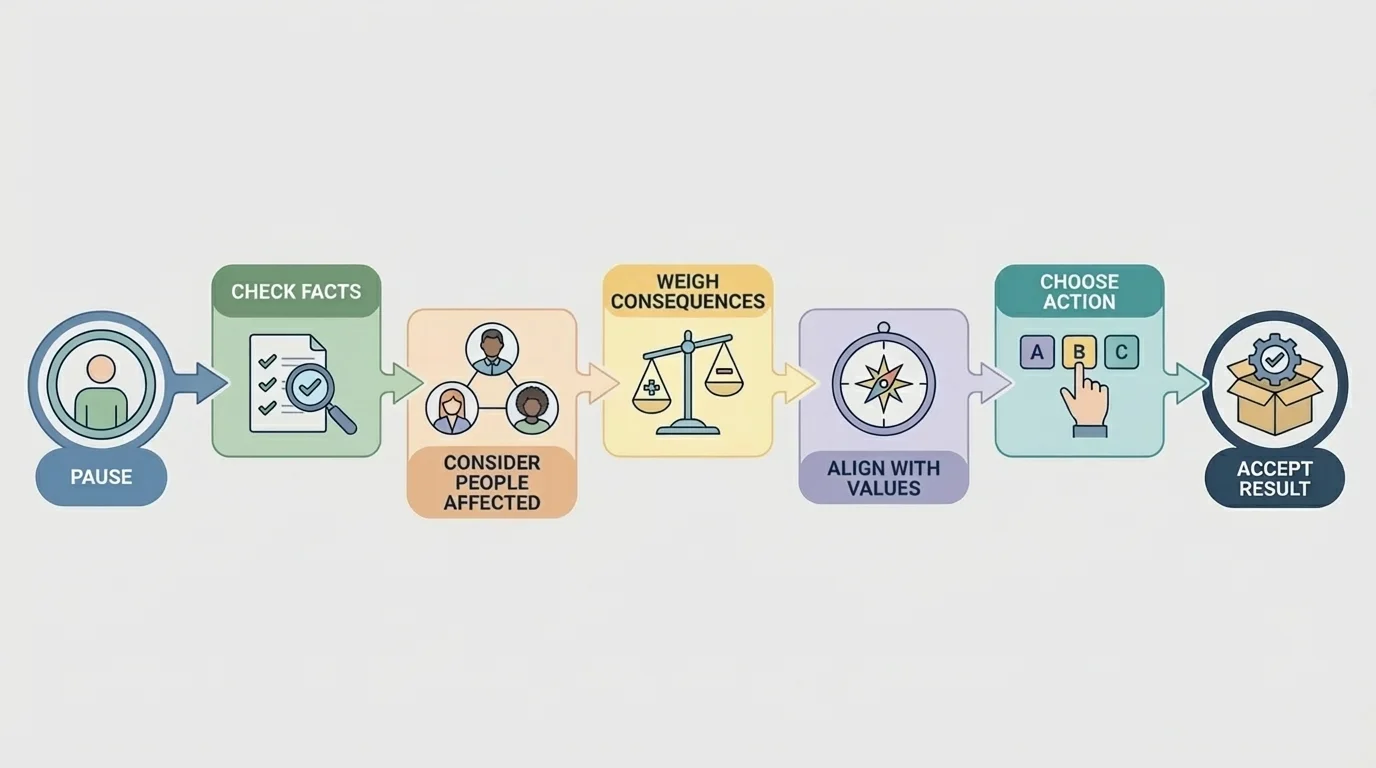
A strong decision process, shown in [Figure 2], starts with a pause. When people act impulsively, they often choose what feels easiest in the next five minutes instead of what is best for the next five days, five months, or five years. Pausing creates space for judgment.
Here is a practical decision framework: stop, check the facts, think about who is affected, consider short-term and long-term consequences, compare the options with your values, and then choose. This process helps you act on purpose instead of reacting automatically.
Suppose a friend pressures you to share someone's private message. The fast choice may seem harmless. But accountability asks bigger questions: Is it respectful? Is it honest? Would I accept this if someone did it to me? Could it damage trust? Independent decision-making means you do not need immediate supervision to know the right direction.
Another example is money. If you have $60 and spend $45 impulsively on something you do not need, you still have money left, but your options shrink. The arithmetic is simple: after spending, you have \(60 - 45 = 15\). The more important part is the decision behind it. Accountability means recognizing that choosing one thing often means giving up another.
Independent decisions also require resisting excuse-based thinking. Statements like "Everyone does it," "It's not a big deal," or "No one will find out" are warning signs. They shift attention away from values and toward convenience. Many harmful decisions begin with minimizing the impact.
Decision scenario: choosing the honest option
You are asked in an online group project whether you completed your part. You know you only finished half of it.
Step 1: Pause before answering.
Do not protect yourself with an instant lie.
Step 2: State the truth clearly.
Say, "I only finished part of it, and that affects the group."
Step 3: Offer the next action.
For example: "I can finish the rest by 7:00 tonight, or I can send what I have now so someone else can build on it."
Step 4: Learn from the pattern.
Ask what caused the delay and what system would prevent the same issue next time.
This kind of honesty can feel uncomfortable, but it protects long-term credibility.
As your independence grows, your accountability becomes a form of self-respect. You are proving to yourself that your choices are guided by principles, not only pressure or mood.
Good intentions are helpful, but systems work better. One practical system is: write it down, break it down, check in, communicate early, and review. This takes only a few minutes each day and prevents many avoidable problems.
Step 1: Write down every real commitment. If it matters, do not rely on memory alone. Put tasks, times, and promises in one trusted place.
Step 2: Break larger responsibilities into smaller actions. "Finish application" is vague. "Collect documents, draft answers, review, submit" is manageable.
Step 3: Set earlier personal deadlines. If the real deadline is Friday, treat Thursday as your target when possible. That gives you room for unexpected problems.
Step 4: Check in with yourself daily. Ask: What have I promised? What is due soon? What have I been avoiding? This short review keeps responsibility visible.
Step 5: Communicate before a problem becomes a surprise. Last-minute honesty is still better than dishonesty, but early honesty is better than both.
Step 6: Review the result. If something went well, ask why. If something went badly, ask what process failed. This is how habits improve.
You do not need a complicated productivity system. A simple planner, notes app, or calendar used consistently is more powerful than an advanced system you abandon after three days.
If you like checklists, keep one with three short questions: What did I promise? What is my next action? Who needs an update? Those questions are simple, but they keep accountability active.
One trap is avoidance. You know a task is late or a mistake happened, so you avoid messages, delay replies, or distract yourself. Avoidance can feel like relief, but it usually increases stress. The problem grows while your options shrink.
Another trap is blaming circumstances for everything. Sometimes conditions really are difficult. Maybe your schedule changed, technology failed, or another person let you down. Accountable people still ask, "What part was mine?" That question protects your ability to grow.
A third trap is perfectionism. Some students think accountability means never slipping up. Then, when they do slip up, they feel embarrassed and hide it. Real accountability is not flawless performance. It is honest response. In fact, people often trust someone more after a mistake is handled maturely.
A fourth trap is saying yes too often. If you agree to every request, your promises become weak because you cannot realistically keep all of them. Sometimes the most responsible answer is "I can't do that well right now." Boundaries support accountability because they keep commitments realistic.
A fifth trap is confusing apology with repair. Saying sorry matters, but it is only the beginning. Repair means taking action to correct harm where possible. If you borrowed something and damaged it, accountability may include replacing it, not just apologizing.
Accountability is not a personality trait that some people are born with and others are not. It is a set of habits practiced repeatedly. Every time you tell the truth early, keep a promise, admit your part, or repair a mistake, you strengthen your character.
These habits matter for your future. Employers look for reliability. Friends look for honesty. Communities depend on responsible participation. And your own decision-making becomes stronger when you stop treating choices as random and start treating them as reflections of who you are becoming.
Think of accountability as evidence. It is the evidence that your words mean something. It is the evidence that people can trust you with tasks, time, and information. It is the evidence that you can guide yourself even when nobody is telling you what to do.
That is why accountability supports work, community, and independent decision-making at the same time. The same habits carry across all three: honesty, consistency, communication, follow-through, and repair. When you practice them regularly, you become someone others can rely on and someone you can rely on too.
