Most people notice laws only when they are broken, but laws and civic systems influence your life long before that. They affect whether a job can hire you, what happens if someone spreads lies about you online, how safe food businesses must be, how roads are repaired, and whether your community gets a new bus stop or loses funding for a park. Even if you are not yet voting age, these systems already shape your choices and your future.
When you decide what to post online, whether to sign a petition, how to respond to unfair treatment, or whether to speak up about a community problem, you are making a civic decision. A civic decision is not just something politicians do. It is any decision connected to your rights, responsibilities, and the well-being of other people.
Good civic judgment can protect you and help your community. Poor civic judgment can create harm, conflict, fines, lost opportunities, or damaged trust. If you understand how systems work, you are less likely to feel powerless. You become better at asking the right questions: What rule applies here? Who makes this decision? How can people influence it? What are the consequences?
Law is an official rule created and enforced by government. Institution is an organized system or body, such as a court, city council, health department, or nonprofit, that plays a role in public life. Civic process is a method people use to participate in public decision-making, such as voting, attending meetings, submitting comments, signing petitions, or contacting officials.
These three ideas are connected. A law may require a safety rule. An institution, such as a local agency, may enforce it. A civic process may allow people to challenge, improve, or support that rule.
Your personal and community decisions are shaped by laws, institutions, and civic processes working together, as [Figure 1] shows. If you focus on only one part, you miss how the full system affects real life.
Laws set boundaries. They tell people what is allowed, required, limited, or prohibited. Institutions put those rules into action. Civic processes give people ways to influence what happens next, whether that means supporting a current policy, reporting a problem, or pushing for change.
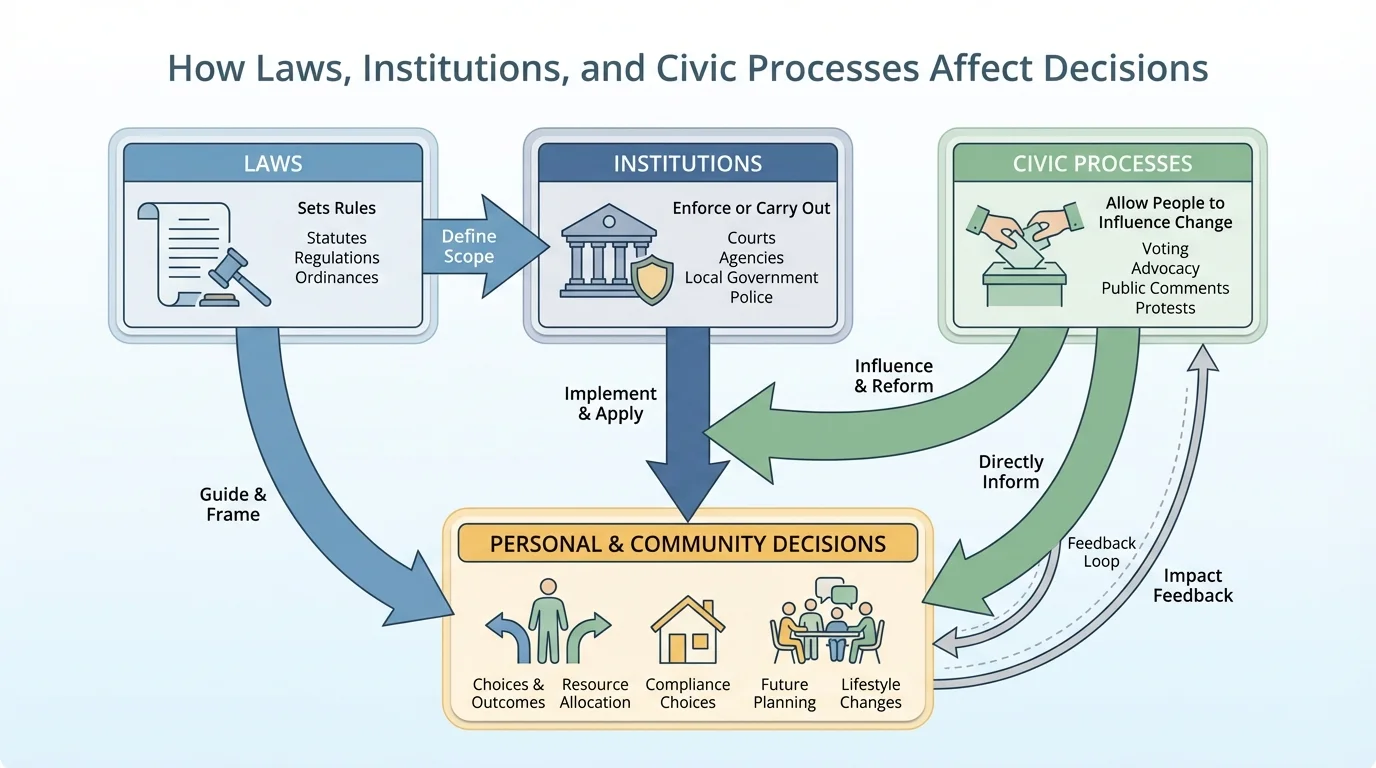
Think of it this way: laws are the written rules, institutions are the people and systems carrying them out, and civic processes are the pathways for public voice. If a community wants safer intersections, traffic laws matter, transportation departments matter, and public hearings or city council meetings matter too.
This is why civic awareness is a life skill, not just a government topic. You use it when comparing tenant rights, understanding school or workplace policies, checking whether a protest is lawful, or deciding how to respond when something in your community feels unfair or unsafe.
Many important community decisions are made at the local level, not the national level. Zoning, public transportation, park rules, noise limits, and public health policies often affect daily life more directly than big national headlines.
That local focus matters because the closer a decision is to your daily life, the more likely you can see its effects quickly. If a streetlight is broken for months, a local institution and a local civic process are usually the path to fixing it.
A law can protect you, limit you, or require something from you. The same law may do all three at once. For example, labor laws can protect teen workers from unsafe hours, limit what jobs they can legally do, and require employers to follow specific rules. That affects whether you accept a job, what hours you can work, and how you respond if an employer ignores safety, as [Figure 2] helps illustrate when institutions become involved.
Some laws shape your decisions so quietly that you may not notice them. Consumer protection laws affect what businesses must tell you before selling something. Privacy laws affect what companies can collect about you. Traffic laws affect whether you can ride, drive, or park somewhere legally. Defamation, harassment, and threat laws affect how far "free speech" actually goes when behavior harms others.
This does not mean you need to memorize every law. It means you should learn to pause before acting and ask: Is this legal? Is it safe? Does it affect someone else's rights? Could there be a record, fine, or long-term consequence?
Rights and responsibilities work together. A right gives you protection or freedom, such as speaking your opinion or seeking equal treatment. A responsibility means using that freedom in a way that does not violate the rights, safety, or dignity of others. Mature civic thinking means holding both ideas at the same time.
For example, you may have the right to post your views online. But if you post someone's private information, make threats, or spread false claims that damage their reputation, legal and school, workplace, or platform consequences may follow. A smart decision is not just asking, "Can I say this?" It is also asking, "Should I say it this way, and what happens next?"
Age matters too. Some laws treat minors and adults differently. That can affect contracts, medical consent, curfews, employment, and driving. If you are unsure whether you can sign something, share certain information, or enter an agreement, checking the law first is a practical protection, not a weakness.
When laws are understood well, they can help you avoid preventable mistakes. When laws are ignored or misunderstood, people often make choices based on emotion, pressure, or misinformation.
An institution is not just a building. It is a system of people, rules, and responsibilities. Courts settle disputes. Local governments pass ordinances and budgets. Health departments protect public safety. Libraries expand access to information. Nonprofits fill gaps when government or business does not meet every need.
Different institutions influence different kinds of community decisions. If your concern is unsafe drinking water, a health department or environmental agency matters. If your concern is unfair housing treatment, courts, fair housing offices, or legal aid groups may matter. If your concern is youth activities in your area, parks departments, nonprofits, and city councils may all play a role.
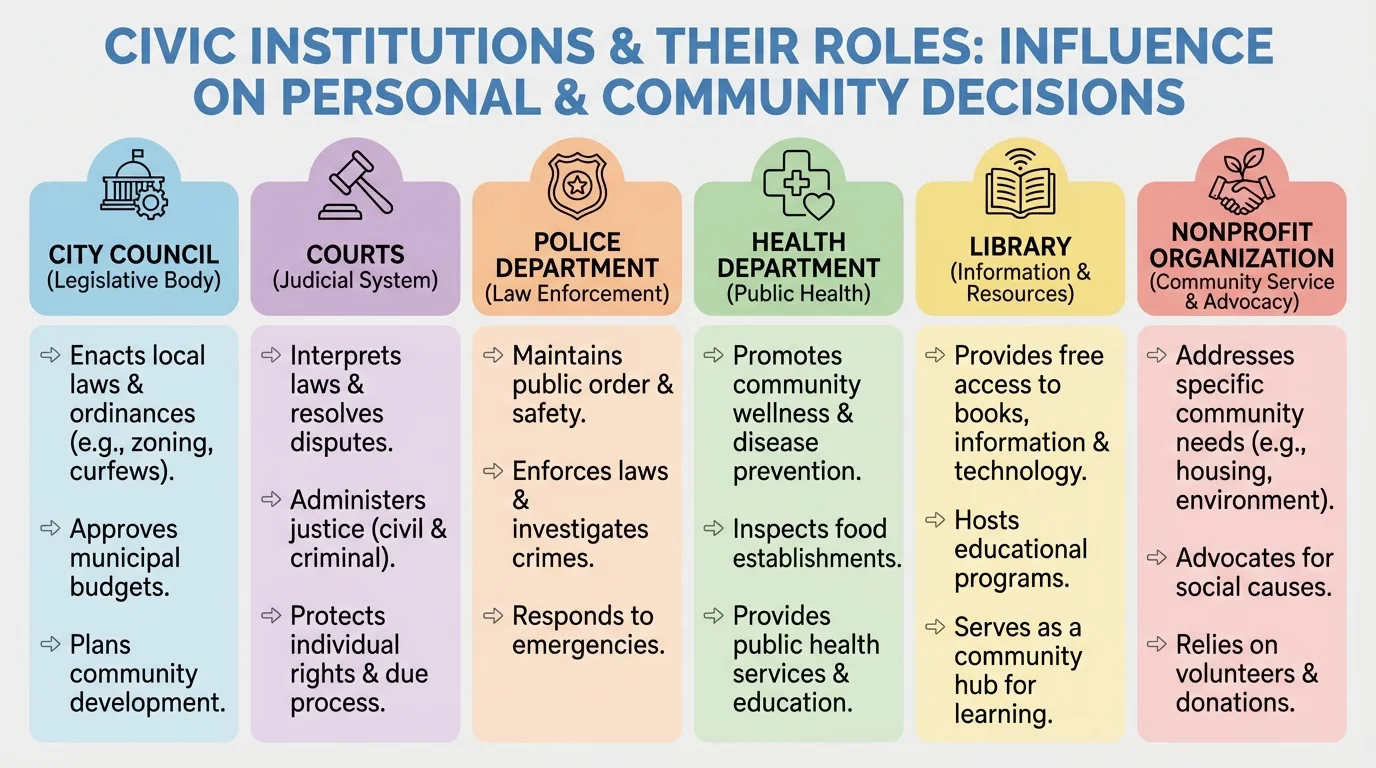
Understanding which institution does what saves time and improves your chances of being heard. Many people feel frustrated not because no solution exists, but because they direct their concern to the wrong place. Complaining on social media may raise awareness, but it does not automatically reach the institution with the power to act.
Institutions also shape trust. If people believe courts are fair, officials are transparent, and agencies respond clearly, they are more likely to follow rules and participate respectfully. If institutions act unfairly or inconsistently, trust drops and conflict rises.
That is why accountability matters. Good institutions should explain decisions, follow procedures, and allow review or appeal when appropriate. If a permit is denied, a family faces a housing issue, or a business ignores safety rules, there should be a process for review. This is one reason records, documentation, and written communication matter in civic life.
| Institution | Main Role | How It Affects Decisions |
|---|---|---|
| City council | Makes local rules and budgets | Influences parks, roads, zoning, and services |
| Courts | Interpret laws and settle disputes | Affects rights, penalties, and fairness |
| Health department | Protects public health | Shapes safety rules, inspections, and responses |
| Police and emergency services | Respond to safety threats | Affects reporting, enforcement, and protection |
| Libraries | Provide access to information and programs | Supports education, job seeking, and community access |
| Nonprofits | Meet community needs and advocate | Helps with food, housing, youth support, and reform efforts |
Table 1. Common local institutions, their main roles, and how they influence community decisions.
As seen earlier in [Figure 1], institutions are the part of the system that turns rules into action. They can solve problems, but they can also create barriers if they are hard to access or understand. That is why learning how to contact them matters, and [Figure 3] shows how people can work through a civic process to seek action.
People often say, "Someone should do something." A person practicing civic participation asks a better question: What process exists for doing something? Civic processes are the path people use to move from frustration to action.
These processes include voting, public comment, attending meetings, serving on a jury when eligible, contacting representatives, filing complaints, joining community organizations, submitting petitions, and peacefully advocating for change. Not every process fits every problem, but most public issues have some channel for input.
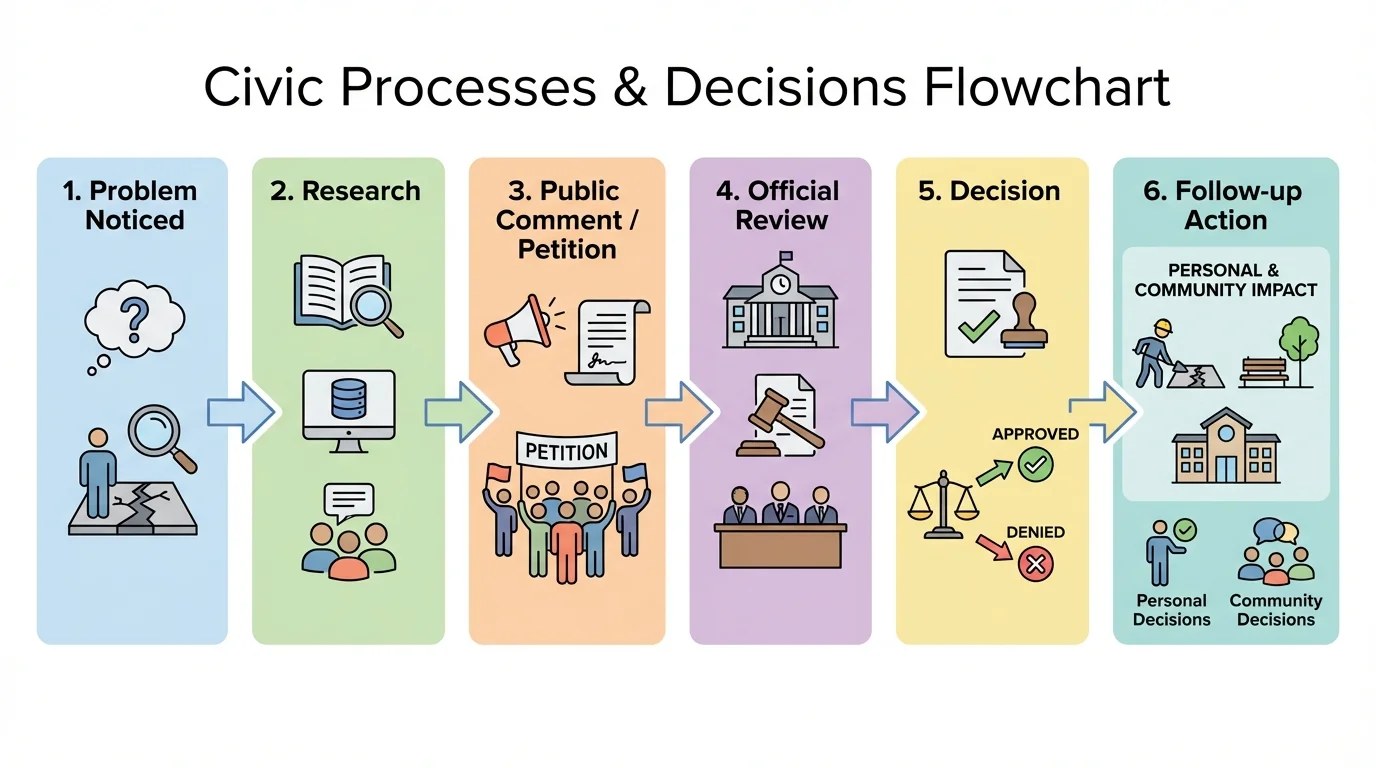
Suppose your area lacks a safe crosswalk near a busy road. Posting complaints online may express frustration, but effective civic action usually includes documenting the problem, identifying the correct department, gathering support, submitting a request, and following up at a meeting or through official communication.
This is where many people confuse expression with impact. Expression matters, but process creates change. If you understand deadlines, procedures, and who has authority, you are more likely to get results.
Case study: Getting a broken streetlight fixed
Step 1: Identify the problem clearly.
Write down the exact location, how long the light has been out, and why it creates risk.
Step 2: Find the responsible institution.
Check the city website, utility company information, or local reporting system.
Step 3: Use the correct civic process.
Submit a service request, attach photos if allowed, and record the confirmation number.
Step 4: Follow up respectfully.
If there is no response, contact the appropriate office again or raise the issue during a public comment period.
This approach is more effective than posting "This city never fixes anything" without documentation or follow-up.
Civic processes also protect fairness. If only the loudest people were heard, public decisions would be less balanced. Formal processes create records, timelines, and procedures that help communities handle disagreement more responsibly.
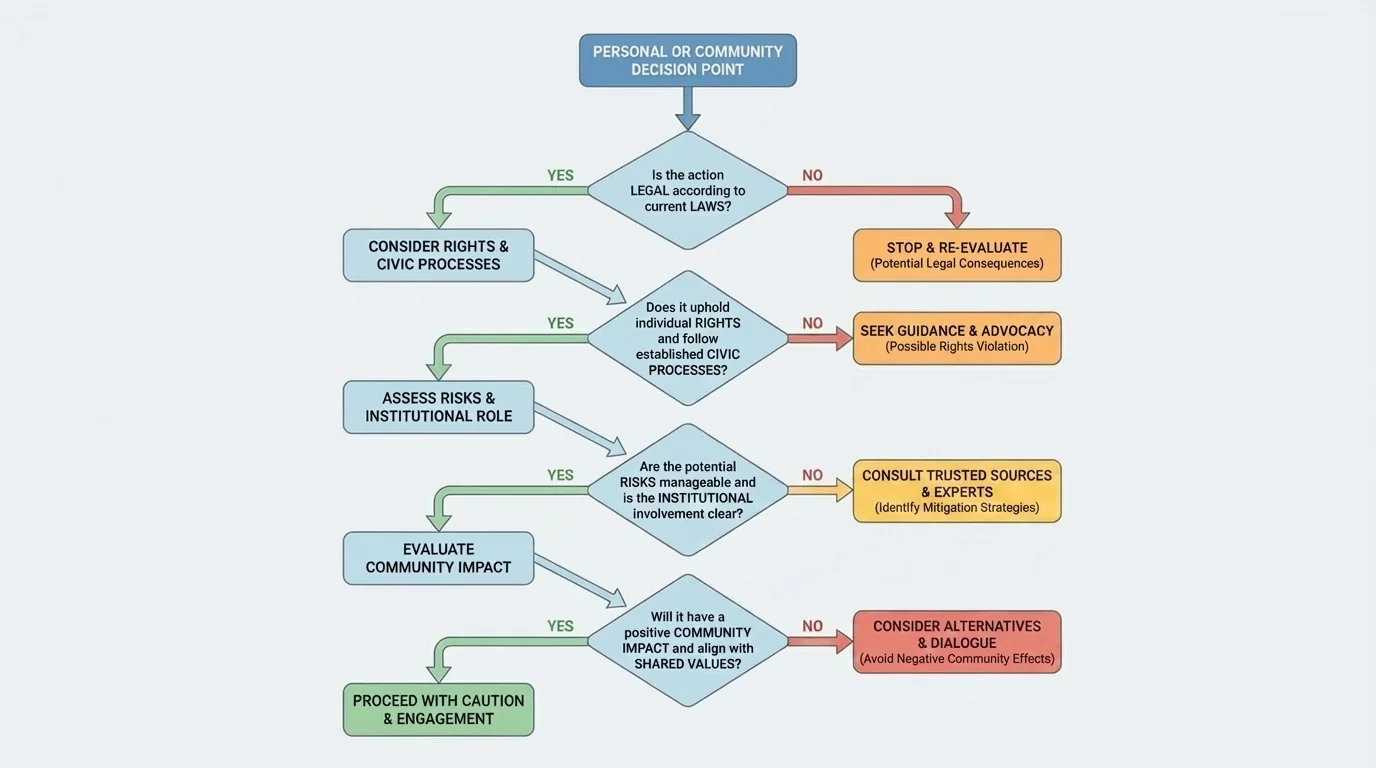
Later, when you evaluate whether a community response was effective, [Figure 3] remains useful because it reminds you that action usually requires more than one step. Most public change is slower than social media makes it look, and [Figure 4] adds a decision framework for choosing the next step carefully.
When a law- or community-related issue comes up, a simple framework can help you slow down and think clearly. This is especially useful when people around you are reacting quickly, emotionally, or with incomplete information.
Step 1: Identify the issue. What exactly is happening? Separate the facts from assumptions. "The park closes at sunset" is a fact if posted in city rules. "They just do not want teens there" is an interpretation unless supported by evidence.
Step 2: Check the rule. Is there a law, policy, ordinance, or official guideline involved? If so, find the real source. Screenshots and rumors are not enough.
Step 3: Identify the institution. Who has the authority to enforce, explain, or change the rule? Not every problem belongs to the police, and not every complaint belongs to city council.
Step 4: Consider rights and responsibilities. What freedoms are involved? What duties or limits come with them? Ask how your action affects other people's safety, privacy, and access.
Step 5: Think about consequences. What happens if you act, do nothing, or choose a different route? Consider short-term and long-term effects. A dramatic post may feel satisfying for five minutes but create conflict, a report, or a lost opportunity later.
Step 6: Choose the best process. Should you report, document, ask questions, appeal, organize support, or wait for more facts? Good decisions match the response to the issue.
Step 7: Reflect after action. Did your choice help? Did it escalate things unnecessarily? Civic growth comes from learning what worked.
Strong decisions often come from skills you already use in other parts of life: checking sources, reading carefully, communicating respectfully, and thinking ahead about consequences. Civic engagement builds on those same habits.
If you look back at [Figure 2], you can see why identifying the right institution is a major part of this framework. The best argument in the world will not help much if it never reaches the people with authority to act.
Scenario 1: A rumor spreads online about a local business. A friend wants you to repost a claim that a restaurant is unsafe. Before reposting, ask whether the claim comes from an official inspection report or just from hearsay. Health departments and inspection records are the relevant institutions and sources here. A reckless repost could harm workers and owners unfairly. A responsible response is to verify first.
Scenario 2: A neighborhood wants a later curfew at a public basketball court. Some residents want more recreation time. Others want less noise at night. This is not simply a "good people versus bad people" conflict. Laws or ordinances, local government, parks departments, and public meetings all matter. A strong civic response would gather facts, listen to both sides, and use formal channels instead of insults or pressure campaigns.
Case study: Evaluating a public decision
Step 1: Name the decision.
A city is considering reducing one bus route to save money.
Step 2: Identify who is affected.
Workers, students, older adults, and people without cars may lose access to jobs, appointments, and stores.
Step 3: Check the institutions and process.
The transit agency, local government budget process, and public hearings all shape the outcome.
Step 4: Assess consequences.
Saving money may help the budget, but reduced access may hurt families and local businesses.
Step 5: Recommend action.
A balanced response might include public comments, alternate route ideas, and requests for clearer impact data before a final vote.
This is how civic assessment works: you consider rules, institutions, processes, and impact together.
Scenario 3: You witness discriminatory behavior in a community program. Your response should depend on facts, safety, and process. Document what happened if appropriate, review the organization's policy, report through the proper channel, and seek support from a trusted adult or advocate if needed. Civic responsibility includes standing up for fairness without making unsupported accusations.
Scenario 4: A petition is circulating. Before signing, ask what the petition actually requests, who receives it, and whether it connects to a real decision-maker. A petition can be useful, but only if it is accurate, specific, and tied to an actionable process.
Responsible civic action is not about being loud. It is about being informed, strategic, and respectful. That means reading original sources when possible, checking dates, separating opinion from evidence, and recognizing when a problem is legal, ethical, personal, or all three.
It also means communicating in ways that build credibility. If you contact an official or organization, be clear, brief, and factual. Include what happened, where, when, who is affected, and what response you are seeking. Angry messages without details often get less attention than calm messages with evidence.
"The price of freedom is eternal vigilance."
— Often attributed to Thomas Jefferson
That quote does not mean living in fear. It means freedom lasts only when people pay attention, ask questions, and participate. Communities become weaker when people assume someone else will handle every issue.
Another part of responsible participation is accepting that disagreement is normal. In a healthy community, people do not always want the same thing. The goal is not to eliminate disagreement. The goal is to handle it through fair rules, functioning institutions, and accessible civic processes instead of intimidation or chaos.
If you return to [Figure 4], the decision tree helps explain why good civic choices are usually slower and more thoughtful than impulsive ones. You do not need to know everything immediately. You do need to know how to find out what matters before acting.
The decisions you make now build habits for adult life. Whether you become a voter, tenant, employee, business owner, volunteer, parent, advocate, or juror, you will interact with laws, institutions, and civic processes again and again. Knowing how they work helps you protect your interests and contribute to a fairer, more functional community.
Your future community will be shaped not just by big national events, but by ordinary local decisions: where money goes, who gets heard, what rules are enforced, and whether people respond to conflict with facts and process or with noise and reaction. Civic awareness helps you choose the first path.
When you assess how laws, institutions, and civic processes affect personal and community decisions, you become better at seeing the full picture. You stop asking only, "What do I want right now?" and start asking, "What is fair, what is effective, what is legal, and what helps people live together well?" That is the kind of thinking strong communities depend on.
