One decision you make in your teen years can shape where you live, how you spend your time, how much money you owe, and what doors open for you later. That decision is not just, "Am I going to college?" A better question is, "What path after high school actually fits my goals, strengths, and life situation?" For some students, a four-year degree is the best move. For others, a training program, apprenticeship, military path, or direct entry into work makes more sense.
This matters because postsecondary choices are not only about prestige. They are about fit. A path that looks impressive online can still be a bad match if it creates too much debt, does not lead to the kind of work you want, or demands a learning style that does not work well for you. A path that seems less talked about can be a smart, efficient choice if it builds skills quickly and leads to steady income.
When you assess your options well, you are being responsible to your future self. You are also thinking about your community. The people who repair electrical systems, care for patients, write software, teach children, drive logistics, manage businesses, and serve in the military all took different routes. There is no single "correct" postsecondary plan. There is only a better-informed one.
Postsecondary options are education, training, service, or work pathways you choose after high school. Requirements are the qualifications or steps needed to enter a pathway. Benefits are the advantages a pathway can provide. Costs include money, time, effort, stress, and missed opportunities tied to that choice.
Before you compare options, it helps to know the main categories. Some students choose programs focused on academic study. Others choose hands-on training or paid learning. Some want to start earning money right away. Some need flexibility because of family responsibilities, health needs, or work schedules.
After high school, your path can branch in several directions, as [Figure 1] shows. These pathways are not ranked from "best" to "worst." They are different tools for different goals. The smart move is to understand what each one is designed to do.
A community college often offers two-year degree programs, transfer pathways to four-year schools, and career-focused certificates. A four-year college or university usually offers bachelor's degrees and a broader campus experience, though many students now attend partly or fully online. Trade schools or technical schools focus on specific job skills such as welding, automotive technology, cosmetology, HVAC, or medical assisting. An apprenticeship combines paid work with training, often in fields like construction, plumbing, or electrical work.
Other routes include joining the military, taking a certificate program, going directly into a job with employer training, or planning a gap year with structure and purpose. A gap year is not "doing nothing." At its best, it is a planned period for work, service, skill-building, or saving money before starting another step.
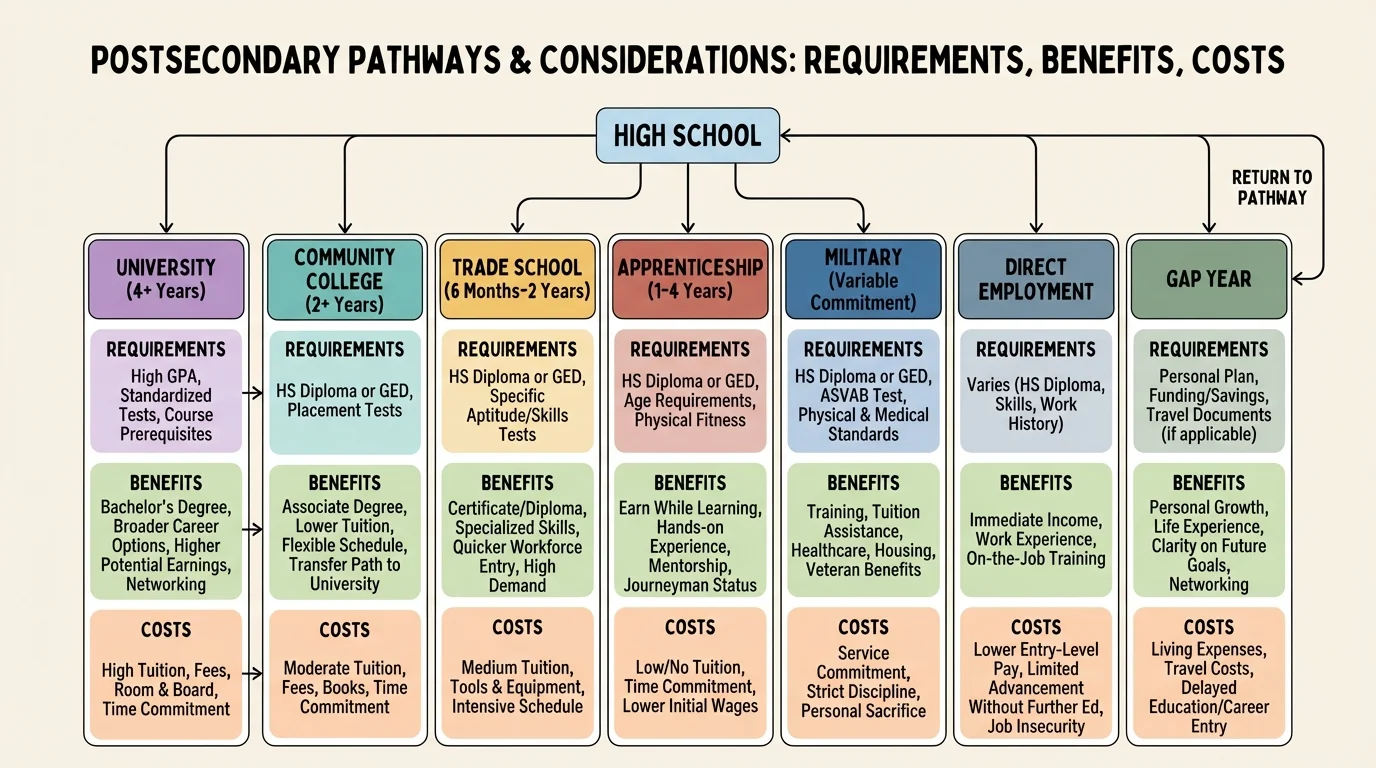
Each option can lead to success, but not in the same way or on the same timeline. A student who wants to become a civil engineer will likely need a university degree. A student who wants to become an electrician may be better served by technical training and an apprenticeship. A student who wants quick entry into health care might choose a shorter certification first, then continue education later. That flexibility is one reason [Figure 1] matters: it reminds you that paths can connect rather than stay separate forever.
Many careers do not require a four-year degree to get started, and some skilled trades can lead to strong incomes with less student debt than traditional college paths.
It is easy to get trapped by labels. Some people speak as if university means ambition and everything else means settling. That is false. Ambition is about building a future with intention. A low-debt, high-skill pathway can be extremely ambitious if it moves you toward the life you want.
Every pathway has entry requirements, and this is where many students make mistakes. They focus on the dream but ignore the gate. If you do not know what is required, you cannot prepare in time.
For colleges and universities, requirements may include transcripts, a minimum grade point average, essays, recommendation letters, application forms, deadlines, and sometimes test scores. Some programs, such as nursing, engineering, or art, may have extra requirements like prerequisite courses, auditions, or portfolios.
Trade schools and certificate programs often have fewer academic barriers, but they may still require a high school diploma or an equivalent credential, age minimums, background checks, immunization records for health programs, or placement testing. Apprenticeships may require you to pass a skills test, meet physical requirements, hold a driver's license, or be available for full-time work hours.
The military has its own set of requirements, which can include age limits, physical fitness, medical standards, testing, legal eligibility, and commitment terms. Direct-to-work options may require a résumé, interview skills, references, transportation, and a schedule that fits the employer's needs.
Since you learn online, you should also think about digital readiness. If a program is online or hybrid, can you manage deadlines independently? Do you have reliable internet, a quiet workspace, and the discipline to stay on track without someone physically supervising you? Those are real requirements too, even when they are not listed on an application page.
Requirements are more than paperwork. A pathway may be open to you on paper but still difficult in daily life. For example, if a program requires clinical hours at early morning times, but you have no transportation, that requirement affects your real ability to complete it. When you research a program, ask both: "Can I get in?" and "Can I realistically finish?"
One practical way to assess requirements is to create a personal checklist. Include deadlines, documents, grades, costs to apply, technical needs, and any lifestyle demands. This turns a vague goal into a real plan.
The benefits of a pathway are not just about salary. A good option may offer faster training, flexible scheduling, lower debt, paid experience, access to mentors, or a chance to test a field before committing to more school.
A four-year degree can open doors in careers that specifically require one, and it can provide broad learning, professional networks, and access to advanced study later. A community college can be more affordable and may let you explore subjects before transferring. Trade schools often lead to direct job skills in less time. Apprenticeships are powerful because you earn while you learn. Military service can offer training, structure, benefits, and future education support. Direct employment can help you build experience, independence, and income immediately.
There are also personal benefits. Some students thrive in academic study and want the challenge of long-term learning. Others learn best by doing. Some need a path that lets them support family members or pay bills quickly. A "best" choice on paper may be a poor choice if it clashes with how you actually function every day.
Benefits also include flexibility over time. You do not have to finish your entire life plan at age 15. One pathway can lead to another. For example, you might begin at community college, transfer later, or start in a job, gain experience, and then return for specialized training once you know what field fits you.
"The goal is not to choose the most impressive path. The goal is to choose the path that helps you build a stable and meaningful future."
That idea can protect you from comparing your life to curated social media posts. You are not choosing for someone else's image. You are choosing for your actual future.
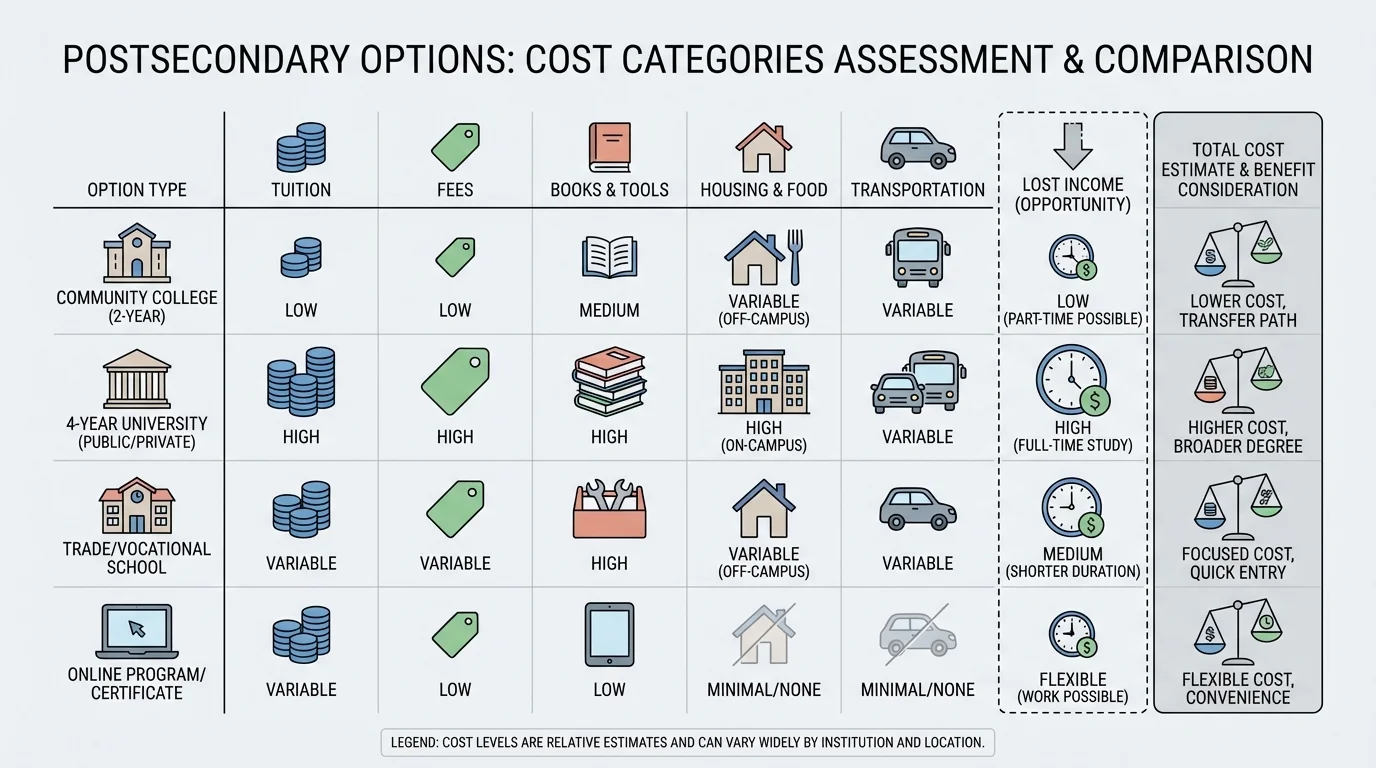
Costs are where students often underestimate reality. The total price of a pathway includes more than tuition. You also need to think about fees, books, tools, housing, food, transportation, technology, uniforms, test fees, and lost income if you are studying full-time instead of working.
There is also a less obvious idea called opportunity cost, as [Figure 2] helps illustrate. That means what you give up by choosing one option over another. If you attend a full-time college program, you may gain education but give up some full-time earnings for several years. If you go straight to work, you may gain income now but delay training that could increase earnings later.
Suppose Program A costs $6,000 per year for two years, and Program B costs $24,000 per year for four years. The visible tuition difference is large. Program A totals $12,000, while Program B totals $96,000, because \(2 \times 6{,}000 = 12{,}000\) and \(4 \times 24{,}000 = 96{,}000\). But you would still need to add books, transportation, and other expenses to estimate the real cost.
Hidden costs matter too. If a welding program requires $2,000 in tools and protective gear, that needs to be in your plan. If a nursing assistant program is short but requires unpaid clinical hours, your schedule may limit your ability to work during training. If a college is far from home, housing and food costs can significantly affect the total cost.
Debt is another major trade-off. Borrowing is not automatically bad, but unmanaged debt can limit your freedom for years. If your future monthly payment is high, it can affect where you live, whether you can save, and how much financial stress you carry. Looking at costs early helps you avoid picking a path only because it sounds prestigious.
There are emotional costs too: stress, burnout, uncertainty, and pressure. A path that overloads you can damage your performance. That does not mean avoid challenge. It means be honest about what kind of challenge helps you grow and what kind pushes you into crisis.
Comparing visible and hidden costs
Jordan is choosing between a local certificate program and a residential college.
Step 1: Add the basic program cost.
Certificate program: tuition is $8,000 total. College: tuition is $18,000 per year for four years, so the tuition total is \(4 \times 18{,}000 = 72{,}000\).
Step 2: Add extra yearly costs.
College housing and food are $10,000 per year, so over four years that is \(4 \times 10{,}000 = 40{,}000\). Books and fees average $1,500 per year, so \(4 \times 1{,}500 = 6{,}000\).
Step 3: Estimate totals.
College estimated total: \(72{,}000 + 40{,}000 + 6{,}000 = 118{,}000\). Certificate program estimated total may be $8,000 plus commuting and supplies.
Jordan should not assume the certificate is always better or that college is always worth the extra cost. The right question is whether the added cost leads to a career path Jordan truly needs and wants.
As you saw with the cost categories in [Figure 2], the smartest comparison is the total picture, not just the advertised tuition.
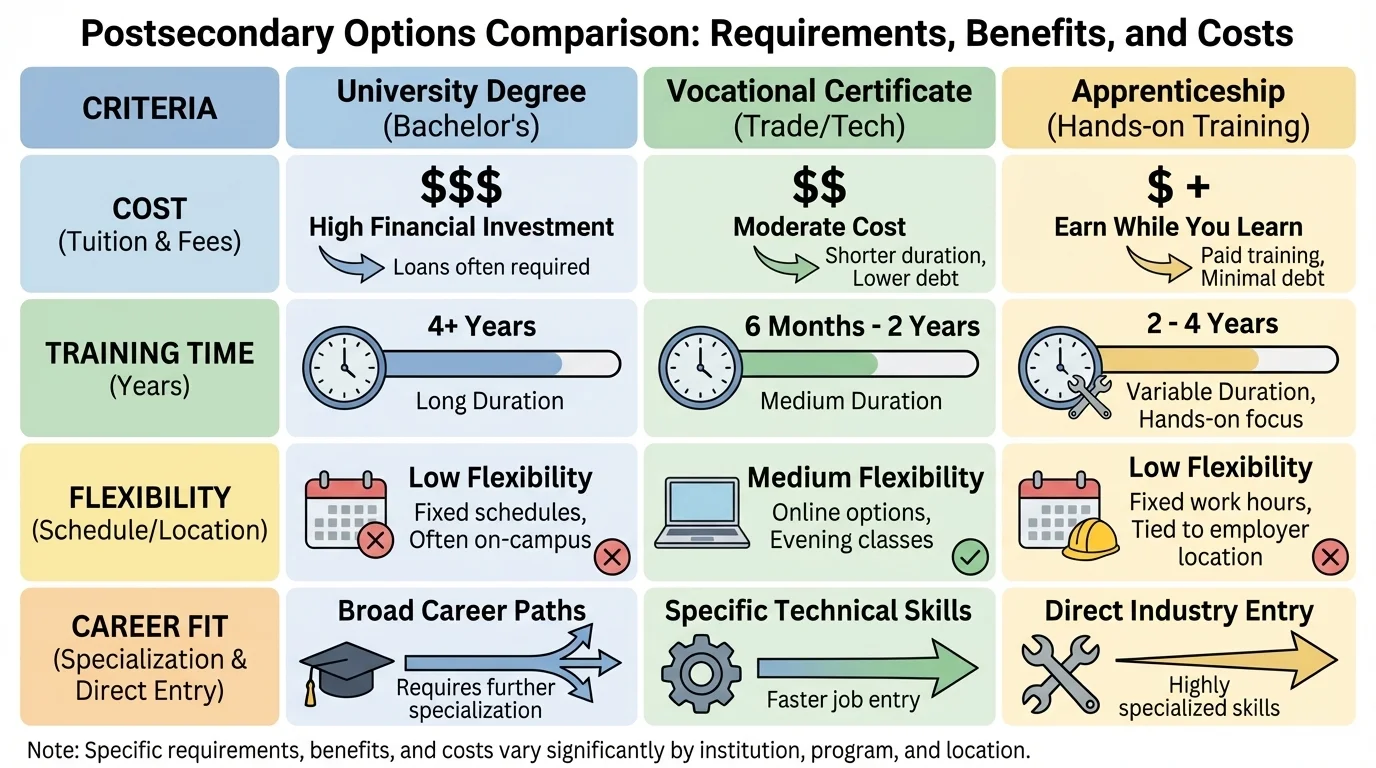
A good decision process turns emotion into evidence. One practical tool is a decision matrix, and [Figure 3] shows how this kind of comparison works. You list your options, decide what matters most, and compare them side by side.
Your categories might include cost, training time, job outlook, flexibility, location, earning potential, interest level, physical demands, and whether the path matches your learning style. Not every category matters equally. For one student, affordability may be the top issue. For another, speed to employment may matter more.
| Option | Typical time | Common benefits | Common concerns |
|---|---|---|---|
| Community college | (2 years) | Lower cost, transfer options, local access | May still require later transfer for some careers |
| Four-year university | (4 years) | Degree access, wider career options, campus resources | Higher cost, more debt risk |
| Trade school | (6 months to 2 years) | Fast skill training, direct job focus | Narrower specialization |
| Apprenticeship | (1 to 5 years) | Paid training, real experience | Competitive entry, physical demands in some fields |
| Military | Varies | Training, benefits, structure | Strict commitment, lifestyle demands |
| Direct employment | Immediate | Income now, practical experience | Slower access to some careers without later training |
Table 1. A comparison of common postsecondary pathways, including time, benefits, and concerns.
Use a table like this as a starting point, not a final answer. General patterns help, but your actual choice should depend on specific programs, not broad assumptions.
Here is a simple scoring approach. Rate each option from \(1\) to \(5\) on categories that matter to you. Then look for patterns. If one option scores well in most of your highest-priority categories, that is a signal worth paying attention to. The math is simple, but the value comes from forcing yourself to compare honestly.
Sample decision matrix
Maya is comparing three options: community college nursing pathway, medical assistant certificate, and direct retail work.
Step 1: Choose categories.
Maya picks cost, speed, long-term earnings, and personal interest.
Step 2: Score each option from \(1\) to \(5\).
Community college: cost \(4\), speed \(3\), long-term earnings \(5\), interest \(5\).
Certificate: cost \(3\), speed \(5\), long-term earnings \(3\), interest \(4\).
Retail work: cost \(5\), speed \(5\), long-term earnings \(2\), interest \(2\).
Step 3: Add the scores.
Community college total: \(4 + 3 + 5 + 5 = 17\).
Certificate total: \(3 + 5 + 3 + 4 = 15\).
Retail total: \(5 + 5 + 2 + 2 = 14\).
Maya still needs to research exact programs, but this shows that the community college path may be the strongest overall fit. The matrix in [Figure 3] represents this same idea visually.
Another smart move is to ask, "What must be true for this option to work?" If you choose a residential university, maybe you must secure scholarships, maintain certain grades, and live away from home successfully. If you choose an apprenticeship, maybe you must have transportation, basic physical endurance, and readiness for early mornings. This question keeps your decision grounded in reality.
Consider three students with different goals. Alex wants to become a software developer but is not sure about spending four years and a large amount of money right away. A strong plan might be to start at community college, build coding skills, complete transferable courses, and then decide whether to transfer or pursue industry certifications.
Brianna wants a stable health-care job quickly because she needs to help with family expenses. A shorter allied-health certificate could get her into the workforce sooner, while still allowing future advancement later. Her best choice may not be the longest program first. It may be the one that balances urgency and growth.
Carlos likes hands-on work, does not enjoy sitting through long academic lectures, and is interested in electrical systems. For him, trade school and apprenticeship routes may be stronger than a traditional four-year degree. That is not a backup plan. It is a better-aligned plan.
The lesson from these examples is simple: a strong choice matches both your future goals and your present reality. You should not ignore your interests, but you also should not ignore finances, responsibilities, or learning style.
You already make comparison decisions in everyday life: choosing a phone plan, buying a game system, or deciding whether a part-time job fits your schedule. Postsecondary planning uses the same life skill on a bigger scale: compare requirements, total costs, and long-term value before saying yes.
Talking with others can help too, but choose your sources carefully. A relative may push a path that worked years ago but is less practical now. An influencer may make a career look easy without showing the real steps. Try to gather information from official program pages, financial aid offices, workers in the field, and adults who can explain both advantages and drawbacks honestly.
You do not need to know your entire future today, but you can make your options clearer now. Start by listing three possible postsecondary paths you might consider. Then research each one using the same categories: requirements, length, total estimated cost, likely earnings, daily work life, and flexibility.
Step 1: Make a comparison document. A note app, spreadsheet, or paper chart works fine. Keep everything in one place.
Step 2: Check official requirements. Do not rely only on opinions from friends or social media.
Step 3: Estimate total costs. Include tuition, supplies, transportation, housing, and lost income if relevant.
Step 4: Identify funding possibilities such as scholarships, grants, paid training, or employer support.
Step 5: Test your interest. Watch day-in-the-life videos, read job descriptions, attend virtual information sessions, or contact someone working in the field.
Step 6: Talk with a trusted adult about what is realistic for your life right now and what can be built later.
Step 7: Revisit your plan every few months. Interests change, and new information matters.
Be careful of common mistakes: choosing a path only because your friends like it, assuming expensive means better, ignoring application deadlines, underestimating debt, or picking a field without understanding the daily work. A smart decision is not about certainty. It is about reducing avoidable surprises.
When you assess postsecondary options well, you are practicing responsibility, planning, and future readiness. Those skills matter no matter which direction you choose.
