What if one tiny plan could help you get better at something you really care about? Maybe you want to draw more, speak kindly when you feel upset, read with more confidence, or remember to feed a pet on time. A goal is like a small road sign. It helps you know where you are going and what to do next.
A goal is something you want to do, learn, or improve. When you set a simple goal, you give yourself a clear job. Instead of saying, "I want to be better," you say exactly what "better" means. That makes it easier to start.
Goal means something you want to work toward. A simple goal is small, clear, and possible to do.
Interest means something you enjoy and care about.
Area for growth means something you want to get better at.
Goals are useful in real life. If you do not have a goal, you may feel stuck, forget what you wanted to do, or give up quickly. If you do have a goal, you can take one small step at a time. That feels calmer and more doable.
For example, if you like music, a goal can help you practice a song. If you want to grow in responsibility, a goal can help you remember a daily chore. If you want stronger friendships, a goal can help you practice kind words during an online game or a video call.
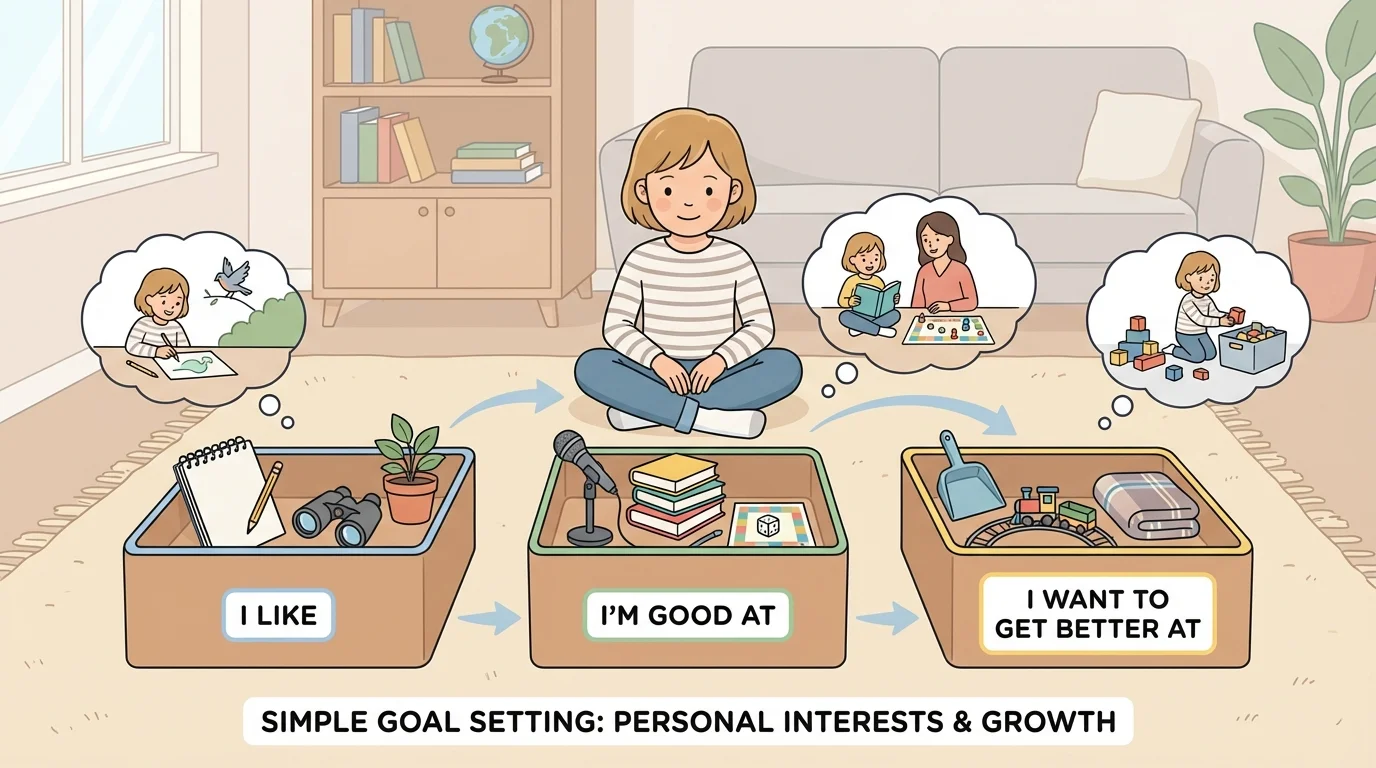
You do not need to copy someone else's goal. A good goal starts with knowing yourself. As [Figure 1] shows, you can look at three simple categories: things you like, things you do well, and things you want to improve. That helps you choose a goal that fits a personal interest or an area for growth.
Ask yourself simple questions. What do I enjoy? What makes me feel proud? What is hard for me right now? What is one thing I want to do a little better?
Your answers might sound like this: "I love soccer in the park." "I like building with blocks." "I want to get better at staying calm when I lose a game." "I want to remember to put my art supplies away." These are great places to begin.
It is okay if you are good at something already. You can still set a goal to grow more. It is also okay if you choose something hard for you. Goals are not only for your best skills. They are also for the parts of life where you want practice.
Your brain grows stronger when you practice small steps again and again. Tiny actions can lead to big changes over time.
Sometimes students think a goal must be huge to matter. That is not true. A small goal that you really do is more powerful than a giant goal that feels too hard to start.
A simple goal has a few important parts. It should be clear, small, and possible. Clear means you know exactly what you will do. Small means it is not too big for right now. Possible means you can really try it with the time and help you have.
Compare these two ideas: "I want to be amazing at reading" and "I will read for 10 minutes after breakfast on three days this week." The second one is better because you know what to do.
Simple goals turn wishes into actions. A wish is something you hope happens. A goal is something you plan to do. When you add clear actions, your idea becomes easier to follow.
A good goal is also about you. It should not be about changing another person. You can set a goal to use kind words, but not a goal to make your brother act the way you want. You are in charge of your own choices.
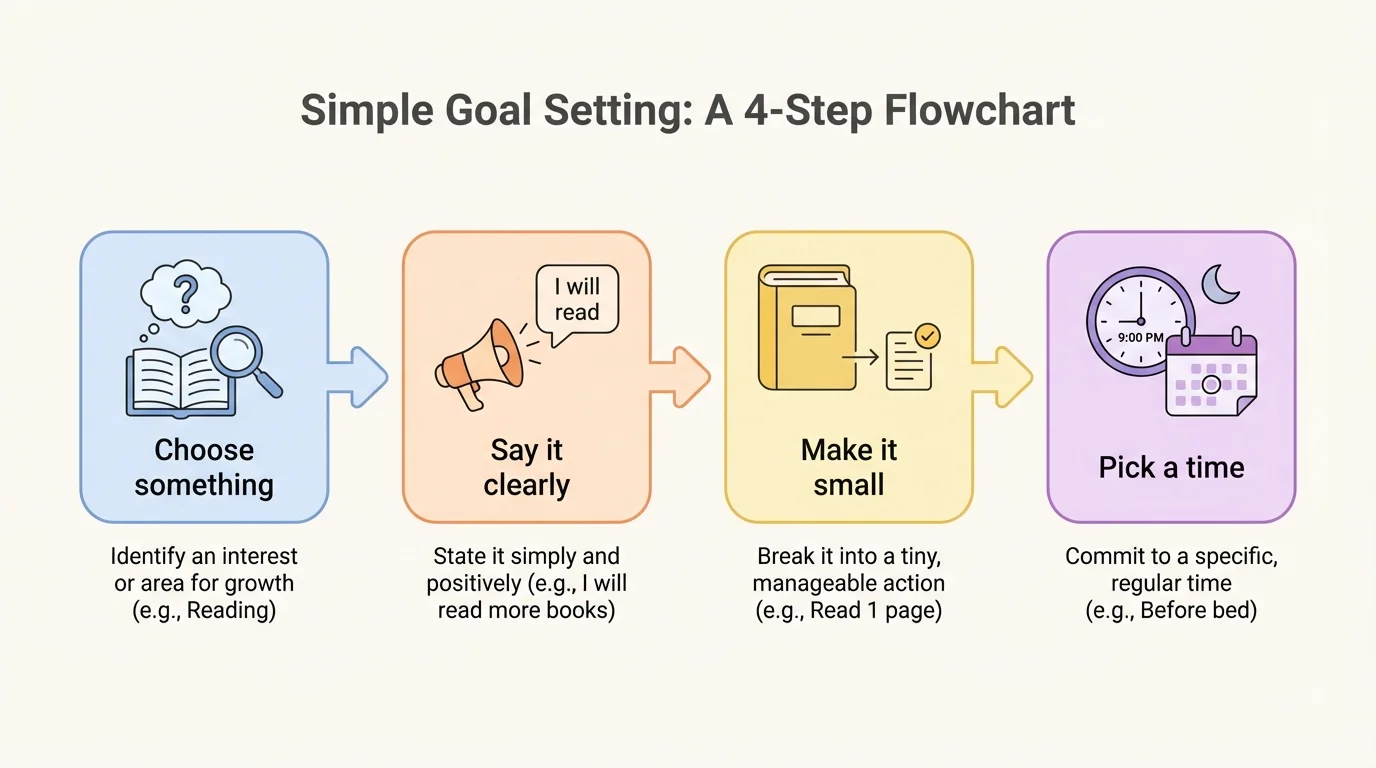
You can make a goal in four easy steps, as [Figure 2] lays out in order. This way helps you take a big thought and turn it into one small plan you can actually do.
Step 1: Choose one thing. Pick one interest or one area for growth. Do not pick too many things at once.
Step 2: Say it clearly. Use simple words to tell what you will do.
Step 3: Make it small. Ask, "Can I do this without feeling overwhelmed?" If not, make it smaller.
Step 4: Pick a time. Decide when you will do it. A goal is easier when it has a time or day attached.
Here is a simple pattern you can use: "I will ______ for ______ on ______." For example: "I will practice piano for 10 minutes on Monday, Wednesday, and Friday."
Making one goal step by step
Step 1: Pick the topic.
You choose an area for growth: staying organized.
Step 2: Say what action you will do.
You decide: put your pencils, crayons, and paper away.
Step 3: Make it small.
Instead of cleaning your whole room, focus only on your art space.
Step 4: Pick the time.
You choose after art time each day.
Your goal becomes: "I will put away my art supplies after art time each day this week."
That goal works because it is not giant. It is one clear action in one clear time.
[Figure 3] Sometimes it helps to see the difference between a big wish and a simple goal. Big wishes are not bad, but they usually need smaller goals underneath them.
Here are some examples you could use in daily life:
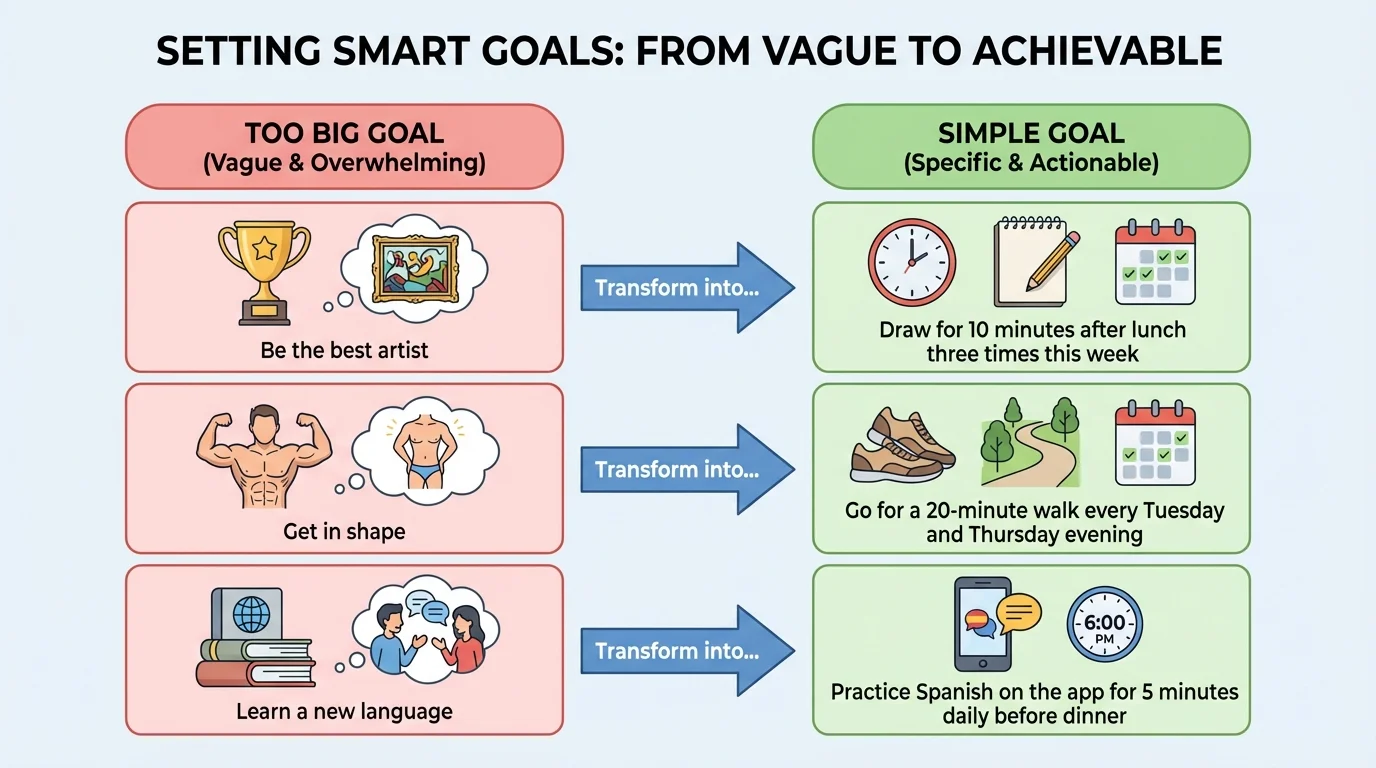
Notice that each goal tells what to do. It does not just say "be better." It names the action.
Goals can be about hobbies, feelings, helpful habits, friendships, or health. Maybe you want to stretch for a few minutes each morning, remember to carry your dish to the sink, or practice listening without interrupting. These all count.
"Little by little, a little becomes a lot."
That saying matters because growth usually happens in small pieces. The child who practices a little often learns more than the child who plans a giant goal and never begins.
Sometimes a goal feels easy at first and hard later. That is normal. You might forget, get distracted, feel tired, or choose a goal that is too big. This does not mean you failed. It means you may need to adjust your plan.
If your goal is too hard, make it smaller. If your goal was "read for 20 minutes every day," maybe change it to "read for 10 minutes on three days." If you forget your goal, put a reminder where you will see it, like near your reading spot or art table.
Changing a goal is a smart choice, not quitting. When you learn that a goal is too big or not clear enough, you can fix it. Strong goal-setters adjust and keep going.
You can also connect your goal to something you already do. For example, if you want to water a plant, do it after breakfast. If you want to practice gratitude, say one thankful thought before bedtime. This helps your brain remember.
When you feel frustrated, think back to the simple sorting idea from [Figure 1]. You can return to what matters to you and choose a goal that fits your real life better.
You do not have to work on a goal alone. You can tell a parent, caregiver, coach, club leader, or another trusted adult. They can remind you, cheer for you, or help you make the goal smaller and clearer.
A progress check means stopping to notice how things are going. You can ask: Did I do my goal? Was it too easy? Was it too hard? Do I want to keep it, change it, or choose a new one?
Easy ways to check your goal
Step 1: Say the goal out loud.
"I will practice my keyboard for 10 minutes on Monday, Wednesday, and Friday."
Step 2: Notice what happened.
You practiced on Monday and Friday but forgot on Wednesday.
Step 3: Decide what to do next.
You keep the same goal and ask for a reminder on Wednesday.
This kind of check helps you learn. It is not about being perfect. It is about paying attention.
The four-step plan from [Figure 2] can help again here. If a goal is not working, go back through the steps and see what needs to change.
Every time you set a simple goal, you learn more about yourself. You learn what you enjoy, what helps you, and what kind of support works best. That is part of growing up.
You might finish one goal and then make another. Maybe first you set a goal to put away your markers. Next week, you set a goal to clean your whole art area on Saturday. Small goals can grow into bigger ones over time.
There is no "perfect" goal. The best goal is one that matters to you and is small enough to start today. When you know yourself, choose one step, and keep trying, you build confidence one action at a time.
