Have you ever noticed that one child loves drawing for a long time, while another happily builds with blocks, and someone else wants to read about animals or learn songs? That is not random. People often choose learning that connects to what they like and what they do well. When you understand your own interests and strengths, you can make better choices about what to practice, explore, and learn next.
Your interest is something you enjoy, wonder about, or want to know more about. Your strength is something you do well or are getting better at through practice. These are not exactly the same, but they often connect, as [Figure 1] shows. You might be interested in animals and also be strong at noticing small details. Those two things together can help you choose learning about pets, wildlife, or nature journals.
Sometimes an interest comes first. You may love music, so you choose to sing, listen closely, or try an instrument. Sometimes a strength shows up first. You may notice that you are good at explaining ideas clearly, so you choose activities where you can teach, share, or lead. Many good learning choices grow where your interests and strengths meet.
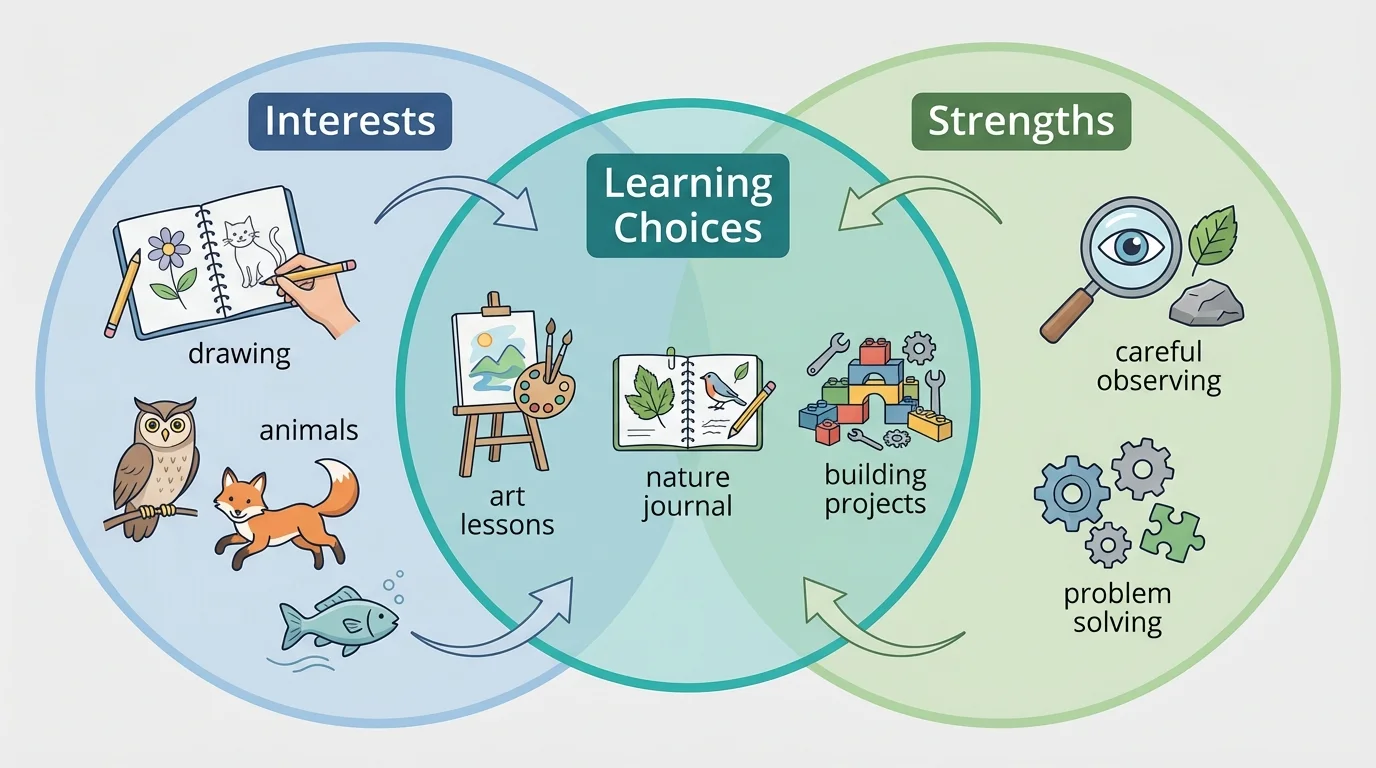
Interests are things you enjoy, care about, or want to explore. Strengths are skills, habits, or abilities that come more easily to you or have grown through practice.
An interest can change over time. Last year, you may have loved dinosaurs. Now you may love cooking, basketball, coding, or making videos. Strengths can grow too. You may not be strong at something yet, but with practice, you can improve. That means your learning choices can change as you grow.
Interests matter because they give you energy. When you care about something, you are more likely to pay attention, keep trying, and remember what you learn. If you like space, you may enjoy reading space books, watching videos about planets, or building a model rocket. If you like helping people, you may enjoy learning how to speak kindly, solve problems, or care for younger children.
Think about the difference between doing something because someone tells you to and doing it because you truly care. When you are interested, learning often feels more exciting. You may ask more questions, spend more time on it, and feel proud of what you discover.
This does not mean you only learn fun things all the time. It means your interests can help you choose some of your activities wisely. If you enjoy stories, you might choose audiobooks, creative writing, or acting. If you enjoy technology, you might choose typing practice, safe internet skills, or beginner coding games.
Your brain often pays better attention to things you care about. That is one reason interests can make learning feel easier to start.
Good learning choices can begin with a simple question: What do I want to know more about? That question helps you move from being curious to taking action.
Your strengths are like tools in a toolbox. If you know which tools you have, you can choose the best ones for the job. A child who is strong at listening may learn well from podcasts or spoken directions. A child who is strong at moving and doing may learn well by acting things out, building, or practicing with hands-on materials.
Strengths are not only academic skills. They can include being patient, organized, creative, brave, caring, calm, funny, or focused. These strengths can help in daily life. For example, if you are strong at staying calm, you may do well learning how to help in emergencies. If you are strong at creativity, you may enjoy making decorations, designing a game, or inventing new stories.
A learning choice is a decision about what, how, or when you learn. Your strengths help with these choices. If reading long text is hard right now but listening is a strength, you might choose an audiobook first. If you are strong at drawing, you might take notes with pictures. That is not cheating. That is choosing a smart path that fits you.
Strengths are not just talents you are born with. Some strengths may come naturally, but many grow because you practice, pay attention, and keep trying. A strength today can become an even bigger strength tomorrow.
When you know your strengths, you can feel more confident. Confidence matters because it helps you begin. Starting is often the hardest part of learning something new.
Interests pull you toward learning. Strengths help you move forward in learning. When both work together, learning choices often feel more satisfying. For example, if you love nature and you are strong at observing, a bird-watching journal could be a great choice. If you enjoy talking and you are strong at kindness, learning how to welcome a new child in a community group could be a great choice too.
But interests and strengths do not always match perfectly. You may be very interested in basketball but still be learning to dribble well. You may be strong at organizing but not very interested in cleaning your room. This is normal. Sometimes interests help you stick with a hard skill. Sometimes strengths help you handle a task even if it is not your favorite.
The best question is not Am I already amazing at this? The better questions are: Do I care about this? and Can one of my strengths help me learn it?
Self-awareness means paying attention to yourself in an honest way. You can notice your interests by watching what you choose when no one forces you. What videos do you click? What books do you pick? What games, hobbies, or topics make you forget the clock for a while?
You can notice strengths by watching what feels easier, what others ask you for help with, and what improves when you practice. Maybe your family asks you to explain tech problems because you are patient and clear. Maybe friends in an online game listen to your ideas because you are good at teamwork. Maybe you notice patterns quickly when building or solving puzzles.
Simple ways to spot your interests and strengths
Step 1: Notice what grabs your attention.
Ask yourself, "What do I choose for fun, even when I do not have to?"
Step 2: Notice what feels easier or more natural.
Ask, "What can I do pretty well now?"
Step 3: Notice what others see.
Ask trusted adults, "What do you think I am good at?"
Step 4: Notice what grows with practice.
Ask, "What is getting better because I keep trying?"
You do not need to know everything about yourself all at once. You are still growing. The goal is simply to pay attention and learn more about who you are.
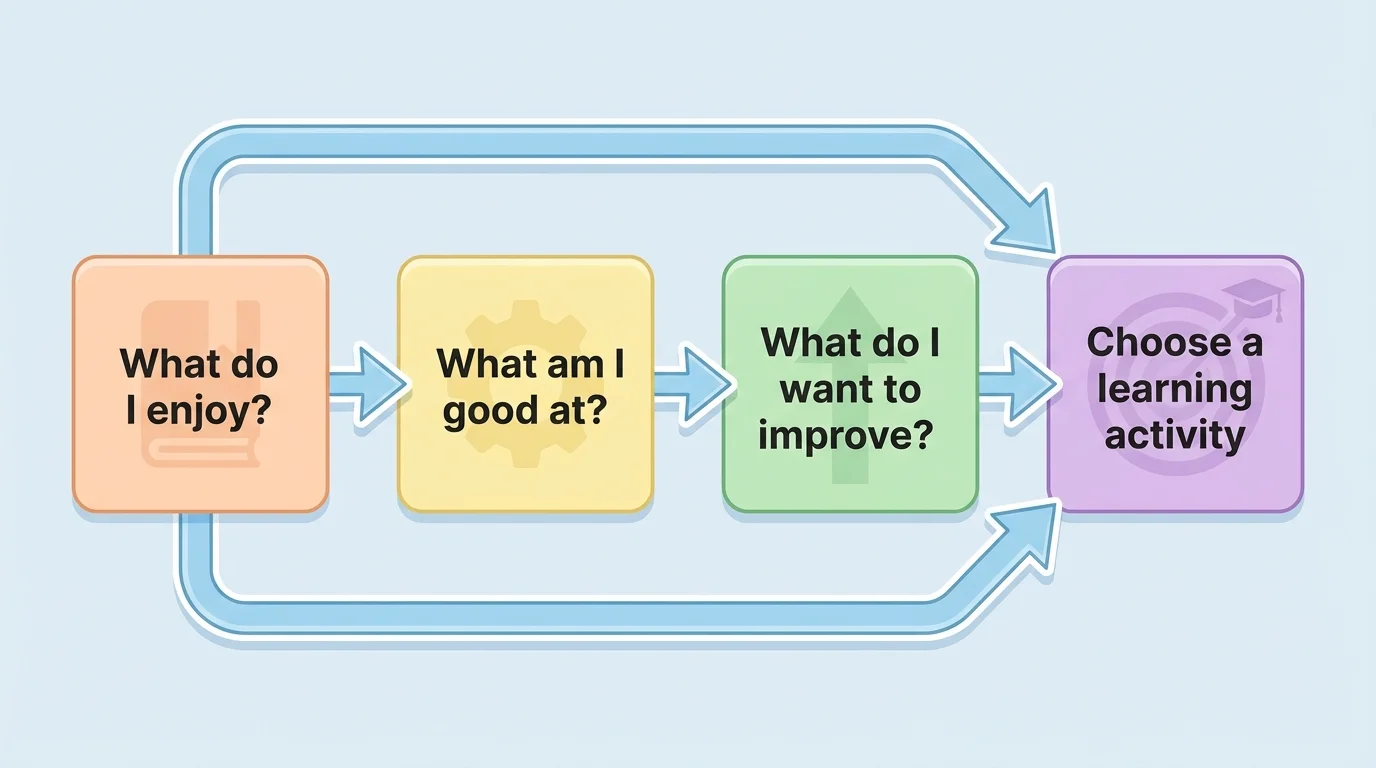
There is a simple way to make choices, and [Figure 2] lays it out as a step-by-step path. First, think about what you enjoy. Next, think about what you are good at. Then, think about one thing you want to get better at. Last, choose an activity that fits at least one interest and one strength, or one interest and one growth goal.
Here is what that looks like in real life. If you enjoy cooking and you are strong at following steps, you might choose to learn a simple recipe. If you enjoy animals and you are strong at responsibility, you might choose to learn how to care for a pet. If you enjoy technology and you want to improve patience, you might choose a beginner coding project that takes time and problem solving.
When you make a learning choice, it helps to ask yourself three quick questions: Do I care about this?, Can one of my strengths help me?, and What will I gain if I keep going? If you can answer those, you are more likely to make a good choice.
You can also start small. You do not need a huge goal right away. Instead of saying, "I will become a great artist," you can say, "I will watch one drawing lesson and practice shading for ten minutes." Small choices are easier to begin, and beginning matters.
You do not have to choose the same way as someone else. A smart choice is a choice that fits you, not a choice that only looks impressive to other people.
Good choices also save time and energy. If you ignore your interests and strengths all the time, you may feel bored, frustrated, or ready to quit. If you use them wisely, you often feel more focused and proud.
Sometimes you are interested in something but not strong at it yet. That can feel frustrating. You may think, "I like this, but I am bad at it." Try adding one small word: yet. "I am not good at this yet." That word leaves room for growth.
This is where a goal can help. A goal is something you decide to work toward. If you love piano but your fingers feel clumsy, your goal might be to practice one short song each day. If you love soccer but need better balance, your goal might be ten minutes of footwork practice.
Interests can give you a reason to keep going when things feel hard. Strengths can also help. Maybe you are not strong at singing yet, but you are strong at listening carefully. That listening strength can help you hear the notes and improve.
"I can't do it yet."
— A helpful growth reminder
Do not quit too quickly just because something is hard. Hard does not always mean wrong. Sometimes hard means you are learning.
Not everyone will like what you like. Not everyone will be strong in the same things as you. That is a good thing. Different interests and strengths help people work together. One child may be great at planning. Another may be great at cheering people on. Another may be great at solving problems quietly.
This matters in friendships, family life, and online groups. If you understand that people are different, you are less likely to laugh at someone else's choices. Instead, you can be curious and respectful. You might say, "You really know a lot about bugs," or "You are good at explaining game rules."
Respecting others also helps you learn from them. Someone else's strength can teach you a new way to do something. As we saw in [Figure 1], learning choices come from different combinations of interests and strengths, so two people can both make smart choices even when those choices are very different.
There is no single perfect path for every child. What matters is the match between the person and the choice. A good learning choice feels meaningful, useful, and possible.
[Figure 3] compares several different paths. Look at these examples. Notice how each one connects an interest, a strength, and a next step.
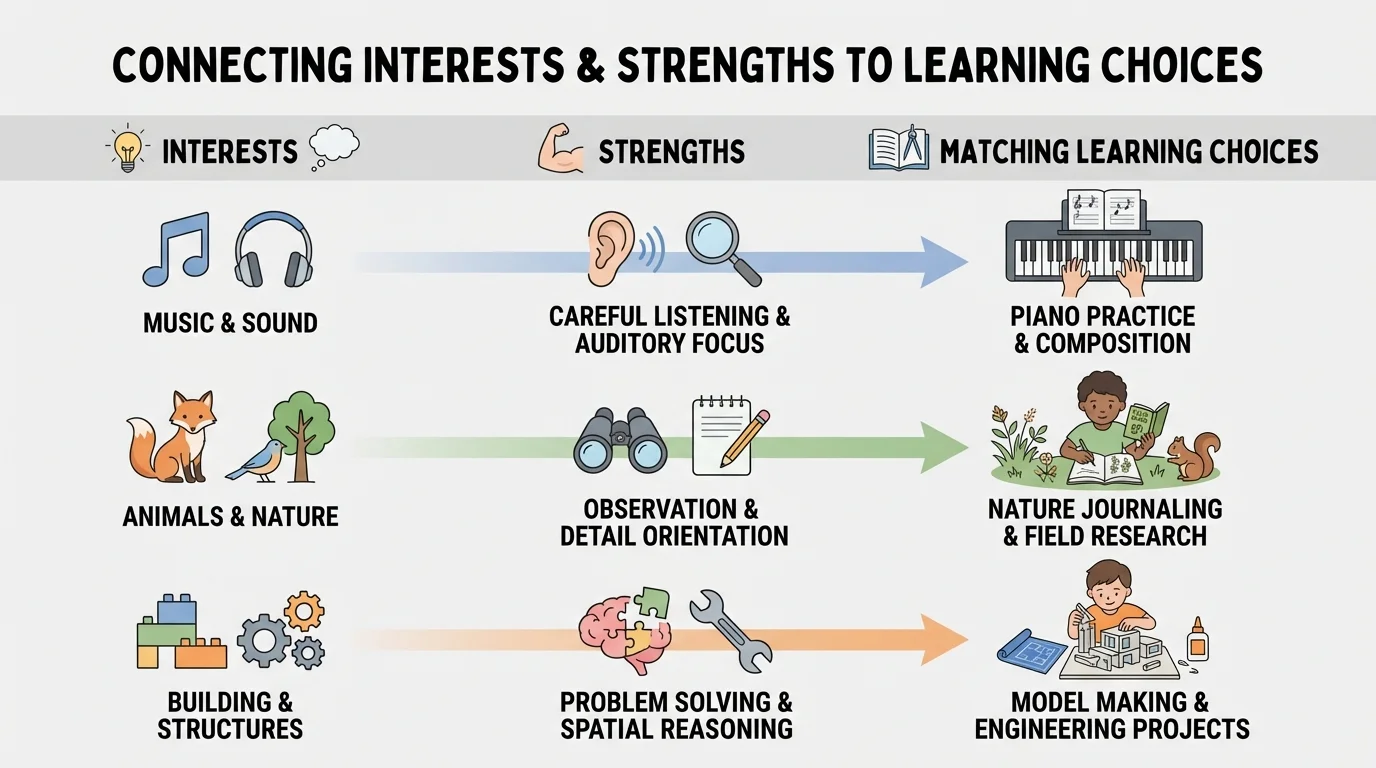
| Interest | Strength | Learning Choice |
|---|---|---|
| Drawing | Noticing details | Learn shading, sketch objects, or design cards |
| Animals | Responsibility | Help care for a pet or keep a nature notebook |
| Music | Careful listening | Practice rhythm, singing, or a simple instrument |
| Building | Problem solving | Make models, follow building instructions, or invent structures |
| Helping others | Kindness | Learn welcoming words, conflict-solving, or service projects |
| Technology | Patience | Try beginner coding, keyboarding, or safe digital tools |
Table 1. Examples of how interests and strengths can connect to learning choices.
Here is another way this works in daily life. A child who enjoys stories and is strong at imagination might choose creative writing. A child who enjoys cooking and is strong at following directions might learn to make breakfast safely. A child who enjoys movement and is strong at persistence might practice dance, martial arts, or bike skills.
Real-life choice examples
Example 1: Maya loves art and is strong at noticing color.
Her learning choice is to watch short art lessons online and practice mixing colors with paint.
Example 2: Eli loves animals and is strong at being gentle and careful.
His learning choice is to learn pet care routines and record what his pet needs each day.
Example 3: Noor loves games and is strong at spotting patterns.
Her learning choice is to try beginner coding puzzles and build simple game ideas.
These examples are different, but they all follow the same idea: choose learning that fits who you are and who you are becoming.
Pay attention to your own day. Notice one thing you enjoy, one thing you do well, and one thing you want to improve. Then make one small learning choice that connects them. It could be reading one article, watching one tutorial, practicing one skill, or asking one adult for help getting started.
If your first choice does not fit, that is okay. Change it. Learning choices are not permanent. They are tools to help you grow. As you learn more about yourself, you can make better choices.
Later, when you see the decision path in [Figure 2] and the different example paths in [Figure 3], remember that the goal is not to copy someone else exactly. The goal is to notice what fits your interests, your strengths, and your next steps.
