Have you ever noticed how one small action can change a whole group? When someone says, "You can join us," a person who felt left out can suddenly feel calm, happy, and important. That is the power of inclusion. It may seem like a small choice, but it helps build a place where people feel they truly belong.
Inclusion means making sure people feel welcomed, respected, and able to take part. It means noticing that people are different in many ways and making room for those differences. Some people may learn in different ways, speak differently, move differently, dress differently, or enjoy different things. Inclusion says, "There is space for you here too."
Belonging is the feeling that you are accepted and valued. It is the feeling that you matter to a group. In an online class, belonging can grow when people listen to you, use your name kindly, wait for your turn, and care about what you say. In your neighborhood, club, team, or family event, belonging grows when others make space for you instead of shutting you out.
Inclusion means welcoming people and making sure they can join, participate, and feel respected.
Belonging means feeling accepted, safe, and important in a group.
When inclusion is missing, people may feel lonely, embarrassed, nervous, or invisible. They might stop sharing ideas. They may stop joining activities. A group can become less kind and less strong. But when inclusion is present, people often feel brave enough to speak, learn, help, and connect.
Inclusion is not just a big idea. It is a group of everyday actions. In an online class, as [Figure 1] shows, inclusion can look like greeting others, waiting your turn to talk, reading the chat carefully, and inviting someone quiet to share if they want to. These actions tell people, "You are part of this group too."
Inclusion also means paying attention. You might notice that one student's message has been ignored in the class chat. You can reply kindly. You might see that someone is new to a club or game. You can explain the rules simply. You might realize that a joke could hurt someone's feelings. You can choose different words.
Sometimes inclusion means changing what you do so others can join more easily. For example, if you are talking very fast in a video call, you can slow down. If a game has confusing rules, you can explain them one step at a time. If one person does not like loud teasing, even if others think it is funny, you can stop and choose kinder humor.
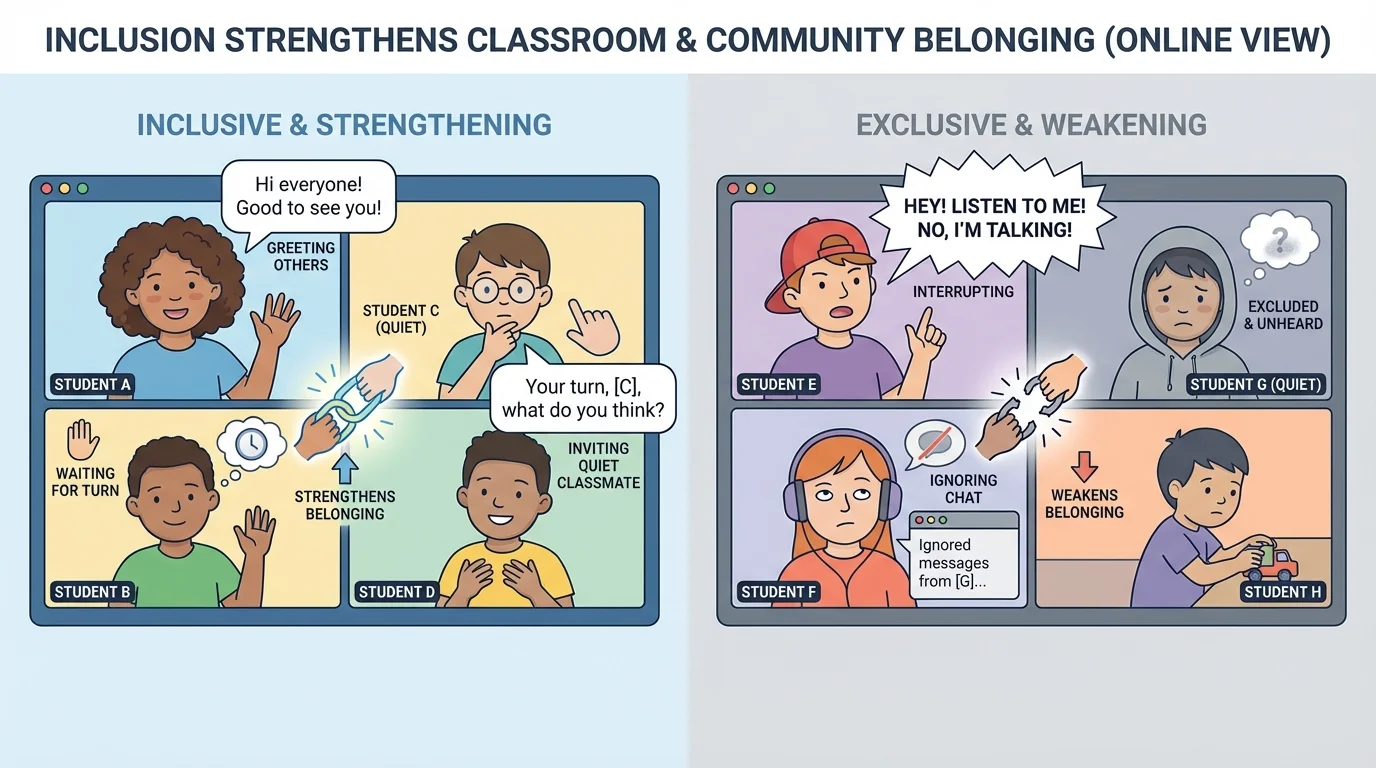
Inclusion does not mean everyone has to be the same. It means people can be different and still be part of the group. You do not have to like all the same games, foods, hobbies, or music to include someone. You just need to treat them with care and fairness.
Inclusion is an action, not only a feeling. You build inclusion by what you say, what you do, and what you choose not to do. Kind actions, fair turns, respectful words, and open invitations all help other people feel seen and valued.
Here are some simple signs of inclusive behavior:
Here are signs of excluding behavior:
When people are included, they feel safer. A group feels stronger when members do not have to worry about being laughed at or left out. Feeling safe helps people focus, share ideas, and ask for help when they need it.
Inclusion also builds empathy. Empathy means trying to understand how another person feels. If you think, "How would I feel if no one answered my message?" you are more likely to act with care. That caring action helps someone else feel they matter.
A group with inclusion often works better too. People bring different ideas, skills, and experiences. One person may be great at explaining. Another may be good at listening. Another may notice when someone is left out. When these strengths are welcomed, the whole group becomes more helpful and creative.
Groups often become friendlier and more successful when people feel safe enough to share their real ideas. When everyone gets a chance to join in, the group gains more than just extra voices—it gains better teamwork.
Think about two online group projects. In the first one, one student controls everything, ignores ideas, and interrupts others. Some group members stop trying. The work may get rushed or sloppy. In the second group, students take turns, ask for opinions, and thank each other for helping. More people join in, and the group usually feels calmer and does better work. Inclusion helps both feelings and results.
Because you learn online, your classroom belonging is built through screens, voices, typed words, and shared work. That means your choices in digital spaces matter a lot. A kind message, a patient response, or a fair turn can make someone's day better.
You can practice inclusion online in these ways:
These habits may sound small, but they help create a positive community. A community is a group of people who share a space, activity, or goal and care about how members are treated. Your online class is a community, even though everyone is in different places.
Example: Including someone in a video class discussion
Step 1: Notice what is happening.
You see that one classmate has raised a hand twice but has not been called on yet.
Step 2: Make space kindly.
When it is your turn, you say, "I think Maya had a thought too."
Step 3: Stay respectful.
You do not force Maya to speak. You just open the door for her if she wants to join.
Step 4: Support the group.
By making room for another voice, you help everyone feel that sharing is welcome.
Sometimes inclusion online means thinking before you type. Written words can feel stronger than you expect because people cannot always hear your voice or see your face. A short message like "That makes no sense" can sound harsh. A more inclusive message would be, "I'm confused. Can you explain that another way?"
As you saw earlier in [Figure 1], welcoming actions in online spaces are often very simple. They are built from good manners, patience, and attention. You do not have to do something huge to help someone feel they belong.
Belonging does not only happen in class. It grows in many places, as [Figure 2] illustrates: neighborhood games, clubs, sports, faith groups, library events, family gatherings, and local activities. When people are included in these places, they feel more connected to the people around them.
Maybe a new child moves into your neighborhood. Maybe someone wants to join a game but does not know the rules. Maybe a younger child wants to help with a project. Inclusion means looking for a fair way to welcome them, instead of protecting a group by shutting others out.
In community spaces, inclusion can also mean respecting different needs. One child may need clearer directions. Another may need more time. Another may not be able to run fast but can still join if the game is adjusted. Making a fair change is not "ruining" the activity. It is helping more people take part.
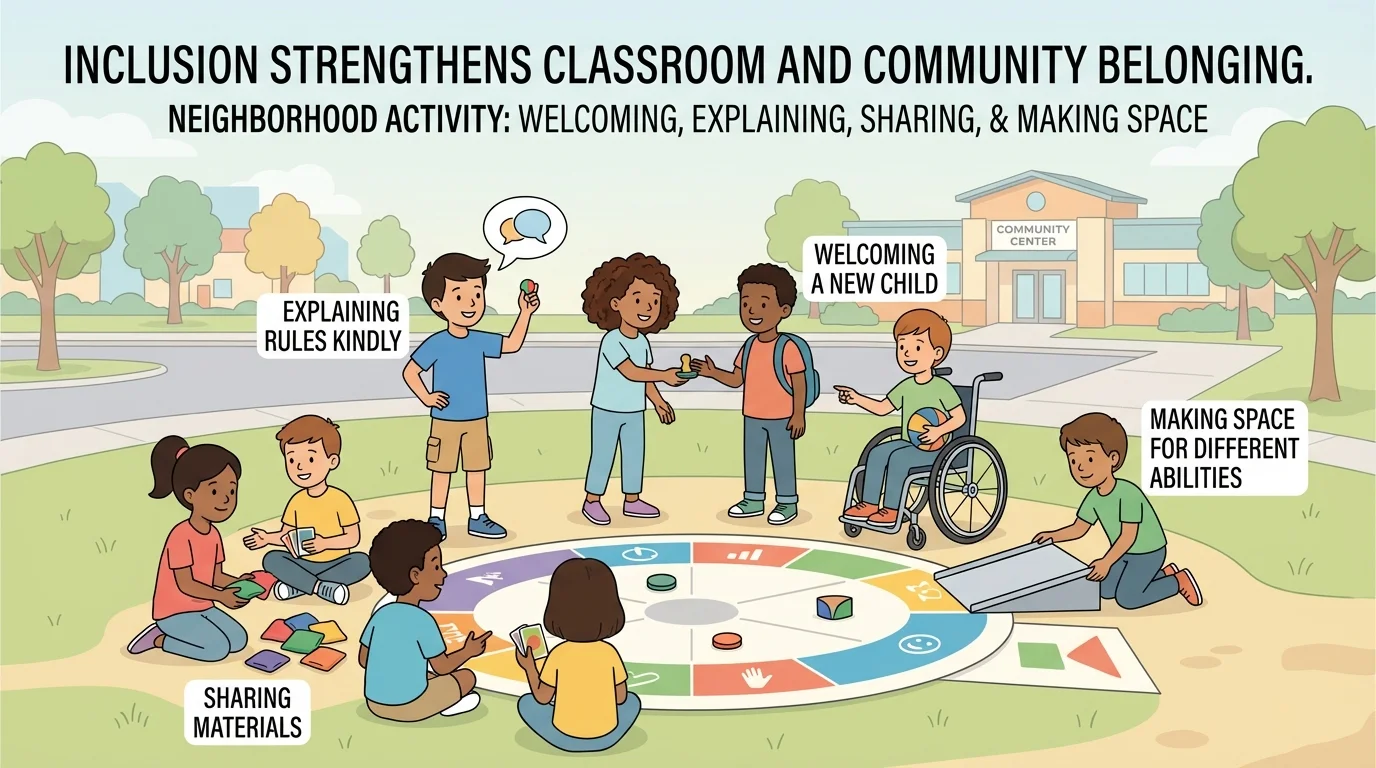
For example, if a sidewalk chalk game has lots of complicated rules, you can make a simple version for everyone. If someone cannot hear you well in a noisy place, you can face them when speaking. If a game is too fast for one child, the group can slow one part down. These choices build stronger friendships.
| Situation | Excluding Choice | Including Choice |
|---|---|---|
| A new child joins a game | "You don't know how. Go away." | "Want me to show you the rules?" |
| Someone is quieter than others | Never asking what they think | "You can share if you want." |
| A person needs more time | Getting annoyed and rushing them | Waiting patiently and helping |
| A difference becomes a joke | Laughing along | Changing the subject or saying, "That's not kind." |
Table 1. Examples of excluding and including choices in everyday community situations.
When more people feel welcome, the community becomes warmer and safer. People are more likely to help each other, solve problems together, and build trust. That is one reason inclusion matters so much: it helps a group become a place where people care for one another.
"You belong here too."
— A simple message that can change a group
That short idea is powerful because it gives others dignity. Dignity means a person deserves respect just because they are a person. Inclusive choices protect that respect.
Sometimes people leave others out without thinking. Sometimes they do it on purpose. You may also make mistakes yourself. Everyone does at times. What matters is noticing the problem and choosing a better action next time.
If you realize you excluded someone, you can fix it. You might say, "I'm sorry. I should have included you." Then invite them in, explain the rules, or restart the conversation more fairly. A sincere apology can rebuild trust.
If someone else is being excluded, you do not need to be rude or start a fight. You can be calm and kind. Say things like, "Let's make room for everyone," or "We can explain it so they can join," or "That joke could hurt someone." These are respectful ways to stand up for inclusion.
Example: What to do when someone is left out
Step 1: Notice the problem.
You see that a child at a community activity is being ignored.
Step 2: Use a kind opening.
Say, "Do you want to be on my team?" or "Come sit with us."
Step 3: Help with the next step.
Explain the rules, share materials, or make space so joining feels easier.
Step 4: Keep it going.
Stay friendly after the first invitation so the person continues to feel included.
Sometimes a person may say no, and that is okay too. Inclusion means offering real welcome, not forcing someone to join. Respect also means listening to their choice.
As shown earlier in [Figure 2], a welcoming group often works because someone notices a need and responds with kindness. Inclusion grows when people pay attention and act.
You do not need a perfect plan. A few steady habits can make a big difference.
Step 1: Notice. Look around your online class or community activity. Who is quiet? Who is new? Who is being talked over?
Step 2: Think. Ask yourself, "How might this person feel?" This is where empathy helps.
Step 3: Act. Choose one kind action: greet, invite, explain, wait, share, or speak up respectfully.
Step 4: Check. Did your action help? If not, try another kind way.
Step 5: Repeat. Inclusion becomes stronger when it is a habit, not just a one-time choice.
You already know that kindness matters. Inclusion takes kindness one step further: it makes sure your actions help other people join, participate, and feel valued.
Here are some Try This ideas you can use right away:
Inclusion strengthens classroom and community belonging because it helps people feel seen, respected, and welcome. When people feel they belong, they are more likely to participate, help others, and enjoy being part of the group. Your choices can help create that kind of space every day.
